Georgia's land and early people
Students start the year mapping Georgia's regions, rivers, and coast. They learn about the American Indian groups who lived here first and what changed when Spanish and British explorers arrived.
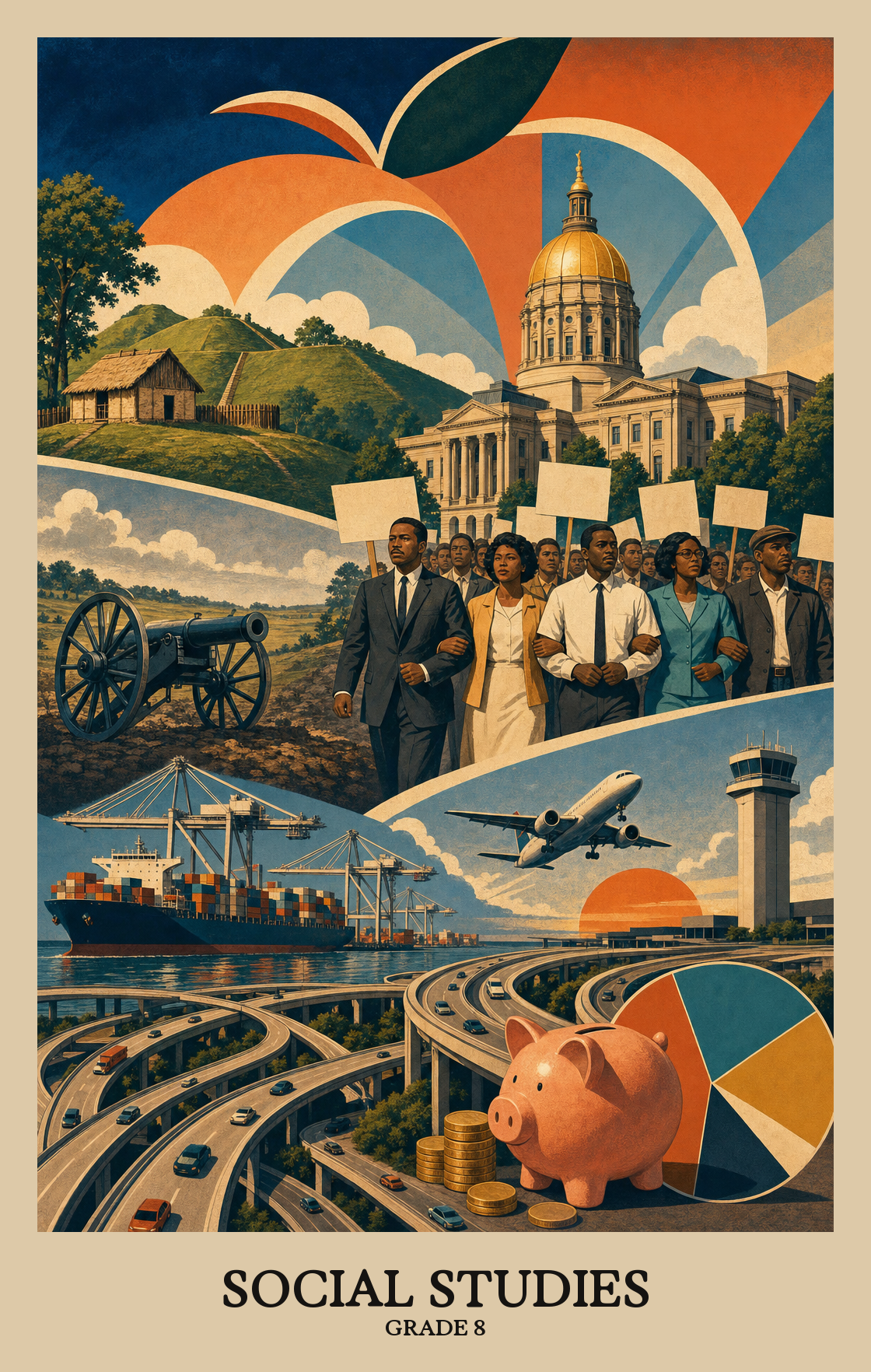
This is the year social studies zooms in on Georgia itself. Students walk through the state's full story, from the American Indians who lived here before European contact, through the Civil War and Jim Crow, to the civil rights movement and modern Atlanta. They also learn how Georgia's state government works, why the ports, airport, and highways matter, and how to budget a paycheck. By spring, students can explain how an idea becomes a Georgia law and why Atlanta grew into a major city.
Students start the year mapping Georgia's regions, rivers, and coast. They learn about the American Indian groups who lived here first and what changed when Spanish and British explorers arrived.
Students follow Georgia from Oglethorpe's Savannah settlement through the American Revolution and into the early 1800s. They look at why people came, how the colony changed, and how new land policies pushed the Creek and Cherokee out.
Students examine the arguments over slavery and secession, then trace Georgia through the war and the years after. They study the 13th, 14th, and 15th Amendments and the daily reality of sharecropping and Jim Crow.
Students study Henry Grady's New South, the rise of Jim Crow, and Georgia's role in two world wars and the Great Depression. They look at how the boll weevil, the New Deal, and wartime factories reshaped the state.
Students follow Georgia through the civil rights movement and into today. They look at leaders like Martin Luther King Jr. and Jimmy Carter, the 1996 Olympics, and how Atlanta, the ports, and the film industry drive the state now.
Students close the year with how Georgia actually runs. They study the state constitution, the three branches, how a bill becomes law, how courts handle adults and juveniles, and how to budget, save, and use debt wisely.
Students examine how European explorers and settlers changed life for Native American tribes in Georgia, including the spread of disease, loss of land, and shifts in trade and power.
Students describe what life looked like for Native American groups in Georgia before Europeans arrived: what they ate, how they built shelter, and what tools and weapons they used.
Spanish and British explorers came to the Southeast for land, wealth, and religious influence. Students learn why each group made the trip and what they hoped to gain by staying.
Spanish explorers and missionaries changed life for Native Georgians. Students examine what happened when Hernando de Soto's expedition moved through the region and when Spain built missions on the coastal islands.
Students study how Georgia developed as a British colony, from its founding through the tensions that led to the American Revolution. The focus is on who settled here, how they governed themselves, and how colonial life shaped the state's early identity.
The Charter of 1732 created the colony of Georgia. Students learn why Britain established it: to give poor settlers a fresh start, to open new trade, and to protect the southern colonies from Spanish Florida.
Three people made Savannah possible. Students study how James Oglethorpe relied on Mary Musgrove to translate and on Tomochichi's trust to settle at Yamacraw Bluff, and why the colony likely fails without any one of them.
Students examine why different groups, including Jewish settlers and Scottish Highlanders, chose to come to Georgia in the 1730s and 1740s, and what each group contributed to the young colony.
Georgia gave up its original rules and became a royal colony under British control. Students learn what changed: who could own land, why slavery became legal, and how the government shifted away from the founders who first built it.
Students identify what colonial Georgians made, grew, and sold, such as rice, lumber, and deerskins, and explain who they traded with and why those goods mattered to the colony's survival.
Georgia's role in the American Revolution goes beyond the famous battles. Students examine why some Georgians supported independence while others stayed loyal to Britain, and how the fight for revolution played out differently in this southern colony.
Students trace why Georgia colonists joined the Revolution, starting with Britain's new taxes and land rules after the French and Indian War. The Proclamation of 1763 blocked western settlement, and the Stamp Act taxed everyday paper goods, turning colonists against British rule.
Students read the Declaration of Independence in three parts: the opening argument for rights, the list of complaints against the king, and the formal break from Britain. They also identify the three Georgians who signed it.
Georgians were split during the Revolution. Students study why some sided with the British (Loyalists) and others fought for independence (Patriots), using two key battles fought on Georgia soil to understand what that divide meant in practice.
The Articles of Confederation gave the new government almost no real power. Students learn why that failed and how those failures pushed leaders to write the Constitution.
Students learn what pushed Georgia's borders west in the early 1800s, including land lotteries, the removal of Native American nations, and the promise of fertile farmland.
Students learn why Georgia founded its public university and why the state capital moved westward twice as Georgia's population spread inland after the Revolution.
Georgia gave out land in different ways after the Revolution. Students learn how the headright system rewarded head-of-household settlers, how land lotteries opened territory to ordinary citizens, and why the Yazoo Land Fraud became one of the biggest corruption scandals in state history.
The cotton gin let farmers process cotton far faster, and railroads moved goods across the state. Both pushed Georgia's economy to grow quickly in the 1800s, reshaping where people lived and how they worked.
William McIntosh was a Creek chief who signed treaties giving Creek land to the U.S. government, against the wishes of most Creek leaders. His decisions helped speed the removal of Creek people from Georgia in the 1820s and 1830s.
Students trace how the discovery of gold in north Georgia, a Supreme Court ruling, and the decisions of leaders like Andrew Jackson and Cherokee chief John Ross pushed the Cherokee people off their land and onto the forced march west called the Trail of Tears.
Students examine how the Civil War changed Georgia, from battles fought on Georgia soil to the collapse of the plantation economy and the freeing of enslaved people.
Students study the chain of events that pushed Georgia and the nation toward the Civil War, from arguments over slavery and states' rights to the Dred Scott case and Lincoln's election, and why Georgia debated whether to leave the Union.
Students trace Georgia's path through the Civil War, from Union ships cutting off the coastline to Sherman burning his way to Savannah, covering key battles, Lincoln's Emancipation Proclamation, and the brutal prisoner-of-war camp at Andersonville.
Students examine what happened in Georgia after the Civil War, when the federal government tried to rebuild the state and reshape its laws, economy, and political life. This period is called Reconstruction.
The 13th, 14th, and 15th Amendments ended slavery, made formerly enslaved people citizens, and gave Black men the right to vote. Students explain how these three changes to the Constitution shaped life in the South after the Civil War.
Students compare three competing plans for rebuilding the South after the Civil War: Lincoln's lenient approach, Johnson's continuation of it, and Congress's stricter terms that included new rights for formerly enslaved people.
Students look at two groups that shaped Reconstruction-era Georgia in opposite ways. The Freedmen's Bureau worked to help formerly enslaved people find work, schooling, and legal protection. The Klan used threats and violence to take those rights away.
After the Civil War, Black legislators were elected to Georgia's state government, then forcibly removed by white politicians who refused to accept their right to serve. Students examine why that happened and what it meant for Black political power in Georgia.
Reconstruction-era Georgia ran on sharecropping and tenant farming, where formerly enslaved people and poor whites worked land owned by someone else in exchange for a share of the crop or a rented plot. Students identify the goods and services this system produced after the Civil War.
Students examine how Georgia rebuilt its economy and society after Reconstruction, from the rise of industry and sharecropping to shifts in political power. The focus is on what changed for ordinary Georgians and why it mattered.
Key figures and movements in the 1870s, 1900s tried to reshape Georgia's economy and politics after the Civil War. Students learn who the Bourbon Triumvirate, Henry Grady, and Tom Watson were, and what each group wanted Georgia to become.
Students examine how Southern states used laws, court rulings, and violence to strip Black Americans of voting rights and basic freedoms after Reconstruction. The 1906 Atlanta Riot is one example of how that system was enforced.
Students learn what Booker T. Washington, W.E.B. Du Bois, and Alonzo Herndon each did to push for Black Americans' rights after Reconstruction, and why their approaches differed.
The Leo Frank case (1913) put antisemitism and racial injustice on full display in Georgia. Students examine how prejudice shaped the trial, the verdict, and the mob violence that followed.
Students examine how Georgia's role shifted during World War I and how the Great Depression hit the state, from soldiers and military bases to failing farms and struggling families.
Students learn what Georgia provided during World War I: the military bases, soldiers, and wartime industries that made the state a key part of the American war effort.
Georgia farmers were already struggling with boll weevil damage and drought before the stock market crashed in 1929. Students explain how those pressures, layered on top of each other, pushed Georgia into the Great Depression.
Eugene Talmadge was a Georgia governor who fought against Franklin Roosevelt's New Deal. Students learn why he opposed federal relief programs, believing they threatened states' rights and interfered with Georgia's way of life.
Students learn why Franklin Roosevelt kept returning to Warm Springs, Georgia, and how his time there shaped both his personal life and the policies he brought to the state.
Students learn what FDR's New Deal programs actually did for Georgia: putting young men to work in state parks, steadying farm income, bringing electricity to rural homes, and creating the retirement and unemployment safety net still in place today.
Georgia played a major part in World War II through its military bases, war industries, and the soldiers who served. Students trace how the war changed the state, from factory jobs on the home front to Georgians fighting overseas.
Students trace how the U.S. moved toward World War II, from lending weapons and supplies to Allied nations before entering the fight, to Japan's surprise attack on Pearl Harbor that pushed Congress to declare war.
Students look at why Georgia became a major wartime production hub during World War II. They study how the Bell Bomber Plant, military bases, and coastal shipyards brought jobs and money into the state.
Students learn how two Georgia politicians shaped the country. Richard Russell steered federal money and military bases to Georgia, and Carl Vinson built up the U.S. Navy over decades in Congress.
Students examine how Georgia changed after World War II, from the civil rights movement and political shifts to the growth of Atlanta as a major city.
New farm machines in the early 1900s let fewer workers grow more food. That shift pushed many Georgians off farms and into cities, changing where and how most people in the state lived.
Two mayors shaped modern Atlanta. William B. Hartsfield built the city into a major airport hub and kept racial tensions from boiling over. Ivan Allen, Jr. pushed for civil rights and brought professional sports teams to Georgia, turning Atlanta into an economic engine for the whole state.
The 1944 Supreme Court ruling that ended whites-only primary elections let Black voters participate for the first time. That shift shaped the heated 1946 Georgia governor's race, where candidates had to reckon with a broader, more contested electorate.
Students examine how Georgia shaped the civil rights movement, from the activism of Martin Luther King Jr. to the sit-ins, marches, and legal battles that pushed the country toward equal rights.
Students learn how Georgia's leaders pushed back against school desegregation in the 1950s and 1960s, from redesigning the state flag to include Confederate imagery to holding public hearings that ultimately shaped how Georgia's schools integrated.
Students learn what Martin Luther King Jr., John Lewis, the SNCC, the SCLC, and key protests like the Albany Movement and March on Washington actually did to advance civil rights in Georgia and across the country.
Students learn why some Georgians opposed the Civil Rights Act of 1964 and how Lester Maddox became a symbol of that resistance when he refused to serve Black customers at his Atlanta restaurant.
Georgia's recent history, from the 1980s to today, covers how the state grew into a major economic and cultural hub. Students examine key political changes, population growth, and events that shaped modern Georgia.
Students learn how two Atlanta mayors, Maynard Jackson and Andrew Young, helped turn Atlanta into a major city and what that growth meant for the rest of Georgia.
Students trace Jimmy Carter's career from Georgia state senator to governor, then U.S. president, and follow the humanitarian work he continued after leaving office.
Students look at how hosting the 1996 Atlanta Olympics changed Georgia, both right after the games and in the years that followed, focusing on jobs, business growth, and how many people moved to the state.
Students examine how Georgia makes money today, looking at how tourists spend in the state, how the Port of Savannah ships goods around the world, and how film and TV productions choose Georgia as a filming location.
Georgia covers several distinct regions, from the Blue Ridge mountains in the north to the coastal marshes in the south. Students learn how those regions shape the state's climate, land use, and daily life.
Students find Georgia on a map and describe where it sits within the Southeast, the United States, North America, and the Western Hemisphere.
Students compare Georgia's five geographic regions, such as the mountains, piedmont, and coast, by where they sit on a map, what the weather is like, what gets farmed there, and how each region earns money for the state.
Students identify major physical features of Georgia, such as the Fall Line, the Appalachian Mountains, and the barrier islands, and explain why each one matters to the state's geography, history, and daily life.
Water shaped where Georgia's towns grew, how goods moved, and which industries took hold. Students examine rivers, ports, and coastlines as drivers of trade, farming, and settlement across the state's history.
Georgia's state government is built on a constitution that sets the rules for how the state is run. Students learn where that authority comes from, what rights it protects, and how Georgia's founding documents shaped the government that exists today.
Georgia's state constitution is organized like a blueprint for state government: a preamble, a bill of rights, articles that set up each branch, and amendments added over time. It must stay in line with the U.S. Constitution, which takes priority when the two conflict.
Georgia splits its state government into three branches, each with the power to limit what the others can do. Students learn how the legislative, executive, and judicial branches check each other so no single branch runs the show.
The Georgia Constitution spells out what rights residents have and what duties come with those rights. Students learn what Georgians are protected from, what freedoms they hold, and what responsibilities they take on as citizens of the state.
Students learn what it takes to be eligible to vote in Georgia, covering requirements like age, citizenship, and residency. This standard focuses on state-level rules, not federal ones.
Students learn that Georgia's state pledge names three guiding principles: wisdom, justice, and moderation. Those words aren't decoration; they describe what Georgia's government is supposed to stand for.
Georgia's General Assembly is the part of state government that writes and votes on laws. Students learn how bills become law, what senators and representatives do, and how the legislature shapes life in Georgia.
Georgia's General Assembly is the state legislature that writes and passes laws for Georgia. Students learn who can serve in it, including age and residency rules, and how a bill moves through the House and Senate to become law.
Committees are small groups of legislators who study proposed laws before the full Assembly votes. They hold hearings, suggest changes, and decide whether a bill moves forward, which keeps the lawmaking process from grinding to a halt.
Students trace how a bill moves through the Georgia General Assembly, from introduction and committee review to a vote in both chambers and the governor's signature.
Students learn how Georgia pays for schools, roads, and other public services through taxes and fees, and how lawmakers decide where that money goes each year.
The executive branch carries out Georgia's laws. Students learn what the governor does, which other statewide officers share that work, and how the branch is organized to run the day-to-day business of state government.
Georgia's governor and lieutenant governor must meet specific age, citizenship, and residency requirements before running for office. Students learn what those qualifications are and what each official actually does as part of the state's executive branch.
State agencies are the working arms of Georgia's governor. Students learn how those agencies run day-to-day programs, like public health or transportation, and make sure state laws are actually followed.
Georgia's courts interpret the state's laws and settle legal disputes. Students learn how judges are selected, how cases move through the court system, and what the state Supreme Court does.
Georgia has two ways to put judges on the bench: voters elect some judges in nonpartisan elections, and the governor appoints others to fill open seats. Students learn which courts use each method.
Georgia courts do two things: they decide what state laws actually mean and they settle legal cases fairly. Students learn how judges apply the law to real disputes and why that role sits separate from the legislature and governor.
Criminal law covers acts the government considers crimes, like theft or assault. Civil law covers disputes between people or organizations, like a contract disagreement or property conflict. Students learn to tell the two apart and understand how each type of case moves through Georgia's courts.
Students trace what happens after someone is arrested: booking, charges, a trial or plea, and sentencing. The focus is on how Georgia's courts move a case from arrest to a final verdict or punishment.
Students learn how Georgia courts handle young people who break the law differently from adults. The focus is on rehabilitation over punishment, including what happens at hearings, what sentences look like, and when a case might move to adult court.
Students learn the legal difference between a minor who breaks the law and one who is simply out of parental control. Each category leads to a different court process and a different set of consequences.
When a young person is arrested or goes to court, they keep many of the same legal rights as adults. Students learn what those protections are and how the juvenile justice system is supposed to treat people under 18.
When a young person is arrested, there are specific steps that follow before any punishment is decided. Students learn how that process works, from the first police contact through intake, hearings, and the decisions a judge can make.
Local governments run the day-to-day services in Georgia's cities and counties, from schools and roads to police and zoning. Students study how those governments are structured, who holds power, and how decisions get made at the local level.
Students learn why Georgia has city governments, county governments, and special-purpose bodies like school districts. They look at how each type was created and what problem it was designed to solve.
Local governments pay for roads, schools, and public services using taxes and fees collected from residents. Students learn how local officials decide where that money goes and how those budget choices get made.
Georgia's roads, airports, rivers, and railroads move goods and people across the state. Students explain how each of those four systems helps businesses grow and keeps Georgia's economy connected to the rest of the country.
Georgia's roads, airports, ports, and railroads don't work alone. Students examine how these four systems connect to move goods across the country and around the world, and why that network matters for Georgia's economy.
Georgia's roads, railroads, airports, and ports each support thousands of jobs. Students explain how each system employs workers, from truck drivers and rail crews to airport staff and dockworkers.
Students examine how Georgia companies, from small businesses to major corporations, shape the state's economy by creating jobs, generating tax revenue, and driving growth in industries like agriculture, logistics, and film production.
Profit is what makes entrepreneurs take the risk of starting a business. Students learn how the chance to earn more than they spend pushes people to create new products and companies.
Entrepreneurs start businesses by investing time and money in a new product or service before they know if it will succeed. Students explain why taking that financial risk is central to how new businesses get started.
Students look at how farming, film and music, factories, service jobs, and tech companies each shape Georgia's economy, then weigh which sectors bring in the most jobs and money.
Students learn how to make a budget, spend less than they earn, and save for future goals. This standard covers the basic money habits that keep personal finances from falling apart.
Income, what students earn or receive, is where personal money management starts. Students learn why tracking what comes in matters before deciding how to spend, save, or give.
A household budget is a plan for how a family spends and saves its money each month. Students learn why families make one and what problems it helps avoid, like running out of money before the bills are paid.
Saving money means setting aside part of what you earn instead of spending it right away. Students learn why people save, such as for emergencies or big purchases, and how saving builds financial security over time.
Students learn when borrowing money makes sense and when it becomes a problem. They look at how debt works, what interest costs, and what happens when someone borrows more than they can pay back.
| Standard | Definition | Code |
|---|---|---|
| Evaluate the impact of European exploration and settlement on American Indians… | Students examine how European explorers and settlers changed life for Native American tribes in Georgia, including the spread of disease, loss of land, and shifts in trade and power. | SS8H1 |
| Describe the characteristics of American Indians living in Georgia at the time… | Students describe what life looked like for Native American groups in Georgia before Europeans arrived: what they ate, how they built shelter, and what tools and weapons they used. | SS8H1.a |
| Explain reasons for European exploration and settlement of North America, with… | Spanish and British explorers came to the Southeast for land, wealth, and religious influence. Students learn why each group made the trip and what they hoped to gain by staying. | SS8H1.b |
| Evaluate the impact of Spanish contact on American Indians, including the… | Spanish explorers and missionaries changed life for Native Georgians. Students examine what happened when Hernando de Soto's expedition moved through the region and when Spain built missions on the coastal islands. | SS8H1.c |
| Analyze the colonial period of Georgia's history | Students study how Georgia developed as a British colony, from its founding through the tensions that led to the American Revolution. The focus is on who settled here, how they governed themselves, and how colonial life shaped the state's early identity. | SS8H2 |
| Explain the importance of the Charter of 1732, including the reasons for… | The Charter of 1732 created the colony of Georgia. Students learn why Britain established it: to give poor settlers a fresh start, to open new trade, and to protect the southern colonies from Spanish Florida. | SS8H2.a |
| Analyze the relationship between James Oglethorpe, Tomochichi | Three people made Savannah possible. Students study how James Oglethorpe relied on Mary Musgrove to translate and on Tomochichi's trust to settle at Yamacraw Bluff, and why the colony likely fails without any one of them. | SS8H2.b |
| Evaluate the role of diverse groups | Students examine why different groups, including Jewish settlers and Scottish Highlanders, chose to come to Georgia in the 1730s and 1740s, and what each group contributed to the young colony. | SS8H2.c |
| Explain the transition of Georgia into a royal colony with regard to land… | Georgia gave up its original rules and became a royal colony under British control. Students learn what changed: who could own land, why slavery became legal, and how the government shifted away from the founders who first built it. | SS8H2.d |
| Give examples of the kinds of goods and services produced and traded in… | Students identify what colonial Georgians made, grew, and sold, such as rice, lumber, and deerskins, and explain who they traded with and why those goods mattered to the colony's survival. | SS8H2.e |
| Analyze the role of Georgia in the American Revolutionary Era | Georgia's role in the American Revolution goes beyond the famous battles. Students examine why some Georgians supported independence while others stayed loyal to Britain, and how the fight for revolution played out differently in this southern colony. | SS8H3 |
| Explain the causes of the American Revolution as they impacted Georgia | Students trace why Georgia colonists joined the Revolution, starting with Britain's new taxes and land rules after the French and Indian War. The Proclamation of 1763 blocked western settlement, and the Stamp Act taxed everyday paper goods, turning colonists against British rule. | SS8H3.a |
| Interpret the three parts of the Declaration of Independence | Students read the Declaration of Independence in three parts: the opening argument for rights, the list of complaints against the king, and the formal break from Britain. They also identify the three Georgians who signed it. | SS8H3.b |
| Analyze the significance of the Loyalists and Patriots as a part of Georgia's… | Georgians were split during the Revolution. Students study why some sided with the British (Loyalists) and others fought for independence (Patriots), using two key battles fought on Georgia soil to understand what that divide meant in practice. | SS8H3.c |
| Analyze the weaknesses of the Articles of Confederation and explain how those… | The Articles of Confederation gave the new government almost no real power. Students learn why that failed and how those failures pushed leaders to write the Constitution. | SS8H3.d |
| Explain significant factors that affected westward expansion in Georgia between… | Students learn what pushed Georgia's borders west in the early 1800s, including land lotteries, the removal of Native American nations, and the promise of fertile farmland. | SS8H4 |
| Explain reasons for the establishment of the University of Georgia | Students learn why Georgia founded its public university and why the state capital moved westward twice as Georgia's population spread inland after the Revolution. | SS8H4.a |
| Evaluate the impact of land policies pursued by Georgia | Georgia gave out land in different ways after the Revolution. Students learn how the headright system rewarded head-of-household settlers, how land lotteries opened territory to ordinary citizens, and why the Yazoo Land Fraud became one of the biggest corruption scandals in state history. | SS8H4.b |
| Explain how technological developments, including the cotton gin and railroads… | The cotton gin let farmers process cotton far faster, and railroads moved goods across the state. Both pushed Georgia's economy to grow quickly in the 1800s, reshaping where people lived and how they worked. | SS8H4.c |
| Describe the role of William McIntosh in the removal of the Creek from Georgia | William McIntosh was a Creek chief who signed treaties giving Creek land to the U.S. government, against the wishes of most Creek leaders. His decisions helped speed the removal of Creek people from Georgia in the 1820s and 1830s. | SS8H4.d |
| Analyze how key people | Students trace how the discovery of gold in north Georgia, a Supreme Court ruling, and the decisions of leaders like Andrew Jackson and Cherokee chief John Ross pushed the Cherokee people off their land and onto the forced march west called the Trail of Tears. | SS8H4.e |
| Analyze the impact of the Civil War on Georgia | Students examine how the Civil War changed Georgia, from battles fought on Georgia soil to the collapse of the plantation economy and the freeing of enslaved people. | SS8H5 |
| Explain the importance of key issues and events that led to the Civil War | Students study the chain of events that pushed Georgia and the nation toward the Civil War, from arguments over slavery and states' rights to the Dred Scott case and Lincoln's election, and why Georgia debated whether to leave the Union. | SS8H5.a |
| Explain Georgia's role in the Civil War | Students trace Georgia's path through the Civil War, from Union ships cutting off the coastline to Sherman burning his way to Savannah, covering key battles, Lincoln's Emancipation Proclamation, and the brutal prisoner-of-war camp at Andersonville. | SS8H5.b |
| Analyze the impact of Reconstruction on Georgia | Students examine what happened in Georgia after the Civil War, when the federal government tried to rebuild the state and reshape its laws, economy, and political life. This period is called Reconstruction. | SS8H6 |
| Explain the roles of the 13th, 14th | The 13th, 14th, and 15th Amendments ended slavery, made formerly enslaved people citizens, and gave Black men the right to vote. Students explain how these three changes to the Constitution shaped life in the South after the Civil War. | SS8H6.a |
| Explain the key features of the Lincoln, the Johnson | Students compare three competing plans for rebuilding the South after the Civil War: Lincoln's lenient approach, Johnson's continuation of it, and Congress's stricter terms that included new rights for formerly enslaved people. | SS8H6.b |
| Compare and contrast the goals and outcomes of the Freedmen's Bureau and the Ku… | Students look at two groups that shaped Reconstruction-era Georgia in opposite ways. The Freedmen's Bureau worked to help formerly enslaved people find work, schooling, and legal protection. The Klan used threats and violence to take those rights away. | SS8H6.c |
| Examine reasons for and effects of the removal of African American or Black… | After the Civil War, Black legislators were elected to Georgia's state government, then forcibly removed by white politicians who refused to accept their right to serve. Students examine why that happened and what it meant for Black political power in Georgia. | SS8H6.d |
| Give examples of goods and services produced during the Reconstruction Era… | Reconstruction-era Georgia ran on sharecropping and tenant farming, where formerly enslaved people and poor whites worked land owned by someone else in exchange for a share of the crop or a rented plot. Students identify the goods and services this system produced after the Civil War. | SS8H6.e |
| Evaluate key political, social | Students examine how Georgia rebuilt its economy and society after Reconstruction, from the rise of industry and sharecropping to shifts in political power. The focus is on what changed for ordinary Georgians and why it mattered. | SS8H7 |
| Identify the ways individuals, groups | Key figures and movements in the 1870s, 1900s tried to reshape Georgia's economy and politics after the Civil War. Students learn who the Bourbon Triumvirate, Henry Grady, and Tom Watson were, and what each group wanted Georgia to become. | SS8H7.a |
| Analyze how rights were denied to African Americans or Blacks through Jim Crow… | Students examine how Southern states used laws, court rulings, and violence to strip Black Americans of voting rights and basic freedoms after Reconstruction. The 1906 Atlanta Riot is one example of how that system was enforced. | SS8H7.b |
| Explain the roles of Booker T | Students learn what Booker T. Washington, W.E.B. Du Bois, and Alonzo Herndon each did to push for Black Americans' rights after Reconstruction, and why their approaches differed. | SS8H7.c |
| Examine antisemitism and the resistance to racial equality exemplified in the… | The Leo Frank case (1913) put antisemitism and racial injustice on full display in Georgia. Students examine how prejudice shaped the trial, the verdict, and the mob violence that followed. | SS8H7.d |
| Analyze Georgia's participation in important events that occurred from World… | Students examine how Georgia's role shifted during World War I and how the Great Depression hit the state, from soldiers and military bases to failing farms and struggling families. | SS8H8 |
| Describe Georgia's contributions to World War I | Students learn what Georgia provided during World War I: the military bases, soldiers, and wartime industries that made the state a key part of the American war effort. | SS8H8.a |
| Explain economic factors that resulted in the Great Depression | Georgia farmers were already struggling with boll weevil damage and drought before the stock market crashed in 1929. Students explain how those pressures, layered on top of each other, pushed Georgia into the Great Depression. | SS8H8.b |
| Describe Eugene Talmadge's opposition to the New Deal Programs | Eugene Talmadge was a Georgia governor who fought against Franklin Roosevelt's New Deal. Students learn why he opposed federal relief programs, believing they threatened states' rights and interfered with Georgia's way of life. | SS8H8.c |
| Discuss President Roosevelt's ties to Georgia, including his visits to Warm… | Students learn why Franklin Roosevelt kept returning to Warm Springs, Georgia, and how his time there shaped both his personal life and the policies he brought to the state. | SS8H8.d |
| Examine the effects of the New Deal in terms of the impact of the Civilian… | Students learn what FDR's New Deal programs actually did for Georgia: putting young men to work in state parks, steadying farm income, bringing electricity to rural homes, and creating the retirement and unemployment safety net still in place today. | SS8H8.e |
| Describe the role of Georgia in WWII | Georgia played a major part in World War II through its military bases, war industries, and the soldiers who served. Students trace how the war changed the state, from factory jobs on the home front to Georgians fighting overseas. | SS8H9 |
| Describe key events leading up to American involvement in World War II | Students trace how the U.S. moved toward World War II, from lending weapons and supplies to Allied nations before entering the fight, to Japan's surprise attack on Pearl Harbor that pushed Congress to declare war. | SS8H9.a |
| Evaluate the purpose and economic impact of the Bell Bomber Plant, military… | Students look at why Georgia became a major wartime production hub during World War II. They study how the Bell Bomber Plant, military bases, and coastal shipyards brought jobs and money into the state. | SS8H9.b |
| Explain the economic and military contributions of Richard Russell and Carl… | Students learn how two Georgia politicians shaped the country. Richard Russell steered federal money and military bases to Georgia, and Carl Vinson built up the U.S. Navy over decades in Congress. | SS8H9.c |
| Evaluate key post-World War II developments in Georgia | Students examine how Georgia changed after World War II, from the civil rights movement and political shifts to the growth of Atlanta as a major city. | SS8H10 |
| Explain how technology transformed agriculture and created a population shift… | New farm machines in the early 1900s let fewer workers grow more food. That shift pushed many Georgians off farms and into cities, changing where and how most people in the state lived. | SS8H10.a |
| Explain how the development of Atlanta under mayors William B | Two mayors shaped modern Atlanta. William B. Hartsfield built the city into a major airport hub and kept racial tensions from boiling over. Ivan Allen, Jr. pushed for civil rights and brought professional sports teams to Georgia, turning Atlanta into an economic engine for the whole state. | SS8H10.b |
| Describe the relationship between the end of the white primary and the 1946… | The 1944 Supreme Court ruling that ended whites-only primary elections let Black voters participate for the first time. That shift shaped the heated 1946 Georgia governor's race, where candidates had to reckon with a broader, more contested electorate. | SS8H10.c |
| Evaluate the role of Georgia in the modern civil rights movement | Students examine how Georgia shaped the civil rights movement, from the activism of Martin Luther King Jr. to the sit-ins, marches, and legal battles that pushed the country toward equal rights. | SS8H11 |
| Explain Georgia's response to Brown v | Students learn how Georgia's leaders pushed back against school desegregation in the 1950s and 1960s, from redesigning the state flag to include Confederate imagery to holding public hearings that ultimately shaped how Georgia's schools integrated. | SS8H11.a |
| Describe the role of individuals | Students learn what Martin Luther King Jr., John Lewis, the SNCC, the SCLC, and key protests like the Albany Movement and March on Washington actually did to advance civil rights in Georgia and across the country. | SS8H11.b |
| Explain the resistance to the 1964 Civil Rights Act, emphasizing the role of… | Students learn why some Georgians opposed the Civil Rights Act of 1964 and how Lester Maddox became a symbol of that resistance when he refused to serve Black customers at his Atlanta restaurant. | SS8H11.c |
| Explain the importance of developments in Georgia since the late 20th century | Georgia's recent history, from the 1980s to today, covers how the state grew into a major economic and cultural hub. Students examine key political changes, population growth, and events that shaped modern Georgia. | SS8H12 |
| Explain how the continued development of Atlanta under mayors Maynard Jackson… | Students learn how two Atlanta mayors, Maynard Jackson and Andrew Young, helped turn Atlanta into a major city and what that growth meant for the rest of Georgia. | SS8H12.a |
| Describe the role of Jimmy Carter in Georgia as state senator, governor… | Students trace Jimmy Carter's career from Georgia state senator to governor, then U.S. president, and follow the humanitarian work he continued after leaving office. | SS8H12.b |
| Evaluate the short-term and long-term impacts of hosting the 1996 Olympics on… | Students look at how hosting the 1996 Atlanta Olympics changed Georgia, both right after the games and in the years that followed, focusing on jobs, business growth, and how many people moved to the state. | SS8H12.c |
| Analyze Georgia's role in the national and global economy of the 21st Century… | Students examine how Georgia makes money today, looking at how tourists spend in the state, how the Port of Savannah ships goods around the world, and how film and TV productions choose Georgia as a filming location. | SS8H12.d |
| Describe Georgia's geography and climate | Georgia covers several distinct regions, from the Blue Ridge mountains in the north to the coastal marshes in the south. Students learn how those regions shape the state's climate, land use, and daily life. | SS8G1 |
| Locate Georgia in relation to region, nation, continent | Students find Georgia on a map and describe where it sits within the Southeast, the United States, North America, and the Western Hemisphere. | SS8G1.a |
| Distinguish among the five geographic regions of Georgia in terms of location… | Students compare Georgia's five geographic regions, such as the mountains, piedmont, and coast, by where they sit on a map, what the weather is like, what gets farmed there, and how each region earns money for the state. | SS8G1.b |
| Locate key physical features of Georgia and explain their importance | Students identify major physical features of Georgia, such as the Fall Line, the Appalachian Mountains, and the barrier islands, and explain why each one matters to the state's geography, history, and daily life. | SS8G1.c |
| Analyze the importance of water in Georgia's historical development and… | Water shaped where Georgia's towns grew, how goods moved, and which industries took hold. Students examine rivers, ports, and coastlines as drivers of trade, farming, and settlement across the state's history. | SS8G1.d |
| Describe the foundations of Georgia's government | Georgia's state government is built on a constitution that sets the rules for how the state is run. Students learn where that authority comes from, what rights it protects, and how Georgia's founding documents shaped the government that exists today. | SS8CG1 |
| Explain the basic structure of the Georgia state constitution | Georgia's state constitution is organized like a blueprint for state government: a preamble, a bill of rights, articles that set up each branch, and amendments added over time. It must stay in line with the U.S. Constitution, which takes priority when the two conflict. | SS8CG1.a |
| Explain separation of powers and checks and balances among Georgia's three… | Georgia splits its state government into three branches, each with the power to limit what the others can do. Students learn how the legislative, executive, and judicial branches check each other so no single branch runs the show. | SS8CG1.b |
| Describe the rights and responsibilities of citizens according to the Georgia… | The Georgia Constitution spells out what rights residents have and what duties come with those rights. Students learn what Georgians are protected from, what freedoms they hold, and what responsibilities they take on as citizens of the state. | SS8CG1.c |
| List voting qualifications for elections in Georgia | Students learn what it takes to be eligible to vote in Georgia, covering requirements like age, citizenship, and residency. This standard focuses on state-level rules, not federal ones. | SS8CG1.d |
| Identify wisdom, justice | Students learn that Georgia's state pledge names three guiding principles: wisdom, justice, and moderation. Those words aren't decoration; they describe what Georgia's government is supposed to stand for. | SS8CG1.e |
| Analyze the role of the legislative branch in Georgia | Georgia's General Assembly is the part of state government that writes and votes on laws. Students learn how bills become law, what senators and representatives do, and how the legislature shapes life in Georgia. | SS8CG2 |
| Explain the qualifications for members of the General Assembly and its role as… | Georgia's General Assembly is the state legislature that writes and passes laws for Georgia. Students learn who can serve in it, including age and residency rules, and how a bill moves through the House and Senate to become law. | SS8CG2.a |
| Describe the purpose of the committee system within the Georgia General… | Committees are small groups of legislators who study proposed laws before the full Assembly votes. They hold hearings, suggest changes, and decide whether a bill moves forward, which keeps the lawmaking process from grinding to a halt. | SS8CG2.b |
| Explain the process for making a law in Georgia | Students trace how a bill moves through the Georgia General Assembly, from introduction and committee review to a vote in both chambers and the governor's signature. | SS8CG2.c |
| Describe how state government is funded and how spending decisions are made | Students learn how Georgia pays for schools, roads, and other public services through taxes and fees, and how lawmakers decide where that money goes each year. | SS8CG2.d |
| Analyze the role of the executive branch in Georgia state government | The executive branch carries out Georgia's laws. Students learn what the governor does, which other statewide officers share that work, and how the branch is organized to run the day-to-day business of state government. | SS8CG3 |
| Explain the qualifications for the governor and lieutenant governor and their… | Georgia's governor and lieutenant governor must meet specific age, citizenship, and residency requirements before running for office. Students learn what those qualifications are and what each official actually does as part of the state's executive branch. | SS8CG3.a |
| Describe how the executive branch fulfills its role through state agencies that… | State agencies are the working arms of Georgia's governor. Students learn how those agencies run day-to-day programs, like public health or transportation, and make sure state laws are actually followed. | SS8CG3.b |
| Analyze the role of the judicial branch in Georgia state government | Georgia's courts interpret the state's laws and settle legal disputes. Students learn how judges are selected, how cases move through the court system, and what the state Supreme Court does. | SS8CG4 |
| Describe the ways that judges are selected in Georgia | Georgia has two ways to put judges on the bench: voters elect some judges in nonpartisan elections, and the governor appoints others to fill open seats. Students learn which courts use each method. | SS8CG4.a |
| Analyze the dual purpose of the judicial branch | Georgia courts do two things: they decide what state laws actually mean and they settle legal cases fairly. Students learn how judges apply the law to real disputes and why that role sits separate from the legislature and governor. | SS8CG4.b |
| Explain the difference between criminal law and civil law | Criminal law covers acts the government considers crimes, like theft or assault. Civil law covers disputes between people or organizations, like a contract disagreement or property conflict. Students learn to tell the two apart and understand how each type of case moves through Georgia's courts. | SS8CG4.c |
| Explain the steps in the adult criminal justice system beginning with arrest | Students trace what happens after someone is arrested: booking, charges, a trial or plea, and sentencing. The focus is on how Georgia's courts move a case from arrest to a final verdict or punishment. | SS8CG4.d |
| Explain how the Georgia court system treats juvenile offenders | Students learn how Georgia courts handle young people who break the law differently from adults. The focus is on rehabilitation over punishment, including what happens at hearings, what sentences look like, and when a case might move to adult court. | SS8CG5 |
| Explain the difference between delinquent and unruly behavior and the… | Students learn the legal difference between a minor who breaks the law and one who is simply out of parental control. Each category leads to a different court process and a different set of consequences. | SS8CG5.a |
| Describe the rights of juveniles involved in the juvenile justice system | When a young person is arrested or goes to court, they keep many of the same legal rights as adults. Students learn what those protections are and how the juvenile justice system is supposed to treat people under 18. | SS8CG5.b |
| Explain the steps in the juvenile justice system when a juvenile is first taken… | When a young person is arrested, there are specific steps that follow before any punishment is decided. Students learn how that process works, from the first police contact through intake, hearings, and the decisions a judge can make. | SS8CG5.c |
| Analyze the role of local governments in the state of Georgia | Local governments run the day-to-day services in Georgia's cities and counties, from schools and roads to police and zoning. Students study how those governments are structured, who holds power, and how decisions get made at the local level. | SS8CG6 |
| Explain the origins and purposes, of city, county | Students learn why Georgia has city governments, county governments, and special-purpose bodies like school districts. They look at how each type was created and what problem it was designed to solve. | SS8CG6.a |
| Describe how local government is funded and how spending decisions are made | Local governments pay for roads, schools, and public services using taxes and fees collected from residents. Students learn how local officials decide where that money goes and how those budget choices get made. | SS8CG6.b |
| Explain how the four transportation systems | Georgia's roads, airports, rivers, and railroads move goods and people across the state. Students explain how each of those four systems helps businesses grow and keeps Georgia's economy connected to the rest of the country. | SS8E1 |
| Evaluate the ways in which the Interstate Highway System, Hartsfield-Jackson… | Georgia's roads, airports, ports, and railroads don't work alone. Students examine how these four systems connect to move goods across the country and around the world, and why that network matters for Georgia's economy. | SS8E1.a |
| Explain how the four transportation systems provide jobs for Georgians | Georgia's roads, railroads, airports, and ports each support thousands of jobs. Students explain how each system employs workers, from truck drivers and rail crews to airport staff and dockworkers. | SS8E1.b |
| Evaluate the influence of Georgia-based businesses on the State's economic… | Students examine how Georgia companies, from small businesses to major corporations, shape the state's economy by creating jobs, generating tax revenue, and driving growth in industries like agriculture, logistics, and film production. | SS8E2 |
| Describe how profit is an incentive for entrepreneurs | Profit is what makes entrepreneurs take the risk of starting a business. Students learn how the chance to earn more than they spend pushes people to create new products and companies. | SS8E2.a |
| Explain how entrepreneurs take risks to develop new goods and services to start… | Entrepreneurs start businesses by investing time and money in a new product or service before they know if it will succeed. Students explain why taking that financial risk is central to how new businesses get started. | SS8E2.b |
| Evaluate the economic impact of various industries in Georgia including… | Students look at how farming, film and music, factories, service jobs, and tech companies each shape Georgia's economy, then weigh which sectors bring in the most jobs and money. | SS8E2.c |
| Explain the principles of effective personal money management | Students learn how to make a budget, spend less than they earn, and save for future goals. This standard covers the basic money habits that keep personal finances from falling apart. | SS8E3 |
| Explain that income is the starting point for personal financial management | Income, what students earn or receive, is where personal money management starts. Students learn why tracking what comes in matters before deciding how to spend, save, or give. | SS8E3.a |
| Describe the reasons for and the benefits of a household budget | A household budget is a plan for how a family spends and saves its money each month. Students learn why families make one and what problems it helps avoid, like running out of money before the bills are paid. | SS8E3.b |
| Describe the reasons for and the benefits of savings | Saving money means setting aside part of what you earn instead of spending it right away. Students learn why people save, such as for emergencies or big purchases, and how saving builds financial security over time. | SS8E3.c |
| Describe the uses of debt and associated risks | Students learn when borrowing money makes sense and when it becomes a problem. They look at how debt works, what interest costs, and what happens when someone borrows more than they can pay back. | SS8E3.d |
End-of-grade social studies assessment in grade 8, aligned to Georgia's state-adopted social studies standards.
Federally administered sample-based assessment in reading, mathematics, science, writing, and other subjects. NAEP results inform state-by-state comparisons rather than individual student or school accountability.
The year is Georgia's story from the first American Indians through today, plus how the state government and economy work. Students move through European contact, the colony, the Revolution, the Civil War, Reconstruction, the New South, the World Wars, civil rights, and modern Atlanta. They also study the state constitution, the courts, and personal money habits.
Pick one person, event, or place each week and talk about it at dinner for five minutes. Ask what happened, who was involved, and why it still matters. A weekend drive past a historical marker, a local courthouse, or a Civil War site makes the textbook feel real.
Students should be able to point to the five regions of the state on a map and say what each one grows or produces. They should also know the Fall Line, the Okefenokee Swamp, the Appalachian Mountains, the Chattahoochee and Savannah Rivers, and the barrier islands, and why water shaped where cities grew.
A common rhythm is geography and American Indians in the first weeks, colony through Reconstruction by winter break, New South through World War II in late winter, and civil rights through the modern era in spring. Save four to six weeks at the end for government, the court system, and personal finance.
The hardest stretches are the causes of the Civil War, the three Reconstruction plans, and the difference between Jim Crow, Plessy, and disenfranchisement. The branches of state government and the steps in the adult and juvenile court systems also need a second pass before any test.
Watch a short documentary clip about Martin Luther King, Jr., John Lewis, or the Albany Movement and talk about it after. Ask what the people wanted, what they risked, and what changed. Visiting the King Center or a local civil rights marker in Atlanta or Albany makes the unit stick.
Students learn that income is the starting point, a budget keeps spending in check, savings protects against surprises, and debt has real costs. At home, walk through a grocery receipt, a phone bill, or a savings goal together so the ideas attach to real numbers.
Students learn the three branches, how a bill becomes a law in Georgia, how judges are picked, and the steps from arrest through trial. The juvenile system is taught separately, with the difference between delinquent and unruly behavior. A visit to a county courthouse or a city council meeting brings it to life.
By the end of the year, students should be able to put Georgia's major eras in order, explain cause and effect across two or three events, and use a primary source to back up a claim. They should also read a map of the state, name the branches of government, and explain a simple budget.