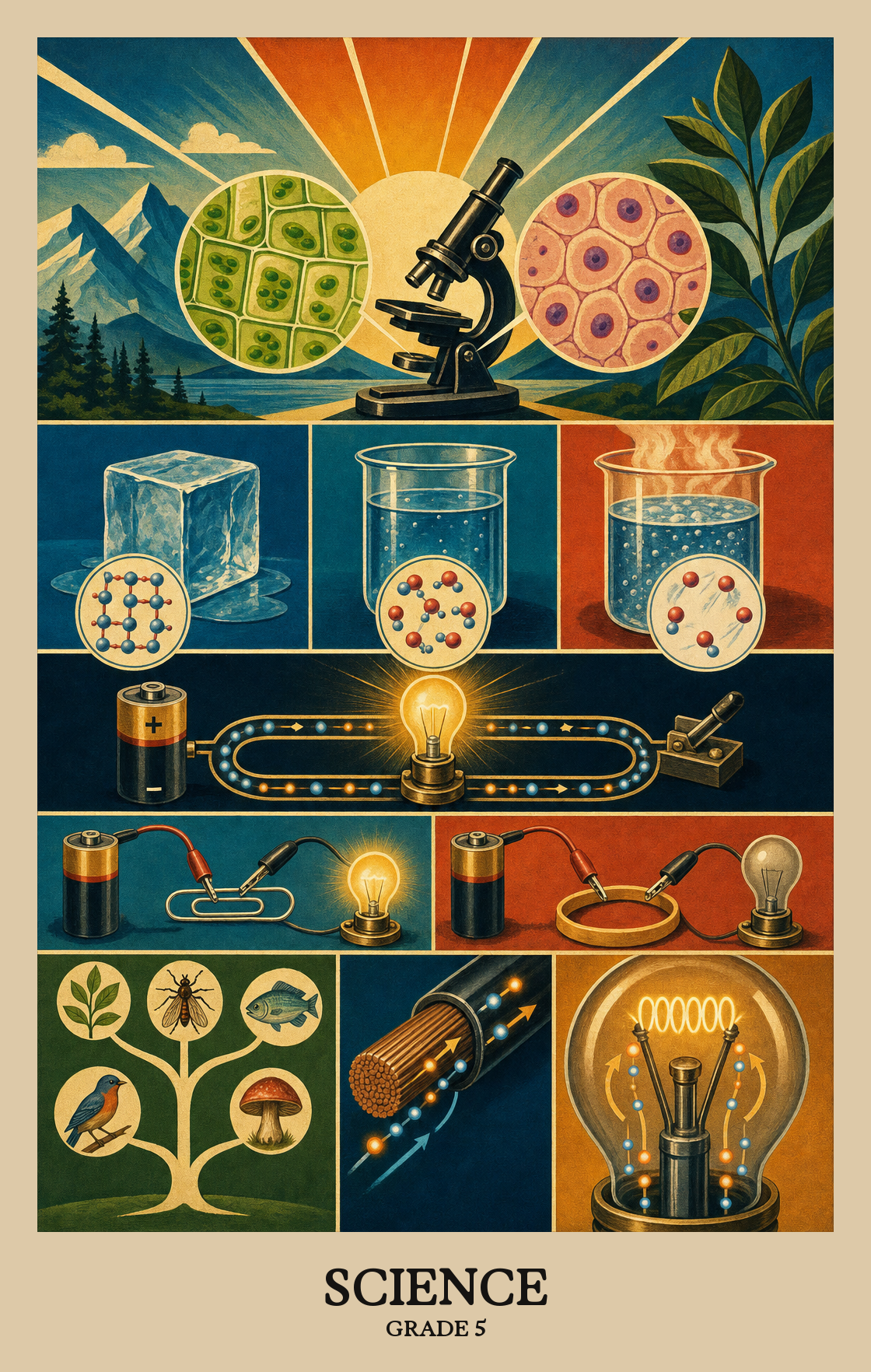
Obtain, evaluate, and communicate information to group organisms using… | Students sort living things into groups based on shared traits, using the same classification system scientists use. They learn why a mushroom isn't a plant and why a whale isn't a fish. | S5L1 |
Develop a model that illustrates how animals are sorted into groups | Students sort animals into groups based on shared traits, starting with whether the animal has a backbone. Vertebrates get sorted further into fish, amphibians, reptiles, birds, and mammals using evidence from more than one source. | S5L1.a |
Develop a model that illustrates how plants are sorted into groups | Students sort plants into two groups: ones that make seeds and ones that don't. They build a model or diagram to show how those groups differ, using information gathered from books, observations, or other sources. | S5L1.b |
Obtain, evaluate, and communicate information showing that some characteristics… | Some traits, like eye color, are passed down from parents. Others, like a scar or a skill, come from experience. Students learn to tell the difference between traits kids are born with and traits they pick up over time. | S5L2 |
Ask questions to compare and contrast instincts and learned behaviors | Instincts are behaviors animals are born with, like a spider spinning a web. Learned behaviors develop through experience, like a dog sitting on command. Students compare these two types to understand where animal behavior comes from. | S5L2.a |
Ask questions to compare and contrast inherited and acquired physical traits | Students sort physical traits into two groups: ones passed down from parents (like eye color) and ones that developed from experience or environment (like a scar or a callus). The goal is understanding which traits you're born with and which ones life gives you. | S5L2.b |
Obtain, evaluate, and communicate information to compare and contrast the parts… | Plant and animal cells share some parts, like a nucleus and membrane, but differ in key ways. Students learn which structures each cell type has and what those structures do. | S5L3 |
Gather evidence by utilizing technology tools to support a claim that plants… | Students gather evidence to support the claim that living things are made of cells too small to see with the naked eye. They use microscopes or digital tools to observe plant and animal cells up close. | S5L3.a |
Develop a model to identify and label parts of a plant cell | Students draw or build a model of a plant cell and an animal cell, then label the parts of each. They learn which parts both cells share and which parts, like the cell wall and chloroplasts, only show up in plants. | S5L3.b |
Construct an explanation that differentiates between the structure of plant and… | Plant cells have a stiff outer wall and a large central compartment that animal cells don't. Students compare diagrams of both cell types and explain, in writing, what makes each one different. | S5L3.c |
Obtain, evaluate, and communicate information about how microorganisms benefit… | Microorganisms are too small to see without a microscope, but they affect every living thing. Students learn how bacteria and other tiny organisms can help animals and plants stay healthy or make them sick. | S5L4 |
Construct an argument using scientific evidence to support a claim that some… | Students build a case, using real scientific evidence, that some microorganisms help larger living things. Think bacteria that aid digestion or fungi that break down dead matter. | S5L4.a |
Construct an argument using scientific evidence to support a claim that some… | Students build a written argument, backed by scientific evidence, explaining why certain microorganisms cause disease or damage in larger living things. | S5L4.b |