Stars, planets, and the solar system
Students compare stars and planets and figure out why some stars look bigger or brighter than others. They study models of the solar system and notice what those models get right and what they leave out.
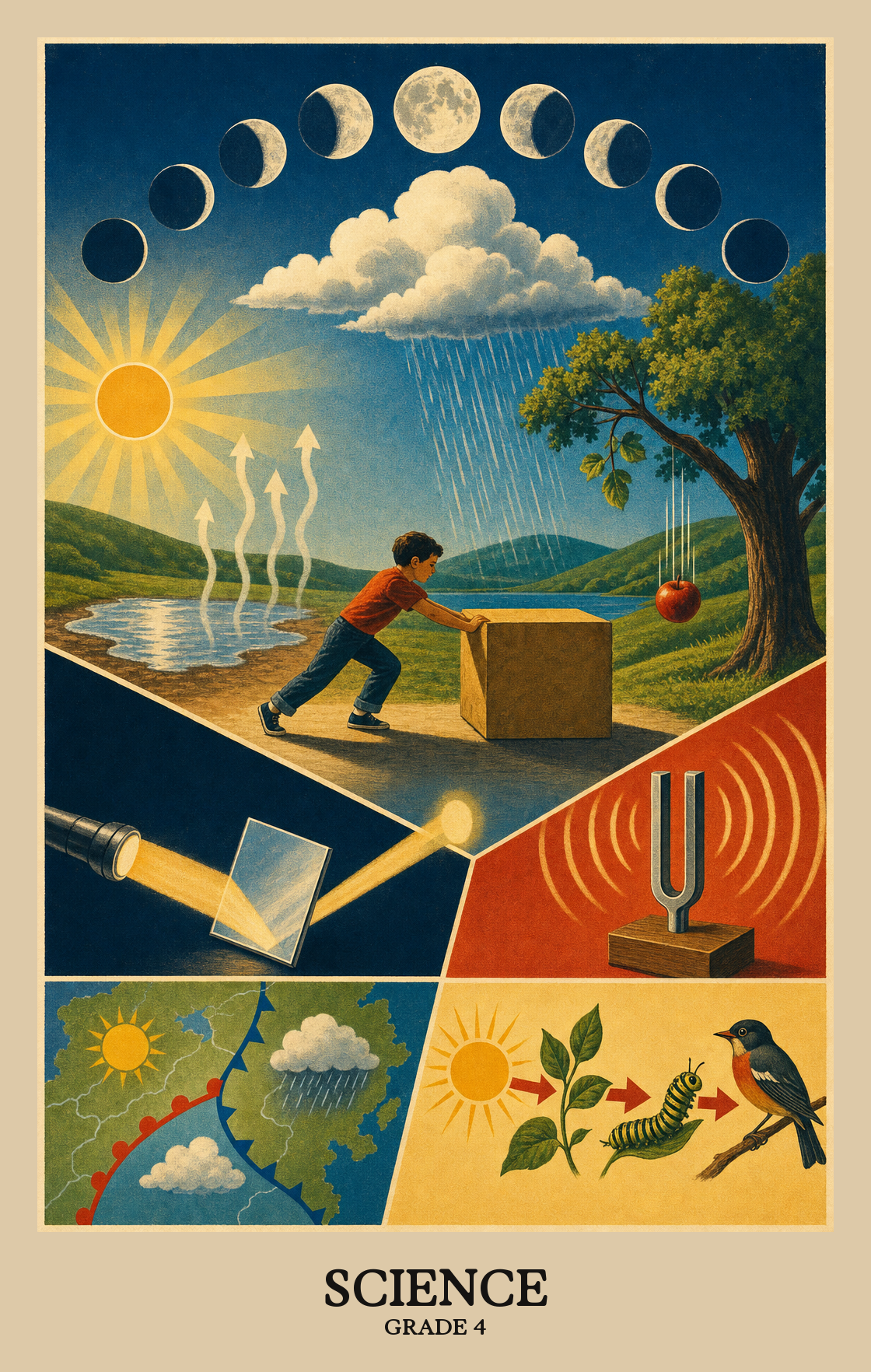
This is the year science zooms out to the sky and in to everyday forces. Students study stars, planets, moon phases, and the seasons, and they track the water cycle from puddle to cloud to rain. They investigate how light bounces off mirrors, how sound travels, and how pushes, pulls, and gravity move objects. By spring, they can read a weather map to predict tomorrow's forecast and draw a food chain showing how energy moves from the sun to plants to animals.
Students compare stars and planets and figure out why some stars look bigger or brighter than others. They study models of the solar system and notice what those models get right and what they leave out.
Students build models to explain why days get longer or shorter, why seasons change, and why the moon looks different each week. Expect questions at home about sunrise times and the shape of the moon.
Students watch water move between ice, liquid, and vapor, then track clouds, temperature, and pressure to predict tomorrow's weather. They learn the difference between a rainy week and a region's climate.
Students test how light passes through, bounces off, or bends around everyday materials, and how vibrations make sound louder or higher. They design a small device that sends a message using light or sound.
Students push and pull objects to see what balanced and unbalanced forces do, and they argue from evidence that gravity pulls things down. They explore how ramps, levers, and pulleys make hard jobs easier.
Students map how energy moves from the sun to plants to animals to decomposers. They model what happens to a habitat when a plant or animal disappears or takes over, using real data.
Stars and planets look similar in the night sky, but they are very different objects. Students learn what sets them apart by reading, discussing, and comparing details like size, brightness, and what each one is made of.
Telescopes and space probes have changed what we know about stars and planets. Students look at how older and newer tools collect different kinds of information about objects too far away to visit.
Students build an argument explaining why some stars look bigger or brighter in the sky. The key idea: a star's apparent size and brightness depend on how far away it is, not just how large it actually is.
Stars make their own light; planets only reflect light from a star. Students explain what makes each one different, using what they observe about brightness, movement, and position in the night sky.
Models of the solar system (like posters or diagrams) show the order and appearance of planets, but they can't show everything accurately. Students learn what those models get right and where they fall short, such as showing true size differences between planets and the sun.
Students learn why we see phases of the moon and why seasons change. They use models to show how the Earth and moon move around the sun and how that movement changes what we observe from the ground.
Seasons shift how many hours of sunlight Earth gets each day. Students build a model showing why summer days are long and winter days are short, based on how Earth tilts as it orbits the sun.
Students build a model showing how the moon appears to change shape over the course of a month, from a thin sliver to a full circle and back again, based on their own observations.
Students explain why summers are hot and winters are cold: as Earth travels around the sun, its tilt stays fixed, so each hemisphere leans toward or away from the sun at different times of year.
Students trace how water moves from the ground into the air and back down as rain or snow. They learn why puddles disappear, where clouds come from, and how the same water keeps cycling through Earth over and over.
Students watch ice melt into water and water evaporate into air, then trace it back again. The goal is seeing how heat moves the same water through each change.
Water can travel many different paths through the water cycle. Students draw or build models showing how water evaporates into the air, condenses into clouds, and falls back down as rain or snow.
Students read weather maps and recorded data to spot patterns and predict what weather is coming next.
Students learn what a thermometer, rain gauge, barometer, wind vane, and anemometer each measure, then explain how forecasters use that collected data to predict coming weather.
Students read a weather map, spotting cold and warm fronts, air pressure, and precipitation patterns, then use what they find to predict what tomorrow's weather will likely be.
Students look at cloud shapes to guess what weather is coming. Wispy, flat, and puffy clouds each signal different conditions.
Students explain why a week of rainstorms is just weather, while a region's rainy season every year is climate. One is a short-term event; the other is the long-term pattern.
| Standard | Definition | Code |
|---|---|---|
| Obtain, evaluate, and communicate information to compare and contrast the… | Stars and planets look similar in the night sky, but they are very different objects. Students learn what sets them apart by reading, discussing, and comparing details like size, brightness, and what each one is made of. | S4E1 |
| Ask questions to compare and contrast technological advances that have changed… | Telescopes and space probes have changed what we know about stars and planets. Students look at how older and newer tools collect different kinds of information about objects too far away to visit. | S4E1.a |
| Construct an argument on why some stars | Students build an argument explaining why some stars look bigger or brighter in the sky. The key idea: a star's apparent size and brightness depend on how far away it is, not just how large it actually is. | S4E1.b |
| Construct an explanation of the differences between stars and planets | Stars make their own light; planets only reflect light from a star. Students explain what makes each one different, using what they observe about brightness, movement, and position in the night sky. | S4E1.c |
| Evaluate strengths and limitations of models of our solar system in describing… | Models of the solar system (like posters or diagrams) show the order and appearance of planets, but they can't show everything accurately. Students learn what those models get right and where they fall short, such as showing true size differences between planets and the sun. | S4E1.d |
| Obtain, evaluate, and communicate information to model the effects of the… | Students learn why we see phases of the moon and why seasons change. They use models to show how the Earth and moon move around the sun and how that movement changes what we observe from the ground. | S4E2 |
| Develop a model to support an explanation of why the length of day and night… | Seasons shift how many hours of sunlight Earth gets each day. Students build a model showing why summer days are long and winter days are short, based on how Earth tilts as it orbits the sun. | S4E2.a |
| Develop a model based on observations to describe the repeating pattern of the… | Students build a model showing how the moon appears to change shape over the course of a month, from a thin sliver to a full circle and back again, based on their own observations. | S4E2.b |
| Construct an explanation of how the Earth's orbit, with its consistent tilt… | Students explain why summers are hot and winters are cold: as Earth travels around the sun, its tilt stays fixed, so each hemisphere leans toward or away from the sun at different times of year. | S4E2.c |
| Obtain, evaluate, and communicate information to demonstrate the water cycle | Students trace how water moves from the ground into the air and back down as rain or snow. They learn why puddles disappear, where clouds come from, and how the same water keeps cycling through Earth over and over. | S4E3 |
| Plan and carry out investigations to observe the flow of energy in water as it… | Students watch ice melt into water and water evaporate into air, then trace it back again. The goal is seeing how heat moves the same water through each change. | S4E3.a |
| Develop models to illustrate multiple pathways water may take during the water… | Water can travel many different paths through the water cycle. Students draw or build models showing how water evaporates into the air, condenses into clouds, and falls back down as rain or snow. | S4E3.b |
| Obtain, evaluate, and communicate information to predict weather events and… | Students read weather maps and recorded data to spot patterns and predict what weather is coming next. | S4E4 |
| Construct an explanation of how weather instruments | Students learn what a thermometer, rain gauge, barometer, wind vane, and anemometer each measure, then explain how forecasters use that collected data to predict coming weather. | S4E4.a |
| Interpret data from weather maps, including fronts | Students read a weather map, spotting cold and warm fronts, air pressure, and precipitation patterns, then use what they find to predict what tomorrow's weather will likely be. | S4E4.b |
| Ask questions and use observations of cloud types | Students look at cloud shapes to guess what weather is coming. Wispy, flat, and puffy clouds each signal different conditions. | S4E4.c |
| Construct an explanation based on research to communicate the difference… | Students explain why a week of rainstorms is just weather, while a region's rainy season every year is climate. One is a short-term event; the other is the long-term pattern. | S4E4.d |
Students learn how light travels, bends, reflects, and passes through objects. They explore what happens when light hits a mirror, a glass of water, or an opaque wall.
Students sort materials by how much light passes through them. A brick that blocks all light is opaque, a clear glass that lets all light through is transparent, and a frosted window that lets some light through is translucent.
Students shine a light at a mirror and watch where the beam goes. They test different angles to see how the mirror changes the direction of the light.
Students bend light using everyday objects like a glass of water or a prism, then describe what they observe. The goal is to see how light changes direction when it passes from one material into another.
Students learn how sound is made and how it changes in pitch or volume. They also explore ways people use sound and light to send messages, like a foghorn warning ships or a flashing signal light.
Students use everyday objects to make sound, then predict what happens when they change how hard or fast something vibrates. The goal is to see how vibration strength and speed affect the sound produced.
Students design and build a device that sends a message across a distance using light or sound, such as a flashlight signal or a drum tap.
Students learn what makes things move, stop, or stay still. They compare situations where forces are equal (balanced) and where one force wins out (unbalanced), and explain what happens to the object each time.
Students plan and run a simple test to see what happens when forces on an object are equal (it stays still) or unequal (it moves), then share what they found.
Students build a case for why gravity pulls objects downward, using examples like a dropped ball or a falling leaf to show how gravity changes the way things move.
Students learn what levers, pulleys, ramps, and other simple machines actually do: they change the direction or amount of force needed to move or lift something. Students ask questions about where these machines show up in everyday tools and how they make hard tasks easier.
| Standard | Definition | Code |
|---|---|---|
| Obtain, evaluate, and communicate information about the nature of light and how… | Students learn how light travels, bends, reflects, and passes through objects. They explore what happens when light hits a mirror, a glass of water, or an opaque wall. | S4P1 |
| Plan and carry out investigations to observe and record how light interacts… | Students sort materials by how much light passes through them. A brick that blocks all light is opaque, a clear glass that lets all light through is transparent, and a frosted window that lets some light through is translucent. | S4P1.a |
| Plan and carry out investigations to describe the path light travels from a… | Students shine a light at a mirror and watch where the beam goes. They test different angles to see how the mirror changes the direction of the light. | S4P1.b |
| Plan and carry out an investigation utilizing everyday materials to explore… | Students bend light using everyday objects like a glass of water or a prism, then describe what they observe. The goal is to see how light changes direction when it passes from one material into another. | S4P1.c |
| Obtain, evaluate, and communicate information about how sound is produced and… | Students learn how sound is made and how it changes in pitch or volume. They also explore ways people use sound and light to send messages, like a foghorn warning ships or a flashing signal light. | S4P2 |
| Plan and carry out an investigation utilizing everyday objects to produce sound… | Students use everyday objects to make sound, then predict what happens when they change how hard or fast something vibrates. The goal is to see how vibration strength and speed affect the sound produced. | S4P2.a |
| Design and construct a device to communicate across a distance using light… | Students design and build a device that sends a message across a distance using light or sound, such as a flashlight signal or a drum tap. | S4P2.b |
| Obtain, evaluate, and communicate information about the relationship between… | Students learn what makes things move, stop, or stay still. They compare situations where forces are equal (balanced) and where one force wins out (unbalanced), and explain what happens to the object each time. | S4P3 |
| Plan and carry out an investigation on the effects of balanced and unbalanced… | Students plan and run a simple test to see what happens when forces on an object are equal (it stays still) or unequal (it moves), then share what they found. | S4P3.a |
| Construct an argument to support the claim that gravitational force affects the… | Students build a case for why gravity pulls objects downward, using examples like a dropped ball or a falling leaf to show how gravity changes the way things move. | S4P3.b |
| Ask questions to identify and explain the uses of simple machines | Students learn what levers, pulleys, ramps, and other simple machines actually do: they change the direction or amount of force needed to move or lift something. Students ask questions about where these machines show up in everyday tools and how they make hard tasks easier. | S4P3.c |
Students learn how living things in an ecosystem depend on each other for food and energy. They look at who eats whom and how energy moves from plants to animals and beyond.
Students sort living things into three jobs: producers (plants that make food from sunlight), consumers (animals that eat other organisms), and decomposers (fungi and bacteria that break down dead matter). They show how these roles connect in a diagram or model.
Plants capture sunlight and turn it into food. Students draw or map how that energy moves from plants to the animals that eat them, and finally to decomposers that break down what's left.
Students think through what happens to a food chain or habitat when one part changes, like a predator disappearing or a water source drying up, then describe or sketch how the rest of the ecosystem responds.
Students look up real data about what happens when one animal or plant disappears or takes over, then draw or diagram how that ripple moves through the food chain.
| Standard | Definition | Code |
|---|---|---|
| Obtain, evaluate, and communicate information about the roles of organisms and… | Students learn how living things in an ecosystem depend on each other for food and energy. They look at who eats whom and how energy moves from plants to animals and beyond. | S4L1 |
| Develop a model to describe the roles of producers, consumers | Students sort living things into three jobs: producers (plants that make food from sunlight), consumers (animals that eat other organisms), and decomposers (fungi and bacteria that break down dead matter). They show how these roles connect in a diagram or model. | S4L1.a |
| Develop simple models to illustrate the flow of energy through a food web/food… | Plants capture sunlight and turn it into food. Students draw or map how that energy moves from plants to the animals that eat them, and finally to decomposers that break down what's left. | S4L1.b |
| Design a scenario to demonstrate the effect of a change on an ecosystem | Students think through what happens to a food chain or habitat when one part changes, like a predator disappearing or a water source drying up, then describe or sketch how the rest of the ecosystem responds. | S4L1.c |
| Use printed and digital data to develop a model illustrating and describing… | Students look up real data about what happens when one animal or plant disappears or takes over, then draw or diagram how that ripple moves through the food chain. | S4L1.d |
Federally administered sample-based assessment in reading, mathematics, science, writing, and other subjects. NAEP results inform state-by-state comparisons rather than individual student or school accountability.
Students study four big areas: the sky and space, weather and the water cycle, light and sound, and living things in ecosystems. They also learn about forces like gravity and simple machines such as ramps and pulleys. Most lessons involve doing an investigation, not just reading about it.
Step outside at the same time each week and look at the moon together. Sketch what it looks like in a notebook. After a month, students will see the pattern of new, crescent, quarter, gibbous, and full moons that they are learning in class.
Weather is what it is doing outside right now, like rainy or windy today. Climate is the pattern over many years, like hot summers and mild winters. Watching a local forecast together and talking about the symbols on the map is good practice.
Many teachers start with physical science because light, sound, and forces are easy to investigate with classroom materials. Earth and space pairs well with seasonal changes in fall and winter. Ecosystems often land in spring when students can observe living things outside.
Moon phases and seasons trip up a lot of students because they confuse the two. The water cycle terms (evaporation, condensation, precipitation) also need repeated practice. Building physical models, not just labeling diagrams, tends to fix both.
Put a small cup of water on a sunny windowsill and mark the level each day. Students will see the water disappear into the air. Talking through where it went, and where rain comes from, reinforces what they are learning about evaporation and condensation.
Most standards begin with verbs like plan, investigate, model, or construct. That means students should be doing science, not just reading about it. Plan for at least one short investigation in each unit, even if it uses cups, flashlights, or string.
By the end of the year, students should be able to explain why we have seasons and moon phases, read a basic weather map, describe how light and sound behave, and trace energy through a food chain. They should also be comfortable writing a short explanation backed by what they observed.