Looking closely at everyday objects
Students start the year by noticing what things are made of and how they feel. They sort buttons, cloth, and other small objects by color, size, shape, and texture using their senses and simple tools.
This is the year science becomes the habit of looking closely and asking why. Students sort everyday things by what they notice: rocks by size and color, buttons by shape, animals by their features. They test what sinks, what floats, and how a push makes something roll straight or spin. By spring, they can watch the sky shift from day to night and explain, in their own words, what they saw.
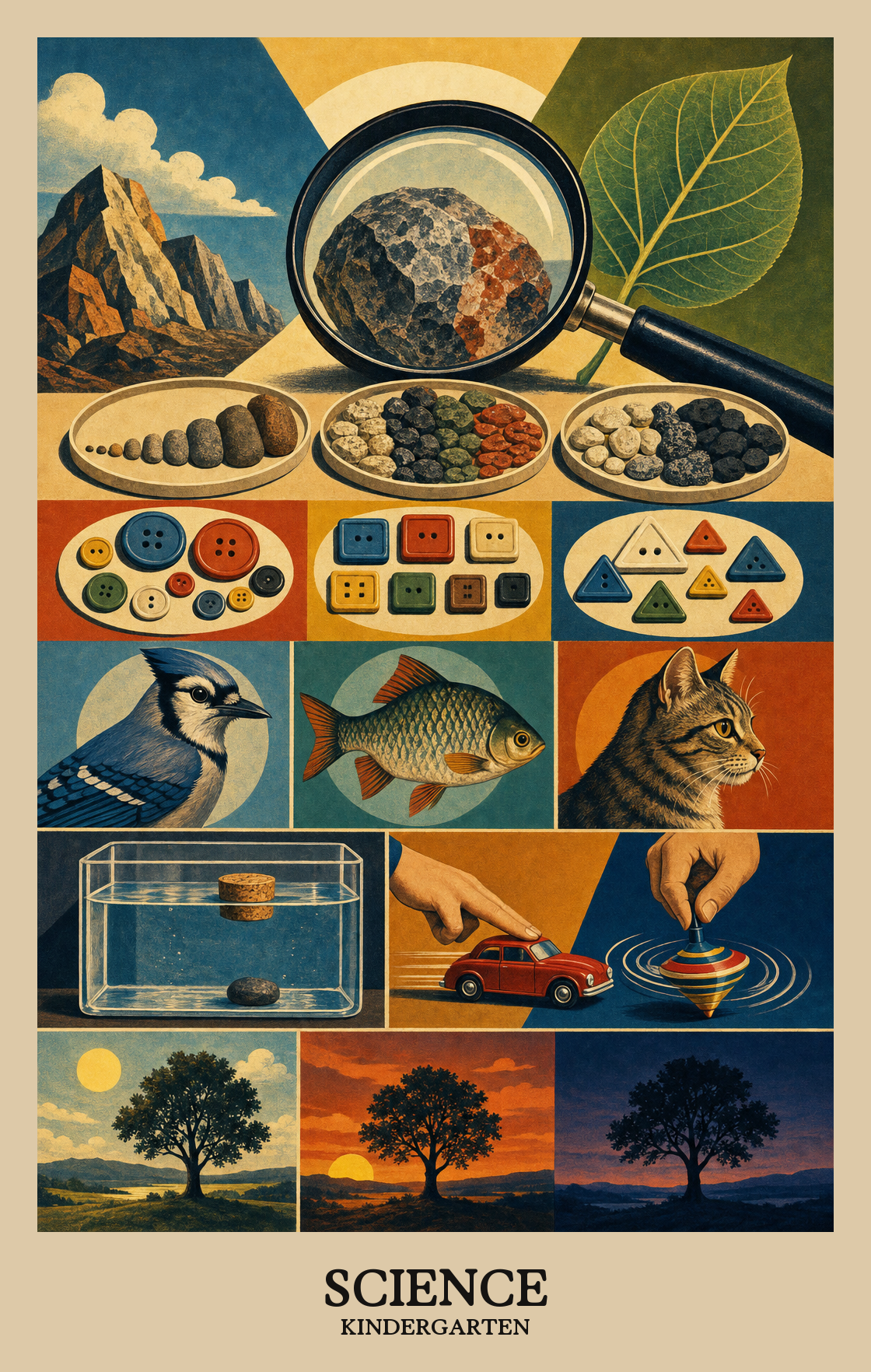
Students start the year by noticing what things are made of and how they feel. They sort buttons, cloth, and other small objects by color, size, shape, and texture using their senses and simple tools.
Students figure out what counts as alive. They compare a plant or a bug to a rock or a toy, and sort a mix of items into groups based on what they notice.
Students look at how animals can be grouped by features like fur, feathers, or fins, and how plants can be grouped by their parts. They also notice how baby animals look like their parents.
Students explore the ground under their feet and the air around them. They sort rocks by size, weight, and color, and use simple tools to look closely at soil.
Students test how things move when given a push or a pull. They try rolling, sliding, and floating to see what moves in a straight line, in circles, or back and forth, and which objects sink or float in water.
Students wrap up the year watching the sky. They notice the sun, moon, and stars, talk about what shows up during the day versus at night, and draw pictures of how the sky changes from morning to evening.
Students watch the sky and notice patterns, like when the sun appears during the day and when the moon and stars come out at night. They describe what they see and talk about how the sky changes over time.
Students sort the sun, moon, and stars into where they belong: the day sky, the night sky, or both. This is usually one of the first times kids think carefully about what they actually see when they look up.
Students draw and label pictures showing how the sky changes from morning to night and back again, capturing what the sun looks like at different times and what appears once darkness falls.
Students learn to observe and describe the basic materials found on Earth: soil, rocks, water, and air. They notice how these materials look, feel, and compare to each other.
Students learn to notice and name the basic materials that make up Earth: soil, rocks, water, and air. They practice asking questions about what each one looks, feels, or acts like.
Students sort rocks into groups by how they look and feel. They explain their sorting choices using the rocks themselves as evidence, pointing to color, texture, size, or weight.
Students use their hands and simple tools to feel, look at, and describe soil. They notice things like whether it feels rough or smooth and what color it is.
| Standard | Definition | Code |
|---|---|---|
| Obtain, evaluate, and communicate observations about time patterns | Students watch the sky and notice patterns, like when the sun appears during the day and when the moon and stars come out at night. They describe what they see and talk about how the sky changes over time. | SKE1 |
| Ask questions to classify objects according to those seen in the day sky, the… | Students sort the sun, moon, and stars into where they belong: the day sky, the night sky, or both. This is usually one of the first times kids think carefully about what they actually see when they look up. | SKE1.a |
| Develop a model to communicate the changes that occur in the sky during the… | Students draw and label pictures showing how the sky changes from morning to night and back again, capturing what the sun looks like at different times and what appears once darkness falls. | SKE1.b |
| Obtain, evaluate, and communicate information to describe the physical… | Students learn to observe and describe the basic materials found on Earth: soil, rocks, water, and air. They notice how these materials look, feel, and compare to each other. | SKE2 |
| Ask questions to identify and describe earth materials—soil, rocks, water | Students learn to notice and name the basic materials that make up Earth: soil, rocks, water, and air. They practice asking questions about what each one looks, feels, or acts like. | SKE2.a |
| Construct an argument supported by evidence for how rocks can be grouped by… | Students sort rocks into groups by how they look and feel. They explain their sorting choices using the rocks themselves as evidence, pointing to color, texture, size, or weight. | SKE2.b |
| Use tools to observe and record physical attributes of soil such as texture and… | Students use their hands and simple tools to feel, look at, and describe soil. They notice things like whether it feels rough or smooth and what color it is. | SKE2.c |
Students sort and describe everyday objects by what they are made of (wood, plastic, metal) and how they look and feel (size, shape, color, texture).
Students sort everyday objects by what they are made of, such as wood, metal, or cloth, and ask questions about how those materials are different.
Students sort everyday objects like buttons and fabric scraps by what they can see, feel, and weigh. They use their senses and simple tools to group things by color, shape, size, and texture.
Students predict whether an object will sink or float, then drop it in water to see if they were right. They learn to notice how an object looks and feels before guessing what it will do.
Students sort and describe ways things move, like spinning, sliding, rolling, or going back and forth. They watch objects in action and talk about how each one moves differently.
Students push, pull, or roll objects to see how size, shape, and weight change the way things move. A heavier ball rolls differently than a light one, and a flat block slides differently than a round one.
Students look at an object and decide the best way to move it: push it, pull it, roll it, or slide it. The choice depends on what the object is made of, how heavy it is, and what shape it has.
| Standard | Definition | Code |
|---|---|---|
| Obtain, evaluate, and communicate information to describe objects in terms of… | Students sort and describe everyday objects by what they are made of (wood, plastic, metal) and how they look and feel (size, shape, color, texture). | SKP1 |
| Ask questions to compare and sort objects made of different materials | Students sort everyday objects by what they are made of, such as wood, metal, or cloth, and ask questions about how those materials are different. | SKP1.a |
| Use senses and science tools to classify common objects, such as buttons or… | Students sort everyday objects like buttons and fabric scraps by what they can see, feel, and weigh. They use their senses and simple tools to group things by color, shape, size, and texture. | SKP1.b |
| Plan and carry out an investigation to predict and observe whether objects… | Students predict whether an object will sink or float, then drop it in water to see if they were right. They learn to notice how an object looks and feels before guessing what it will do. | SKP1.c |
| Obtain, evaluate, and communicate information to compare and describe different… | Students sort and describe ways things move, like spinning, sliding, rolling, or going back and forth. They watch objects in action and talk about how each one moves differently. | SKP2 |
| Plan and carry out an investigation to determine the relationship between an… | Students push, pull, or roll objects to see how size, shape, and weight change the way things move. A heavier ball rolls differently than a light one, and a flat block slides differently than a round one. | SKP2.a |
| Construct an argument as to the best way to move an object based on its… | Students look at an object and decide the best way to move it: push it, pull it, roll it, or slide it. The choice depends on what the object is made of, how heavy it is, and what shape it has. | SKP2.b |
Students sort living things (plants, animals) and non-living things (rocks, water) into groups based on what they have in common.
Students sort living things from non-living objects by looking closely and explaining what they notice. A dog breathes and grows; a rock does not.
Students sort living things and non-living objects into groups by what they look like or how they act, then draw or build a model to show how those groups are organized.
Students sort plants and animals into groups by looking at what they have in common and how they differ. A fish and a frog both live near water, but one has fins and one has legs.
Students sort animals into groups based on features like legs, fur, or wings. They explain what makes each group belong together, using what they can see as their evidence.
Students sort plants into groups based on what they observe, like leaf shape, stem type, or whether the plant grows flowers. Then they explain why they put each plant where they did, using what they actually see as their reason.
Students look at baby animals and their parents to spot what looks the same and what looks different. A puppy and its mother share some features, but not all.
| Standard | Definition | Code |
|---|---|---|
| Obtain, evaluate, and communicate information about how organisms | Students sort living things (plants, animals) and non-living things (rocks, water) into groups based on what they have in common. | SKL1 |
| Construct an explanation based on observations to recognize the differences… | Students sort living things from non-living objects by looking closely and explaining what they notice. A dog breathes and grows; a rock does not. | SKL1.a |
| Develop a model to represent how a set of organisms and non-living objects are… | Students sort living things and non-living objects into groups by what they look like or how they act, then draw or build a model to show how those groups are organized. | SKL1.b |
| Obtain, evaluate, and communicate information to compare the similarities and… | Students sort plants and animals into groups by looking at what they have in common and how they differ. A fish and a frog both live near water, but one has fins and one has legs. | SKL2 |
| Construct an argument supported by evidence for how animals can be grouped… | Students sort animals into groups based on features like legs, fur, or wings. They explain what makes each group belong together, using what they can see as their evidence. | SKL2.a |
| Construct an argument supported by evidence for how plants can be grouped… | Students sort plants into groups based on what they observe, like leaf shape, stem type, or whether the plant grows flowers. Then they explain why they put each plant where they did, using what they actually see as their reason. | SKL2.b |
| Ask questions and make observations to identify the similarities and… | Students look at baby animals and their parents to spot what looks the same and what looks different. A puppy and its mother share some features, but not all. | SKL2.c |
Federally administered sample-based assessment in reading, mathematics, science, writing, and other subjects. NAEP results inform state-by-state comparisons rather than individual student or school accountability.
Students look closely at the world and learn to sort what they see. They explore the sky, rocks, soil, water, and air, then group objects by how they look, feel, and move. They also notice what makes something alive.
Go outside and ask what students notice. Pick up a few rocks and sort them by size or color. Drop a spoon and a leaf in a bowl of water and guess which will float. Five minutes of noticing counts as science.
No. Kindergarten science is about observing and explaining, not memorizing. If students can describe what they see and sort things into groups with a reason, they are doing the work.
Start with sorting and describing, since every unit leans on those skills. Once students can group buttons or leaves by attributes and explain why, the sky, motion, and living things units move much faster.
The alive versus not alive distinction trips students up, especially with things like seeds, water, and stuffed animals. Plan a few short sorting rounds across the year with new examples each time instead of one long unit.
Students should describe an object using words like rough, heavy, or red, and explain why two things belong in the same group. They should also tell you what changes between day and night and name something living and something not living.
Students predict before they drop the object, say why they think so, and then compare the result to their guess. The goal is the reasoning, not a correct prediction. Keep the objects simple and let students handle them first.
Tell them the moon is up there a lot, even when the sun is bright, so we just notice it less. Step outside at different times for a week and draw what you see in the sky. That drawing is exactly the kind of thinking the standards ask for.