Skip to content

What does a student learn in ?

This is the year reading shifts from finding one right answer to backing up an interpretation with several pieces of proof from the text. Students track a theme across a whole book and notice how a setting changes a character. In writing, they build a real argument: a clear claim, evidence, and a response to the other side. By spring, they can write a multi-paragraph essay that argues a point and cites sources.

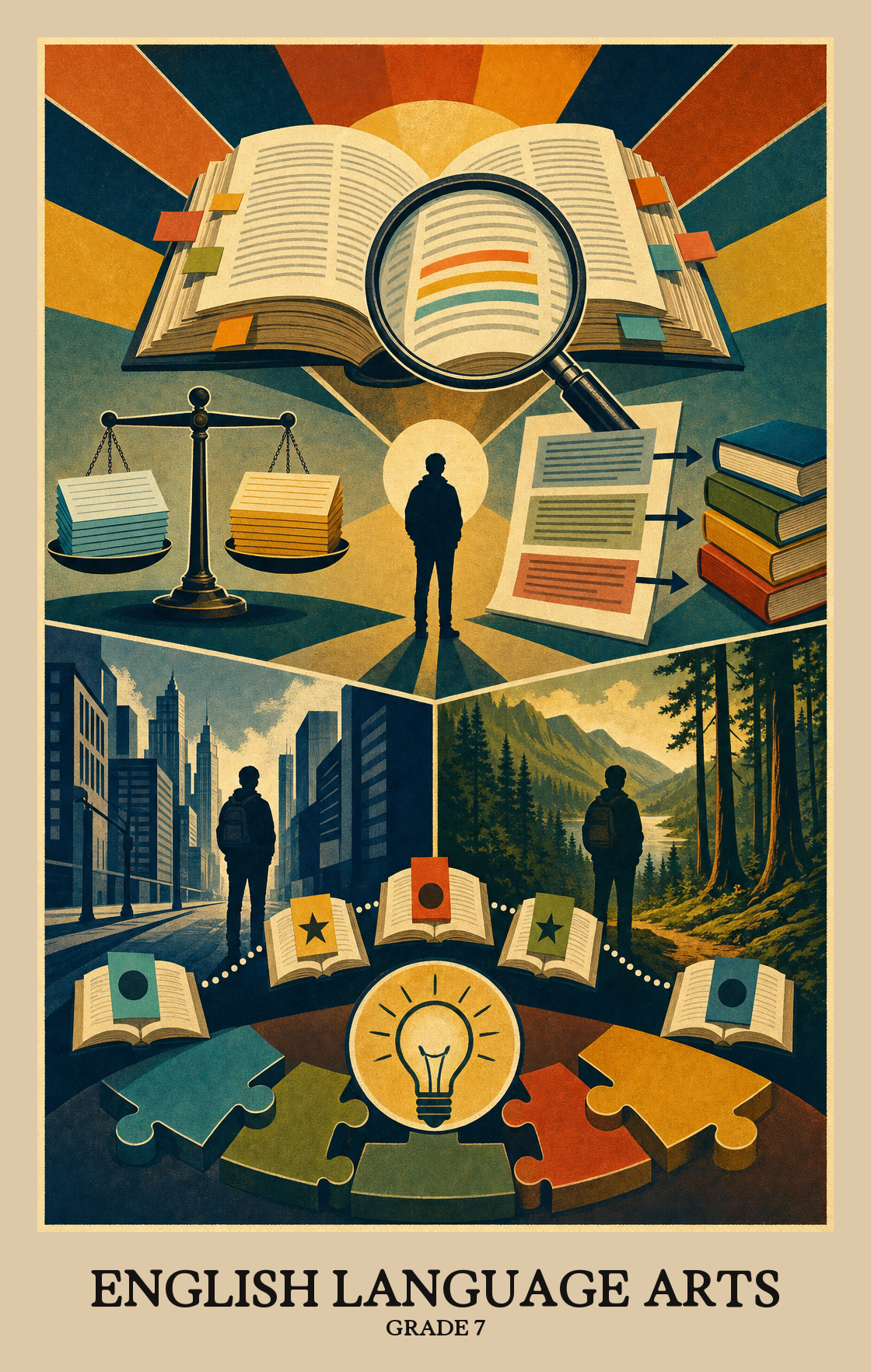
Illustration of what students learn in Grade 7 English Language Arts
  • Citing evidence
  • Argument writing
  • Theme analysis
  • Research projects
  • Word meaning
  • Class discussions
Source: Kansas Kansas Standards
Year at a glance
How the year usually goes. Every school and district set their own curriculum, so treat this as a guide, not official pacing.
  1. 1

    Reading closely with evidence

    Students read stories, poems, and articles and back up their thinking with specific lines from the text. They start naming the theme of a story and the central ideas of an article, then write short summaries that stick to what the text actually says.

  2. 2

    How writers build meaning

    Students look at how a writer's choices shape a piece. They study how setting pushes a character into action, how word choice sets a tone, and how the shape of a poem or chapter affects what it means.

  3. 3

    Writing arguments and explanations

    Students write essays that make a claim and back it up with reasons and evidence from sources. They also write informational pieces that explain a topic clearly, with a real introduction, organized middle, and conclusion that lands.

  4. 4

    Research and source checking

    Students run short research projects on a question they care about. They pull information from several print and online sources, check whether each source is trustworthy, and cite what they use instead of copying it.

  5. 5

    Narrative writing and craft

    Students write real or imagined stories with a clear narrator, a sequence of events that builds, and details a reader can picture. They use dialogue and pacing to bring scenes to life and end with a conclusion that reflects on what happened.

  6. 6

    Discussion, presenting, and language

    Students come to discussions ready to talk about what they read, ask questions that push the conversation further, and adjust their thinking when classmates raise good points. They also present findings out loud and tighten their grammar, punctuation, and word choice in writing.

Mastery Learning Standards
The required skills a student should display by the end of Grade 7.
Reading: Literature
  • Cite several pieces of textual evidence to support analysis of what the text…

    RL.7.1

    Students back up their reading with proof from the story or poem. They quote or paraphrase the text to show what the author states outright and what readers have to figure out on their own.

  • Determine a theme of a text and analyze its development over the course of the…

    RL.7.2

    Students find the central message of a story and trace how it builds from beginning to end. They also summarize the story in their own words, sticking to what actually happens without adding opinions.

  • Analyze how particular elements of a story or drama interact

    RL.7.3

    Characters, setting, and plot push and pull on each other. Students look at how where a story takes place changes what characters do, or how a character's choices drive the events forward.

  • Determine the meaning of words and phrases as they are used in a text…

    RL.7.4

    Students figure out what words mean in context, including when language is figurative or loaded with feeling. They also look at how rhyme and repeated sounds shape the mood or meaning of a poem, story, or play.

  • Analyze how a drama's or poem's form or structure contributes to its meaning

    RL.7.5

    Students look at how a poem or play is built, such as its acts, scenes, stanzas, or line breaks, and explain how that shape affects what the piece means or feels like.

  • Explain how an author develops the point of view of the narrator or speaker in…

    RL.7.6

    Students look at how an author shapes the way a narrator or character sees the world, then compare that perspective to how other characters in the same story see things differently.

  • Compare and contrast a written story, drama or poem to its audio, filmed…

    RL.7.7

    Students compare a story, play, or poem to a movie, recording, or stage version of the same work, then explain how each version creates different effects through choices like lighting, camera angles, or sound.

  • Not applicable for literature

    RL.7.8

    This standard does not apply to literature. In English classes, analyzing sources and evidence is a skill tied to nonfiction reading, not stories or novels.

  • Compare and contrast a fictional portrayal of setting or character with a…

    RL.7.9

    Students read a novel and a history book covering the same era, then explain what the author changed or kept. The goal is understanding why a writer might bend the facts to shape a story.

  • Use knowledge of language and its conventions when reading to aid comprehension

    RL.7.10

    Reading a story closely means noticing how word choice, sentence structure, and punctuation shape meaning. Students use what they know about language to understand what a text is really saying.

  • Determine or clarify the meaning of unknown and multiple-meaning words and…

    RL.7.11

    Students figure out what unfamiliar or confusing words mean by using context clues, word roots, or other hints in the text they are already reading.

  • Use context to determine the meaning of a word or phrase

    RL.7.11.a

    Students figure out what an unfamiliar word means by reading the sentences around it. No dictionary needed, they use the context of the passage to make a reasonable guess.

  • Use common, grade-appropriate Greek or Latin affixes and roots to define the…

    RL.7.11.b

    Students use familiar Greek and Latin word parts, like "bio" or "rupt," to figure out the meaning of an unfamiliar word while reading.

  • Consult general and specialized reference materials, both print and digital, to…

    RL.7.11.c

    Students look up unfamiliar words in a dictionary or other reference, in print or online, to confirm how a word is pronounced, what it means, or how it functions in a sentence.

  • Verify the preliminary determination of the meaning of a word or phrase

    RL.7.11.d

    Students look up or confirm the meaning they guessed from context, checking a dictionary or other source to see if they got it right.

  • Demonstrate understanding of figurative language, word relationships and…

    RL.7.12

    Students read sentences and explain what figurative language like metaphors and similes actually mean, then think about how word choice shifts the feeling or meaning of a passage.

  • Interpret figures of speech in context

    RL.7.12.a

    Students read a poem, story, or speech and figure out what a comparison or expression really means in that moment. They look at the surrounding sentences to unlock the meaning, not just memorize a definition.

  • Use the relationship between particular words to better understand each of the…

    RL.7.12.b

    Students study pairs of words that are related, like synonyms, antonyms, or words that share a root, and use each connection to sharpen their understanding of what both words mean.

  • Distinguish among the connotations

    RL.7.12.c

    Words can share a basic meaning but feel very different. Students learn to notice those shades, like how "cheap" and "thrifty" both mean low-cost but send opposite signals about a person.

  • Read and comprehend high-quality dramas, prose and poetry of appropriate…

    RL.7.13

    Students read full stories, plays, and poems that are genuinely challenging for seventh grade. The goal is building the stamina and skill to handle complex writing, not just get through it.

Reading: Informational
  • Cite several pieces of textual evidence to support analysis of what the text…

    RI.7.1

    Students find and quote specific lines from a nonfiction text to back up what it says directly and what it implies. They use more than one piece of evidence to support each point they make.

  • Determine two or more central ideas in a text and analyze their development…

    RI.7.2

    Students find the main points an article or nonfiction passage is making, then trace how the author builds each one from start to finish. They also write a short summary that sticks to what the text says, without adding their own opinion.

  • Analyze the interactions between individuals, events and ideas in a text

    RI.7.3

    Students trace how people, events, and ideas in a nonfiction text push and pull on each other. For example, they explain how one person's decision changed an event, or how a new idea shifted what a group believed or did.

  • Determine the meaning of words and phrases as they are used in a text…

    RI.7.4

    Students figure out what words mean in context, including when a word carries emotional weight or subject-specific meaning. Then they look at why the author chose that word and what it does to the feeling or message of the passage.

  • Analyze the structure an author uses to organize a text, including how the…

    RI.7.5

    Students break down how a nonfiction piece is organized, looking at why the author arranged the sections in that order and how each section builds toward the article's main point.

  • Determine an author's perspective

    RI.7.6

    Students figure out where an author stands on a topic and how the author uses word choice or emphasis to separate their own view from the views of others they mention or quote.

  • Compare and contrast a text to an audio, video or multimedia version of the…

    RI.7.7

    Students read a text, then watch or listen to a version of the same content, and compare how the two formats tell the story differently. A written speech and a recorded one, for example, can land in very different ways.

  • Trace and evaluate the argument and specific claims in a text, assessing…

    RI.7.8

    Students read a nonfiction passage and decide whether the author's argument holds up. They check if the reasons make sense and if the facts given are actually enough to back up what the author is claiming.

  • Analyze how two or more authors writing about the same topic shape their…

    RI.7.9

    Students read two articles on the same topic and compare how each author chose different facts or spun the same facts differently to support their own point of view.

  • Use knowledge of language and its conventions when reading to aid comprehension

    RI.7.10

    Students use what they know about grammar, sentence structure, and word choice to figure out what a passage means. Noticing how a sentence is built or why a writer chose a particular word helps unlock harder texts.

  • Determine or clarify the meaning of unknown and multiple-meaning words and…

    RI.7.11

    When students hit an unfamiliar word in a nonfiction article or textbook, they figure out what it means using context clues, word roots, or a dictionary. This standard covers words that have more than one meaning, too.

  • Use context to determine the meaning of a word or phrase

    RI.7.11.a

    Students figure out what an unfamiliar word means by reading the sentences around it, rather than stopping to look it up. This is one of the most practical reading habits students can build.

  • Use common, grade-appropriate Greek or Latin affixes and roots to define the…

    RI.7.11.b

    Students use familiar Greek and Latin word parts, like "bio," "rupt," or "pre," to figure out what an unfamiliar word means. This works across science, history, and almost every subject they read.

  • Consult general and specialized reference materials, both print and digital, to…

    RI.7.11.c

    Students look up unfamiliar words in a dictionary or other reference, whether in print or online, to confirm spelling, pronunciation, or how the word functions in a sentence.

  • Verify the preliminary determination of the meaning of a word or phrase

    RI.7.11.d

    Students look up or cross-check a word they guessed from context to confirm whether their guess was right. They use a dictionary, glossary, or other source to lock in the actual meaning.

  • Demonstrate understanding of figurative language, word relationships and…

    RI.7.12

    Students identify figurative language and word relationships in nonfiction texts, explaining how a writer's word choices shape meaning. This includes spotting metaphors, connotations, and how related words connect to each other.

  • Interpret figures of speech in context

    RI.7.12.a

    Students identify figurative language (like metaphors or irony) in nonfiction articles, essays, or speeches and explain what the author means by using it there.

  • Use the relationship between particular words to better understand each of the…

    RI.7.12.b

    Students use context clues from nearby words to figure out the meaning of unfamiliar words. Seeing how two words relate to each other, such as a cause and its effect or a word and its opposite, sharpens the meaning of both.

  • Distinguish among the connotations

    RI.7.12.c

    Words can share a basic meaning but carry different feelings. Students practice telling apart words like "cheap" and "frugal" to understand how a writer's word choice shapes the reader's reaction.

  • Read and comprehend high-quality and engaging informational text of appropriate…

    RI.7.13

    Students read nonfiction articles, essays, and other real-world texts that match the reading level expected by the end of seventh grade.

Writing
  • Write arguments to support claims with clear reasons and relevant evidence

    W.7.1

    Students write a paragraph or essay that takes a clear position on a topic and backs it up with real evidence from a source. The goal is to give readers a reason to agree, not just a summary of what happened.

  • Introduce claim(s), acknowledge alternate or opposing claims and organize the…

    W.7.1.a

    Students write an opening that states their argument clearly, notes what someone on the other side might say, and lines up the supporting reasons in a logical order.

  • Support claim(s) with logical reasoning and relevant evidence, using accurate…

    W.7.1.b

    Students back up their main argument with reasons and facts drawn from reliable sources. The evidence has to connect clearly to the point they're making, not just fill space.

  • Use words, phrases and clauses to create cohesion and clarify the relationships…

    W.7.1.c

    Students practice linking ideas together with connecting words like "because," "therefore," and "for example" so each reason and piece of evidence ties clearly back to the main argument.

  • Establish and maintain a formal style

    W.7.1.d

    Writing a persuasive piece means keeping a consistent, formal tone throughout. Students avoid slang and casual phrasing, writing the way they would for a teacher or a school board, not a text message to a friend.

  • Provide a concluding statement or section that follows from and supports the…

    W.7.1.e

    Students write a final paragraph that ties back to their argument and leaves the reader with a clear sense of why it matters. The ending grows from what the essay already proved.

  • Write informative/explanatory texts to examine a topic and convey ideas…

    W.7.2

    Students write to explain a topic clearly, choosing facts and details that matter, then organizing them so a reader can follow the thinking from start to finish.

  • Introduce a topic clearly, previewing what is to follow

    W.7.2.a

    Students open an informational piece by naming the topic and signaling what's ahead, then organize the body using tools like comparison or cause and effect. Headings, charts, or other visuals come in wherever they help a reader follow the ideas.

  • Develop the topic with relevant facts, definitions, concrete details…

    W.7.2.b

    Students back up their main topic with facts, definitions, and direct quotes pulled from real sources. The details should connect clearly to the topic, not just fill space.

  • Use appropriate transitions to create cohesion and clarify the relationships…

    W.7.2.c

    Students practice choosing transition words and phrases (like "as a result" or "in contrast") that show how one idea connects to the next. The goal is a paragraph where the logic flows clearly from sentence to sentence.

  • Use precise language and domain-specific vocabulary to inform about or explain…

    W.7.2.d

    Students choose exact words and subject-specific terms to explain a topic clearly. A paper about climate change uses words like "atmosphere" and "carbon dioxide" instead of vague phrases like "bad stuff in the air."

  • Establish and maintain a formal style

    W.7.2.e

    Writing assignments at this level call for a formal tone, not a casual one. Students avoid slang, contractions, and first-person opinions to keep the writing sounding objective and consistent from the first sentence to the last.

  • Provide a concluding statement or section that follows from and supports the…

    W.7.2.f

    The final paragraph ties back to the main idea and gives the piece a clear ending. Students don't just stop writing; they close with a sentence or two that shows why the explanation matters.

  • Write narratives to develop real or imagined experiences or events using…

    W.7.3

    Students write a story, real or made-up, with a clear sequence of events and specific details that bring the characters and setting to life.

  • Engage and orient the reader by establishing a context and point of view and…

    W.7.3.a

    Students open a story by setting the scene and making clear whose eyes readers are seeing through. The events that follow happen in an order that feels natural, not jumbled.

  • Use narrative techniques, such as dialogue, pacing and description, to develop…

    W.7.3.b

    Students practice the craft moves that make stories feel real: what characters say out loud, how fast or slow a scene unfolds, and the details that put a reader inside the moment.

  • Use a variety of transition words, phrases and clauses to convey sequence and…

    W.7.3.c

    Students practice moving readers smoothly through a story by choosing transition words and phrases that show when time jumps forward, skips back, or the scene shifts to a new place.

  • Use precise words and phrases, relevant descriptive details and sensory…

    W.7.3.d

    Students choose exact words and sensory details to put the reader inside the action. A strong smell, a sharp sound, or a precise verb does more work than a vague one.

  • Provide a conclusion that follows from and reflects on the narrated experiences…

    W.7.3.e

    The ending of a narrative should feel earned. Students write a conclusion that circles back to what happened in the story and says something real about it, not just a line that announces the story is over.

  • Produce clear and coherent writing in which the development, organization and…

    W.7.4

    Writing fits the assignment. Students match how they organize and phrase their work to what the task asks for and who will read it.

  • With some guidance and support from adults and peers, develop and strengthen…

    W.7.5

    Students revise and edit their own writing with feedback from a teacher or classmate, asking whether the piece actually says what they meant to say and whether it fits the reader it was written for.

  • Use technology, including the Internet, to produce and publish writing and link…

    W.7.6

    Students use computers and the internet to write, publish, and share their work. They link to sources they used and collaborate with classmates online.

  • Conduct short research projects to answer a question, drawing on several…

    W.7.7

    Students pick a question, find answers in several sources, and write up what they learned. Along the way they notice new questions worth looking into.

  • Gather relevant information from multiple print and digital sources, using…

    W.7.8

    Students find useful information from books and websites, judge whether each source can be trusted, and then quote or paraphrase what they find with a citation so readers know where it came from.

  • Draw evidence from literary or informational texts to support analysis…

    W.7.9

    Students find quotes and details from books or articles, then use them to back up a point in their own writing. The evidence has to connect clearly to the argument or idea they're developing.

  • Demonstrate command of the conventions of standard English grammar and usage…

    W.7.10

    Students apply standard grammar rules in their writing: matching subjects with verbs, using correct pronouns, and keeping tenses consistent. The goal is writing that a reader can follow without tripping over the mechanics.

  • Choose language that expresses ideas precisely and concisely, recognizing and…

    W.7.10.a

    Students pick words that say exactly what they mean, then cut the extra ones. That means spotting phrases that repeat the same idea twice or stretch a sentence longer than it needs to be.

  • Explain the function of phrases and clauses in general and their function in…

    W.7.10.b

    Students learn to spot phrases and clauses inside a sentence and explain what job each one is doing. A phrase adds detail; a clause can carry the main idea or add a condition.

  • Choose among simple, compound, complex and compound-complex sentences to signal…

    W.7.10.c

    Students practice mixing short sentences with longer, joined ones to show how ideas connect, contrast, or build on each other. The choice of sentence shape changes what a reader understands about how two ideas relate.

  • Place phrases and clauses within a sentence, recognizing and correcting…

    W.7.10.d

    Students learn to place describing phrases where they belong in a sentence. A phrase like "running down the street" needs to sit next to the word it describes, or the sentence says something unintended.

  • Demonstrate command of the conventions of standard English capitalization…

    W.7.11

    Students apply standard capitalization, punctuation, and spelling rules in their writing. That means knowing when to use a capital letter, where a comma goes, and how to spell the words they choose.

  • Use a comma to separate coordinate adjectives

    W.7.11.a

    Students learn to separate two adjectives that equally describe the same noun with a comma, like "a dark, stormy night." If the adjectives could be swapped or joined with "and" without sounding odd, a comma goes between them.

  • Spell correctly

    W.7.11.b

    Students spell words correctly in their writing, including tricky words with silent letters, irregular patterns, and homophones like "there" and "their."

  • Write routinely over extended time frames

    W.7.12

    Students write often, in short bursts and over longer projects, adjusting their purpose and approach depending on the assignment and the subject.

Speaking and Listening
  • Engage effectively in a range of collaborative discussions

    SL.7.1

    Students talk through grade-level topics and texts with classmates and teachers, listening well enough to build on what others say and explaining their own thinking clearly.

  • Come to discussions prepared, having read or researched material under study

    SL.7.1.a

    Students read or research the material before a group discussion, then point to specific evidence from that reading when sharing or questioning ideas in the conversation.

  • Follow rules for collegial discussions, track progress toward specific goals…

    SL.7.1.b

    Students learn to run a productive group discussion: staying on task, keeping track of what the group needs to finish, and knowing who is responsible for what.

  • Pose questions that elicit elaboration and respond to others' questions and…

    SL.7.1.c

    Students ask follow-up questions that push classmates to say more, then respond to others with ideas that keep the conversation on track.

  • Acknowledge new information expressed by others and, when warranted, modify…

    SL.7.1.d

    Students listen to what others say and update their own opinion when someone makes a good point. The goal is honest discussion, not just defending the first thing they said.

  • Analyze the main ideas and supporting details presented in diverse media and…

    SL.7.2

    Students watch, listen to, or read something like a video, chart, or speech, then explain how it adds to what they already know about a topic.

  • Delineate a speaker's argument and specific claims, evaluating the soundness of…

    SL.7.3

    Students listen to a speaker's argument and decide whether the reasoning holds up and whether the evidence actually supports the point being made.

  • Present claims and findings, emphasizing salient points in a focused, coherent…

    SL.7.4

    Students practice delivering a short speech or presentation to the class, making their main point clear and backing it up with specific facts and details. They also work on looking up from their notes, speaking loudly enough to be heard, and pronouncing words clearly.

  • Include multimedia components and visual displays in presentations to clarify…

    SL.7.5

    Students add images, charts, or short video clips to a presentation to make their main points clearer and easier to follow. The visuals do real work, not just decoration.

  • Adapt speech to a variety of contexts and tasks, demonstrating command of…

    SL.7.6

    Students adjust how they speak depending on the situation. In a class presentation or discussion with adults, they use complete sentences and formal language instead of casual slang.

  • Demonstrate command of the conventions of standard English grammar and usage…

    SL.7.7

    Speaking clearly means using correct grammar out loud, not just in writing. Students practice the same sentence structure and word usage in class discussions and presentations that they use on the page.

  • Choose language that expresses ideas precisely and concisely, recognizing and…

    SL.7.7.a

    Students practice cutting out extra words so each sentence says exactly what it needs to say. They learn to spot repeated ideas and vague phrasing, then swap them for cleaner, more direct language.

  • Choose among simple, compound, complex and compound-complex sentences to signal…

    SL.7.7.b

    Students choose between short sentences and longer ones that connect ideas with words like "because," "although," or "so." The sentence structure itself shows how two thoughts are related.

  • Place phrases and clauses within a sentence, recognizing and correcting…

    SL.7.7.c

    Students learn to position describing phrases where they belong in a sentence. A misplaced modifier accidentally describes the wrong word, and a dangling modifier describes nothing at all. Students spot and fix both problems.

  • Acquire and use accurately grade-appropriate general academic and…

    SL.7.8

    Students build vocabulary as they read, write, and discuss. When an unfamiliar word matters for understanding a topic or making a point, students figure out what it means and start using it accurately in conversation and writing.

Assessments
The state tests students at this grade and subject take.
State Summative

Kansas Assessment Program: English Language Arts

KAP English language arts assessment for grades 3 through 8 and grade 10, aligned to the Kansas English Language Arts Standards.

When given:
spring
Frequency:
annual
Official source
Common Questions
  • What does the reading and writing year look like overall?

    Students read stories, poems, plays, and nonfiction, and back up their ideas with specific lines from the text. They write three big kinds of pieces: arguments with reasons and evidence, explanations of a topic, and narratives. Research projects and class discussions run alongside all of that.

  • How can I help with reading at home?

    Ask students to point to the exact sentence in the book that made them think something. After a chapter or article, ask what the main idea was in their own words. Five minutes of that builds the habit of using evidence instead of guessing.

  • What does a strong piece of writing look like by the end of the year?

    A clear claim or main idea up front, reasons and evidence that actually support it, smooth transitions between paragraphs, and a conclusion that ties back to the opening. Sentences vary in length and structure, and the style stays formal when the task calls for it.

  • How should argument writing be sequenced across the year?

    Start with claim and evidence on familiar topics before layering in counterclaims. Move from one source to multiple sources once students can cite cleanly. Save formal style and cohesive transitions for the second half, after the basic structure is solid.

  • My student says the book is boring. What can I do?

    Ask about a character instead of the plot: who do they trust, who do they not trust, and why. That pulls them into point of view and theme without it feeling like homework. A short graphic novel or audiobook version alongside the print copy often helps too.

  • Which skills usually need the most reteaching?

    Citing several pieces of evidence instead of one, separating theme from plot summary, and tracing an argument's reasoning. Sentence-level work on misplaced modifiers and comma use also tends to need a second pass in the spring.

  • How much should students be writing at home?

    Short writing four or five times a week beats one long piece. A paragraph defending an opinion, a quick summary of an article, or a journal entry with dialogue all count. The goal is fluency and revision habits, not volume.

  • How do I know students are ready for next year?

    They can read a grade-level article or short story and pull out the central idea with two or three quotes that support it. They can plan, draft, and revise a multi-paragraph piece with a clear claim. They can also disagree in a discussion without losing the thread.

  • What about vocabulary and spelling?

    Students learn new words mostly through reading and through Greek and Latin roots, not weekly lists. At home, ask what an unfamiliar word probably means based on the sentence around it, then check a dictionary together. That mirrors the habit expected in class.