Who we are in a community
Students start the year thinking about identity. They look at what makes a family, a school, or a neighborhood feel like home, and how different people can share the same place.
This is the year students start to see their community as a place built by real people with different beliefs and ways of life. Students look at how families, neighborhoods, and groups shape the rules and traditions around them. They practice backing up an opinion with a reason from what they read or saw. By spring, students can explain how one group's beliefs or choices changed life in their community.
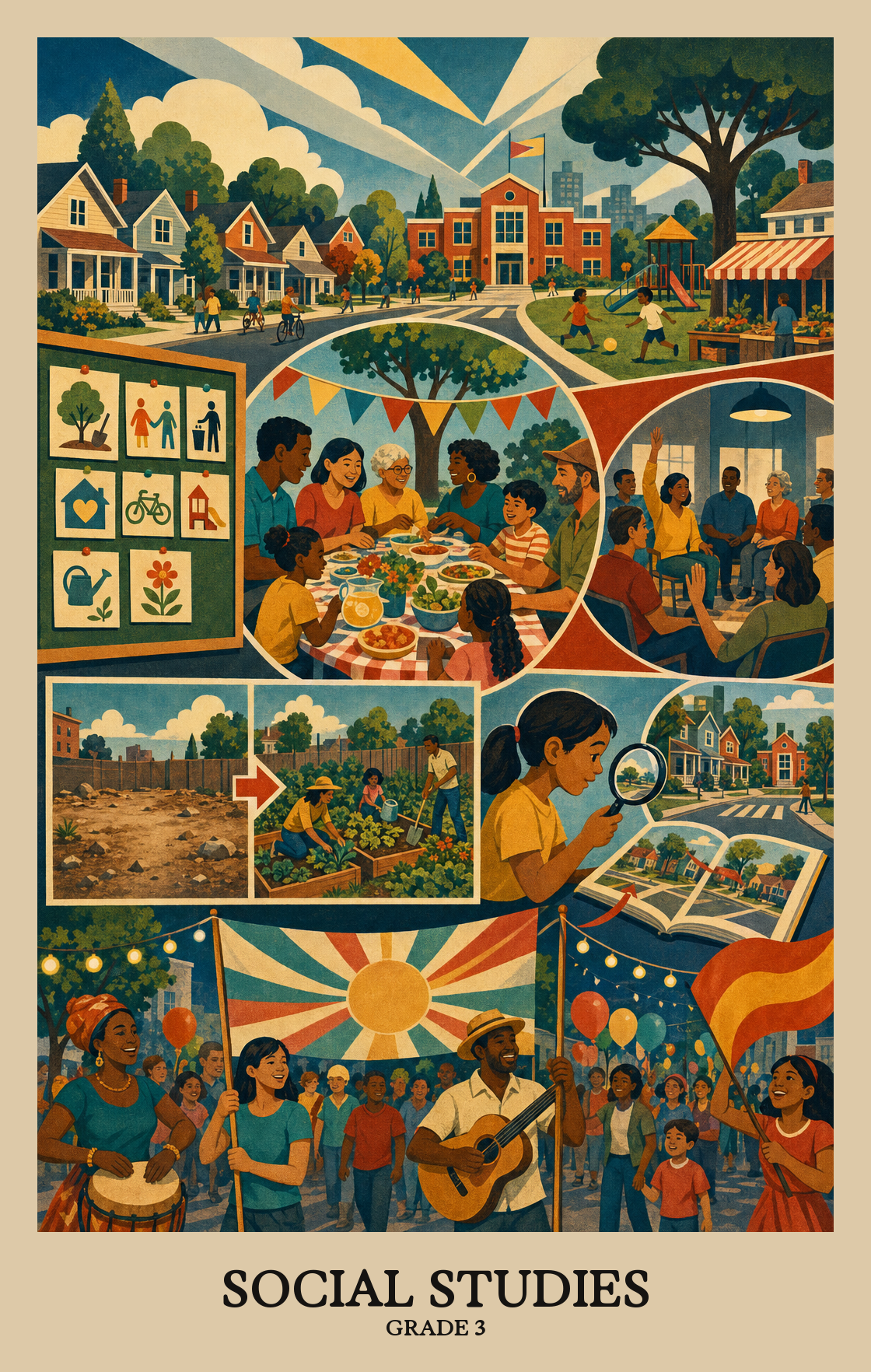
Students start the year thinking about identity. They look at what makes a family, a school, or a neighborhood feel like home, and how different people can share the same place.
Students learn how holidays, customs, and shared stories pass from one generation to the next. They notice how a group's beliefs show up in everyday life, from food to celebrations to rules.
Students practice asking why a group did what it did. They read short accounts of real people and draw conclusions about what those people valued and why their choices made sense at the time.
Students link what they have learned to issues they see now, like fairness at school or how a community welcomes new neighbors. They start to see history as something still in motion.
Students finish the year by taking a position on a question about people and community. They back up their idea with examples from what they read and learned, in writing or out loud.
People, families, and communities each bring their own traditions and ideas to the places they share. Those differences shape how a society looks, what it values, and how it changes over time.
Students look at why communities look and act differently from one another, and trace those differences back to the beliefs, traditions, and backgrounds of the people who live there.
Students look at examples from history and daily life to figure out why communities look and act the way they do, based on what the people in them believe and how they live.
Students look at a community, religion, or cultural tradition today and trace how the beliefs and habits of real people helped shape it. The goal is to connect past choices to present-day life.
Students pick a real-world example of how a group's traditions or beliefs shaped a community, then build a case for it using facts and details from what they've read or studied.
| Standard | Definition | Code |
|---|---|---|
| Societies are shaped by the identities, beliefs | People, families, and communities each bring their own traditions and ideas to the places they share. Those differences shape how a society looks, what it values, and how it changes over time. | 3.3 |
| The student will recognize and evaluate how societies are shaped by the… | Students look at why communities look and act differently from one another, and trace those differences back to the beliefs, traditions, and backgrounds of the people who live there. | 3.3.1 |
| The student will analyze context and draw conclusions about how societies are… | Students look at examples from history and daily life to figure out why communities look and act the way they do, based on what the people in them believe and how they live. | 3.3.2 |
| The student will investigate and connect how societies are shaped by the… | Students look at a community, religion, or cultural tradition today and trace how the beliefs and habits of real people helped shape it. The goal is to connect past choices to present-day life. | 3.3.3 |
| The student will use their understanding of how societies are shaped by the… | Students pick a real-world example of how a group's traditions or beliefs shaped a community, then build a case for it using facts and details from what they've read or studied. | 3.3.4 |
Federally administered sample-based assessment in reading, mathematics, science, writing, and other subjects. NAEP results inform state-by-state comparisons rather than individual student or school accountability.
Third graders look at how communities are shaped by the people in them. Students think about what different groups believe, how they live, and how those choices affect the places around them. Expect lots of discussion about families, neighborhoods, and the wider community.
Talk about your own family traditions, holidays, and where relatives came from. Ask students what their friends or classmates do differently and why that might be. Five minutes at dinner is plenty.
Make it personal. Pull out old photos, cook a recipe from a grandparent, or watch a short video about a place a family member has lived. Students remember the stories tied to people they know.
Start with identity and family, then move to local community groups, then to how different communities solve shared problems. Save the claim-and-evidence work for the second half of the year, once students have enough background to point to real examples.
Drawing conclusions from a source trips students up. They can describe what a picture or short reading shows, but jumping to what it means about a group takes practice. Build in weekly think-alouds with one image or short passage.
Not really. The focus is on understanding why people in a community act the way they do, not on memorizing a list. Asking good questions about people matters more than reciting facts.
Give them a sentence stem like "I think this because the text said..." and practice it weekly. Start with pictures before moving to short readings. By spring, students should be pointing to a specific line or detail when they share a claim.
By the end of the year, students should be able to describe a group they belong to, explain something that group believes or does, and connect it to a real issue in the community. If they can hold that kind of conversation, they are ready.