Asking questions about the past
Students start the year learning how historians work. They ask questions about why things changed, look for whose stories get told, and notice whose voices are missing from old documents and textbooks.
This is the year social studies widens out to the whole country and beyond. Students dig into how the United States government works at the local, state, federal, and tribal levels, and why citizens have both rights and duties. They learn how money moves between countries, how maps and geography shape where people live, and how to read a historical source for who wrote it and who got left out. By spring, students can use evidence from more than one source to build an argument about the past.
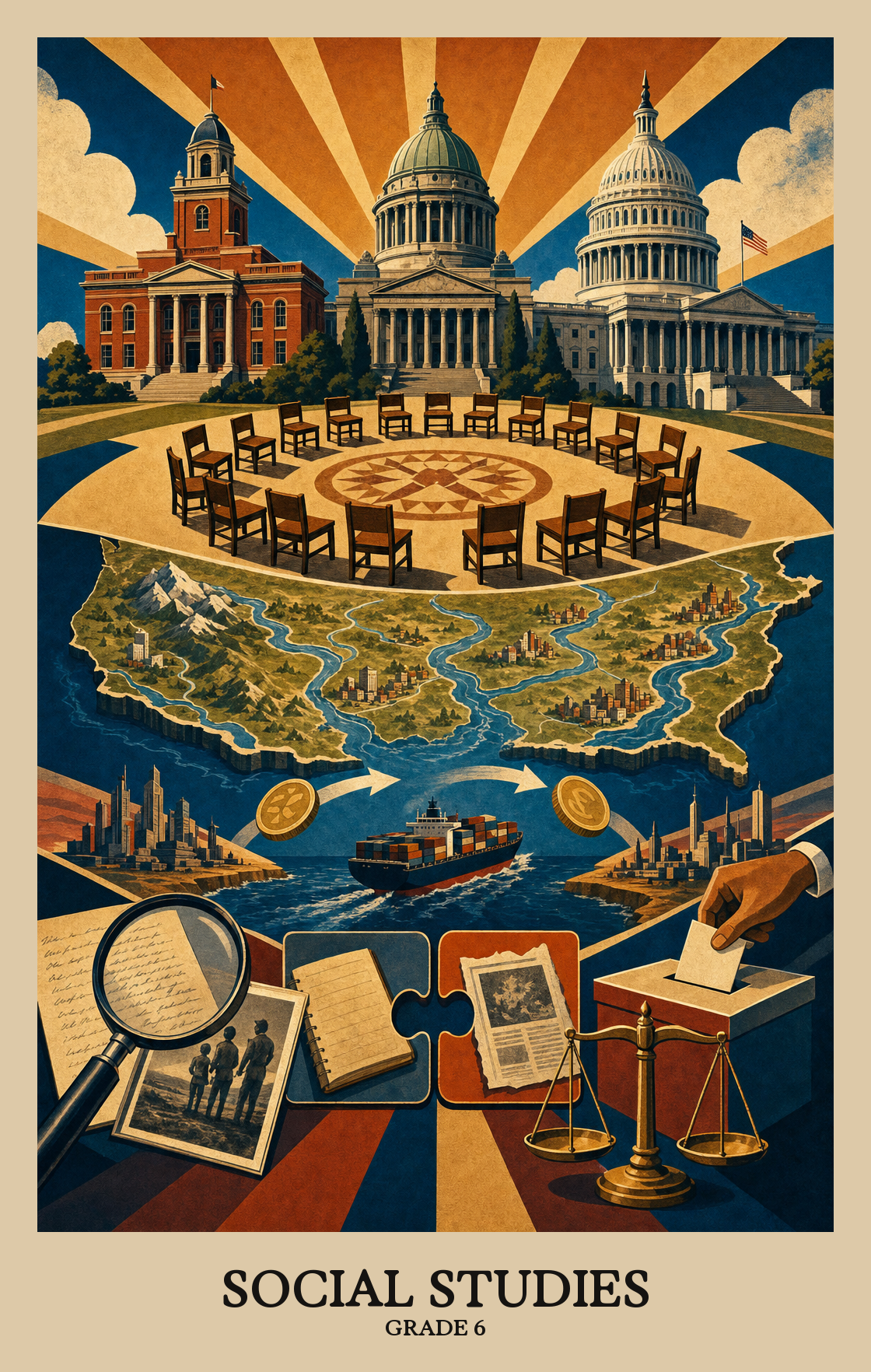
Students start the year learning how historians work. They ask questions about why things changed, look for whose stories get told, and notice whose voices are missing from old documents and textbooks.
Students dig into letters, photos, speeches, and articles to figure out who wrote them and why. They learn to back up a claim about the past with evidence from more than one source.
Students study how local, state, and federal government work, and how Tribal Nations govern themselves as sovereign nations. They look at rights and responsibilities, and at real tensions in how the country lives out its founding ideas.
Students learn how households set financial goals, how trade between countries works, and how things like jobs and prices show whether an economy is doing well. They also look at why wealth has been easier for some families to build than others.
Students use maps and mapping tools to solve real problems about where people live, move, and trade. They look at how power shapes regions and how human choices affect the environment, including climate change.
Students examine how race, religion, gender, and geography shape identity and opportunity in Minnesota and beyond. They study how communities have organized for change, then plan a response to an issue that matters to them now.
Civic reasoning means looking at a real issue, weighing different viewpoints, and deciding what a responsible citizen should do about it. Students practice these habits now so they can vote, speak up, and take part in community decisions as adults.
Students explain the core values behind democracy, like majority rule and individual rights, and look at where those values can pull against each other in real U.S. government decisions.
Students explain what rights they hold as members of a democracy and what duties come with those rights. They also weigh whether people are living up to those responsibilities.
Students learn how laws and rules are made and enforced at every level of American government, from city councils to Congress, including Tribal Nations. They also weigh whether those processes are working fairly.
Students learn how laws get made and enforced at the city, state, and national level, including within Tribal Nations. They practice explaining how those rules work and deciding whether they're fair or effective.
Students examine how tribal nations function as self-governing entities with their own laws and leaders, while also holding a distinct legal relationship with the federal government. Both systems coexist, and understanding that relationship is the focus here.
| Standard | Definition | Code |
|---|---|---|
| Civic Skills: Apply civic reasoning and demonstrate civic skills for the… | Civic reasoning means looking at a real issue, weighing different viewpoints, and deciding what a responsible citizen should do about it. Students practice these habits now so they can vote, speak up, and take part in community decisions as adults. | 6.1.1.1 |
| Democratic Values and Principles: Explain democratic values and principles that… | Students explain the core values behind democracy, like majority rule and individual rights, and look at where those values can pull against each other in real U.S. government decisions. | 6.1.2.1 |
| Rights and Responsibilities | Students explain what rights they hold as members of a democracy and what duties come with those rights. They also weigh whether people are living up to those responsibilities. | 6.1.3.1 |
| Governmental Institutions and Political Processes: Explain and evaluate… | Students learn how laws and rules are made and enforced at every level of American government, from city councils to Congress, including Tribal Nations. They also weigh whether those processes are working fairly. | 6.1.4.1 |
| Governmental Institutions and Political Processes: Explain and evaluate… | Students learn how laws get made and enforced at the city, state, and national level, including within Tribal Nations. They practice explaining how those rules work and deciding whether they're fair or effective. | 6.1.4.2 |
| Tribal Nations: Evaluate the unique political status, trust relationships and… | Students examine how tribal nations function as self-governing entities with their own laws and leaders, while also holding a distinct legal relationship with the federal government. Both systems coexist, and understanding that relationship is the focus here. | 6.1.6.1 |
Students learn to set money goals and make a plan to reach them, using real examples of what helps or holds people back from building savings and wealth over time.
Students look at data like employment rates and average incomes to judge how well a country's economy is doing, explain why it grows or shrinks, and weigh how government decisions shape people's everyday financial lives.
Students learn why a country's economy grows or shrinks, how governments use taxes and spending to respond, and what measures like unemployment or income levels reveal about how well people in a nation are actually doing.
Students explain why countries buy from and sell to each other, then weigh the tradeoffs: lower prices and more goods on one side, and effects on local jobs and the environment on the other.
| Standard | Definition | Code |
|---|---|---|
| Personal Finance: Apply economic concepts and models to develop individual… | Students learn to set money goals and make a plan to reach them, using real examples of what helps or holds people back from building savings and wealth over time. | 6.2.9.1 |
| Macroeconomics: Measure and evaluate the well-being of nations and… | Students look at data like employment rates and average incomes to judge how well a country's economy is doing, explain why it grows or shrinks, and weigh how government decisions shape people's everyday financial lives. | 6.2.11.1 |
| Macroeconomics: Measure and evaluate the well-being of nations and… | Students learn why a country's economy grows or shrinks, how governments use taxes and spending to respond, and what measures like unemployment or income levels reveal about how well people in a nation are actually doing. | 6.2.11.2 |
| Global and International | Students explain why countries buy from and sell to each other, then weigh the tradeoffs: lower prices and more goods on one side, and effects on local jobs and the environment on the other. | 6.2.12.1 |
Students use maps, satellite images, and digital tools to ask geographic questions and figure out why things are located where they are. Think of it as detective work using real-world data about places.
Students use maps, satellite images, and digital geography tools to figure out why things are located where they are and how location affects people and places.
Students describe places and regions by explaining who holds power there and how that power shapes daily life, borders, and the way land is used.
Students study how people, goods, and ideas move between communities, countries, and economies. They look for patterns that connect local decisions to what happens on the other side of the world.
Students look at how people change the environment and how the environment shapes the way people live, including how a warming climate is shifting both.
| Standard | Definition | Code |
|---|---|---|
| Geospatial Skills and Inquiry | Students use maps, satellite images, and digital tools to ask geographic questions and figure out why things are located where they are. Think of it as detective work using real-world data about places. | 6.3.13.1 |
| Geospatial Skills and Inquiry | Students use maps, satellite images, and digital geography tools to figure out why things are located where they are and how location affects people and places. | 6.3.13.2 |
| Places and Regions: Describe places and regions, explaining how they are… | Students describe places and regions by explaining who holds power there and how that power shapes daily life, borders, and the way land is used. | 6.3.14.1 |
| Human Systems: Analyze patterns of movement and interconnectedness within… | Students study how people, goods, and ideas move between communities, countries, and economies. They look for patterns that connect local decisions to what happens on the other side of the world. | 6.3.15.1 |
| Human-Environment Interaction: Evaluate the relationship between humans and the… | Students look at how people change the environment and how the environment shapes the way people live, including how a warming climate is shifting both. | 6.3.16.1 |
Students learn to ask questions about why events happened, what changed over time, and whose stories got left out of the history books.
Students learn to ask questions about why historical events happened, then compare the "official" story with voices and perspectives that often get left out of textbooks.
Students learn to ask questions about why things happened the way they did in history, then compare the stories told by people in power with the stories left out. The goal is to see whose voices shaped what we call "history."
Students learn to ask questions about why history looks different depending on who's telling it. They compare the stories that got written down with the ones that didn't, and think about what changed over time and what stayed the same.
Students learn to ask questions about the past that go beyond the "official" story. They look at who gets left out of history and why, comparing what changed over time with what stayed the same.
Reading history means understanding that every source has a point of view. Students learn to spot whose perspective is being shared and how a person's background, culture, or position shapes what they notice and what they leave out.
Reading history means understanding that two people can witness the same event and describe it very differently. Students learn to spot those differences and explain why a person's background, culture, or position shapes what they notice and how they tell the story.
Reading history means understanding that two people can watch the same event and describe it differently. Students learn to spot whose perspective is missing from a source and explain how a person's background shapes what they notice and believe.
Students read original documents and later accounts of the same event, then ask whose voices are missing and why the author wrote what they wrote. Figuring out who is left out of the historical record is just as important as reading what is there.
Students pull facts and details from several historical sources, then build one clear argument or story that explains what happened and why.
Students pull facts and details from several historical sources, then build a written argument or story that explains what happened and why. The evidence drives the conclusion.
Students trace a current real-world problem back to its historical roots, then draft a plan to address it. They use primary sources and historical evidence to explain how the past shaped the issue today.
Students trace a current real-world problem back to its historical roots, then draft a plan to address it. The work connects what happened in the past to decisions that could be made today.
Students trace a current real-world problem back to its historical roots, then propose a plan to address it. The work connects what happened in the past to decisions people face today.
| Standard | Definition | Code |
|---|---|---|
| Context, Change, and Continuity: Ask historical questions about context… | Students learn to ask questions about why events happened, what changed over time, and whose stories got left out of the history books. | 6.4.18.1 |
| Context, Change, and Continuity: Ask historical questions about context… | Students learn to ask questions about why historical events happened, then compare the "official" story with voices and perspectives that often get left out of textbooks. | 6.4.18.2 |
| Context, Change, and Continuity: Ask historical questions about context… | Students learn to ask questions about why things happened the way they did in history, then compare the stories told by people in power with the stories left out. The goal is to see whose voices shaped what we call "history." | 6.4.18.3 |
| Context, Change, and Continuity: Ask historical questions about context… | Students learn to ask questions about why history looks different depending on who's telling it. They compare the stories that got written down with the ones that didn't, and think about what changed over time and what stayed the same. | 6.4.18.4 |
| Context, Change, and Continuity: Ask historical questions about context… | Students learn to ask questions about the past that go beyond the "official" story. They look at who gets left out of history and why, comparing what changed over time with what stayed the same. | 6.4.18.5 |
| Historical Perspectives | Reading history means understanding that every source has a point of view. Students learn to spot whose perspective is being shared and how a person's background, culture, or position shapes what they notice and what they leave out. | 6.4.19.1 |
| Historical Perspectives | Reading history means understanding that two people can witness the same event and describe it very differently. Students learn to spot those differences and explain why a person's background, culture, or position shapes what they notice and how they tell the story. | 6.4.19.2 |
| Historical Perspectives | Reading history means understanding that two people can watch the same event and describe it differently. Students learn to spot whose perspective is missing from a source and explain how a person's background shapes what they notice and believe. | 6.4.19.3 |
| Historical Sources and Evidence: Investigate a variety of historical sources… | Students read original documents and later accounts of the same event, then ask whose voices are missing and why the author wrote what they wrote. Figuring out who is left out of the historical record is just as important as reading what is there. | 6.4.20.1 |
| Causation and Argumentation: Integrate evidence from multiple… | Students pull facts and details from several historical sources, then build one clear argument or story that explains what happened and why. | 6.4.21.1 |
| Causation and Argumentation: Integrate evidence from multiple… | Students pull facts and details from several historical sources, then build a written argument or story that explains what happened and why. The evidence drives the conclusion. | 6.4.21.2 |
| Connecting Past and Present | Students trace a current real-world problem back to its historical roots, then draft a plan to address it. They use primary sources and historical evidence to explain how the past shaped the issue today. | 6.4.22.1 |
| Connecting Past and Present | Students trace a current real-world problem back to its historical roots, then draft a plan to address it. The work connects what happened in the past to decisions that could be made today. | 6.4.22.2 |
| Connecting Past and Present | Students trace a current real-world problem back to its historical roots, then propose a plan to address it. The work connects what happened in the past to decisions people face today. | 6.4.22.3 |
Students examine how words and power shape the way society labels people by race, religion, where they live, ethnicity, and gender. Then they connect those patterns to groups in Minnesota whose stories have often been left out of history.
Students learn how people and communities have pushed back against unfair systems of power, both nearby and around the world. They look at which strategies have led to real, lasting change and practice working with others to stand up for everyone's rights.
Students study how people and communities have pushed back against unjust systems, from local movements to global ones, and look at which strategies created real, lasting change.
Students learn how people and communities have pushed back against unfair systems, look at which strategies created real change, and practice working with others to protect everyone's rights.
Students look at history through the eyes of ethnic and Indigenous communities to understand why certain groups face unfair treatment today. They study past examples to think about what could make things more just now.
| Standard | Definition | Code |
|---|---|---|
| Identity: Analyze the ways power and language construct the social identities… | Students examine how words and power shape the way society labels people by race, religion, where they live, ethnicity, and gender. Then they connect those patterns to groups in Minnesota whose stories have often been left out of history. | 6.5.23.1 |
| Resistance: Describe how individuals and communities have fought for freedom… | Students learn how people and communities have pushed back against unfair systems of power, both nearby and around the world. They look at which strategies have led to real, lasting change and practice working with others to stand up for everyone's rights. | 6.5.24.1 |
| Resistance: Describe how individuals and communities have fought for freedom… | Students study how people and communities have pushed back against unjust systems, from local movements to global ones, and look at which strategies created real, lasting change. | 6.5.24.2 |
| Resistance: Describe how individuals and communities have fought for freedom… | Students learn how people and communities have pushed back against unfair systems, look at which strategies created real change, and practice working with others to protect everyone's rights. | 6.5.24.3 |
| Ways of Knowing and Methodologies: Use ethnic and Indigenous studies methods… | Students look at history through the eyes of ethnic and Indigenous communities to understand why certain groups face unfair treatment today. They study past examples to think about what could make things more just now. | 6.5.25.1 |
Federally administered sample-based assessment in reading, mathematics, science, writing, and other subjects. NAEP results inform state-by-state comparisons rather than individual student or school accountability.
Students dig into government, economics, geography, history, and ethnic studies all in one year. They learn how laws get made, how trade works between countries, how to read maps and data, and how to weigh different sides of a historical event. Expect more reading, more debate, and more writing than in earlier grades.
Ask students to explain a news story or a chapter in their own words at dinner. Then ask one follow-up: who is telling the story, and whose side is missing? That habit builds the same thinking the class uses with primary sources.
Students study Tribal Nations as sovereign governments with their own laws, leaders, and treaty relationships with the United States. This is not a side topic. If a student visits a reservation or sees a treaty mentioned in the news, ask what they have learned about how that government works.
Many teachers anchor the year in history and weave civics, economics, and geography into each unit. Ethnic studies threads run throughout rather than sitting in one unit. Plan for a culminating project where students research a contemporary issue and propose a plan to address it.
Sourcing and perspective trip up the most students. They can summarize a document but struggle to ask who wrote it, for whom, and what was left out. Build short sourcing routines into warm-ups so the question becomes automatic before the big research project.
Talk about real household decisions: why a grocery bill went up, how a paycheck gets divided, what a savings goal looks like. Students this year are expected to set financial goals and understand why prices and jobs shift, so kitchen-table examples land better than worksheets.
A student picks a current issue, traces its history using primary and secondary sources, considers more than one perspective, and proposes a realistic plan of action. The argument should be supported by specific evidence, not just opinion. That product shows readiness for seventh grade.
By spring, students should be able to read a short primary source, name the author's point of view, and compare it to another source on the same event. They should also be able to explain how a local, state, federal, or Tribal government decision affects daily life.