Watching the sky
Students notice the sun, moon, and stars and track how they show up at different times of day. They start looking for patterns they can predict, like when it gets dark or where the sun appears.
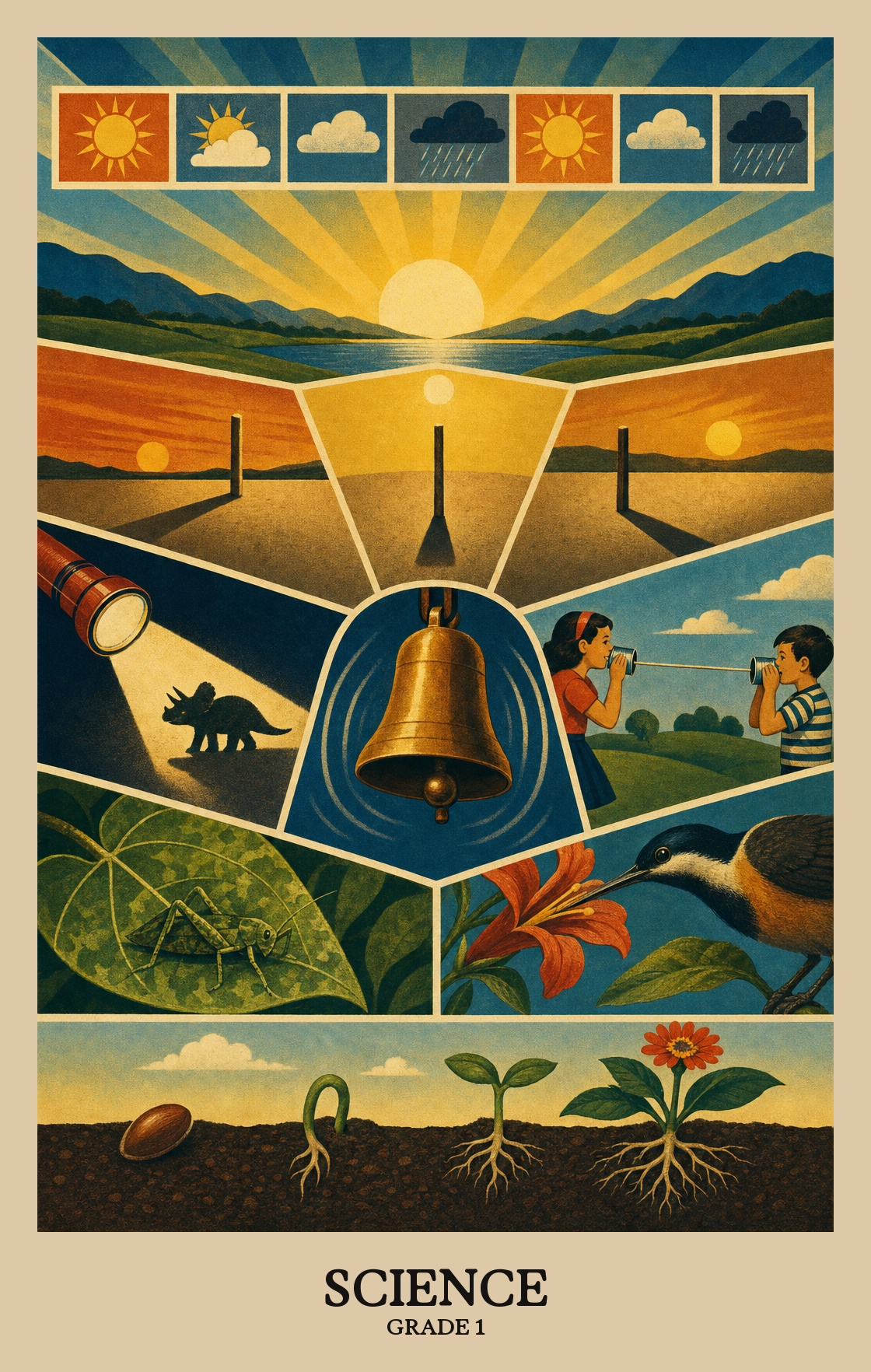
This is the year science becomes about noticing patterns and using them. Students watch the sky, the weather, and living things, and start to predict what comes next. They explore how light and sound travel, and how animals and plants use their bodies to survive. By spring, they can sketch a simple tool to solve a real problem, like a cup-and-string phone, and explain why it works.
Students notice the sun, moon, and stars and track how they show up at different times of day. They start looking for patterns they can predict, like when it gets dark or where the sun appears.
Students keep track of what the weather is doing day by day. They connect what they see, like dark clouds before rain or cold air with snow, to make sense of how weather works.
Students explore how things like the sun, a lamp, or a stove warm objects up. They also test how sound is made by vibrations and try building a tool to send a message with light or sound.
Students look at how animals and plants use their bodies to survive, like beaks, claws, or roots. They also compare baby animals and plants to their parents and notice what is alike and what is different.
Students take a real problem, sketch an idea, and build something simple to try it out. They test two versions, see which one works better, and talk about why.
Students explore where energy comes from and what it does. They notice how light warms a surface, how sound travels from a source, and how a push or pull makes objects move.
Students learn how light and sound move as waves. They explore how waves carry information, like how a phone call travels through a signal or how a flashlight beam bounces off a mirror.
Students learn how living things are built and how they work. They study the parts of plants and animals and figure out what each part does to keep the organism alive.
Students learn that young animals and plants look similar to their parents but not identical. A puppy has fur like its mother, but its spots or size may differ.
Students learn that Earth is one object in a much bigger universe. They observe patterns in the sky, like how the sun appears each day and the moon changes shape over weeks.
Students learn how water, wind, land, and living things work together to shape the world around them.
Students learn how engineers spot a problem, think up solutions, and test their ideas to see what works. It's the same thinking behind every invention, from a better pencil grip to a safer playground slide.
| Standard | Definition | Code |
|---|---|---|
| Energy | Students explore where energy comes from and what it does. They notice how light warms a surface, how sound travels from a source, and how a push or pull makes objects move. | PS3 |
| Waves and Their Applications in technologies for Information Transfer | Students learn how light and sound move as waves. They explore how waves carry information, like how a phone call travels through a signal or how a flashlight beam bounces off a mirror. | PS4 |
| From Molecules to Organisms | Students learn how living things are built and how they work. They study the parts of plants and animals and figure out what each part does to keep the organism alive. | LS1 |
| Heredity: Inheritance and Variation of Traits | Students learn that young animals and plants look similar to their parents but not identical. A puppy has fur like its mother, but its spots or size may differ. | LS3 |
| Earth's Place in the Universe | Students learn that Earth is one object in a much bigger universe. They observe patterns in the sky, like how the sun appears each day and the moon changes shape over weeks. | ESS1 |
| Earth's Systems | Students learn how water, wind, land, and living things work together to shape the world around them. | ESS2 |
| Engineering Design | Students learn how engineers spot a problem, think up solutions, and test their ideas to see what works. It's the same thinking behind every invention, from a better pencil grip to a safer playground slide. | ETS1 |
Sunlight warms a sidewalk. Sound shakes a window. Students learn that energy is what causes changes they can see, hear, or feel in the world around them.
Students learn that heat comes from a source, like the sun or a stove, and that getting closer to that source makes objects warmer. They practice identifying what is causing something to heat up.
| Standard | Definition | Code |
|---|---|---|
| Definitions of Energy | Sunlight warms a sidewalk. Sound shakes a window. Students learn that energy is what causes changes they can see, hear, or feel in the world around them. | PS3.A |
| Identify the source of energy that causes an increase in the temperature of an… | Students learn that heat comes from a source, like the sun or a stove, and that getting closer to that source makes objects warmer. They practice identifying what is causing something to heat up. | 1.PS3.A |
Sound and light move in waves. Students learn what a wave looks like, how loud or bright it can be, and how waves carry energy from one place to another.
Students shake or tap objects to discover what makes sound, then watch how sound waves can make other objects move or wiggle in return.
Students learn how tools like phones, cameras, and computers send and receive information. The focus is on how people use technology to share what they see, hear, or know with others far away.
Students build a device that sends a message using light or sound, like a flashlight signal or a drum tap, to communicate with someone too far away to hear a voice.
| Standard | Definition | Code |
|---|---|---|
| Wave Properties | Sound and light move in waves. Students learn what a wave looks like, how loud or bright it can be, and how waves carry energy from one place to another. | PS4.A |
| Plan and conduct investigations to provide evidence that vibrating materials… | Students shake or tap objects to discover what makes sound, then watch how sound waves can make other objects move or wiggle in return. | 1.PS4.A |
| Information Technologies and Instrumentation | Students learn how tools like phones, cameras, and computers send and receive information. The focus is on how people use technology to share what they see, hear, or know with others far away. | PS4.C |
| Use tools and materials to design and build a device that uses light or sound… | Students build a device that sends a message using light or sound, like a flashlight signal or a drum tap, to communicate with someone too far away to hear a voice. | 1.PS4.C |
Living things have parts that help them survive. Students learn how a plant's leaves, roots, and stem each do a specific job, and how animals use their eyes, legs, or wings to find food and stay safe.
Students pick a problem people face, then design something that copies how an animal or plant body part solves a similar problem. A beaver's flat tail inspired paddle shapes; a cactus spine inspired needle design.
| Standard | Definition | Code |
|---|---|---|
| Structure and Function | Living things have parts that help them survive. Students learn how a plant's leaves, roots, and stem each do a specific job, and how animals use their eyes, legs, or wings to find food and stay safe. | LS1.A |
| Use materials to design a solution to a human problem by mimicking how plants… | Students pick a problem people face, then design something that copies how an animal or plant body part solves a similar problem. A beaver's flat tail inspired paddle shapes; a cactus spine inspired needle design. | 1.LS1.A |
Young animals look like their parents but not exactly. Students learn why offspring share some features with their parents and differ in others.
Young plants and animals look similar to their parents but not identical. Students observe real plants or animals and explain what matches and what differs between parent and offspring.
| Standard | Definition | Code |
|---|---|---|
| Inheritance of Traits | Young animals look like their parents but not exactly. Students learn why offspring share some features with their parents and differ in others. | LS3.A |
| Make observations to construct an evidence based account that young plants and… | Young plants and animals look similar to their parents but not identical. Students observe real plants or animals and explain what matches and what differs between parent and offspring. | 1.LS3.A |
Students learn that the sun is a star, and that the sky holds many other stars too far away to see well during the day. They observe patterns in the sky, like how the sun appears to move from morning to evening.
Students learn that the Sun appears during the day, the Moon and stars appear at night, and these patterns repeat. They practice describing what they see in the sky and when.
Students watch how the sun, moon, and stars move across the sky and look for patterns that repeat. Over time, they can predict what will happen next, like when the moon will look full or where the sun will rise.
| Standard | Definition | Code |
|---|---|---|
| The Universe and its Stars | Students learn that the sun is a star, and that the sky holds many other stars too far away to see well during the day. They observe patterns in the sky, like how the sun appears to move from morning to evening. | ESS1.A |
| Describe the presence of the Sun, Moon | Students learn that the Sun appears during the day, the Moon and stars appear at night, and these patterns repeat. They practice describing what they see in the sky and when. | 1.ESS1.A.a |
| Use observations of the sun, moon | Students watch how the sun, moon, and stars move across the sky and look for patterns that repeat. Over time, they can predict what will happen next, like when the moon will look full or where the sun will rise. | 1.ESS1.A.b |
Students learn the difference between today's weather and the patterns that repeat across seasons. They observe temperature, rain, and wind over time to see what a place's climate typically looks like.
Students look at weather data, like temperature readings and cloud cover, and spot patterns. For example, they connect colder temperatures with snow or heavy clouds with rain.
| Standard | Definition | Code |
|---|---|---|
| Weather and Climate | Students learn the difference between today's weather and the patterns that repeat across seasons. They observe temperature, rain, and wind over time to see what a place's climate typically looks like. | ESS2.D |
| Identify patterns indicating relationships between bserved weather data and… | Students look at weather data, like temperature readings and cloud cover, and spot patterns. For example, they connect colder temperatures with snow or heavy clouds with rain. | 1.ESS2.D |
Students learn that a problem needs a clear description before anyone can fix it. They practice naming what is wrong, what would count as a solution, and what limits (like cost or materials) get in the way.
Students look at something that doesn't work well, ask questions about it, and gather information to figure out exactly what needs fixing before trying to build or improve a tool that solves the problem.
Students think of more than one way to solve a problem, then compare their ideas to pick the best one. Simple tests help them see which solution works.
Students draw or build a simple model showing how the shape of something helps it do its job. A wide base keeps a tower from falling; a pointed tip helps something pierce.
Students test their design, see what isn't working, and make changes to get it closer to what they need it to do.
Students test two different solutions to the same problem, then compare how well each one works and where each falls short.
| Standard | Definition | Code |
|---|---|---|
| Defining and Delimiting Engineering Problems | Students learn that a problem needs a clear description before anyone can fix it. They practice naming what is wrong, what would count as a solution, and what limits (like cost or materials) get in the way. | ETS1.A |
| Ask questions, make observations | Students look at something that doesn't work well, ask questions about it, and gather information to figure out exactly what needs fixing before trying to build or improve a tool that solves the problem. | 1.ETS1.A |
| Developing Possible Solutions | Students think of more than one way to solve a problem, then compare their ideas to pick the best one. Simple tests help them see which solution works. | ETS1.B |
| Develop a simple sketch, drawing | Students draw or build a simple model showing how the shape of something helps it do its job. A wide base keeps a tower from falling; a pointed tip helps something pierce. | 1.ETS1.B |
| Optimizing the Solution Process | Students test their design, see what isn't working, and make changes to get it closer to what they need it to do. | ETS1.C |
| Analyze data from tests of two objects designed to solve the same problem to… | Students test two different solutions to the same problem, then compare how well each one works and where each falls short. | 1.ETS1.C |
Alternate assessment for eligible students with significant cognitive disabilities, covering the state-tested grade-level and end-of-course subjects.
Students explore where heat and light come from, how sound is made, how plants and animals survive, and patterns in the sky and weather. They also try simple design projects, like building a tool that sends a signal across the room. Most learning happens through hands-on activities, not reading.
Step outside and notice things together. Watch the moon change shape over a few weeks, listen for sounds that make objects buzz, or talk about why a jacket feels warm in the sun. Asking students what they notice and what they wonder is more useful than giving them answers.
Many teachers start with sky and weather patterns in the fall because students can observe outside daily. Light, heat, and sound fit well in winter when the sun sits lower. Plant and animal structures land nicely in spring, with engineering design woven through every unit.
Not really. The focus is on observing, asking questions, and noticing patterns. A student who can describe what happens when sunlight hits a sidewalk, or how a bird's beak helps it eat, is doing the work of this grade.
Students define a small problem, sketch an idea, build it with simple materials, and test it. For example, they might design a cup-and-string phone to send a message across the room. The point is trying, testing, and improving, not getting it right the first time.
Sound as vibration is tricky because students cannot see it. Predicting patterns in the sun and moon also takes time, since observations stretch over weeks. Plan to revisit both with short, repeated investigations rather than one long unit.
By spring, students should describe weather and sky patterns from their own observations, explain that sound comes from vibrations, and compare how baby animals look like their parents. They should also be able to sketch a simple design and tell what worked and what did not.