Reading closely with evidence
Students start the year practicing how to back up what they say about a text. They point to specific lines from a story or article to explain what is happening and what the writer suggests without saying outright.
This is the year reading turns into argument. Students back up their thinking with several pieces of evidence from a text, not just one, and they start judging whether an author's reasoning actually holds up. In writing, they take a clear position, bring in real sources, and answer the other side instead of ignoring it. By spring, students can write a short research-based paper that states a claim, cites sources, and addresses an opposing view.
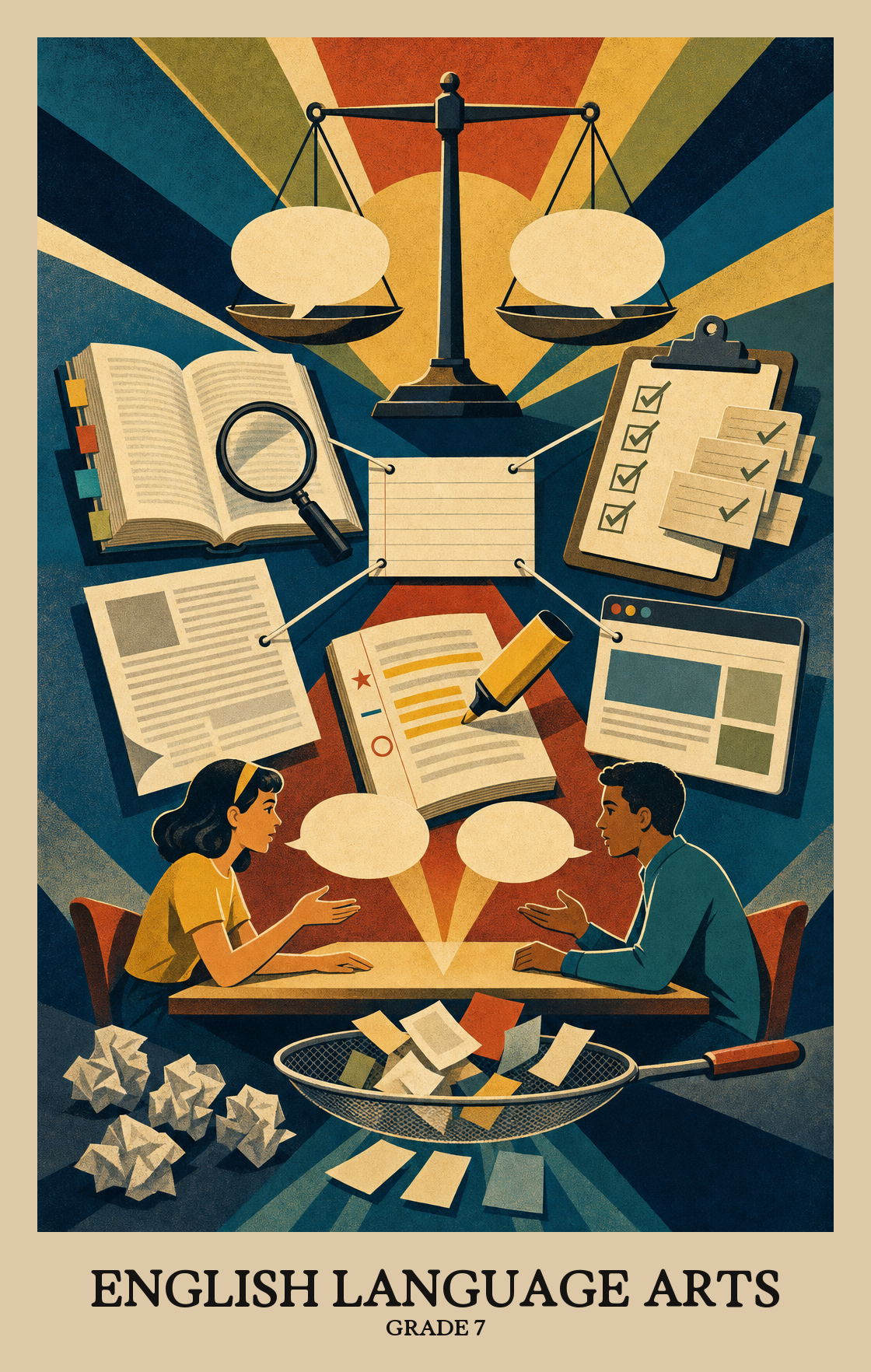
Students start the year practicing how to back up what they say about a text. They point to specific lines from a story or article to explain what is happening and what the writer suggests without saying outright.
Students dig into how writers pick their words. They figure out what unfamiliar words mean from the sentences around them and notice how a single word can shift the feeling of a passage.
Students look at the bigger picture in what they read. They name the message of a story, compare how different characters see events, and judge whether a writer's argument actually holds up.
Students pick a question, hunt down sources, and decide which ones to trust. They write stories, explanations, and arguments, quoting sources correctly and organizing ideas so a reader can follow along.
Students wrap the year by talking through ideas with classmates and sharpening their own writing. They ask follow-up questions, weigh new information, and revise drafts for clearer language and stronger transitions.
Reading grade-level texts closely enough to understand what they say and figure out what they mean. Students move past the surface of a story or article to ask why the author made certain choices.
Students back up their conclusions about a story or article with specific lines or passages from the text, not just a general feeling about what it means.
Students back up their conclusions with multiple quotes or details pulled directly from the text, not just a single line. They also use clues in the text to explain ideas the author implies but never states outright.
Students figure out what unfamiliar words mean by using context clues, word parts like prefixes and suffixes, or a dictionary. This includes understanding when a word is used figuratively or carries an emotional weight beyond its dictionary definition.
Students figure out what unfamiliar or figurative words mean by using context clues in the sentence, word roots and suffixes, or a dictionary.
Students identify the main message or big idea in a text, then explain which specific details and events support it.
Students find the central idea of a nonfiction text and point to specific passages that show how the author builds that idea across the piece.
Students read stories and articles the way a writer would, noticing how word choices, sentence structure, and organization shape the way a piece feels and works.
Students examine how an author shapes the way two characters see the same events differently. This means looking at word choices, details, and what each character knows or hides to understand why their perspectives clash.
Students read an informational text and figure out what the author believes or is trying to prove, then notice where that view differs from what other sources or voices in the text say.
Word choice shapes how a story feels. Students look at why an author picked certain words and what those choices do to the meaning and mood of the text.
Word choice shapes how a piece of writing feels. Students read nonfiction passages and explain how the author's specific words create a particular mood or message.
Students examine how the place, people, and events in a story push against each other to shape what the story means. A cold, isolated setting might change how a character acts; a character's choice might redirect the whole plot.
Students read a nonfiction passage and decide whether the author's argument actually holds up. They check if the reasons make sense and if the facts given are strong enough to back the main point.
Reading two or more texts on the same topic, students compare what each source says, note where they agree or disagree, and pull the key ideas together into one clear picture.
Students read two articles or books on the same topic and compare how each author chose to organize and present the information. The focus is on why each author built the piece the way they did, not just what it says.
| Standard | Definition | Code |
|---|---|---|
| Approach texts as a reader by comprehending and interpreting grade appropriate… | Reading grade-level texts closely enough to understand what they say and figure out what they mean. Students move past the surface of a story or article to ask why the author made certain choices. | 7.R.1 |
| draw conclusions, infer | Students back up their conclusions about a story or article with specific lines or passages from the text, not just a general feeling about what it means. | 7.RL.1.A |
| draw conclusions, infer | Students back up their conclusions with multiple quotes or details pulled directly from the text, not just a single line. They also use clues in the text to explain ideas the author implies but never states outright. | 7.RI.1.A |
| determine the meaning of words and phrases as they are used in the text… | Students figure out what unfamiliar words mean by using context clues, word parts like prefixes and suffixes, or a dictionary. This includes understanding when a word is used figuratively or carries an emotional weight beyond its dictionary definition. | 7.RL.1.B |
| determine the meaning of words and phrases as they are used in the text… | Students figure out what unfamiliar or figurative words mean by using context clues in the sentence, word roots and suffixes, or a dictionary. | 7.RI.1.B |
| determine the theme(s)/central idea of a text and explain the relationship… | Students identify the main message or big idea in a text, then explain which specific details and events support it. | 7.RL.1.D |
| determine the theme(s)/central idea of a text and explain the relationship… | Students find the central idea of a nonfiction text and point to specific passages that show how the author builds that idea across the piece. | 7.RI.1.D |
| Approach texts as a writer by analyzing craft and structure in… | Students read stories and articles the way a writer would, noticing how word choices, sentence structure, and organization shape the way a piece feels and works. | 7.R.2 |
| analyze how an author develops and contrasts the points of view of different… | Students examine how an author shapes the way two characters see the same events differently. This means looking at word choices, details, and what each character knows or hides to understand why their perspectives clash. | 7.RL.2.B |
| analyze how an author develops his/her point of view or purpose and… | Students read an informational text and figure out what the author believes or is trying to prove, then notice where that view differs from what other sources or voices in the text say. | 7.RI.2.B |
| analyze how specific word choices contribute to meaning and tone | Word choice shapes how a story feels. Students look at why an author picked certain words and what those choices do to the meaning and mood of the text. | 7.RL.2.C |
| analyze how specific word choices contribute to meaning and tone | Word choice shapes how a piece of writing feels. Students read nonfiction passages and explain how the author's specific words create a particular mood or message. | 7.RI.2.C |
| analyze how the setting, characters | Students examine how the place, people, and events in a story push against each other to shape what the story means. A cold, isolated setting might change how a character acts; a character's choice might redirect the whole plot. | 7.RL.2.D |
| evaluate an author’s argument, assessing whether the reasoning is sound and the… | Students read a nonfiction passage and decide whether the author's argument actually holds up. They check if the reasons make sense and if the facts given are strong enough to back the main point. | 7.RI.2.D |
| Approach texts as a researcher by synthesizing/comparing/ contrasting ideas… | Reading two or more texts on the same topic, students compare what each source says, note where they agree or disagree, and pull the key ideas together into one clear picture. | 7.RI.3 |
| compare and contrast how two or more authors writing about the same topic make… | Students read two articles or books on the same topic and compare how each author chose to organize and present the information. The focus is on why each author built the piece the way they did, not just what it says. | 7.RI.3.B |
Before writing an argument or opinion piece, students gather information and look into the topic the way a reporter would, so their writing is grounded in real evidence rather than guesswork.
Students pick a question they want to answer, then find and read sources to build an actual answer. The research shapes what they write, not the other way around.
Students pull facts, details, and ideas from multiple sources and weave them into their own writing so the final piece reads as one clear argument or explanation, not a list of quotes.
Students practice finding useful information from books, websites, and other sources by choosing search terms that actually pull up what they need.
Students learn to question whether a source is trustworthy before using it in their writing. They look at who wrote something, where it was published, and whether the facts check out.
Students practice pulling exact words or reworded ideas from a source and giving that source credit, using a standard citation format like MLA or APA.
Students learn to make deliberate choices about words, structure, and detail, the way a published author would. The goal is to write with purpose, not just to complete the assignment.
Students write stories or poems, real or imagined, that stay in one consistent point of view from start to finish. Characters feel defined, events follow a clear order, and the details chosen actually serve the story.
Expository writing explains a topic using real facts and examples. Students connect each piece of evidence back to the main idea, so the reader can follow how one point leads to the next.
Students write an argument by stating a clear position, backing it up with relevant evidence, and addressing the strongest reason someone might disagree. Each piece of evidence connects directly to the claim it supports.
Reading their own drafts the way a stranger would, students check whether their writing makes sense without extra explanation. They ask: would someone who wasn't there understand this?
Students open with a clear topic, stay focused through the middle, and close with an ending that fits what they said. They also add or cut sentences to make the whole piece easier to follow.
Students pick words that fit their audience and purpose, then vary how sentences are built so the connections between ideas come through clearly.
Students write with correct grammar, spelling, and punctuation. That means sentences are complete, words are spelled right, and commas and periods land where they belong.
Students practice linking sentences and paragraphs with transition words that show how ideas connect or how time moves forward. The writing flows instead of jumping around.
| Standard | Definition | Code |
|---|---|---|
| Approach the writing task as a researcher | Before writing an argument or opinion piece, students gather information and look into the topic the way a reporter would, so their writing is grounded in real evidence rather than guesswork. | 7.W.1.A |
| Conduct research to answer a question | Students pick a question they want to answer, then find and read sources to build an actual answer. The research shapes what they write, not the other way around. | 7.W.1.A.a |
| Integrate information | Students pull facts, details, and ideas from multiple sources and weave them into their own writing so the final piece reads as one clear argument or explanation, not a list of quotes. | 7.W.1.A.b |
| gather relevant information from multiple print and digital resources, using… | Students practice finding useful information from books, websites, and other sources by choosing search terms that actually pull up what they need. | 7.W.1.A.c |
| assess the credibility and accuracy of sources | Students learn to question whether a source is trustworthy before using it in their writing. They look at who wrote something, where it was published, and whether the facts check out. | 7.W.1.A.d |
| quote or paraphrase while avoiding plagiarism following a standard format for… | Students practice pulling exact words or reworded ideas from a source and giving that source credit, using a standard citation format like MLA or APA. | 7.W.1.A.e |
| Approach the writing task as a writer | Students learn to make deliberate choices about words, structure, and detail, the way a published author would. The goal is to write with purpose, not just to complete the assignment. | 7.W.2 |
| Narrative writing, including poems about real or imagined experiences that… | Students write stories or poems, real or imagined, that stay in one consistent point of view from start to finish. Characters feel defined, events follow a clear order, and the details chosen actually serve the story. | 7.W.2.A.a |
| Expository (informational/explanatory) writing to examine a topic with relevant… | Expository writing explains a topic using real facts and examples. Students connect each piece of evidence back to the main idea, so the reader can follow how one point leads to the next. | 7.W.2.A.b |
| Argumentative writing introducing and supporting a claim with clear reasons and… | Students write an argument by stating a clear position, backing it up with relevant evidence, and addressing the strongest reason someone might disagree. Each piece of evidence connects directly to the claim it supports. | 7.W.2.A.c |
| Approach the writing task as a reader | Reading their own drafts the way a stranger would, students check whether their writing makes sense without extra explanation. They ask: would someone who wasn't there understand this? | 7.W.3 |
| introduce the topic, maintain a clear focus throughout the text | Students open with a clear topic, stay focused through the middle, and close with an ending that fits what they said. They also add or cut sentences to make the whole piece easier to follow. | 7.W.3.A.a |
| choose appropriate, precise language for the style, task | Students pick words that fit their audience and purpose, then vary how sentences are built so the connections between ideas come through clearly. | 7.W.3.A.b |
| demonstrate a command of the conventions of standard English grammar and usage… | Students write with correct grammar, spelling, and punctuation. That means sentences are complete, words are spelled right, and commas and periods land where they belong. | 7.W.3.A.c |
| use effective transitions to clarify relationships, connect ideas and claims… | Students practice linking sentences and paragraphs with transition words that show how ideas connect or how time moves forward. The writing flows instead of jumping around. | 7.W.3.A.d |
Students discuss ideas with a small group or the whole class, listening closely and building on what others say rather than just waiting for a turn to talk.
Students listen to a speaker's argument, judge whether the reasoning holds up, and ask questions that push the conversation deeper. When others respond, students tie their replies back to the main topic.
Students listen to other people's ideas, including ones shared through video or audio, and update their own opinion when the new information gives them good reason to.
| Standard | Definition | Code |
|---|---|---|
| Collaborate | Students discuss ideas with a small group or the whole class, listening closely and building on what others say rather than just waiting for a turn to talk. | 7.SL.1 |
| delineate a speaker’s argument and claims, evaluating reasoning in order to… | Students listen to a speaker's argument, judge whether the reasoning holds up, and ask questions that push the conversation deeper. When others respond, students tie their replies back to the main topic. | 7.SL.1.B |
| Acknowledge new information expressed by other including those presented in… | Students listen to other people's ideas, including ones shared through video or audio, and update their own opinion when the new information gives them good reason to. | 7.SL.1.C |
Missouri Assessment Program grade-level English language arts assessment for grades 3 through 8.
Alternate assessment for eligible students with significant cognitive disabilities, covering the state-tested grade-level and end-of-course subjects.
Students read longer stories and articles and back up what they say with more than one detail from the text. They write stories, explanations, and arguments with a clear point, real evidence, and a strong ending. Discussions get sharper too, with students questioning each other's reasoning.
Ask students to point to two or three places in the book or article that made them think something. A quick question like "what made you say that?" pushes them past a one-word answer. Five minutes after a chapter is plenty.
An opinion is just what someone thinks. An argument has a clear claim, reasons, evidence from a source, and a nod to what the other side might say. Students are expected to write the second kind by the end of the year.
Start with short tasks where students answer one question using two sources, then build toward longer pieces with three or four. Teach source checking and citation early so it becomes habit before the bigger papers. Plagiarism conversations belong in the first quarter, not the last.
Citing several pieces of evidence, not just one, trips up many students. So does handling counterclaims in argument writing and figuring out word meaning from context instead of guessing. Plan short cycles on each across the year rather than one big unit.
When a tricky word comes up in a show, article, or text message, ask what it might mean from the sentence around it. Then check a dictionary together. Doing this two or three times a week builds the same skill used on every reading test.
A finished piece has a clear focus from start to end, precise word choices, varied sentences, and smooth transitions between ideas. Grammar, spelling, and punctuation are mostly clean on a final draft. Evidence is quoted or paraphrased and cited.
Before a discussion, students should mark a few spots in the reading and jot a question or reaction next to each. In the conversation, they are expected to respond to classmates, not just wait for a turn. At home, dinner table debates count as practice.
Listen for whether students can summarize a story or article and back up their take with specific lines or facts. Look at a recent paper for a clear point, real evidence, and a conclusion that fits. If both are there, students are in good shape.