Ratios and rates
Students start the year comparing quantities, like 3 cups of flour to 2 cups of sugar. They figure out unit prices, percents off, and how to switch between inches and centimeters.
This is the year math shifts from working with single numbers to comparing them. Students start using ratios and percents to solve everyday problems, like figuring out a better deal or a tip. They also meet negative numbers on the number line and start writing simple equations with a letter standing in for an unknown. By spring, students can solve a problem like "if 3 pounds of apples cost \$6, what do 5 pounds cost" and explain their thinking.
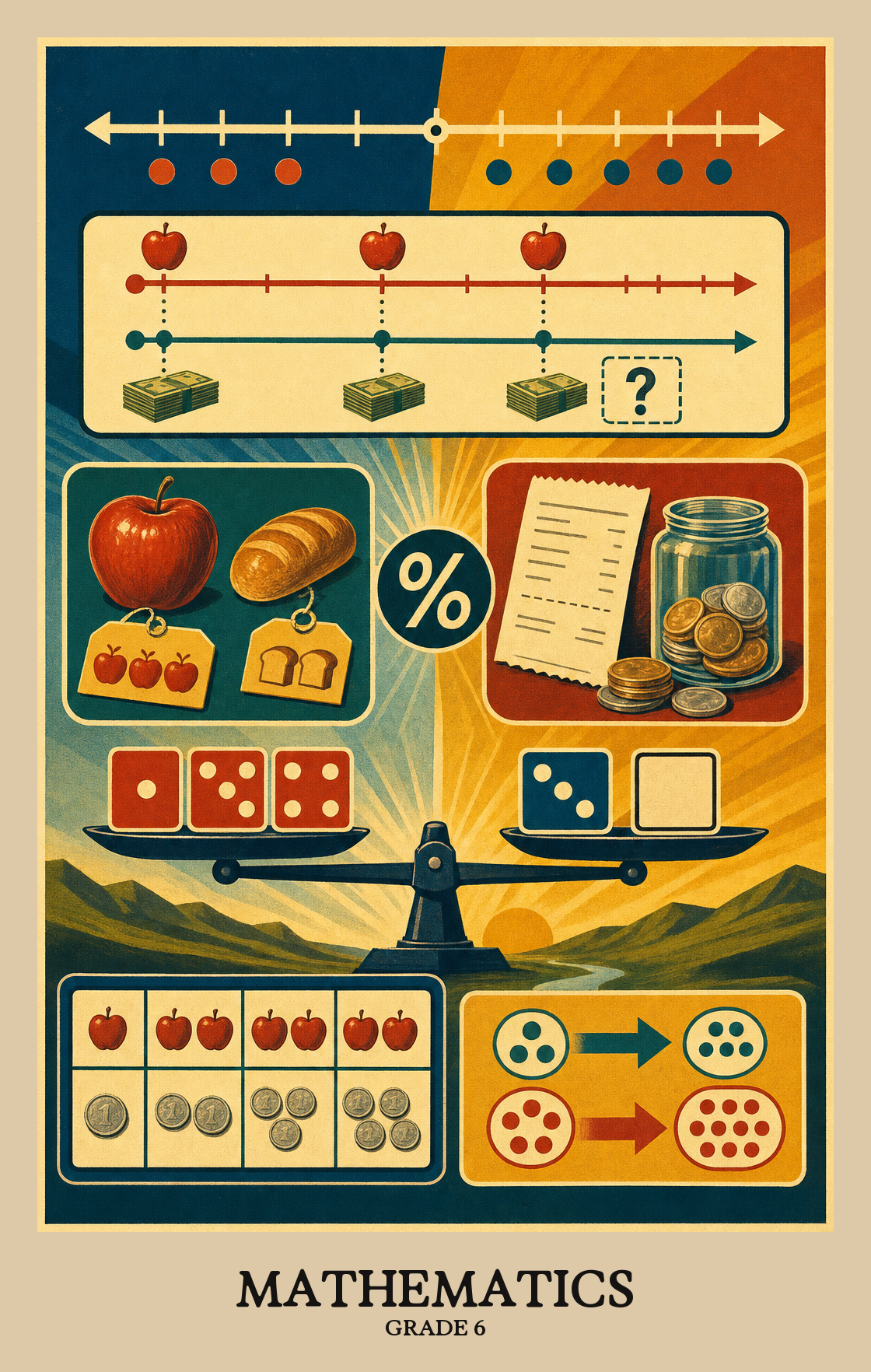
Students start the year comparing quantities, like 3 cups of flour to 2 cups of sugar. They figure out unit prices, percents off, and how to switch between inches and centimeters.
Students learn what it means to divide one fraction by another, like how many half-cups fit in three cups. They also work with factors, multiples, and large numbers.
Students extend the number line to include negatives. They place points in all four quadrants of a grid, find distances between points, and connect a number to its opposite.
Letters start standing in for unknown numbers. Students write expressions like 3x + 5, solve simple equations, and use inequalities to describe a range of possible answers.
Students find the area of triangles and odd-shaped figures by breaking them apart. They also measure the surface and volume of boxes and other 3D shapes.
Students collect data and describe it with graphs and a single number like the mean or median. They notice the shape of the data and what it says about the question being asked.
Ratios compare two amounts, like 3 red tiles to 5 blue tiles. Students use that relationship to solve problems involving rates, prices, speeds, and other real-world comparisons.
A ratio compares two quantities, like 3 red tiles to 5 blue tiles. Students write and read these comparisons using words, fractions, or the colon notation 3:5.
Students build a table of equivalent ratios, fill in any missing values, then plot each pair on a coordinate grid to see the relationship as a line of points.
Students find out how much of something there is per one unit, like miles per hour or price per item, then use that single-unit rate to answer real questions about speed, cost, or distance.
Students figure out percent problems: finding a percent of a number, calculating what percent one number is of another, or working backward to find the original amount. Think sale prices, tips, or test scores.
Students practice switching between units like inches and centimeters, or miles and kilometers. They use ratios to set up the conversion and solve it.
| Standard | Definition | Code |
|---|---|---|
| Understand and use ratios to solve problems | Ratios compare two amounts, like 3 red tiles to 5 blue tiles. Students use that relationship to solve problems involving rates, prices, speeds, and other real-world comparisons. | 6.RP.A |
| Understand a ratio as a comparison of two quantities and represent… | A ratio compares two quantities, like 3 red tiles to 5 blue tiles. Students write and read these comparisons using words, fractions, or the colon notation 3:5. | 6.RP.A.1 |
| Create tables of equivalent ratios, find missing values in the tables and plot… | Students build a table of equivalent ratios, fill in any missing values, then plot each pair on a coordinate grid to see the relationship as a line of points. | 6.RP.A.3a |
| Solve unit rate problems | Students find out how much of something there is per one unit, like miles per hour or price per item, then use that single-unit rate to answer real questions about speed, cost, or distance. | 6.RP.A.3b |
| Solve percent problems | Students figure out percent problems: finding a percent of a number, calculating what percent one number is of another, or working backward to find the original amount. Think sale prices, tips, or test scores. | 6.RP.A.3c |
| Convert measurement units within and between two systems of measurement | Students practice switching between units like inches and centimeters, or miles and kilometers. They use ratios to set up the conversion and solve it. | 6.RP.A.3d |
Dividing a fraction by another fraction. Students learn why the "flip and multiply" shortcut works, then use it to solve real problems like splitting half a pizza into quarter-slice servings.
Students divide one fraction by another to solve real problems, like figuring out how many quarter-cup servings fit in two-thirds of a cup. They set up the problem, flip the second fraction, and multiply to find the answer.
Students add, subtract, multiply, and divide large whole numbers by hand. They also find which factors two numbers share and what multiples they have in common.
Students rewrite a addition problem like 12 + 8 as 4 x (3 + 2) by pulling out the shared factor both numbers divide into evenly. It's a way of reorganizing numbers to make them easier to work with.
Rational numbers include every whole number, fraction, and negative number on the number line. Students place, compare, and calculate with all of them, including numbers below zero.
Positive and negative versions of the same number sit on opposite sides of zero on a number line. For example, 3 and -3 are the same distance from zero, just in opposite directions.
Absolute value is how far a number sits from zero on a number line, regardless of which direction. Students learn that -5 and 5 are both a distance of 5 from zero, so they share the same absolute value.
Students convert the same number between its fraction, decimal, and percent forms. For example, one-half shows up as 0.5 and 50%, and one-third shows up as roughly 0.33 and 33%.
| Standard | Definition | Code |
|---|---|---|
| Apply and extend previous understandings of multiplication and division… | Dividing a fraction by another fraction. Students learn why the "flip and multiply" shortcut works, then use it to solve real problems like splitting half a pizza into quarter-slice servings. | 6.NS.A |
| Solve problems involving division of fractions by fractions | Students divide one fraction by another to solve real problems, like figuring out how many quarter-cup servings fit in two-thirds of a cup. They set up the problem, flip the second fraction, and multiply to find the answer. | 6.NS.A.1a |
| Compute with non-negative multi-digit numbers | Students add, subtract, multiply, and divide large whole numbers by hand. They also find which factors two numbers share and what multiples they have in common. | 6.NS.B |
| Use the distributive property to express a sum of two whole numbers with a… | Students rewrite a addition problem like 12 + 8 as 4 x (3 + 2) by pulling out the shared factor both numbers divide into evenly. It's a way of reorganizing numbers to make them easier to work with. | 6.NS.B.4b |
| Apply and extend previous understandings of numbers to the system of… | Rational numbers include every whole number, fraction, and negative number on the number line. Students place, compare, and calculate with all of them, including numbers below zero. | 6.NS.C |
| Understand that a number and its opposite | Positive and negative versions of the same number sit on opposite sides of zero on a number line. For example, 3 and -3 are the same distance from zero, just in opposite directions. | 6.NS.C.6c |
| Understand that the absolute value of a rational number is its distance from 0… | Absolute value is how far a number sits from zero on a number line, regardless of which direction. Students learn that -5 and 5 are both a distance of 5 from zero, so they share the same absolute value. | 6.NS.C.7 |
| Extend prior knowledge to generate equivalent representations of rational… | Students convert the same number between its fraction, decimal, and percent forms. For example, one-half shows up as 0.5 and 50%, and one-third shows up as roughly 0.33 and 33%. | 6.NS.C.8 |
Algebra builds on arithmetic. Students learn to write and read expressions that use letters to stand in for unknown numbers, the same way they used to write equations with just digits.
An expression is a math phrase with numbers and symbols but no equal sign. An equation sets two expressions equal to each other, like 3x + 2 = 14. Students learn to tell the difference and use each correctly.
Students write expressions like 3x + 5 using variables and numbers, then find the value by swapping the variable for a given number and doing the arithmetic.
A variable is a letter that stands for an unknown number in a real situation. Students learn to read an expression like 3x and ask what x actually represents, such as hours worked or dollars saved.
Students rewrite expressions like 3(x + 4) into 12 + 3x and confirm the two versions always produce the same result. They use properties such as the distributive law to show why two expressions that look different are actually equal.
Students figure out the value of an unknown number in equations and inequalities, then check whether their answer makes the equation or inequality true.
Solving an equation or inequality means finding the number (or numbers) that make it true. Students check whether a value belongs in the solution set by substituting it in and seeing if both sides balance.
Students write equations with a letter standing in for an unknown number, then solve for what that letter must equal. The letter isn't abstract math shorthand; it represents something real, like a missing price or a distance.
Students learn to spot how two quantities are connected, like how total cost changes as the number of items changes. They practice writing and interpreting equations that show how one value depends on another.
Students write an equation that shows how one number changes based on another, like how total cost changes as the number of items bought increases.
Reading a table, graph, or equation that shows how two quantities are connected, then explaining how all three versions show the same relationship. For example, as hours worked increase, total pay increases at the same rate across all three.
| Standard | Definition | Code |
|---|---|---|
| Apply and extend previous understandings of arithmetic to algebraic expressions | Algebra builds on arithmetic. Students learn to write and read expressions that use letters to stand in for unknown numbers, the same way they used to write equations with just digits. | 6.EEI.A |
| Describe the difference between an expression and an equation | An expression is a math phrase with numbers and symbols but no equal sign. An equation sets two expressions equal to each other, like 3x + 2 = 14. Students learn to tell the difference and use each correctly. | 6.EEI.A.1 |
| Write and evaluate algebraic expressions | Students write expressions like 3x + 5 using variables and numbers, then find the value by swapping the variable for a given number and doing the arithmetic. | 6.EEI.A.2d |
| Understand the meaning of the variable in the context of the situation | A variable is a letter that stands for an unknown number in a real situation. Students learn to read an expression like 3x and ask what x actually represents, such as hours worked or dollars saved. | 6.EEI.A.2e |
| Identify and generate equivalent algebraic expressions using mathematical… | Students rewrite expressions like 3(x + 4) into 12 + 3x and confirm the two versions always produce the same result. They use properties such as the distributive law to show why two expressions that look different are actually equal. | 6.EEI.A.3 |
| Reason about and solve one-variable equations and inequalities | Students figure out the value of an unknown number in equations and inequalities, then check whether their answer makes the equation or inequality true. | 6.EEI.B |
| Understand that if any solutions exist, the solution set for an equation or… | Solving an equation or inequality means finding the number (or numbers) that make it true. Students check whether a value belongs in the solution set by substituting it in and seeing if both sides balance. | 6.EEI.B.5 |
| Write and solve equations using variables to represent quantities | Students write equations with a letter standing in for an unknown number, then solve for what that letter must equal. The letter isn't abstract math shorthand; it represents something real, like a missing price or a distance. | 6.EEI.B.6 |
| Represent and analyze quantitative relationships between dependent… | Students learn to spot how two quantities are connected, like how total cost changes as the number of items changes. They practice writing and interpreting equations that show how one value depends on another. | 6.EEI.C |
| Write an equation to express one quantity, the dependent variable, in terms of… | Students write an equation that shows how one number changes based on another, like how total cost changes as the number of items bought increases. | 6.EEI.C.9a |
| Analyze the relationship between the dependent and independent variables… | Reading a table, graph, or equation that shows how two quantities are connected, then explaining how all three versions show the same relationship. For example, as hours worked increase, total pay increases at the same rate across all three. | 6.EEI.C.9b |
Students find the area of flat shapes, the surface area of 3-D objects like boxes and prisms, and the volume of those same figures. The problems ask them to set up and solve real calculations, not just name formulas.
Reading a coordinate plane, students figure out which of the four sections a point sits in by checking whether its two numbers are positive or negative.
Two points that share the same numbers but have opposite signs are mirror images across the x-axis, the y-axis, or both. Students identify where each point lands on a coordinate grid and explain what changed.
Students find the distance between two points on a coordinate grid when they share the same x-value or the same y-value. Instead of measuring with a ruler, they subtract the coordinates.
Students plot points on a grid to draw shapes such as triangles, rectangles, and other polygons. They use the x- and y-axis to place each corner precisely and connect them to form the complete shape.
| Standard | Definition | Code |
|---|---|---|
| Solve problems involving area, surface area and volume | Students find the area of flat shapes, the surface area of 3-D objects like boxes and prisms, and the volume of those same figures. The problems ask them to set up and solve real calculations, not just name formulas. | 6.GM.A |
| Understand signs of numbers in ordered pairs as indicating locations in… | Reading a coordinate plane, students figure out which of the four sections a point sits in by checking whether its two numbers are positive or negative. | 6.GM.A.3a |
| Recognize that when two ordered pairs differ only by signs, the locations of… | Two points that share the same numbers but have opposite signs are mirror images across the x-axis, the y-axis, or both. Students identify where each point lands on a coordinate grid and explain what changed. | 6.GM.A.3b |
| Find distances between points with the same first coordinate or the same… | Students find the distance between two points on a coordinate grid when they share the same x-value or the same y-value. Instead of measuring with a ruler, they subtract the coordinates. | 6.GM.A.3c |
| Construct polygons in the Cartesian coordinate plane | Students plot points on a grid to draw shapes such as triangles, rectangles, and other polygons. They use the x- and y-axis to place each corner precisely and connect them to form the complete shape. | 6.GM.A.3d |
Students learn why data sets spread out differently and what that spread means. They compare groups by looking at how consistent or scattered the numbers are, not just what the average is.
A set of data has a pattern to it. Students learn to describe that pattern by finding the center (a typical value), the spread (how far apart the values are), and the overall shape of the data when displayed in a graph.
Students learn to describe a set of data by looking at its shape, center, and spread. They explain what the numbers mean as a group, not just one at a time.
Students look at a set of numbers, decide whether the data is spread out or bunched to one side, and choose the best measure (mean, median, or range) to describe it. The shape of the data and what it represents both matter.
| Standard | Definition | Code |
|---|---|---|
| Develop understanding of statistical variability | Students learn why data sets spread out differently and what that spread means. They compare groups by looking at how consistent or scattered the numbers are, not just what the average is. | 6.DSP.A |
| Understand that a set of data collected to answer a statistical question has… | A set of data has a pattern to it. Students learn to describe that pattern by finding the center (a typical value), the spread (how far apart the values are), and the overall shape of the data when displayed in a graph. | 6.DSP.A.2 |
| Summarize and describe distributions | Students learn to describe a set of data by looking at its shape, center, and spread. They explain what the numbers mean as a group, not just one at a time. | 6.DSP.B |
| Analyze the choice of measures of center and variability based on the shape of… | Students look at a set of numbers, decide whether the data is spread out or bunched to one side, and choose the best measure (mean, median, or range) to describe it. The shape of the data and what it represents both matter. | 6.DSP.B.5d |
Missouri Assessment Program grade-level mathematics assessment for grades 3 through 8.
Alternate assessment for eligible students with significant cognitive disabilities, covering the state-tested grade-level and end-of-course subjects.
Students compare amounts using ratios and percents, divide fractions, work with negative numbers on a number line, write simple equations with a letter standing in for a number, and find the area of shapes on a grid. They also start to describe sets of numbers by their middle and their spread.
Cooking, shopping, and sports stats are full of sixth grade math. Ask how to double a recipe, what 20 percent off a price comes to, or which player has the better average. Five minutes of real talk about numbers beats a worksheet most nights.
Most word problems get easier when students draw a quick picture or set up a small table before touching the numbers. Ask what the question is really asking and what would be a reasonable answer. Getting close before getting exact builds confidence.
Sixth grade is the first year students treat negatives as real numbers, not just a minus sign. Temperatures below zero, money owed, and floors below ground level all help. A number line drawn on paper makes opposites and distance from zero click faster than a rule.
Ratios and rates pair well early because they connect to fractions and set up percents. Negative numbers and the coordinate plane fit next, which then supports expressions, equations, and dependent and independent variables. Save area on the grid and data distributions for later, once coordinates and number sense are solid.
Dividing fractions by fractions, writing an equation from a word problem, and reading a ratio table without flipping the quantities tend to take the longest. Plan short revisits every few weeks rather than one long unit. Mixed practice over time sticks better than a single push.
Students can solve a percent or unit rate problem from a real situation, divide one fraction by another and explain the answer, write and solve a one step equation with a variable, plot points in all four quadrants, and describe a set of data by its center and spread.
Ready students move between fractions, decimals, and percents without panic, reason about ratios in tables and on a graph, and use a variable as a stand in for an unknown amount. They also accept negative answers as normal instead of assuming they made a mistake.