Water, heat, and change
Students watch water freeze, melt, and disappear into the air. They figure out which changes can be undone by warming or cooling, and which ones cannot.
This is the year science shifts from noticing the world to testing ideas about it. Students melt and freeze water to see how heat changes matter, and they try out magnets and static to study forces that work without touching. In life science, they trace plant and animal life cycles and ask why some traits come from parents while others come from the environment. By spring, students can plan a fair test, chart the weather, and back up a claim with what they observed.
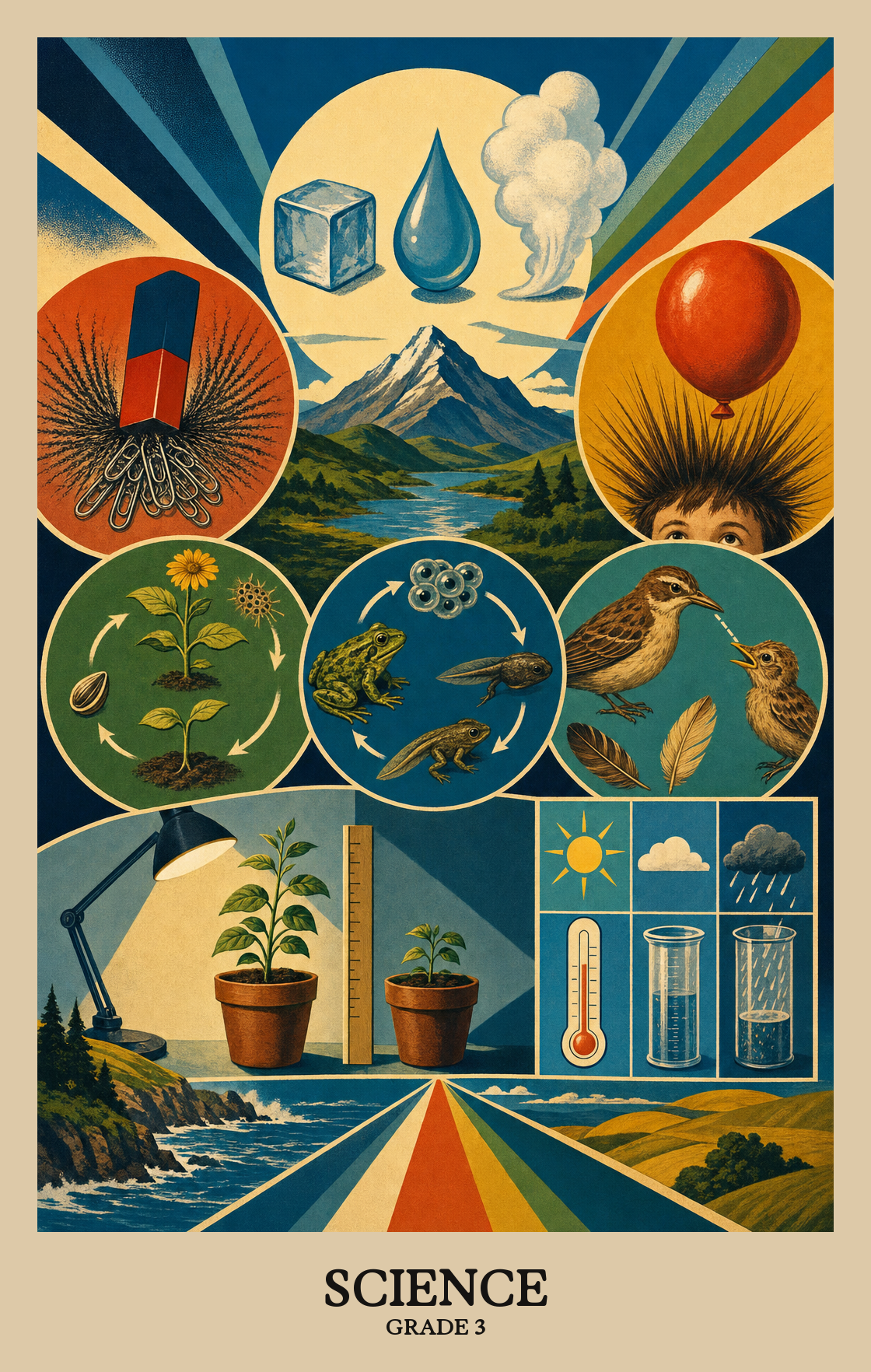
Students watch water freeze, melt, and disappear into the air. They figure out which changes can be undone by warming or cooling, and which ones cannot.
Students test magnets and static electricity to see how two objects can affect each other across a gap. They plan small experiments and look for cause and effect.
Students compare how plants and animals grow up, from seed or egg to adult. They sort which traits come from parents and which are shaped by where an organism lives.
Students look at why some animals thrive in a place while others struggle. They use evidence to explain how small differences between individuals help with finding food, staying safe, and finding mates.
Students chart temperature and rainfall to describe each season, then compare climates around the world. They judge real designs like storm shelters and sea walls that protect people from weather.
Students take a real problem, set rules for what counts as success, and sketch more than one solution. They run fair tests, find weak spots, and improve their design.
Students predict and test what happens when water gets colder or warmer. They watch it freeze into ice, melt back to liquid, or disappear as vapor, then explain why each change happened.
Students learn what happens when two materials meet, such as mixing, dissolving, or one changing the other. The focus is on observing whether the change can be undone.
Heating and cooling can change matter in ways that can be undone (like melting ice) or ways that cannot (like burning wood). Students identify which kind of change happened and explain their thinking with evidence.
| Standard | Definition | Code |
|---|---|---|
| Predict and investigate that water can change from a liquid to a solid | Students predict and test what happens when water gets colder or warmer. They watch it freeze into ice, melt back to liquid, or disappear as vapor, then explain why each change happened. | 3.PS1.A |
| Types of Interactions of Matter | Students learn what happens when two materials meet, such as mixing, dissolving, or one changing the other. The focus is on observing whether the change can be undone. | PS1.B |
| Construct an argument with evidence that some changes caused by heating or… | Heating and cooling can change matter in ways that can be undone (like melting ice) or ways that cannot (like burning wood). Students identify which kind of change happened and explain their thinking with evidence. | 3.PS1.B |
Objects can push or pull each other without touching, like how a magnet attracts a paper clip from across a table. Students learn to spot these invisible forces and predict what will happen when objects interact.
Students plan and run simple tests to find out how magnets or static electricity can push and pull objects without touching them. They look for patterns in what causes each effect.
| Standard | Definition | Code |
|---|---|---|
| Types of Interaction | Objects can push or pull each other without touching, like how a magnet attracts a paper clip from across a table. Students learn to spot these invisible forces and predict what will happen when objects interact. | PS2.B |
| Plan and conduct investigations to determine the cause and effect relationship… | Students plan and run simple tests to find out how magnets or static electricity can push and pull objects without touching them. They look for patterns in what causes each effect. | 3.PS2.B |
Students look at real animals and plants in one habitat and explain, using evidence, why some thrive there, some struggle, and others cannot live there at all. The focus is on how a creature's body or habits make it a good fit or a poor one.
Plants and animals grow in predictable patterns. Students learn why organisms look like their parents, how living things change from birth to adulthood, and what they need to grow through each stage of life.
Students compare the life cycles of plants and animals by building a simple model, like a diagram or chart, that shows how each organism is born, grows, reproduces, and dies.
| Standard | Definition | Code |
|---|---|---|
| Construct an argument with evidence that in a particular ecosystem some… | Students look at real animals and plants in one habitat and explain, using evidence, why some thrive there, some struggle, and others cannot live there at all. The focus is on how a creature's body or habits make it a good fit or a poor one. | 3.LS1.A |
| Growth and Development of Organisms | Plants and animals grow in predictable patterns. Students learn why organisms look like their parents, how living things change from birth to adulthood, and what they need to grow through each stage of life. | LS1.B |
| Develop a model to compare and contrast observations on the life cycle of… | Students compare the life cycles of plants and animals by building a simple model, like a diagram or chart, that shows how each organism is born, grows, reproduces, and dies. | 3.LS1.B |
Students sort traits into two groups: ones passed down from parents (like eye color or leaf shape) and ones shaped by surroundings (like a plant growing taller in sunlight). They back up that sorting with evidence.
Offspring usually look like their parents, but small differences can appear. Students learn how those differences sometimes help an animal survive long enough to have young of its own.
Some animals in a group are faster, better camouflaged, or built differently than others. Students explain how those differences can help certain individuals survive longer and have more offspring.
Animals and plants develop features that help them survive in their environment. Students learn why some of those features get passed from parents to offspring and how they spread through a population over time.
Students explain why some animals thrive in a specific place while others struggle or can't survive at all, using real examples of body features or behaviors as their evidence.
Living things come in an enormous variety of species, and humans depend on that variety for food, medicine, and clean water. When species disappear, those resources can shrink.
Students look at a real problem, like a forest fire or flood changing a habitat, and explain in writing whether a proposed fix would actually help the plants and animals survive there.
| Standard | Definition | Code |
|---|---|---|
| Construct scientific arguments to support claims that some characteristics of… | Students sort traits into two groups: ones passed down from parents (like eye color or leaf shape) and ones shaped by surroundings (like a plant growing taller in sunlight). They back up that sorting with evidence. | 3.LS3.A |
| Natural Selection | Offspring usually look like their parents, but small differences can appear. Students learn how those differences sometimes help an animal survive long enough to have young of its own. | LS3.B |
| Use evidence to construct an explanation for how the variations in… | Some animals in a group are faster, better camouflaged, or built differently than others. Students explain how those differences can help certain individuals survive longer and have more offspring. | 3.LS3.B |
| Adaptation | Animals and plants develop features that help them survive in their environment. Students learn why some of those features get passed from parents to offspring and how they spread through a population over time. | LS3.C |
| Construct an argument with evidence that in a particular ecosystem some… | Students explain why some animals thrive in a specific place while others struggle or can't survive at all, using real examples of body features or behaviors as their evidence. | 3.LS3.C |
| Biodiversity and Humans | Living things come in an enormous variety of species, and humans depend on that variety for food, medicine, and clean water. When species disappear, those resources can shrink. | LS3.D |
| Make a claim about the merit of a solution to a problem caused when the… | Students look at a real problem, like a forest fire or flood changing a habitat, and explain in writing whether a proposed fix would actually help the plants and animals survive there. | 3.LS3.D |
Students record temperature, rainfall, and other weather data in tables and charts to show what weather a season typically brings, like cold and snowy winters or warm and rainy springs.
Students research and compare climates in different parts of the world, then put that information together to describe what the weather is typically like in each region across seasons.
| Standard | Definition | Code |
|---|---|---|
| Represent data in tables and graphical displays to describe typical weather… | Students record temperature, rainfall, and other weather data in tables and charts to show what weather a season typically brings, like cold and snowy winters or warm and rainy springs. | 3.ESS2.D.a |
| Obtain and combine information to describe climates in different regions of the… | Students research and compare climates in different parts of the world, then put that information together to describe what the weather is typically like in each region across seasons. | 3.ESS2.D.b |
Students explore how people use natural resources like soil, water, and sunlight, and what happens when those resources run low. They also look at how weather and other natural events affect communities.
| Standard | Definition | Code |
|---|---|---|
| Earth and Human Activity | Students explore how people use natural resources like soil, water, and sunlight, and what happens when those resources run low. They also look at how weather and other natural events affect communities. | ESS3 |
Natural hazards are events like earthquakes, floods, and wildfires that can harm people and communities. Students learn what causes these events and how people prepare for them or reduce the damage they cause.
Students look at a real structure built to protect people from storms or floods, then explain in writing why it works well or where it falls short.
| Standard | Definition | Code |
|---|---|---|
| Natural Hazards | Natural hazards are events like earthquakes, floods, and wildfires that can harm people and communities. Students learn what causes these events and how people prepare for them or reduce the damage they cause. | ESS3.B |
| Make a claim about the merit of an existing design solution | Students look at a real structure built to protect people from storms or floods, then explain in writing why it works well or where it falls short. | 3.ESS3.B |
Students name a problem they want to solve, then set the rules for a good solution: what it must do, what materials are allowed, and how much time or money can be spent.
Students come up with more than one idea for solving a problem, then compare those ideas to figure out which one best fits the rules and limits they have to work within.
Students test a model or prototype, change one thing at a time, and look for what breaks or falls short. The goal is to find exactly what needs fixing before the next version is built.
| Standard | Definition | Code |
|---|---|---|
| Define a simple design problem reflecting a need or a want that includes… | Students name a problem they want to solve, then set the rules for a good solution: what it must do, what materials are allowed, and how much time or money can be spent. | 3.ETS1.A |
| Generate and compare multiple possible solutions to a problem based on how well… | Students come up with more than one idea for solving a problem, then compare those ideas to figure out which one best fits the rules and limits they have to work within. | 3.ETS1.B |
| Plan and carry out fair tests in which variables are controlled and failure… | Students test a model or prototype, change one thing at a time, and look for what breaks or falls short. The goal is to find exactly what needs fixing before the next version is built. | 3.ETS1.C |
Alternate assessment for eligible students with significant cognitive disabilities, covering the state-tested grade-level and end-of-course subjects.
Students study how matter changes when it heats or cools, how magnets and static electricity push and pull without touching, how plants and animals grow and survive in their habitats, and how weather and climate work. They also try simple engineering, where they build something to solve a problem and test if it works.
Freeze water in an ice cube tray and melt it back. Leave a wet paper towel out and check it later. Stick magnets to the fridge and find what they grab. Watch the weather together and guess tomorrow's temperature. Short, hands-on moments stick better than a worksheet.
Not this year. Students are asked to make a claim and back it up with what they saw or measured. At home, ask why they think something happened and what they noticed. Getting comfortable saying "I think this because I saw that" is the real goal.
A common path is matter and its changes in the fall, forces and magnets in the winter, life cycles and adaptations in the spring, and weather and climate woven in alongside an engineering design challenge. Saving engineering for last lets students apply what they learned about forces, weather, or habitats.
Reversible versus irreversible changes trip students up, because melting and freezing feel similar to burning or cooking. Inherited traits versus learned traits is another sticking point. Plan extra sorting activities and short arguments where students defend which category something belongs in.
A fair test means changing only one thing at a time so students can tell what caused the result. If a paper airplane flies farther, was it the new fold or the harder throw? Asking "what did you change and what did you keep the same?" builds this habit fast.
Short written arguments matter more than long reports. A solid response is a claim, a piece of evidence from an experiment or reading, and a sentence explaining how the evidence supports the claim. Three or four sentences is plenty at this age.
By spring, students should be able to plan a simple investigation, record results in a table or bar graph, and explain a result using what they observed. They should also be able to give an example of an animal trait that helps it survive and point to evidence for why.