Atoms and the building blocks of matter
Students start the year studying what everything is made of. They look at atoms, isotopes, and the periodic table, and learn to sort substances into elements, compounds, and mixtures.
This is the year science gets quantitative. Students move from describing the world to explaining it with equations, models, and lab data, whether they are tracking the motion of a car, balancing a chemical reaction, or following energy through a cell. Living systems, atoms, forces, and Earth's climate all get treated as systems with rules students can measure and predict. By spring, students can read a graph of motion, balance a simple chemical equation, and explain how energy and matter move through a cell or an ecosystem.
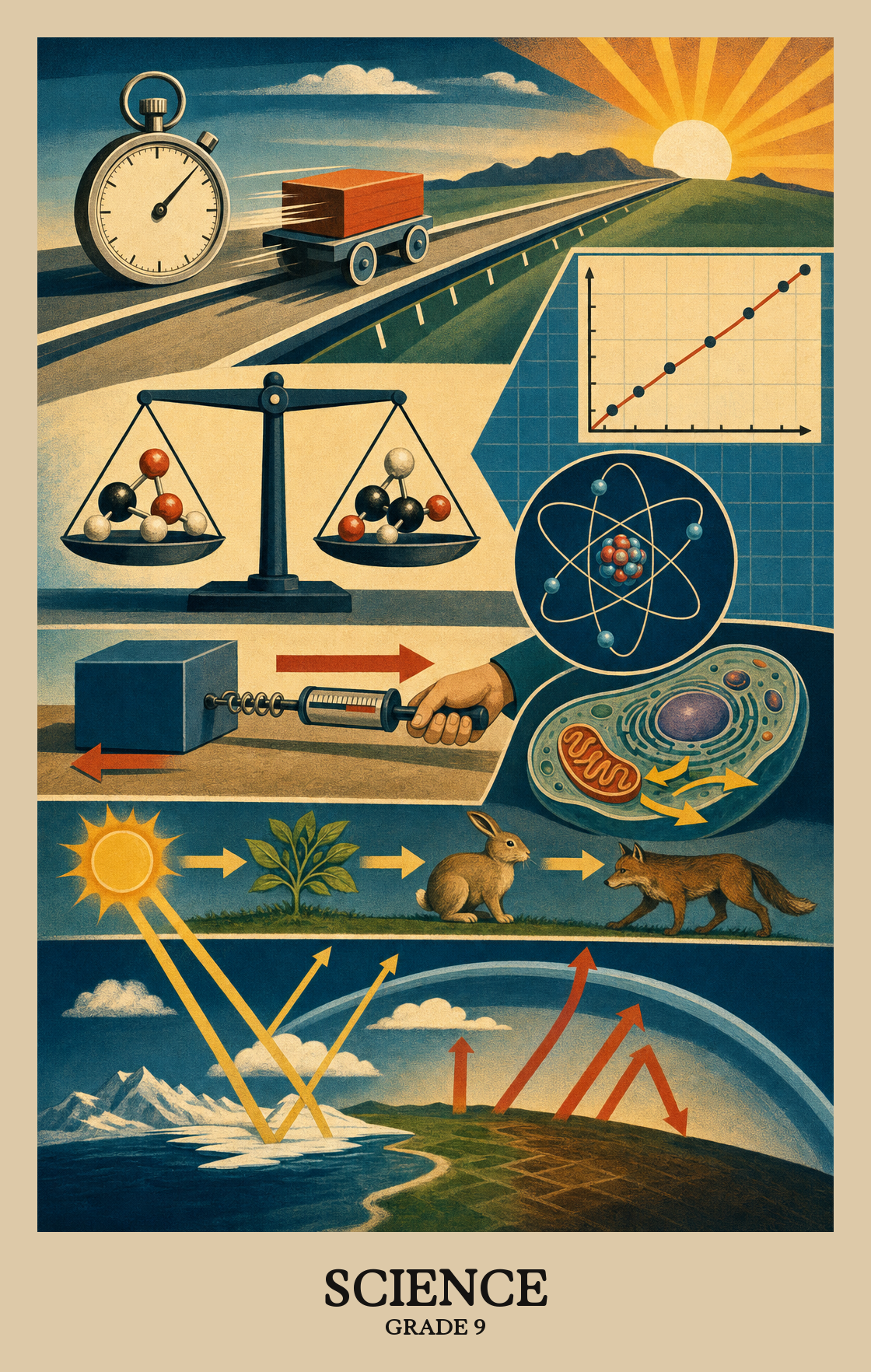
Students start the year studying what everything is made of. They look at atoms, isotopes, and the periodic table, and learn to sort substances into elements, compounds, and mixtures.
Students measure how things move and why. They use graphs and equations to describe speed and acceleration, apply Newton's laws to pushes and pulls, and study work, power, and energy in everyday systems.
Students look inside cells to see how parts work together. They study how DNA codes for proteins, how cells divide, and how enzymes speed up the chemical reactions that keep organisms alive.
Students learn how atoms join to form new substances. They name compounds, balance equations, compare acids and bases, and predict what happens when reactions speed up or slow down.
Students zoom out to the planet and the sky above it. They study how the solar system formed, how plate tectonics shape the ground, and how the ocean and atmosphere drive weather and climate.
Students close the year by connecting genes to populations. They predict inherited traits, study how natural selection shapes species over time, and weigh how human choices affect ecosystems and biodiversity.
Students learn what an atom is made of: protons, neutrons, and electrons. Then they look at isotopes, which are versions of the same element with a different number of neutrons in the nucleus.
Students learn what matter is made of and how different materials behave. They study the building blocks of atoms, how elements are organized, and why some substances conduct heat while others don't.
Scientists did not always know what atoms look like inside. Students trace how those ideas changed over time, from early models of a solid sphere to the modern picture of a nucleus surrounded by electrons.
Students sort materials into categories: pure substances or mixtures, elements or compounds, solutions or suspensions. They explain what makes each category distinct, using evidence about the material's composition.
Students use diagrams or models to compare how solids, liquids, and gases behave differently, and to explain what happens when matter changes from one phase to another, like water freezing or ice melting.
Students compare what happens inside an atom during reactions like alpha decay, beta decay, and nuclear fission. They use diagrams or models to show how the nucleus changes, gains, or splits apart during each type of reaction.
Students run experiments to compare how substances look, feel, or dissolve (physical properties) against how they react with other materials and change into something new (chemical properties).
Students use diagrams or models to show where electrons sit around an atom's nucleus. The pattern of those electrons determines how an atom behaves in a chemical reaction.
Reading the Periodic Table, students explain why elements in the same column react similarly and predict basic properties like hardness or reactivity before ever running an experiment.
Students read Bohr diagrams and electron dot diagrams to figure out how electrons are arranged around an atom. They practice with the first 18 elements on the periodic table.
Students use diagrams or models to compare how atoms change when they gain or lose electrons (becoming ions) or when their nuclei carry different numbers of neutrons (becoming isotopes).
The Periodic Table is arranged so that elements in the same column share similar chemical behavior. Students use that pattern to predict how a given element will react, based on how many electrons sit in its outermost shell.
Students use the Periodic Table to predict how an element will behave, including whether it acts like a metal, what charge it carries in a compound, and how readily it reacts with other elements. The pattern comes from electrons in the atom's outer shell.
Where an element sits on the Periodic Table tells you a lot about it. Students use that position to predict how big its atoms are, how readily it reacts with other elements, and how tightly it holds onto its electrons.
Students examine how substances change when they react with each other, looking at what breaks apart, what forms, and how energy shifts during the process.
Students learn why atoms stick together and how the type of bond between them determines whether a substance is hard or brittle, conducts electricity, or dissolves in water.
Students look at a substance and explain what holds its atoms together. They identify whether the bond is covalent (atoms sharing electrons), ionic (one atom giving electrons to another), or metallic (electrons flowing freely through a metal).
Students learn why atoms link up to form compounds, and whether those links are ionic or covalent. They read data to explain how each bond type forms and what it means for how the compound behaves.
Intermolecular forces are the attractions between molecules that affect how a substance behaves. Students explain how these forces determine whether a compound melts at a high or low temperature, dissolves in water, or stays a gas at room temperature.
Students learn the naming rules chemists use worldwide, then apply those rules to read and write chemical formulas for simple compounds like water or table salt.
Students use naming rules and structural models to figure out what a compound is called or write its chemical formula. This covers ionic compounds, acids, and covalently bonded molecules.
Students balance chemical equations using math to show that atoms are never created or destroyed in a reaction. The same atoms that go in must come out, just rearranged.
Students learn to look at a chemical reaction and name what type it is: two substances joining into one, one substance breaking apart, something burning, or two substances swapping partners.
Students examine what happens when substances combine or break apart in a chemical reaction: how much of each substance is used up, what new substances form, and whether heat or light is released or absorbed in the process.
Students compare acids and bases by looking at what they're made of and how they behave, such as how they taste, react with metals, or change the color of an indicator like litmus paper.
Students use diagrams or models to show whether a chemical reaction releases heat into its surroundings or absorbs heat from them. This explains why some reactions feel warm and others feel cold.
Students run experiments to predict what products a simple chemical reaction will make, then check that the total mass of the starting materials equals the total mass of the products.
Students use diagrams or models to show what happens when an acid and a base mix. They explain how the two substances cancel each other out and form a neutral solution.
Students calculate the exact ratio of atoms in a compound, find how much of each element is present by percentage, and convert between grams and moles to describe what a substance is made of.
Students learn what happens inside an atom's nucleus to produce radiation. That includes how unstable atoms break apart, release energy, and change into different elements over time.
Students use math to calculate how much of each substance is needed or produced in a chemical reaction. This is how chemists figure out exact amounts before mixing materials in a lab or factory.
Students use diagrams and models to compare what happens inside an atom's nucleus during different nuclear reactions, from small particles breaking off to atoms splitting apart or fusing together.
Students calculate how long it takes for a radioactive material to break down by half, then half again. The math shows how quickly an unstable element loses its radioactivity over time.
Students learn what makes chemical reactions speed up or slow down, and why some reactions seem to stop halfway. They practice predicting how changes in temperature, concentration, or pressure push a reaction forward or backward.
Students run experiments to see how speeding up molecules, breaking solids into smaller pieces, or adding a catalyst changes how fast a chemical reaction happens. Each factor works by affecting how often and how forcefully particles collide.
Students learn how nuclear reactions are used in the real world: to date ancient fossils and rocks, to diagnose and treat illness, and to generate electricity. The focus is on what happens inside the atom's nucleus and why it matters outside the lab.
When a chemical reaction is in balance, changing the heat, pressure, or the amount of a substance tips that balance in a predictable direction. Students learn to read data and predict which way the reaction will shift.
Students learn what happens when one substance dissolves into another, like salt disappearing into water. They explore what affects how much dissolves and how quickly.
Students run experiments to find out what makes a substance dissolve faster or slower, and what changes how strong or weak a solution becomes. Think salt in water, but with temperature, stirring, and particle size all playing a role.
Students use math and models to describe exactly how much of a substance is dissolved in a liquid. They work with concentration, dilution, and titration to measure and adjust solutions precisely.
Students test acids and bases in the lab, comparing how each behaves. They record observations like pH, taste-safe indicators, and reactivity to build a working picture of what makes a substance acidic or basic.
| Standard | Definition | Code |
|---|---|---|
| Analyze the structure of atoms and isotopes | Students learn what an atom is made of: protons, neutrons, and electrons. Then they look at isotopes, which are versions of the same element with a different number of neutrons in the nucleus. | PS.Chm.1 |
| Understand types, properties, and structure of matter | Students learn what matter is made of and how different materials behave. They study the building blocks of atoms, how elements are organized, and why some substances conduct heat while others don't. | PSc.1 |
| Use models to explain how the scientific understanding of atomic structure has… | Scientists did not always know what atoms look like inside. Students trace how those ideas changed over time, from early models of a solid sphere to the modern picture of a nucleus surrounded by electrons. | PS.Chm.1.1 |
| Construct an explanation to classify matter as a pure substance or mixture… | Students sort materials into categories: pure substances or mixtures, elements or compounds, solutions or suspensions. They explain what makes each category distinct, using evidence about the material's composition. | PSc.1.1 |
| Use models to compare the phases of matter and the physical changes they… | Students use diagrams or models to compare how solids, liquids, and gases behave differently, and to explain what happens when matter changes from one phase to another, like water freezing or ice melting. | PSc.1.2 |
| Use models to compare nuclear reactions including alpha decay, beta decay and… | Students compare what happens inside an atom during reactions like alpha decay, beta decay, and nuclear fission. They use diagrams or models to show how the nucleus changes, gains, or splits apart during each type of reaction. | PS.Chm.1.2 |
| Carry out investigations to compare physical and chemical properties of matter | Students run experiments to compare how substances look, feel, or dissolve (physical properties) against how they react with other materials and change into something new (chemical properties). | PSc.1.3 |
| Use models to explain how electrons are distributed in atoms | Students use diagrams or models to show where electrons sit around an atom's nucleus. The pattern of those electrons determines how an atom behaves in a chemical reaction. | PS.Chm.1.3 |
| Understand the physical and chemical properties of atoms based on their… | Reading the Periodic Table, students explain why elements in the same column react similarly and predict basic properties like hardness or reactivity before ever running an experiment. | PS.Chm.2 |
| Use models to interpret the data presented in Bohr diagrams and electron dot… | Students read Bohr diagrams and electron dot diagrams to figure out how electrons are arranged around an atom. They practice with the first 18 elements on the periodic table. | PSc.1.4 |
| Use models to compare representations of atoms, ions | Students use diagrams or models to compare how atoms change when they gain or lose electrons (becoming ions) or when their nuclei carry different numbers of neutrons (becoming isotopes). | PSc.1.5 |
| Use the Periodic Table as a model to predict the relative properties of… | The Periodic Table is arranged so that elements in the same column share similar chemical behavior. Students use that pattern to predict how a given element will react, based on how many electrons sit in its outermost shell. | PS.Chm.2.1 |
| Use the Periodic Table as a model to predict the relative properties | Students use the Periodic Table to predict how an element will behave, including whether it acts like a metal, what charge it carries in a compound, and how readily it reacts with other elements. The pattern comes from electrons in the atom's outer shell. | .PSc.1.6 |
| Construct an explanation to infer the atomic size, reactivity, electronegativity | Where an element sits on the Periodic Table tells you a lot about it. Students use that position to predict how big its atoms are, how readily it reacts with other elements, and how tightly it holds onto its electrons. | PS.Chm.2.2 |
| Analyze interactions of matter within a chemical system | Students examine how substances change when they react with each other, looking at what breaks apart, what forms, and how energy shifts during the process. | PSc.2 |
| Understand the bonding that occurs in simple compounds in terms of bond type… | Students learn why atoms stick together and how the type of bond between them determines whether a substance is hard or brittle, conducts electricity, or dissolves in water. | PS.Chm.3 |
| Construct an explanation to classify the type of chemical bond that occurs… | Students look at a substance and explain what holds its atoms together. They identify whether the bond is covalent (atoms sharing electrons), ionic (one atom giving electrons to another), or metallic (electrons flowing freely through a metal). | PSc.2.1 |
| Analyze and interpret data to explain the mechanisms and properties of the two… | Students learn why atoms link up to form compounds, and whether those links are ionic or covalent. They read data to explain how each bond type forms and what it means for how the compound behaves. | PS.Chm.3.1 |
| Construct an explanation to summarize the influences intermolecular forces have… | Intermolecular forces are the attractions between molecules that affect how a substance behaves. Students explain how these forces determine whether a compound melts at a high or low temperature, dissolves in water, or stays a gas at room temperature. | PS.Chm.3.2 |
| Use models to apply International Union of Pure and Applied Chemistry | Students learn the naming rules chemists use worldwide, then apply those rules to read and write chemical formulas for simple compounds like water or table salt. | PSc.2.2 |
| Use models to predict chemical names and formulas including ionic | Students use naming rules and structural models to figure out what a compound is called or write its chemical formula. This covers ionic compounds, acids, and covalently bonded molecules. | PS.Chm.3.3 |
| Use mathematics and computational thinking to execute the balancing of chemical… | Students balance chemical equations using math to show that atoms are never created or destroyed in a reaction. The same atoms that go in must come out, just rearranged. | PSc.2.3 |
| Obtain, evaluate, and communicate information to classify a chemical reaction… | Students learn to look at a chemical reaction and name what type it is: two substances joining into one, one substance breaking apart, something burning, or two substances swapping partners. | PSc.2.4 |
| Analyze chemical reactions in terms of quantities, product formation | Students examine what happens when substances combine or break apart in a chemical reaction: how much of each substance is used up, what new substances form, and whether heat or light is released or absorbed in the process. | PS.Chm.4 |
| Construct an explanation to compare the composition and properties of acids and… | Students compare acids and bases by looking at what they're made of and how they behave, such as how they taste, react with metals, or change the color of an indicator like litmus paper. | PSc.2.5 |
| Use models to explain the exothermic or endothermic nature of chemical changes | Students use diagrams or models to show whether a chemical reaction releases heat into its surroundings or absorbs heat from them. This explains why some reactions feel warm and others feel cold. | PS.Chm.4.1 |
| Carry out investigations to predict the outcome of simple chemical reactions… | Students run experiments to predict what products a simple chemical reaction will make, then check that the total mass of the starting materials equals the total mass of the products. | PS.Chm.4.2 |
| Use models to explain the interactions of acids and bases in the process of… | Students use diagrams or models to show what happens when an acid and a base mix. They explain how the two substances cancel each other out and form a neutral solution. | PSc.2.6 |
| Use mathematics and computational thinking to analyze quantitatively the… | Students calculate the exact ratio of atoms in a compound, find how much of each element is present by percentage, and convert between grams and moles to describe what a substance is made of. | PS.Chm.4.3 |
| Understand the role of the nucleus in radiation and radioactivity | Students learn what happens inside an atom's nucleus to produce radiation. That includes how unstable atoms break apart, release energy, and change into different elements over time. | PSc.3 |
| Use mathematics and computational thinking to apply the mole concept in the… | Students use math to calculate how much of each substance is needed or produced in a chemical reaction. This is how chemists figure out exact amounts before mixing materials in a lab or factory. | PS.Chm.4.4 |
| Use models to compare nuclear reactions including alpha decay, beta decay, and… | Students use diagrams and models to compare what happens inside an atom's nucleus during different nuclear reactions, from small particles breaking off to atoms splitting apart or fusing together. | PSc.3.1 |
| Use mathematics and computational thinking to execute simple… | Students calculate how long it takes for a radioactive material to break down by half, then half again. The math shows how quickly an unstable element loses its radioactivity over time. | PSc.3.2 |
| Understand the factors affecting rate of reaction and chemical equilibrium | Students learn what makes chemical reactions speed up or slow down, and why some reactions seem to stop halfway. They practice predicting how changes in temperature, concentration, or pressure push a reaction forward or backward. | PS.Chm.5 |
| Carry out investigations to explain the effects of temperature, surface area… | Students run experiments to see how speeding up molecules, breaking solids into smaller pieces, or adding a catalyst changes how fast a chemical reaction happens. Each factor works by affecting how often and how forcefully particles collide. | PS.Chm.5.1 |
| Obtain, evaluate, and communicate information to explain the application of… | Students learn how nuclear reactions are used in the real world: to date ancient fossils and rocks, to diagnose and treat illness, and to generate electricity. The focus is on what happens inside the atom's nucleus and why it matters outside the lab. | PSc.3.3 |
| Analyze and interpret data to predict how stressors on a reaction | When a chemical reaction is in balance, changing the heat, pressure, or the amount of a substance tips that balance in a predictable direction. Students learn to read data and predict which way the reaction will shift. | PS.Chm.5.2 |
| Understand solutions and the solution process | Students learn what happens when one substance dissolves into another, like salt disappearing into water. They explore what affects how much dissolves and how quickly. | PS.Chm.6 |
| Carry out investigations to summarize the factors that affect the formation and… | Students run experiments to find out what makes a substance dissolve faster or slower, and what changes how strong or weak a solution becomes. Think salt in water, but with temperature, stirring, and particle size all playing a role. | PS.Chm.6.1 |
| Use models to explain the quantitative nature of a solution | Students use math and models to describe exactly how much of a substance is dissolved in a liquid. They work with concentration, dilution, and titration to measure and adjust solutions precisely. | PS.Chm.6.2 |
| Carry out investigations to compare properties and behaviors | Students test acids and bases in the lab, comparing how each behaves. They record observations like pH, taste-safe indicators, and reactivity to build a working picture of what makes a substance acidic or basic. | PS.Chm.6.3 |
Earth orbits the sun at a distance that keeps temperatures mild enough for liquid water and life. That distance, combined with Earth's tilt, drives our seasons and daily weather patterns.
Models show how the sun and planets formed from a spinning cloud of gas and dust about 4.6 billion years ago. Students use diagrams or simulations to trace how gravity pulled that material together into the solar system we see today.
Students use math to track how Earth moves around the sun, including its tilt and orbit, and connect those patterns to why seasons change and why daylight hours shift through the year.
Students learn how the sun generates energy deep in its core, where hydrogen fuses into helium. They use diagrams or models to show how that process produces the light and heat that reach Earth.
Sunlight hits Earth's surface and atmosphere, driving the weather, water cycle, and temperatures that make life possible. Students explain how that flow of energy from the sun connects to the systems that keep living things alive.
| Standard | Definition | Code |
|---|---|---|
| Explain how Earth's position relative to the sun influences conditions on Earth | Earth orbits the sun at a distance that keeps temperatures mild enough for liquid water and life. That distance, combined with Earth's tilt, drives our seasons and daily weather patterns. | ESS.EES.1 |
| Use models to illustrate the formation of the solar system | Models show how the sun and planets formed from a spinning cloud of gas and dust about 4.6 billion years ago. Students use diagrams or simulations to trace how gravity pulled that material together into the solar system we see today. | ESS.EES.1.1 |
| Use mathematics and computational thinking to analyze Earth’s motion through… | Students use math to track how Earth moves around the sun, including its tilt and orbit, and connect those patterns to why seasons change and why daylight hours shift through the year. | ESS.EES.1.2 |
| Use models to illustrate how the sun produces energy | Students learn how the sun generates energy deep in its core, where hydrogen fuses into helium. They use diagrams or models to show how that process produces the light and heat that reach Earth. | ESS.EES.1.3 |
| Construct an explanation to infer how incoming solar radiation interacts with… | Sunlight hits Earth's surface and atmosphere, driving the weather, water cycle, and temperatures that make life possible. Students explain how that flow of energy from the sun connects to the systems that keep living things alive. | ESS.EES.1.4 |
Students read graphs and solve problems to describe how fast an object moves, which direction it travels, and whether it is speeding up or slowing down. Time, distance, and velocity are the main tools.
Students read position-time and velocity-time graphs to figure out how an object is moving in a straight line. They use equations and diagrams to describe that motion in numbers.
Reading a position graph or a motion diagram, students figure out how an object moves when its path isn't a straight line, such as a ball thrown through the air.
Students look at how multiple forces acting on an object at the same time affect what that object does: whether it stays still, speeds up, or changes direction.
Students draw diagrams that show every force acting on an object, then use those diagrams to figure out whether the object speeds up, slows down, or stays put. The work covers both straight-line and angled situations.
Students run experiments to see how pushes, pulls, and collisions affect a moving or resting object. The results connect to Newton's three laws describing how force and motion work together.
Students use diagrams and math to explain why an object moving in a circle, like a ball on a string or a car on a curved road, gets pulled toward the center of that curve.
Students use diagrams and calculations to show how gravity pulls harder between heavier objects and weaker as objects move farther apart. The more mass two objects have, the stronger the gravitational pull between them.
Students stretch or compress a spring and use the data to find the rule connecting how far it moves to how much force it takes. That rule is Hooke's Law.
Students figure out what happens when two objects collide or push apart by using the idea that total momentum stays the same before and after. They also calculate how a force applied over time changes an object's speed.
Students use diagrams or simulations to study what happens when two objects collide, checking whether the total momentum before the crash equals the total momentum after.
Students calculate how force applied over time changes an object's momentum, and explain why two colliding objects always push back on each other with equal force.
Students learn why some materials build up static electricity and how that charge moves through a wire to power a circuit. This covers both the spark you feel touching a doorknob and the current running through a light switch.
Students learn why charged objects push or pull each other, and how to predict the strength of that force using distance and charge amount. The total charge in a closed system always stays the same.
Students learn how objects gain or lose an electric charge through three methods: rubbing surfaces together, direct contact with a charged object, or bringing a charged object nearby without touching. They use diagrams or physical models to show what happens to the charges in each case.
Students use diagrams and math to trace how electricity moves through simple and complex circuits, finding how voltage, resistance, and current push against or depend on each other.
Students learn how magnets attract or repel other objects and why some materials respond to magnetic fields while others don't.
Students use diagrams or physical models to explain why some materials act like magnets. The key idea is that tiny regions inside a material, called domains, all line up in the same direction to create a magnetic force.
Students learn how magnets and electric currents work together, then trace that relationship to real devices like motors, speakers, and generators.
Speed, velocity, acceleration, and momentum are four ways to describe how objects move. Students calculate each one and use them to explain why a soccer ball curves, a car brakes, or a skateboarder picks up speed on a ramp.
Students read graphs and data tables to explain how an object moves at a steady speed or picks up speed over time.
Students study how the force of a hit and how long it lasts together determine how much an object's speed or direction changes. A longer push or a harder one produces a bigger change in motion.
Forces change how things move. Students learn why a kicked ball speeds up, slows down, or curves, and how balanced forces keep objects still while unbalanced ones set them in motion.
Weight is the pull of gravity on an object; mass is the amount of matter in it. Students use math to calculate and compare both, and learn why an object's weight can change depending on where it is while its mass stays the same.
Students practice explaining why a falling object speeds up as it drops, using diagrams or graphs to show how gravity pulls it faster over time.
Students explain what happens to an object when a push, pull, or friction acts on it. They look at real examples and reason through whether the object will speed up, slow down, or stay put.
Students use diagrams or physical models to show how pushes and pulls change the way an object moves. The work covers all three of Newton's laws, from why a resting object stays still to why equal and opposite forces occur during a collision.
Students learn how electric currents create magnetic fields and how magnets can generate electricity. The two forces are linked: change one and you affect the other.
Students investigate how electric charges build up on objects (static electricity) and how charges flow through a circuit (current electricity). They run hands-on tests and use results to explain what they observed.
Students build diagrams of simple circuits and use Ohm's Law to explain how voltage, current, and resistance behave differently when components are wired in a single loop versus split across separate paths.
Students learn what makes electricity flow more easily or poorly through a wire. They study how the material a wire is made of, its length, its thickness, and its temperature all change how much current runs through it.
Students use diagrams or physical models to show why magnets attract and repel, how north and south poles interact, and how invisible magnetic fields spread out around a magnet.
Students learn how wrapping wire around a metal core and running electricity through it creates a magnet that can be switched on and off. They explore where this shows up in real devices, like speakers, motors, and salvage cranes.
| Standard | Definition | Code |
|---|---|---|
| Analyze the motion of objects using time, distance, displacement, speed… | Students read graphs and solve problems to describe how fast an object moves, which direction it travels, and whether it is speeding up or slowing down. Time, distance, and velocity are the main tools. | PS.Phy.1 |
| Use models (graphs, equations, diagrams) to infer motion in one dimension | Students read position-time and velocity-time graphs to figure out how an object is moving in a straight line. They use equations and diagrams to describe that motion in numbers. | PS.Phy.1.1 |
| Use models (graphs, equations, diagrams) to infer motion in two dimensions | Reading a position graph or a motion diagram, students figure out how an object moves when its path isn't a straight line, such as a ball thrown through the air. | PS.Phy.1.2 |
| Analyze systems of forces and their interaction with matter | Students look at how multiple forces acting on an object at the same time affect what that object does: whether it stays still, speeds up, or changes direction. | PS.Phy.2 |
| Use free body models to qualitatively and quantitatively analyze systems of… | Students draw diagrams that show every force acting on an object, then use those diagrams to figure out whether the object speeds up, slows down, or stays put. The work covers both straight-line and angled situations. | PS.Phy.2.1 |
| Carry out investigations to explain the interactions of forces on an… | Students run experiments to see how pushes, pulls, and collisions affect a moving or resting object. The results connect to Newton's three laws describing how force and motion work together. | PS.Phy.2.2 |
| Use models to qualitatively and quantitatively analyze basic forces related to… | Students use diagrams and math to explain why an object moving in a circle, like a ball on a string or a car on a curved road, gets pulled toward the center of that curve. | PS.Phy.2.3 |
| Use models to qualitatively and quantitatively explain the relationship among… | Students use diagrams and calculations to show how gravity pulls harder between heavier objects and weaker as objects move farther apart. The more mass two objects have, the stronger the gravitational pull between them. | PS.Phy.2.4 |
| Analyze and interpret data to explain the effect of elastic force on objects | Students stretch or compress a spring and use the data to find the rule connecting how far it moves to how much force it takes. That rule is Hooke's Law. | PS.Phy.2.5 |
| Analyze the motion of objects based on the principles of conservation… | Students figure out what happens when two objects collide or push apart by using the idea that total momentum stays the same before and after. They also calculate how a force applied over time changes an object's speed. | PS.Phy.3 |
| Use models to analyze inelastic and elastic collisions in terms of… | Students use diagrams or simulations to study what happens when two objects collide, checking whether the total momentum before the crash equals the total momentum after. | PS.Phy.3.1 |
| Use mathematics and computational thinking to analyze the relationship among… | Students calculate how force applied over time changes an object's momentum, and explain why two colliding objects always push back on each other with equal force. | PS.Phy.3.2 |
| Explain charge interactions in electrostatic systems and in electric circuits | Students learn why some materials build up static electricity and how that charge moves through a wire to power a circuit. This covers both the spark you feel touching a doorknob and the current running through a light switch. | PS.Phy.4 |
| Use models to qualitatively and quantitatively explain the… | Students learn why charged objects push or pull each other, and how to predict the strength of that force using distance and charge amount. The total charge in a closed system always stays the same. | PS.Phy.4.1 |
| Use models to explain the mechanisms for producing electrostatically charged… | Students learn how objects gain or lose an electric charge through three methods: rubbing surfaces together, direct contact with a charged object, or bringing a charged object nearby without touching. They use diagrams or physical models to show what happens to the charges in each case. | PS.Phy.4.2 |
| Use circuit models to qualitatively and quantitatively analyze… | Students use diagrams and math to trace how electricity moves through simple and complex circuits, finding how voltage, resistance, and current push against or depend on each other. | PS.Phy.4.3 |
| Explain the concept of magnetism | Students learn how magnets attract or repel other objects and why some materials respond to magnetic fields while others don't. | PS.Phy.5 |
| Use models to qualitatively explain the relationship between magnetic domains… | Students use diagrams or physical models to explain why some materials act like magnets. The key idea is that tiny regions inside a material, called domains, all line up in the same direction to create a magnetic force. | PS.Phy.5.1 |
| Obtain, evaluate, and communicate information about the relationship between… | Students learn how magnets and electric currents work together, then trace that relationship to real devices like motors, speakers, and generators. | PS.Phy.5.2 |
| Analyze motion in terms of speed, velocity, acceleration, and momentum | Speed, velocity, acceleration, and momentum are four ways to describe how objects move. Students calculate each one and use them to explain why a soccer ball curves, a car brakes, or a skateboarder picks up speed on a ramp. | PSc.4 |
| Analyze and interpret data to explain the motion of an object moving with a… | Students read graphs and data tables to explain how an object moves at a steady speed or picks up speed over time. | PSc.4.1 |
| Analyze and interpret data to explain the relationship between impulse and an… | Students study how the force of a hit and how long it lasts together determine how much an object's speed or direction changes. A longer push or a harder one produces a bigger change in motion. | PSc.4.2 |
| Understand the relationship between forces and motion | Forces change how things move. Students learn why a kicked ball speeds up, slows down, or curves, and how balanced forces keep objects still while unbalanced ones set them in motion. | PSc.5 |
| Use mathematics and computational thinking to compare the weight and mass of an… | Weight is the pull of gravity on an object; mass is the amount of matter in it. Students use math to calculate and compare both, and learn why an object's weight can change depending on where it is while its mass stays the same. | PSc.5.1 |
| Use models to explain the velocity of an object in freefall | Students practice explaining why a falling object speeds up as it drops, using diagrams or graphs to show how gravity pulls it faster over time. | PSc.5.2 |
| Construct an explanation to infer the effects of forces | Students explain what happens to an object when a push, pull, or friction acts on it. They look at real examples and reason through whether the object will speed up, slow down, or stay put. | PSc.5.3 |
| Use models to explain the relationship between an object's motion and the… | Students use diagrams or physical models to show how pushes and pulls change the way an object moves. The work covers all three of Newton's laws, from why a resting object stays still to why equal and opposite forces occur during a collision. | PSc.5.4 |
| Understand electricity and magnetism and their relationship | Students learn how electric currents create magnetic fields and how magnets can generate electricity. The two forces are linked: change one and you affect the other. | PSc.6 |
| Carry out investigations to explain static and current electricity | Students investigate how electric charges build up on objects (static electricity) and how charges flow through a circuit (current electricity). They run hands-on tests and use results to explain what they observed. | PSc.6.1 |
| Construct an explanation to compare simple series and parallel circuits… | Students build diagrams of simple circuits and use Ohm's Law to explain how voltage, current, and resistance behave differently when components are wired in a single loop versus split across separate paths. | PSc.6.2 |
| Obtain, evaluate, and communicate information to explain how current… | Students learn what makes electricity flow more easily or poorly through a wire. They study how the material a wire is made of, its length, its thickness, and its temperature all change how much current runs through it. | PSc.6.3 |
| Use models to explain magnetism in terms of domains, interactions of poles, and… | Students use diagrams or physical models to show why magnets attract and repel, how north and south poles interact, and how invisible magnetic fields spread out around a magnet. | PSc.6.4 |
| Obtain, evaluate, and communicate information to explain the application of… | Students learn how wrapping wire around a metal core and running electricity through it creates a magnet that can be switched on and off. They explore where this shows up in real devices, like speakers, motors, and salvage cranes. | PSc.6.5 |
Structure and function are two sides of the same coin in biology. Students examine how the physical shape of a cell, tissue, or organ determines what it can do and how that design keeps an organism alive.
Students learn how the shape of large biological molecules, like proteins and DNA, determines what job each one does in the body.
Students run lab experiments to see how enzymes speed up chemical reactions inside living things, then test how changes like temperature or pH slow those enzymes down or stop them.
Students use diagrams or models to explain why each organelle's shape and structure lets it do a specific job, and how those jobs keep the cell running.
Students compare two types of cells: simple prokaryotic cells (like bacteria) that have no nucleus, and more complex eukaryotic cells (like plant or animal cells) that have a nucleus and specialized parts. The goal is to explain how those differences in structure affect how each cell works.
Reading a gene is a two-step process. Students explain how DNA gets copied into RNA, and how that RNA is then used as instructions to build a protein inside the cell.
Students examine how living things grow from a single cell into complex organisms, tracing the steps that turn a fertilized egg into a functioning plant or animal.
Cells divide to make new cells, which is how a cut heals, how a baby grows into a child, and how organisms reproduce. Students use diagrams or models to show what happens inside a cell before and after it splits.
Proteins act like switches that turn genes on or off, telling each cell what job to do. Students explain how those switches shape whether a cell becomes a muscle cell, a nerve cell, or a cancer cell.
Students study how living cells make and spend energy, tracing the chemical reactions that keep the body running, from breaking down food to building the proteins and structures cells need.
Homeostasis is the body's way of staying in balance. Students investigate how feedback loops, like the ones that regulate body temperature or blood sugar, help the body detect a change and respond to bring conditions back to normal.
Photosynthesis is how plants turn sunlight into stored food energy. Students use diagrams or models to trace how light goes in and sugar comes out, with carbon dioxide and water as the raw materials.
Cells break down sugar to release usable energy. Students use diagrams or models to show how this process, with or without oxygen, produces ATP, the fuel cells run on.
| Standard | Definition | Code |
|---|---|---|
| Analyze how the relationship between structure and function supports life… | Structure and function are two sides of the same coin in biology. Students examine how the physical shape of a cell, tissue, or organ determines what it can do and how that design keeps an organism alive. | LS.Bio.1 |
| Construct an explanation to illustrate relationships between structure… | Students learn how the shape of large biological molecules, like proteins and DNA, determines what job each one does in the body. | LS.Bio.1.1 |
| Carry out investigations to illustrate how enzymes act as catalysts… | Students run lab experiments to see how enzymes speed up chemical reactions inside living things, then test how changes like temperature or pH slow those enzymes down or stop them. | LS.Bio.1.2 |
| Use models to explain how the structure of organelles determines its function… | Students use diagrams or models to explain why each organelle's shape and structure lets it do a specific job, and how those jobs keep the cell running. | LS.Bio.1.3 |
| Construct explanations to compare prokaryotic and eukaryotic cells in terms of… | Students compare two types of cells: simple prokaryotic cells (like bacteria) that have no nucleus, and more complex eukaryotic cells (like plant or animal cells) that have a nucleus and specialized parts. The goal is to explain how those differences in structure affect how each cell works. | LS.Bio.1.4 |
| Construct an explanation to summarize how DNA and RNA direct the synthesis of… | Reading a gene is a two-step process. Students explain how DNA gets copied into RNA, and how that RNA is then used as instructions to build a protein inside the cell. | LS.Bio.1.5 |
| Analyze the growth and development processes of organisms | Students examine how living things grow from a single cell into complex organisms, tracing the steps that turn a fertilized egg into a functioning plant or animal. | LS.Bio.2 |
| Use models to illustrate how cellular division results in the… | Cells divide to make new cells, which is how a cut heals, how a baby grows into a child, and how organisms reproduce. Students use diagrams or models to show what happens inside a cell before and after it splits. | LS.Bio.2.1 |
| Construct an explanation to illustrate that proteins regulate gene expression… | Proteins act like switches that turn genes on or off, telling each cell what job to do. Students explain how those switches shape whether a cell becomes a muscle cell, a nerve cell, or a cancer cell. | LS.Bio.2.2 |
| Analyze the relationship between biochemical processes and energy use | Students study how living cells make and spend energy, tracing the chemical reactions that keep the body running, from breaking down food to building the proteins and structures cells need. | LS.Bio.3 |
| Carry out investigations to explain how homeostasis is maintained… | Homeostasis is the body's way of staying in balance. Students investigate how feedback loops, like the ones that regulate body temperature or blood sugar, help the body detect a change and respond to bring conditions back to normal. | LS.Bio.3.1 |
| Use models to illustrate how photosynthesis transforms light energy… | Photosynthesis is how plants turn sunlight into stored food energy. Students use diagrams or models to trace how light goes in and sugar comes out, with carbon dioxide and water as the raw materials. | LS.Bio.3.2 |
| Use models to illustrate how cellular respiration [aerobic and… | Cells break down sugar to release usable energy. Students use diagrams or models to show how this process, with or without oxygen, produces ATP, the fuel cells run on. | LS.Bio.3.3 |
Students trace how matter (like carbon or water) moves through living things and their environment, and how energy flows from the sun through food chains. They explain what happens to an ecosystem when those flows are disrupted.
Organisms eat, breathe, grow, and decompose. Students use diagrams or models to show how those everyday processes keep energy moving and materials like carbon and water cycling through an ecosystem.
Models like food webs show how energy moves from plants to animals while matter like carbon and nitrogen cycles back through the ecosystem. Students use these models to explain why living things depend on each other for both energy and raw materials.
Students learn how ecosystems stay balanced, recover from disturbances like drought or fire, and what happens when one part of a food web changes. The focus is on how energy and matter move through living and nonliving parts of an environment.
Students use graphs and calculations to show how predators, prey, and competing species keep an ecosystem from growing out of control. When one population rises or falls, the math explains why others follow.
Students look at real data on habitat loss, pollution, or invasive species, then argue which solutions (protected lands, restoration projects, policy changes) best reduce the damage. The focus is on building a case from evidence, not just picking a side.
| Standard | Definition | Code |
|---|---|---|
| Analyze the relationships between matter and energy within ecosystems | Students trace how matter (like carbon or water) moves through living things and their environment, and how energy flows from the sun through food chains. They explain what happens to an ecosystem when those flows are disrupted. | LS.Bio.4 |
| Use models to illustrate how processes in organisms contribute to the flow of… | Organisms eat, breathe, grow, and decompose. Students use diagrams or models to show how those everyday processes keep energy moving and materials like carbon and water cycling through an ecosystem. | LS.Bio.4.1 |
| Use models to explain the relationship between the flow of energy and cycling… | Models like food webs show how energy moves from plants to animals while matter like carbon and nitrogen cycles back through the ecosystem. Students use these models to explain why living things depend on each other for both energy and raw materials. | LS.Bio.4.2 |
| Understand ecosystem dynamics, functioning, and resilience | Students learn how ecosystems stay balanced, recover from disturbances like drought or fire, and what happens when one part of a food web changes. The focus is on how energy and matter move through living and nonliving parts of an environment. | LS.Bio.5 |
| Use mathematics and computational thinking to explain how interactions between… | Students use graphs and calculations to show how predators, prey, and competing species keep an ecosystem from growing out of control. When one population rises or falls, the math explains why others follow. | LS.Bio.5.1 |
| Engage in argument from evidence to evaluate various solutions to reduce the… | Students look at real data on habitat loss, pollution, or invasive species, then argue which solutions (protected lands, restoration projects, policy changes) best reduce the damage. The focus is on building a case from evidence, not just picking a side. | LS.Bio.5.2 |
Plate tectonics and the rock cycle are the two main forces that reshape Earth's surface over millions of years. Students explain how moving crustal plates build mountains and cause earthquakes, and how rocks form, break down, and form again.
Hot rock deep in the Earth rises, cools, and sinks in slow loops. Students use diagrams or models to show how those loops push and pull the plates that make up Earth's surface.
Students look at maps of past earthquakes and volcanic eruptions to figure out where tectonic plates meet. Those boundaries are where most future quakes and eruptions are likely to happen.
Models show how shifting plates in Earth's crust build mountains, carve ocean trenches, and trigger volcanoes. Students use diagrams or simulations to trace how those plate movements shape the land we see.
Rocks form, break down, and build up again over time. Students investigate how weathering chips away rock, how erosion moves the pieces, and how those processes shape soil and the wider landscape.
Volcanic eruptions don't just reshape the land. Students study real data to explain how eruptions affect the air, oceans, living things, and Earth's surface at the same time.
Water and air constantly swap energy through evaporation, storms, and ocean currents. Students trace how those exchanges shape the long-term climate patterns of different regions on Earth.
Water has unusual properties that drive weather and climate. Students investigate why water resists temperature changes, expands when it freezes, and pulls together in droplets, then connect those behaviors to how oceans and the atmosphere exchange heat.
Water moves heat around the planet as it evaporates, condenses, and flows between the ocean and atmosphere. Students use diagrams or models to trace how that energy transfer shapes weather patterns and climate.
Students study how gases like carbon dioxide and water vapor trap heat in the atmosphere, then use real climate data to explain why rising levels of those gases warm the planet.
Data from weather stations and satellites shows how gases like carbon dioxide and water vapor trap heat close to Earth's surface. Students study those patterns to explain why some regions warm faster than others.
Heat moving between the ocean and the air drives weather and shapes climate. Students explain how that exchange produces patterns ranging from a coastal fog bank to a global wind belt.
Living things shape the land, water, and air around them, and those systems shape living things in return. Students trace how changes in one part of Earth, like soil erosion or drought, ripple through the others.
Living things and their surroundings constantly affect each other. Students use diagrams or models to show how non-living factors like temperature, water, and soil shape which organisms survive in a given ecosystem, and how those organisms shape the environment in return.
Carbon moves through living things, soil, water, and air in a continuous loop. Students study data to explain how that loop shapes the health of different ecosystems, from forests to oceans.
Students look at ice cores, tree rings, and ocean sediment records to figure out how Earth's climate has shifted over thousands of years, and what those patterns reveal about where the climate may be heading.
Students predict how a shift in temperature, water availability, or other non-living conditions could change which species survive in a region and where they live.
Biodiversity is the variety of species living in an ecosystem. Students study how that variety helps ecosystems recover from disturbances like drought, disease, or habitat loss, and what happens when too many species disappear.
| Standard | Definition | Code |
|---|---|---|
| Analyze how the geosphere is shaped by plate tectonics and the rock cycle | Plate tectonics and the rock cycle are the two main forces that reshape Earth's surface over millions of years. Students explain how moving crustal plates build mountains and cause earthquakes, and how rocks form, break down, and form again. | ESS.EES.2 |
| Use models to explain how mantle convection powers plate tectonics | Hot rock deep in the Earth rises, cools, and sinks in slow loops. Students use diagrams or models to show how those loops push and pull the plates that make up Earth's surface. | ESS.EES.2.1 |
| Analyze and interpret data to predict locations of volcanoes and earthquakes… | Students look at maps of past earthquakes and volcanic eruptions to figure out where tectonic plates meet. Those boundaries are where most future quakes and eruptions are likely to happen. | ESS.EES.2.2 |
| Use models to explain how plate tectonics influence topography | Models show how shifting plates in Earth's crust build mountains, carve ocean trenches, and trigger volcanoes. Students use diagrams or simulations to trace how those plate movements shape the land we see. | ESS.EES.2.3 |
| Carry out investigations to explain how the rock cycle and rates of weathering… | Rocks form, break down, and build up again over time. Students investigate how weathering chips away rock, how erosion moves the pieces, and how those processes shape soil and the wider landscape. | ESS.EES.2.4 |
| Analyze and interpret data to explain how volcanic activity influences changes… | Volcanic eruptions don't just reshape the land. Students study real data to explain how eruptions affect the air, oceans, living things, and Earth's surface at the same time. | ESS.EES.2.5 |
| Analyze how the interactions between the hydrosphere and atmosphere transfer… | Water and air constantly swap energy through evaporation, storms, and ocean currents. Students trace how those exchanges shape the long-term climate patterns of different regions on Earth. | ESS.EES.3 |
| Carry out investigations to explain the properties of water | Water has unusual properties that drive weather and climate. Students investigate why water resists temperature changes, expands when it freezes, and pulls together in droplets, then connect those behaviors to how oceans and the atmosphere exchange heat. | ESS.EES.3.1 |
| Use models to explain how water is an agent of energy transfer | Water moves heat around the planet as it evaporates, condenses, and flows between the ocean and atmosphere. Students use diagrams or models to trace how that energy transfer shapes weather patterns and climate. | ESS.EES.3.2 |
| Analyze and interpret data to explain how major greenhouse gases influence… | Students study how gases like carbon dioxide and water vapor trap heat in the atmosphere, then use real climate data to explain why rising levels of those gases warm the planet. | ESS.EES.3.3 |
| Analyze and interpret data to attribute how atmospheric composition and surface… | Data from weather stations and satellites shows how gases like carbon dioxide and water vapor trap heat close to Earth's surface. Students study those patterns to explain why some regions warm faster than others. | ESS.EES.3.4 |
| Construct an explanation to conclude that heat exchange between the ocean and… | Heat moving between the ocean and the air drives weather and shapes climate. Students explain how that exchange produces patterns ranging from a coastal fog bank to a global wind belt. | ESS.EES.3.5 |
| Analyze the connections between the biosphere and other Earth systems… | Living things shape the land, water, and air around them, and those systems shape living things in return. Students trace how changes in one part of Earth, like soil erosion or drought, ripple through the others. | ESS.EES.4 |
| Use models to explain how abiotic/biotic interactions shape various ecosystems | Living things and their surroundings constantly affect each other. Students use diagrams or models to show how non-living factors like temperature, water, and soil shape which organisms survive in a given ecosystem, and how those organisms shape the environment in return. | ESS.EES.4.1 |
| Analyze and interpret data to explain how carbon cycling influences various… | Carbon moves through living things, soil, water, and air in a continuous loop. Students study data to explain how that loop shapes the health of different ecosystems, from forests to oceans. | ESS.EES.4.2 |
| Analyze and interpret data to explain past climate trends | Students look at ice cores, tree rings, and ocean sediment records to figure out how Earth's climate has shifted over thousands of years, and what those patterns reveal about where the climate may be heading. | ESS.EES.4.3 |
| Construct an explanation to predict how potential future changes in abiotic… | Students predict how a shift in temperature, water availability, or other non-living conditions could change which species survive in a region and where they live. | ESS.EES.4.4 |
| Obtain, evaluate and communicate information to explain how biodiversity… | Biodiversity is the variety of species living in an ecosystem. Students study how that variety helps ecosystems recover from disturbances like drought, disease, or habitat loss, and what happens when too many species disappear. | ESS.EES.4.5 |
Work, energy, and power are connected. Students learn how pushing or lifting an object transfers energy, and how quickly that work gets done determines power.
Students use diagrams and calculations to compare the energy of motion with stored energy in a system, such as a moving cart or a ball mid-fall.
Students read graphs and run calculations to explain how work, power, and energy connect. A heavier load lifted faster takes more power, and that power comes from energy stored or transferred somewhere else.
Students examine how waves carry energy through water, sound, and light, then connect those patterns to real tools like speakers, medical scans, and communication signals.
Students compare how light waves and sound waves travel, measuring traits like how fast they move, how tall or spread-out the waves are, and how much energy they carry.
Students use diagrams and math to compare what happens when light bounces off a surface versus bends as it passes into a new material, like water or glass. The math comes from Snell's Law.
Students look at real devices, like radios, phones, and medical scanners, and explain how each one sends or picks up waves to do its job.
Students learn how heating, cooling, squeezing, or expanding a gas or liquid changes its pressure and whether it stays a gas, becomes a liquid, or turns into a solid.
Students use diagrams or models to show how heating or cooling shifts particles in a solid, liquid, or gas closer together or farther apart, and how that changes how strongly those particles pull on each other.
Students use math to calculate how much heat energy moves between substances during a temperature change. The core idea is that heat lost by one substance equals heat gained by another.
Students use formulas to show how a gas responds when pressure, temperature, or the amount of gas changes. Squeeze a gas into a smaller space, heat it up, or add more of it, and the math explains what happens next.
Students trace where energy goes inside a mechanical system, such as a swinging pendulum or a rolling cart, and explain how it shifts between motion, position, and heat.
Students use diagrams or physical models to show how heat moves from one object to another and what causes that movement.
Students use math to show that energy in a moving system never disappears. It shifts between the energy of motion and the energy of position, and the total always stays the same.
Work is force times distance. Students calculate how much energy transfers to an object by multiplying the push or pull applied to it by how far it moves in response.
Students figure out how work and power are related by comparing real examples, like how a slow ramp and a fast motor can move the same load but use time very differently. They also practice the math that connects the two.
| Standard | Definition | Code |
|---|---|---|
| Understand the relationship among work, energy, and power | Work, energy, and power are connected. Students learn how pushing or lifting an object transfers energy, and how quickly that work gets done determines power. | PS.Phy.6 |
| Use models to qualitatively and quantitatively analyze the kinetic… | Students use diagrams and calculations to compare the energy of motion with stored energy in a system, such as a moving cart or a ball mid-fall. | PS.Phy.6.1 |
| Analyze and interpret data to qualitatively and quantitatively explain… | Students read graphs and run calculations to explain how work, power, and energy connect. A heavier load lifted faster takes more power, and that power comes from energy stored or transferred somewhere else. | PS.Phy.6.2 |
| Analyze the behavior of waves and their applications | Students examine how waves carry energy through water, sound, and light, then connect those patterns to real tools like speakers, medical scans, and communication signals. | PS.Phy.7 |
| Obtain, evaluate, and communicate information to compare mechanical and… | Students compare how light waves and sound waves travel, measuring traits like how fast they move, how tall or spread-out the waves are, and how much energy they carry. | PS.Phy.7.1 |
| Use models to qualitatively and quantitatively compare reflection… | Students use diagrams and math to compare what happens when light bounces off a surface versus bends as it passes into a new material, like water or glass. The math comes from Snell's Law. | PS.Phy.7.2 |
| Obtain, evaluate, and communicate information to summarize how instruments that… | Students look at real devices, like radios, phones, and medical scanners, and explain how each one sends or picks up waves to do its job. | PS.Phy.7.3 |
| Understand the relationship among pressure, temperature, volume | Students learn how heating, cooling, squeezing, or expanding a gas or liquid changes its pressure and whether it stays a gas, becomes a liquid, or turns into a solid. | PS.Chm.7 |
| Use models to explain how changes in energy affect the arrangement and movement… | Students use diagrams or models to show how heating or cooling shifts particles in a solid, liquid, or gas closer together or farther apart, and how that changes how strongly those particles pull on each other. | PS.Chm.7.1 |
| Use mathematics and computational thinking to execute simple calorimetric… | Students use math to calculate how much heat energy moves between substances during a temperature change. The core idea is that heat lost by one substance equals heat gained by another. | PS.Chm.7.2 |
| Use mathematics and computational thinking to explain the relationships among… | Students use formulas to show how a gas responds when pressure, temperature, or the amount of gas changes. Squeeze a gas into a smaller space, heat it up, or add more of it, and the math explains what happens next. | PS.Chm.7.3 |
| Analyze energy transfers and transformations within a mechanical system | Students trace where energy goes inside a mechanical system, such as a swinging pendulum or a rolling cart, and explain how it shifts between motion, position, and heat. | PSc.7 |
| Use models to explain thermal energy and its transfer | Students use diagrams or physical models to show how heat moves from one object to another and what causes that movement. | PSc.7.1 |
| Use mathematics and computational thinking to explain the Law of Conservation… | Students use math to show that energy in a moving system never disappears. It shifts between the energy of motion and the energy of position, and the total always stays the same. | PSc.7.2 |
| Use mathematics and computational thinking to explain work in terms of the… | Work is force times distance. Students calculate how much energy transfers to an object by multiplying the push or pull applied to it by how far it moves in response. | PSc.7.3 |
| Construct an explanation to infer the relationship between work and power, both… | Students figure out how work and power are related by comparing real examples, like how a slow ramp and a fast motor can move the same load but use time very differently. They also practice the math that connects the two. | PSc.7.4 |
Students learn how traits vary from parent to child and why siblings can look different from each other. The focus is on the biological rules that cause those differences, from how genes are copied to how they combine during reproduction.
Students trace how a parent's DNA gets divided in half during meiosis, then recombined when two sex cells merge at fertilization. Models like diagrams or simulations show why offspring inherit a unique mix from both parents.
Genetic variation explains why offspring look or work differently from their parents. Students learn how shuffled chromosomes during meiosis, copying errors in DNA, and environmental damage to genes all produce heritable differences passed to the next generation.
Students learn how traits like height or eye color get passed down through genes, and how outside factors like diet or sunlight can shape how those traits actually show up.
Students use Punnett squares and probability to predict which traits offspring are likely to inherit, covering patterns where one trait wins outright, two traits blend or show together, and traits tied to biological sex.
Polygenic traits are controlled by more than one gene, which is why traits like height or skin tone show up in a wide range of variations rather than just two or three options. Students read data and explain why that range exists.
Traits like height or skin color aren't controlled by a single gene. Students explain how multiple genes and outside factors, like diet or sunlight, work together to produce the traits a living thing actually shows.
Students learn how traits pass from parents to offspring and how scientists use that knowledge in real life, from developing medicines to improving crops.
Students compare DNA samples from different sources and draw conclusions about how similar or different the genetic information is. This is how scientists identify individuals, trace ancestry, or match evidence from a crime scene.
Biotechnology tools like gene editing and selective breeding show up in medicine and food production. Students research how these technologies help treat disease or increase crop yields, then explain the tradeoffs for people, communities, and ecosystems.
| Standard | Definition | Code |
|---|---|---|
| Understand genetic mechanisms for variation | Students learn how traits vary from parent to child and why siblings can look different from each other. The focus is on the biological rules that cause those differences, from how genes are copied to how they combine during reproduction. | LS.Bio.6 |
| Use models to explain how DNA is passed from parents to offspring through the… | Students trace how a parent's DNA gets divided in half during meiosis, then recombined when two sex cells merge at fertilization. Models like diagrams or simulations show why offspring inherit a unique mix from both parents. | LS.Bio.6.1 |
| Construct an explanation to summarize how inheritable genetic variations may… | Genetic variation explains why offspring look or work differently from their parents. Students learn how shuffled chromosomes during meiosis, copying errors in DNA, and environmental damage to genes all produce heritable differences passed to the next generation. | LS.Bio.6.2 |
| Understand types of inheritance and how the environment can influence traits | Students learn how traits like height or eye color get passed down through genes, and how outside factors like diet or sunlight can shape how those traits actually show up. | LS.Bio.7 |
| Use mathematics and computational thinking to predict the variation… | Students use Punnett squares and probability to predict which traits offspring are likely to inherit, covering patterns where one trait wins outright, two traits blend or show together, and traits tied to biological sex. | LS.Bio.7.1 |
| Analyze and interpret data to explain how polygenic traits result in a… | Polygenic traits are controlled by more than one gene, which is why traits like height or skin tone show up in a wide range of variations rather than just two or three options. Students read data and explain why that range exists. | LS.Bio.7.2 |
| Construct an explanation to summarize how traits result from interactions of… | Traits like height or skin color aren't controlled by a single gene. Students explain how multiple genes and outside factors, like diet or sunlight, work together to produce the traits a living thing actually shows. | LS.Bio.7.3 |
| Understand applications of genetics and biotechnology | Students learn how traits pass from parents to offspring and how scientists use that knowledge in real life, from developing medicines to improving crops. | LS.Bio.8 |
| Analyze and interpret data to compare DNA samples | Students compare DNA samples from different sources and draw conclusions about how similar or different the genetic information is. This is how scientists identify individuals, trace ancestry, or match evidence from a crime scene. | LS.Bio.8.1 |
| Obtain and communicate information that summarizes the impact of biotechnology… | Biotechnology tools like gene editing and selective breeding show up in medicine and food production. Students research how these technologies help treat disease or increase crop yields, then explain the tradeoffs for people, communities, and ecosystems. | LS.Bio.8.2 |
Students look at how everyday choices, like driving, eating, and buying goods, change land, water, and air over time. The goal is to connect human habits to real effects on Earth's systems.
Students look at maps, charts, and real data to explain how farming, building, and other land use change soil, water, and ecosystems over time.
Students look at real water-use data to figure out how farming, cities, and industry affect the quality and supply of water in rivers, wetlands, coastal inlets, and underground reserves.
Students build a written argument explaining how human activities, like burning fuel or cutting forests, change the mix of gases in the atmosphere and what those changes mean for Earth's climate.
Students weigh the real costs and benefits of energy sources like coal, solar, and wind. They build a written argument explaining which trade-offs matter most when choosing how to power homes, cars, and cities.
Students build a written argument for a real solution to resource overuse, such as recycling programs or energy limits, and explain why that solution can keep working long-term without depleting what's left.
Students look at real problems like pollution or land use, then build a case for which solutions would actually reduce the damage. The focus is on weighing options and defending a choice with evidence.
Students study how earthquakes, floods, climate patterns, and other natural forces shape where people live, what they eat, and how ecosystems survive.
Students look at real data on how mining, farming, or water use affects nearby ecosystems and the people living in them, including health risks.
Students build an argument for why floods and wildfires are happening more often and hitting harder, connecting those changes to human activities like burning fossil fuels and clearing land.
Some natural disasters and environmental problems hit certain communities harder than others. Students build an argument explaining why, looking at factors like where people live, what resources they have, and how prepared local systems are.
| Standard | Definition | Code |
|---|---|---|
| Evaluate how human consumption patterns impact Earth's systems | Students look at how everyday choices, like driving, eating, and buying goods, change land, water, and air over time. The goal is to connect human habits to real effects on Earth's systems. | ESS.EES.5 |
| Analyze and interpret data to explain the impacts of land use on Earth's… | Students look at maps, charts, and real data to explain how farming, building, and other land use change soil, water, and ecosystems over time. | ESS.EES.5.1 |
| Analyze and interpret data to evaluate how human use of ground and surface… | Students look at real water-use data to figure out how farming, cities, and industry affect the quality and supply of water in rivers, wetlands, coastal inlets, and underground reserves. | ESS.EES.5.2 |
| Construct an argument to evaluate the ways that human activities influence… | Students build a written argument explaining how human activities, like burning fuel or cutting forests, change the mix of gases in the atmosphere and what those changes mean for Earth's climate. | ESS.EES.5.3 |
| Construct an argument to evaluate the benefits and trade-offs of… | Students weigh the real costs and benefits of energy sources like coal, solar, and wind. They build a written argument explaining which trade-offs matter most when choosing how to power homes, cars, and cities. | ESS.EES.5.4 |
| Construct an argument to evaluate potential solutions that will… | Students build a written argument for a real solution to resource overuse, such as recycling programs or energy limits, and explain why that solution can keep working long-term without depleting what's left. | ESS.EES.5.5 |
| Construct an argument to evaluate a range of solutions to mitigate impacts of… | Students look at real problems like pollution or land use, then build a case for which solutions would actually reduce the damage. The focus is on weighing options and defending a choice with evidence. | ESS.EES.5.6 |
| Analyze how Earth's systems impact humans and the biosphere | Students study how earthquakes, floods, climate patterns, and other natural forces shape where people live, what they eat, and how ecosystems survive. | ESS.EES.6 |
| Analyze and interpret data to infer how use of natural resources… | Students look at real data on how mining, farming, or water use affects nearby ecosystems and the people living in them, including health risks. | ESS.EES.6.1 |
| Construct an argument to infer how some natural hazards | Students build an argument for why floods and wildfires are happening more often and hitting harder, connecting those changes to human activities like burning fossil fuels and clearing land. | ESS.EES.6.2 |
| Construct an argument to explain how natural hazards and other environmental… | Some natural disasters and environmental problems hit certain communities harder than others. Students build an argument explaining why, looking at factors like where people live, what resources they have, and how prepared local systems are. | ESS.EES.6.3 |
Natural selection explains why some traits spread through a population over time. Students learn how certain features help organisms survive and reproduce, and how those features become more common across generations.
Students look at real data showing how populations change over time when cut off by geography, or when bacteria or insects survive treatments meant to kill them. They use that evidence to explain how natural selection shapes a species.
Common ancestry means all living things share relatives if you go back far enough. Students explain how fossils, DNA comparisons, and body-structure similarities all point to the same conclusion: species change over time and branch from shared ancestors.
Students use diagrams or models to show why some traits help animals survive long enough to reproduce while others don't. The key conditions are overproduction of offspring, inherited differences between individuals, and competition for limited resources.
Natural selection is how populations slowly change over time. Students explain how traits that help an organism survive and reproduce become more common across generations until the whole population looks or behaves differently than its ancestors.
Students examine fossils, DNA comparisons, and body structures to figure out how closely related different species are and how they changed over time.
Students explain how a change in the environment, like a drought or new predator, can cause a species to grow, shrink, split into something new, or disappear entirely.
Students use tools like branching diagrams and classification charts to identify living things and show how they are related by ancestry. Think of it as a family tree, but for species.
| Standard | Definition | Code |
|---|---|---|
| Understand natural selection as a mechanism for biological evolution | Natural selection explains why some traits spread through a population over time. Students learn how certain features help organisms survive and reproduce, and how those features become more common across generations. | LS.Bio.9 |
| Analyze and interpret data to summarize how various factors such as geographic… | Students look at real data showing how populations change over time when cut off by geography, or when bacteria or insects survive treatments meant to kill them. They use that evidence to explain how natural selection shapes a species. | LS.Bio.9.1 |
| Construct an explanation to illustrate how common ancestry and… | Common ancestry means all living things share relatives if you go back far enough. Students explain how fossils, DNA comparisons, and body-structure similarities all point to the same conclusion: species change over time and branch from shared ancestors. | LS.Bio.9.2 |
| Use models to illustrate the conditions required for natural… | Students use diagrams or models to show why some traits help animals survive long enough to reproduce while others don't. The key conditions are overproduction of offspring, inherited differences between individuals, and competition for limited resources. | LS.Bio.9.3 |
| Construct an explanation to explain how natural selection leads to adaptations… | Natural selection is how populations slowly change over time. Students explain how traits that help an organism survive and reproduce become more common across generations until the whole population looks or behaves differently than its ancestors. | LS.Bio.9.4 |
| Analyze evolutionary relationships among organisms | Students examine fossils, DNA comparisons, and body structures to figure out how closely related different species are and how they changed over time. | LS.Bio.10 |
| Construct explanations to illustrate how varying environmental conditions may… | Students explain how a change in the environment, like a drought or new predator, can cause a species to grow, shrink, split into something new, or disappear entirely. | LS.Bio.10.1 |
| Use models (including dichotomous keys, scientific nomenclature, cladograms… | Students use tools like branching diagrams and classification charts to identify living things and show how they are related by ancestry. Think of it as a family tree, but for species. | LS.Bio.10.2 |
Waves carry energy from one place to another without moving matter along with them. Students study how waves behave, including how they reflect and refract, and how those properties show up in tools like speakers, lenses, and medical imaging.
Students measure and compare frequency, speed, and wavelength to find out how those properties relate to each other and how much energy a wave carries.
Students use diagrams or simulations to compare how mechanical waves (like sound) need matter to travel and how electromagnetic waves (like light) don't. Both carry energy, but they behave differently depending on what's in their path.
Students use diagrams and physical models to show what happens when waves bounce off surfaces, bend around corners, or overlap with each other.
Students learn how everyday devices like phones, radios, and medical scanners send and receive waves to transfer information or create images. The focus is on connecting wave behavior to real tools people use outside the classroom.
| Standard | Definition | Code |
|---|---|---|
| Analyze the nature of waves and their applications | Waves carry energy from one place to another without moving matter along with them. Students study how waves behave, including how they reflect and refract, and how those properties show up in tools like speakers, lenses, and medical imaging. | PSc.8 |
| Carry out investigations to explain the quantitative and… | Students measure and compare frequency, speed, and wavelength to find out how those properties relate to each other and how much energy a wave carries. | PSc.8.1 |
| Use models to compare the characteristics of mechanical and electromagnetic… | Students use diagrams or simulations to compare how mechanical waves (like sound) need matter to travel and how electromagnetic waves (like light) don't. Both carry energy, but they behave differently depending on what's in their path. | PSc.8.2 |
| Use models to explain the wave interactions of reflection… | Students use diagrams and physical models to show what happens when waves bounce off surfaces, bend around corners, or overlap with each other. | PSc.8.3 |
| Obtain, evaluate, and communicate information to explain how instruments that… | Students learn how everyday devices like phones, radios, and medical scanners send and receive waves to transfer information or create images. The focus is on connecting wave behavior to real tools people use outside the classroom. | PSc.8.4 |
End-of-course assessment for Biology, administered when students complete the course.
Most ninth graders take one science course this year, often biology, physical science, physics, chemistry, or earth and environmental science. Each course goes deep into one area instead of touching a little of everything. Ask which course the school assigned so home support matches what is being taught.
Ask students to explain a diagram, graph, or vocabulary word out loud in plain language. If they can teach it back in their own words, they understand it. If they get stuck, that is the exact spot to flag for the teacher.
Yes. Students solve equations for motion, forces, energy, chemical amounts, and genetics ratios. Keeping a calculator handy and reviewing basic algebra, unit conversions, and percentages at home makes the science work go faster.
Build from small to large. In biology, move from molecules and cells to organisms and ecosystems. In physical science and physics, start with motion, then forces, then energy and waves. In chemistry, start with atomic structure, then bonding, then reactions and solutions.
Expect to revisit balancing equations, mole conversions, free body diagrams, and Punnett squares with multiple alleles. Students also tend to confuse mitosis with meiosis and weight with mass. Build short review loops into later units instead of one-and-done lessons.
Several standards specifically say carry out investigations, so labs are not optional enrichment. Plan at least one hands-on or data-collection task per unit, even a short one, so students practice measuring, recording data, and explaining results with evidence.
Spaced practice beats cramming. Have students redo old problems, sketch diagrams from memory, and write a two-sentence summary of each topic. Flashcards help for vocabulary, but problem sets and labeled drawings matter more for the questions on the test.
Students should explain a science idea in writing, back it up with data or a diagram, and solve a related calculation. They should also connect ideas across units, such as linking energy flow in ecosystems to photosynthesis and respiration at the cell level.
Look for students who can read a graph or data table and explain what it shows without prompting. They should also feel comfortable with basic algebra in a science context. Those two habits matter more than memorizing every term from this year.