Complex numbers and operations
Students start the year working with numbers that combine a regular part and an imaginary part. They add, subtract, multiply, and graph these numbers, and use them to solve equations that ordinary numbers cannot.
This is the year math stretches past real numbers and into the trig that powers waves, circles, and angles. Students start working with complex numbers, treating them as a real number system with rules they can apply. In trigonometry, they learn to undo a trig function with its inverse and use identities to rewrite expressions. By spring, students can solve a problem using a double angle formula or a Pythagorean identity.
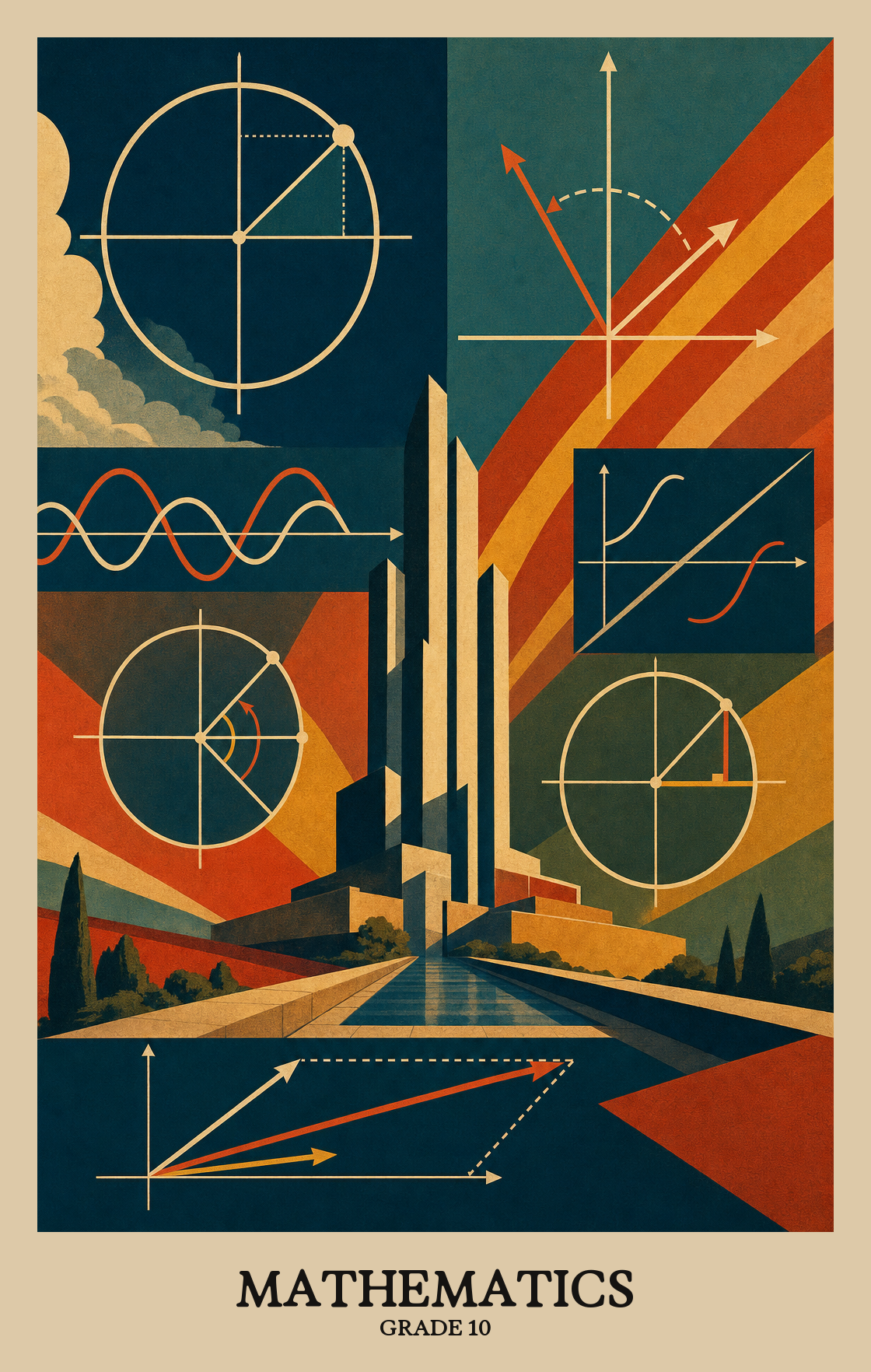
Students start the year working with numbers that combine a regular part and an imaginary part. They add, subtract, multiply, and graph these numbers, and use them to solve equations that ordinary numbers cannot.
Students move into the trigonometry built around right triangles and the unit circle. They learn to undo a trig function to find a missing angle, which is the same math behind ramps, roof pitches, and GPS direction.
Students learn shortcut rules that connect sine, cosine, and tangent. These rules let them rewrite tricky expressions in a simpler form and find exact values for angles that are double or half of a familiar one.
Students end the year applying complex numbers and trigonometry to harder problems. They solve equations, simplify long expressions, and use these tools in the kind of setup they will see in precalculus and beyond.
Students work with numbers in real-world contexts, including very large or very small values, quantities with units, and patterns that grow or shrink. The focus is on understanding what numbers represent, not just calculating with them.
Algebra is the branch of math where students use letters and symbols to represent unknown values, write equations, and solve for missing numbers in real-world and abstract problems.
| Standard | Definition | Code |
|---|---|---|
| Number and Quantity | Students work with numbers in real-world contexts, including very large or very small values, quantities with units, and patterns that grow or shrink. The focus is on understanding what numbers represent, not just calculating with them. | N |
| Algebra | Algebra is the branch of math where students use letters and symbols to represent unknown values, write equations, and solve for missing numbers in real-world and abstract problems. | A |
Students work with imaginary and complex numbers, learning how addition, subtraction, and multiplication apply to them the same way those operations work with real numbers.
| Standard | Definition | Code |
|---|---|---|
| Apply properties of complex numbers and the complex number system | Students work with imaginary and complex numbers, learning how addition, subtraction, and multiplication apply to them the same way those operations work with real numbers. | PC.N.1. |
Students use inverse trig functions (like arcsin or arccos) to work backwards from a ratio to find a missing angle in a triangle or on the unit circle.
Students use double angle formulas to rewrite expressions like sin(2x) or cos(2x) in terms of a single angle, then solve trigonometric equations that would be hard to work with otherwise.
Students use the equation sin²(x) + cos²(x) = 1 to rewrite and simplify trig expressions. This identity connects the sine and cosine of any angle and shows up constantly when solving equations or proving other trig relationships.
| Standard | Definition | Code |
|---|---|---|
| inverse trigonometric functions | Students use inverse trig functions (like arcsin or arccos) to work backwards from a ratio to find a missing angle in a triangle or on the unit circle. | PC.A.2.3a |
| double angle formulas | Students use double angle formulas to rewrite expressions like sin(2x) or cos(2x) in terms of a single angle, then solve trigonometric equations that would be hard to work with otherwise. | PC.A.2.3b |
| Pythagorean identities | Students use the equation sin²(x) + cos²(x) = 1 to rewrite and simplify trig expressions. This identity connects the sine and cosine of any angle and shows up constantly when solving equations or proving other trig relationships. | PC.A.2.3c |
End-of-course assessment for NC Math 1, administered when students complete the course.
End-of-course assessment for NC Math 3, administered when students complete the course.
Alternate assessment for eligible students with significant cognitive disabilities, covering state-tested grades and subjects.
Students work with trigonometry in depth, including sine, cosine, and tangent on the unit circle. They also learn about complex numbers, which extend regular numbers to include the square root of negative one. Expect a lot of equations, graphs, and angle work.
Ask students to explain a problem out loud before solving it. A blank sheet of paper and a calculator usually beat a worked example. If a student is stuck on a triangle or angle problem, have them sketch it first.
Complex numbers include a part called i, which stands for the square root of negative one. They show up when equations have no regular number answer. Students learn to add, multiply, and graph them, which sets up later work in engineering and physics.
Start with right triangle trig and the unit circle so students have a strong base. Move into graphs of sine and cosine, then into identities and inverse functions. Save double angle work for after students are comfortable with the Pythagorean identities.
Inverse trig functions and their restricted ranges trip up most students. The Pythagorean identities also need repeated practice because students memorize them without understanding where they come from. Build in short retrieval practice across units.
Students should solve trig equations, simplify expressions using identities, and use inverse trig functions to find angles. They should also work confidently with complex numbers in both rectangular and polar form. Fluency with the unit circle is a good quick check.
A ready student can pick the right identity for a given problem without prompting and can graph a trig function from its equation. They can also explain why i squared equals negative one. Speed matters less than being able to reason through unfamiliar problems.
Students should know the Pythagorean identities and the basic double angle formulas by heart. Other identities can be derived from those. Flashcards help, but practicing problems that use the identities works better than rote review.