Skip to content

What does a student learn in ?

This is the year world history opens up from 1500 to today. Students trace how empires, religions, and trade reshaped every continent, then follow the chain of revolutions, world wars, and Cold War standoffs that built the modern map. Along the way, they weigh sources, spot bias, and back up arguments with real evidence. By spring, students can explain a major event like World War I or decolonization and point to the causes and consequences behind it.

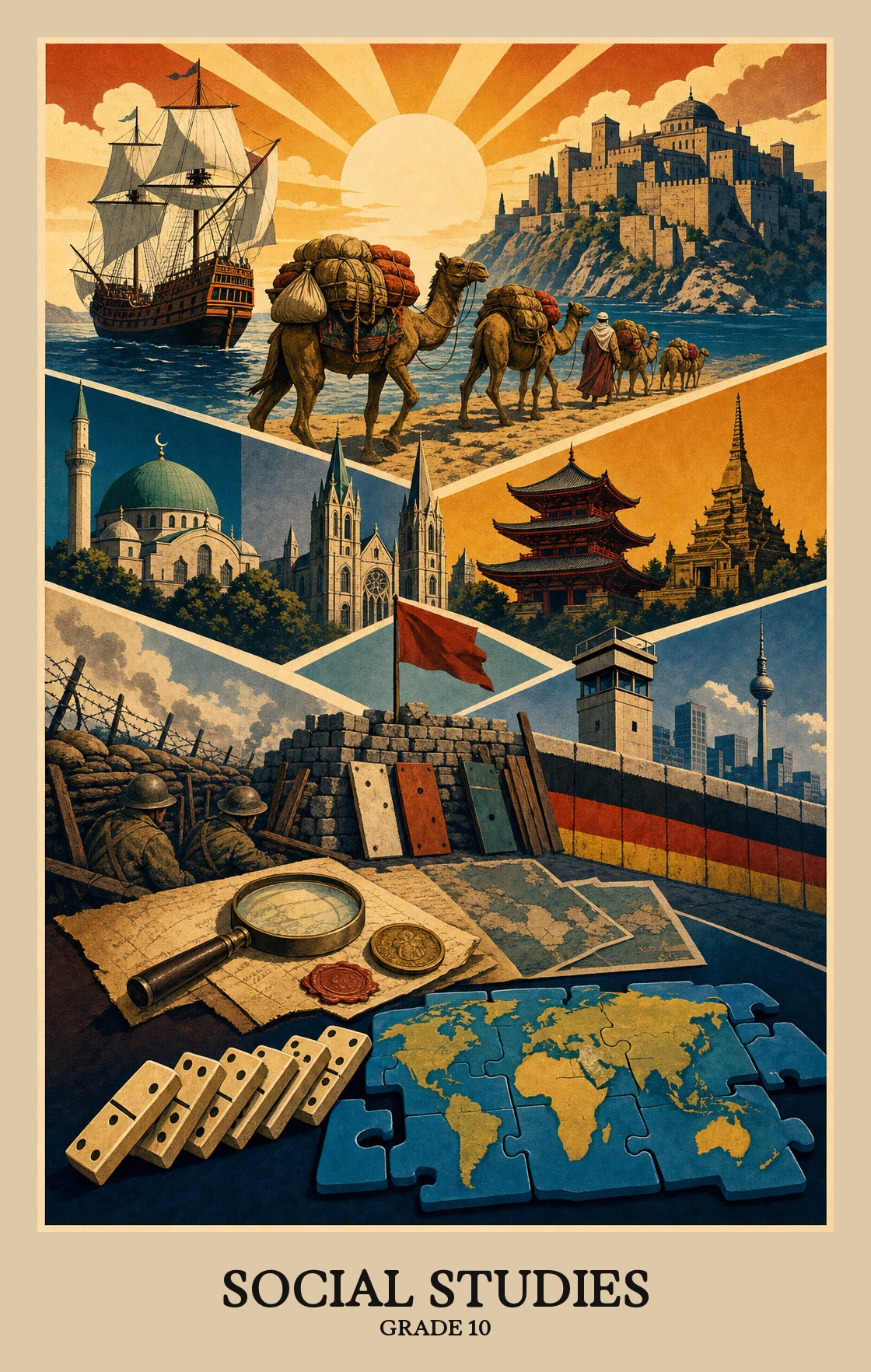
Illustration of what students learn in Grade 10 Social Studies
  • World history
  • Revolutions
  • World wars
  • Cold War
  • Global trade
  • Using evidence
Source: Virginia Virginia Standards of Learning
Year at a glance
How the year usually goes. Every school and district set their own curriculum, so treat this as a guide, not official pacing.
  1. 1

    A connected world around 1500

    Students start the year by mapping the major empires, religions, and trade routes that linked Europe, Asia, Africa, and the Americas. They look at how goods, ideas, and beliefs moved between regions before the modern era began.

  2. 2

    Renaissance, Reformation, and exploration

    Students study how new ideas, the printing press, and religious splits reshaped Europe, then trace how exploration and colonization changed life for people in Africa, Asia, and the Americas. Expect dinner-table questions about Martin Luther and the cost of empire.

  3. 3

    Revolutions and Enlightenment ideas

    Students follow the chain from the Scientific Revolution and Enlightenment thinkers to the American, French, and Latin American Revolutions. They see where ideas like rights, consent, and limited government came from and how they shaped Virginia and the United States.

  4. 4

    Asia, Africa, and industrial change

    Students look at powerful societies in Asia and sub-Saharan Africa during this same stretch, then turn to the Industrial Revolutions and the spread of European empires in the 1800s. They weigh the gains in technology against the human cost of imperialism and the slave trade.

  5. 5

    Two world wars and the Holocaust

    Students work through the causes, major battles, and leaders of World War I and World War II, including the Russian Revolution, the Great Depression, and the rise of dictators. They study the Holocaust in depth and examine how the world tried to rebuild and prevent it from happening again.

  6. 6

    Cold War to the present

    Students close the year with the Cold War, independence movements in Asia and Africa, and the issues shaping the world today. They look at genocide, terrorism, refugees, technology, and global trade, and connect current headlines to the history they have studied.

Mastery Learning Standards
The required skills a student should display by the end of Grade 10.
Skills
  • The student will apply history and social science skills to the content by

    S.WHII

    Reading maps, timelines, and primary sources, students practice the core skills historians use: analyzing evidence, identifying cause and effect, and drawing conclusions from what they find.

  • selecting and synthesizing evidence from information sources, including

    S.WHII.a

    Students gather facts from multiple sources (maps, photographs, documents, charts) and combine them into a single, well-supported explanation of a historical event. One source alone is not enough.

  • applying geographic skills to determine and predict patterns and trends of…

    S.WHII.b

    Students read maps, population data, and geographic patterns to explain why events happened where they did and predict where similar trends might appear next.

  • questioning to construct arguments, using evidence from multiple sources

    S.WHII.c

    Students build an argument by pulling evidence from more than one source, then using that evidence to answer a historical question. The focus is on how well the sources support the case, not just what they say.

  • investigating and analyzing evidence from multiple sources to construct…

    S.WHII.d

    Students read multiple sources on the same topic, compare what those sources say, and build a written argument backed by specific evidence. The skill is about weighing what sources actually show, not just summarizing them.

  • comparing and contrasting historical, cultural, economic

    S.WHII.e

    Comparing two events, groups, or ideas means finding what they share and where they differ. Students look at how people in different times and places thought about history, culture, money, and power differently from one another.

  • determining cause and effect to analyze connections

    S.WHII.f

    Students trace why major events happened and what they set in motion, connecting causes to effects across time periods and regions.

  • using decision-making models, including

    S.WHII.g

    Students practice making decisions by weighing the reasons behind a historical choice and what happened as a result. They use simple tools like comparison charts to organize their thinking before drawing a conclusion.

  • engaging and communicating as an informed individual with…

    S.WHII.h

    Students practice seeing an issue from more than one side, then explain their thinking clearly to someone who disagrees. The goal is to reason through real disagreements, not just repeat one viewpoint.

  • developing products that reflect an understanding of research and content to…

    S.WHII.i

    Students take what they've learned in class and turn it into something real, like a presentation, essay, or project that connects history to the world they live in today.

  • contextualizing and corroborating sources for credibility, propaganda

    S.WHII.j

    Students compare multiple sources on the same event, checking each one for bias or propaganda, then look for patterns across those sources to build a more accurate picture of the modern world.

Emergence of a Global Age
  • The student will apply history and social science skills to analyze the…

    WHII.1

    Around 1500, the world was on the edge of major change. Students study what life, trade, government, and geography looked like across Europe, Africa, Asia, and the Americas just before those regions collided and reshaped each other.

  • locating major states and empires

    WHII.1.a

    Students locate the major empires and kingdoms that controlled large parts of the world around 1500, such as the Ottoman Empire, Ming China, and the Aztec and Inca empires in the Americas.

  • describing the beliefs, sacred writings, traditions, customs

    WHII.1.b

    Students describe the core beliefs, sacred texts, and traditions of major world religions around 1500 A.D., including Buddhism, Christianity, Hinduism, Islam, Judaism, and Sikhism, and explain how each faith spread during that period.

  • analyzing major trade patterns, regional and global interactions, cultural…

    WHII.1.c

    Students trace which goods, ideas, and inventions traveled along major trade routes around 1500, and explain how those exchanges changed the societies sending and receiving them.

  • The student will apply history and social science skills to analyze the…

    WHII.2

    The Renaissance and Protestant Reformation reshaped how Europeans thought about art, religion, and individual power. Students examine how those shifts changed governments, churches, and daily life across the Western world.

  • explaining the effects of the theological, political

    WHII.2.a

    Students examine how religious disagreements in 16th-century Europe led to new churches, political conflicts, and shifts in who held power. The actions of figures like Martin Luther and Henry VIII reshaped governments and daily life across the continent.

  • describing how the Renaissance and Reformation led to changing cultural…

    WHII.2.b

    Students examine how new ideas about art, religion, and human potential spread across Europe during the 1400s and 1500s, and how the printing press turned those ideas into books that reached ordinary people faster than ever before.

  • describing the effect of religious conflicts on society and government actions…

    WHII.2.c

    Students examine how religious disputes in Europe led governments and churches to crack down on dissent, reshape laws, and redraw political boundaries. The Inquisition and Catholic Reformation show what happens when faith and state power collide.

  • The student will apply history and social science skills to describe European…

    WHII.3

    Students learn why European explorers set sail in the 1400s and 1500s, where they went, and what happened when they arrived. The focus is on the forces that pushed Europe outward and the lasting effects of those first contacts.

  • explaining the political, social, cultural

    WHII.3.a

    Students explain why European nations sent explorers abroad: to gain wealth, expand trade, spread religion, and build political power. Those goals shaped which lands they claimed and how they treated the people already living there.

  • comparing and contrasting the social, political, economic

    WHII.3.b

    Colonization changed daily life, government, and trade across Africa, Asia, and the Americas. Students compare what Europeans gained with what Indigenous peoples lost, resisted, or adapted to.

  • analyzing how competition for colonies among Britain, France

    WHII.3.c

    Students study how Britain, France, and Spain raced to claim colonies and how that rivalry shifted trade patterns, created new markets, and moved wealth around Europe in ways that changed how economies worked.

Age of Revolutions
  • The student will apply history and social science skills to analyze the…

    WHII.4

    Students examine why ordinary people in Europe, Russia, and the Americas eventually rebelled against their governments between 1500 and 1800. They look at how poverty, religion, geography, and political power shaped the tensions that pushed societies toward revolution.

  • describing the series of wars in Europe, including

    WHII.4.a

    Students trace the religious and political wars that fractured Europe between the 1500s and 1600s, including conflicts like the Thirty Years War and the Dutch Revolt, and explain what caused them.

  • defining and describing how the Scientific Revolution and Enlightenment…

    WHII.4.b

    Students trace how scientists and philosophers like Locke, Newton, and Rousseau convinced Europeans to question kings, churches, and old ideas about nature by applying reason and evidence instead of tradition.

  • analyzing Enlightenment themes and how they influenced the political…

    WHII.4.c

    Students trace how Enlightenment ideas about reason, rights, and self-government shaped the laws and governing structures of Virginia and the United States.

  • describing the Age of Absolutism with emphasis on the development of France and…

    WHII.4.d

    Students study how kings like Louis XIV of France and Charles V of the Habsburg Empire ruled with nearly unlimited power, controlling armies, taxes, and law without sharing authority with a parliament or the people.

  • describing the development of constitutional monarchy in Great Britain, with…

    WHII.4.e

    Students trace how England shifted from rule by kings alone to rule shared with Parliament, looking closely at the Civil War of the 1640s and the Glorious Revolution of 1688 as the turning points.

  • explaining the influence of the American Revolution on the causes and effects…

    WHII.4.f

    Students trace how the American Revolution gave French and Latin American rebels a working model for overthrowing colonial or royal rule, then explain what changed in those countries as a result.

  • assessing the effect of Napoleon and the Congress of Vienna on political power…

    WHII.4.g

    Students examine how Napoleon's rise and fall reshaped the map of Europe, then look at how European leaders tried to restore the old political order at the Congress of Vienna.

Global Interactions
  • The student will apply history and social science skills to understand Asia…

    WHII.5

    Students examine how Asian civilizations, particularly in China, Japan, and India, responded to trade, religion, and contact with European powers during the 1500s through 1800s. The focus is on how those choices shaped each region's politics and culture.

  • describing the location and development of previously established trade routes…

    WHII.5.a

    Students trace why the Ottoman Empire lasted so long, looking at where its trade routes ran, how religion shaped its rule, and what kept it powerful for centuries.

  • describing the location and development of northern and southern empires in…

    WHII.5.b

    Students learn how empires rose and traded across India during this period, tracing the northern Mughal Empire and the southern kingdoms, the ports where goods moved, and how the Sikh faith grew as a challenge to Mughal rule.

  • describing the location, origins

    WHII.5.c

    Students trace how China's Ming and Qing dynasties grew, who ruled, and how people lived, including how borders expanded and what customs, arts, and social patterns shaped daily life during those centuries.

  • describing the location, origins

    WHII.5.d

    Students learn how Japan closed itself off from most foreign contact under the Tokugawa shogunate, who held real power while the Emperor served a ceremonial role, and how religion shaped daily life during that era.

  • The student will apply history and social science skills to understand…

    WHII.6

    During this period, students study the kingdoms and societies of sub-Saharan Africa, the Atlantic slave trade, and how contact with European traders reshaped the region. They trace causes, effects, and connections across roughly three centuries of African history.

  • describing the location and development of Eastern and Western Africa

    WHII.6.a

    Students identify where Eastern and Western African kingdoms were located and explain how they grew, traded, and changed between roughly 1500 and 1800.

  • explaining the influence of Askia Muhammad in the region

    WHII.6.b

    Askia Muhammad ruled the Songhai Empire in West Africa and expanded its territory, trade networks, and Islamic scholarship, making it one of the most powerful states on the continent during the 1500s.

  • analyzing the role of religion in Eastern and Western Africa, including Islam…

    WHII.6.c

    Students examine how religion shaped daily life and political power in African kingdoms, looking at Islam in Songhai, Coptic Christianity in Ethiopia, and Animist traditions in the Songhai and Asante Empires.

  • analyzing the role of the Ashanti and other powerful Western African empires in…

    WHII.6.d

    Students examine how the Ashanti and other West African kingdoms participated in the Transatlantic Slave Trade, including who held power, who profited, and how the trade reshaped the region over those three centuries.

  • examining the Swahili trade network and its impacts on Eastern Africa

    WHII.6.e

    The Swahili coast connected East African ports to traders from Arabia, Persia, and India. Students examine how that trade shaped the cities, culture, and wealth of the region between 1500 and 1800.

  • comparing and contrasting the development of Central and Southern Africa…

    WHII.6.f

    Students compare how empires like the Songhai, Asante, Kongo, and Zulu built and ran their governments between 1500 and 1800, looking at what those political systems had in common and where they differed.

  • analyzing the adoption of African Christianity in Kongo and comparing it to the…

    WHII.6.g

    Students look at how the Kongo kingdom blended Christianity with local beliefs and compare that religious life to the traditional spiritual practices of the Zulu people during the same period.

  • identifying trading partners, resources

    WHII.6.h

    Students identify which goods, like gold, ivory, or cloth, moved between Central and Southern African empires and their trading partners during this period, and what each region had to offer the other.

  • The student will apply history and social science skills to analyze the global…

    WHII.7

    Students examine how European countries reshaped the wider world during the 1800s. They look at political shifts, economic changes, and the spread of empires to understand how decisions made in Europe affected people far beyond its borders.

  • explaining the roles of resources, capital

    WHII.7.a

    Students learn why factories and industries took off in 19th-century Europe: who supplied the raw materials, who provided the money, and who built the businesses that turned both into profit.

  • analyzing the effects of the First and Second Industrial Revolutions

    WHII.7.b

    The Industrial Revolution turned farming villages into factory cities and hand labor into machine labor. Students examine how those shifts reshaped work, family life, trade, and the gap between rich and poor across Europe and beyond.

  • evaluating responses to imperialism, including

    WHII.7.c

    Students examine how colonized peoples pushed back against European rule. They look at specific uprisings, like a soldier revolt in India and a violent anti-foreign movement in China, to understand why resistance happened and what it changed.

  • explaining the events related to the unification of Italy and the role of…

    WHII.7.d

    Nationalism pushed Italians to unite dozens of separate kingdoms into one country by the 1870s. Students explain the key events and leaders that made Italian unification happen, and why Italians' shared identity drove the movement.

  • explaining the events related to the unification of Germany and the role of…

    WHII.7.e

    Students learn how Otto von Bismarck united dozens of separate German states into one nation by the 1870s, using war, political deals, and Prussian military strength to force rivals into line.

Era of Global Wars
  • The student will apply history and social science skills to understand World…

    WHII.8

    Students trace how a single assassination in 1914 pulled Europe's competing alliances into a world war, then examine trench warfare, new weapons, and the peace settlement that reshaped national borders and planted the seeds of the next conflict.

  • explaining economic and political causes and identifying major events and…

    WHII.8.a

    Students explain what pushed Europe into World War I, from rivalry between empires to the assassination of Archduke Franz Ferdinand, and identify the leaders who shaped the war's course.

  • identifying the changes to modern warfare exemplified in battles along the…

    WHII.8.b

    Trench warfare, poison gas, and machine guns changed how wars were fought. Students study key battles on the Eastern and Western fronts to see how these weapons and tactics made World War I deadlier than any conflict before it.

  • describing major battles, including

    WHII.8.c

    Students study the major battles of World War I, looking at where they were fought, what made each one significant, and how they shaped the course of the war.

  • analyzing and explaining the terms of the Treaty of Versailles, the actions of…

    WHII.8.d

    Students study what the winning countries demanded of Germany after World War I, including the penalties Germany had to pay, the new borders drawn, and the international organization created to prevent future wars.

  • identifying the causes and consequences of the Russian Revolution

    WHII.8.e

    Students learn what drove Russia's 1917 revolution and what followed: why ordinary Russians turned against the tsar, how the Bolsheviks took power, and how that shift reshaped the country and the wider war.

  • explaining the causes and effects of worldwide depression in the 1930s

    WHII.8.f

    Students trace how the global economy collapsed after World War I, leading to mass unemployment and political instability through the 1930s. They connect the causes, like debt and overproduction, to the hardships that reshaped governments worldwide.

  • examining the rise of totalitarianism

    WHII.8.g

    Students study how leaders in the 1920s and 1930s seized total control of their governments, using propaganda, fear, and force to silence opposition. They look at how these regimes took root in places like Italy, Germany, and the Soviet Union.

  • The student will apply history and social science skills to understand World…

    WHII.9

    Students examine how World War II started, how it spread across Europe and the Pacific, and how the war ended. They look at the causes, major turning points, and the lasting effects the conflict had on the modern world.

  • explaining economic and political causes and identifying major events and…

    WHII.9.a

    Students trace how economic collapse and political extremism pulled nations into World War II, and study the decisions made by leaders like Churchill, Hitler, Roosevelt, and Stalin that shaped how the war unfolded.

  • describing the major battles, including

    WHII.9.b

    Students learn where the war's biggest turning points happened on land and sea. Each battle, from Stalingrad to Normandy, shows how geography, strategy, and momentum shifted the outcome of the war.

  • identifying the role of technology in the war, including

    WHII.9.c

    Students study how new technology shaped the outcome of World War II, from radar and submarines to early computers and the atomic bomb.

  • describing key causes, events, victims

    WHII.9.d

    Students study the Holocaust from start to finish: the antisemitism and Nazi rise to power that made it possible, the violence of Kristallnacht, the ghettos and death camps, and the resistance and liberation that followed.

  • examining the effects of the war, with emphasis on the terms of the peace, the…

    WHII.9.e

    After World War II ended, students examine what the peace agreements actually required, how war criminals were put on trial, and how organizations like the United Nations were built to prevent another global war.

  • describing the heroic aspects, including

    WHII.9.f

    Students study moments when soldiers, civilians, and resistance fighters took extraordinary risks to turn the tide of the war, from the Normandy beach landings to secret operations behind enemy lines.

Era of Global Change
  • The student will apply history and social science skills to understand the…

    WHII.10

    Students examine how the United States and Soviet Union competed for global influence after World War II without fighting each other directly. This rivalry shaped alliances, wars by proxy, and the daily fear of nuclear conflict for decades.

  • explaining the causes, the domino theory, the role of containment

    WHII.10.a

    Students learn why the U.S. and Soviet Union became rivals after World War II, what each country's government and economy looked like, and why American leaders believed stopping the spread of communism in one country could prevent it from spreading to its neighbors.

  • describing the events, conflicts

    WHII.10.b

    Students learn the flashpoints where the U.S. and Soviet Union came closest to open war, from the Berlin Blockade to the Cuban Missile Crisis, and examine how secret operations shaped the conflict behind the scenes.

  • describing conflicts, events

    WHII.10.c

    Students trace how power shifted across Asia during the Cold War, focusing on leaders like Mao Zedong and Ho Chi Minh, the civil war in China, the conflict in Vietnam, and the 1989 protests in Tiananmen Square.

  • explaining the collapse of communism in the Soviet Union and Eastern Europe and…

    WHII.10.d

    Students learn why the Soviet Union and communist governments in Eastern Europe fell apart by the early 1990s, and what specific leaders like Gorbachev, Reagan, and others did to speed that collapse.

  • examining the political and economic causes and global consequences of the…

    WHII.10.e

    The Soviet Union collapsed in 1991, ending decades of communist rule. Students examine what political and economic pressures caused that collapse and how the fallout reshaped governments, borders, and economies across the world.

  • analyzing how nations around the world developed a culture of global…

    WHII.10.f

    Countries began relying on each other for trade, security, and ideas in ways that made one nation's problems everybody's problems. Students examine how those connections grew after World War II and why they still shape world events today.

  • The student will apply history and social science skills to identify the…

    WHII.11

    Students examine how countries in Africa, Asia, and the Middle East broke free from colonial rule after World War II. They look at what drove those independence movements and what changed politically and economically once new nations formed.

  • describing the struggles for self-rule, including Gandhi’s leadership and the…

    WHII.11.a

    Students examine how India broke free from British rule, focusing on Gandhi's nonviolent protests and the political steps that turned a independence movement into a functioning democracy.

  • describing African independence movements in Ghana, Algeria, Kenya

    WHII.11.b

    Students study how Ghana, Algeria, Kenya, and South Africa broke free from European colonial rule, including the roles leaders like Jomo Kenyatta and Nelson Mandela played in winning independence for their countries.

  • describing the end of the League of Nations’ mandate system and the creation of…

    WHII.11.c

    Students learn how new countries formed in the Middle East after World War II, including how the League of Nations' mandate system ended and what leaders like Golda Meir and Gamal Abdel Nasser did to shape those new nations.

  • explaining the effects of decolonization and other methods of gaining…

    WHII.11.d

    Students examine what happened after colonies broke free from European control, looking at how new nations built governments, handled poverty, and dealt with borders drawn by outsiders.

  • The student will apply history and social science skills to explain global…

    WHII.12

    Students examine major world events from the early 2000s onward, including conflicts, economic shifts, and political change. They practice explaining how those events connect across countries and why they still matter today.

  • identifying modern era genocides and crimes against humanity, including

    WHII.12.a

    Students learn to recognize mass atrocities and government-led persecution from the 20th and 21st centuries, studying specific cases where millions of civilians were killed or oppressed by their own governments.

  • identifying contemporary economic and political issues and ethnic and religious…

    WHII.12.b

    Students identify why large groups of people flee their home countries today, looking at economic hardship, political unrest, and religious or ethnic conflict as causes of refugee crises.

  • examine the development, role

    WHII.12.c

    Students look at how technology changed everyday life and world events after 2000, focusing on what social media, chemical advances, and biological tools actually did to societies, economies, and conflicts.

  • analyzing the increasing impact, events

    WHII.12.d

    Students study the events and conditions that gave rise to international terrorism, including specific attacks like the Lockerbie bombing and the 2011 Breivik shootings, and explain why these incidents happened and how their impact grew over time.

  • describing economic interdependence, including the rise of multinational…

    WHII.12.e

    Students learn how countries depend on each other economically, including how large companies operate across borders, how international organizations like the World Trade Organization work, and what trade agreements between nations actually do.

Assessments
The state tests students at this grade and subject take.
State Summative

SOL End-of-Course: History and Social Science

High school end-of-course history and social science assessments, including World History, World Geography, and Virginia and U.S. History.

When given:
end-of-course
Frequency:
by course completion
Official source
Common Questions
  • What does this year of social studies actually cover?

    Students study world history from about 1500 to today. That includes the Renaissance and Reformation, European exploration, revolutions, the two World Wars, the Cold War, and global issues like terrorism and migration. The year moves in roughly chronological order across about five centuries.

  • How can a parent help with so much memorization of names and dates?

    Skip the flashcards and ask students to explain why something happened. Pick one event from the week, like the French Revolution or Pearl Harbor, and ask what caused it and what changed afterward. Ten minutes of cause-and-effect talk at dinner does more than a list of dates.

  • How should the year be paced across so much content?

    A common split is one quarter on 1500 to 1750 (exploration, Reformation, early empires), one quarter on revolutions and industrialization, one quarter on the World Wars and Holocaust, and one quarter on the Cold War through today. Building in two weeks of slack for review and writing keeps the spring from collapsing.

  • What skills matter most beyond the history content?

    Students are expected to read primary sources, compare points of view, weigh evidence from charts and maps, and build arguments using more than one source. Source analysis and written argument carry more weight than recalling facts in isolation.

  • What can be done at home to support reading dense history texts?

    Before a chapter, ask students to read the headings and predict what the section is about. After reading, ask them to summarize one paragraph in a sentence. If a primary source comes home, read it together and ask who wrote it and why.

  • Which topics usually need the most reteaching?

    The Enlightenment, the causes of World War I, and the Cold War tend to be the stickiest. Students confuse the philosophers, mix up alliances, and struggle to see why containment mattered. Plan extra time and a second pass on these before assessments.

  • How should students practice writing arguments from sources?

    Short, frequent writing beats one big essay. A weekly paragraph that uses two sources to answer a focused question, like why an empire fell or why a revolution started, builds the habit. Feedback should push for specific evidence, not longer paragraphs.

  • How does this connect to topics in the news?

    Refugee crises, trade disputes, and conflicts in the Middle East all link back to material from this year, including decolonization, the Cold War, and the mandate system. Ask students to find one news story a week and trace it to something they studied.

  • How can readiness for AP or college history be judged by spring?

    Students should be able to read a primary source they have never seen, identify the author's point of view, and use it as evidence in a written claim. If they can do that in 25 minutes with a short document, they are ready for the next level.

  • What if a student finds the wars and genocides upsetting?

    That reaction is appropriate. Topics like the Holocaust, Rwanda, and Cambodia are meant to be taken seriously. Talk through what they read, let them ask questions, and reach out to the teacher if a specific unit is hard to sit with.