Adding and subtracting to 20
Students solve story problems by adding and taking away. They learn quick tricks like counting on from a number and making a ten to find answers up to twenty.
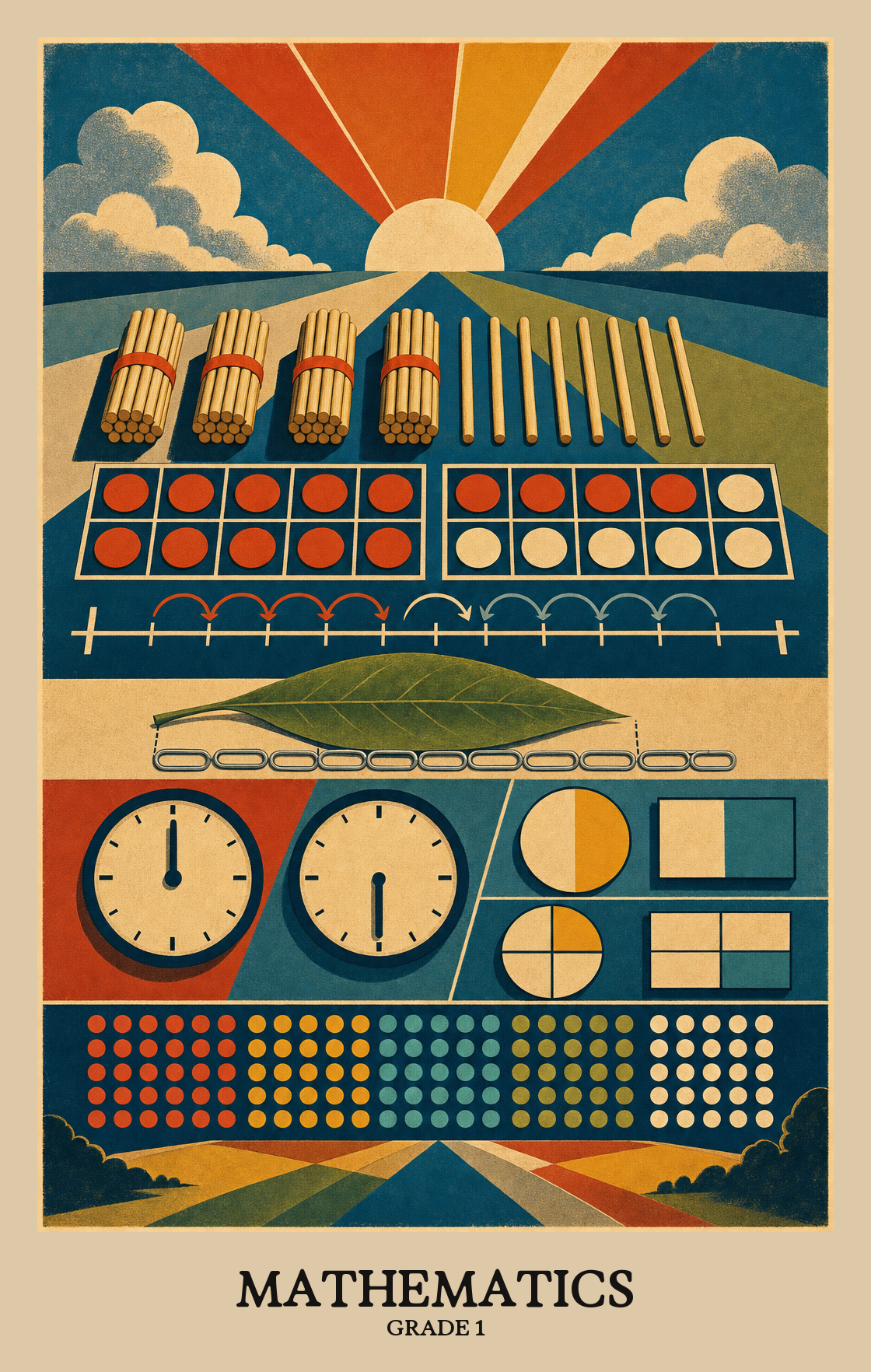
This is the year math jumps from counting single objects to thinking in groups of ten. Students add and subtract within 20, and they start to see that a number like 47 means four tens and seven ones. They count all the way to 120, measure things with paper clips or blocks lined up end to end, and tell time on a clock to the hour and half-hour. By spring, they can split a circle or rectangle into halves and fourths and explain which piece is bigger.
Students solve story problems by adding and taking away. They learn quick tricks like counting on from a number and making a ten to find answers up to twenty.
Students learn that the equal sign means both sides match. They figure out missing numbers in problems like 8 plus blank equals 11 and decide if a number sentence is true or false.
Students count all the way to 120 and start to see numbers as groups of tens and leftover ones. They compare two-digit numbers and learn that a dime is the same as ten pennies.
Students add two-digit numbers using drawings and place value, including jumps of ten. They can quickly say what number is ten more or ten less without counting one by one.
Students line up objects to measure length with no gaps. They tell time on clocks to the hour and half hour, and sort information into simple charts to answer questions.
Students build and draw shapes, then put them together to make new ones. They split circles and rectangles into halves and fourths and follow rules to create patterns.
Students solve simple add-and-subtract word problems, using objects, drawings, or number sentences to show their thinking. Problems involve totals up to 20.
Students solve simple addition and subtraction story problems where a number is missing, using drawings, objects, or equations. Problems go up to 20 and include scenarios like combining groups, removing items, or comparing two amounts.
Three numbers get added together in a story problem, with the total staying at 20 or under. Students use objects, drawings, or number sentences to find the missing piece.
Adding and subtracting are opposites. Students learn that if 3 + 4 = 7, then 7 - 4 = 3, and use that connection to solve simple number problems faster.
Students learn that they can flip the order of two numbers they are adding and still get the same answer. They also practice grouping numbers in different ways to make adding easier, like spotting a pair that adds up to ten first.
Subtraction is just a missing-number puzzle. Students figure out what to add to one number to reach the other, so 10 minus 8 becomes "8 plus what equals 10?"
Students add and subtract numbers up to 20. This is the foundation for most math they'll do in first grade, from counting on fingers to working through simple story problems.
Counting forward and backward is the same thing as adding and subtracting. Students practice starting at a number and counting on to add, or counting back to subtract, instead of starting from zero every time.
Students add and subtract numbers up to 20 using shortcuts like counting on, breaking numbers apart to make a 10, or flipping an addition fact to solve a subtraction problem. The goal is quick, reliable answers up to 10 from memory.
Students practice writing addition and subtraction number sentences that balance on both sides, like 4 + 3 = 7 and 7 - 3 = 4. They learn that the equals sign means "the same as," not just "the answer goes here."
Students learn that the equal sign means "both sides are the same amount," then decide if a number sentence like 7 = 8 - 1 is true or false. They also spot the difference between a number sentence with an equal sign and one without.
Students figure out the missing number in an addition or subtraction problem, such as 8 + ? = 11 or 5 = ? - 3. The missing number can appear anywhere in the equation.
| Standard | Definition | Code |
|---|---|---|
| Represent and solve problems involving addition and subtraction | Students solve simple add-and-subtract word problems, using objects, drawings, or number sentences to show their thinking. Problems involve totals up to 20. | 1.OAT.1 |
| Use addition and subtraction within 20 to solve word problems involving… | Students solve simple addition and subtraction story problems where a number is missing, using drawings, objects, or equations. Problems go up to 20 and include scenarios like combining groups, removing items, or comparing two amounts. | M.1.1 |
| Solve word problems that call for addition of three whole numbers whose sum is… | Three numbers get added together in a story problem, with the total staying at 20 or under. Students use objects, drawings, or number sentences to find the missing piece. | M.1.2 |
| Understand and apply properties of operations and the relationship between… | Adding and subtracting are opposites. Students learn that if 3 + 4 = 7, then 7 - 4 = 3, and use that connection to solve simple number problems faster. | 1.OAT.2 |
| Apply properties of operations as strategies to add and subtract | Students learn that they can flip the order of two numbers they are adding and still get the same answer. They also practice grouping numbers in different ways to make adding easier, like spotting a pair that adds up to ten first. | M.1.3 |
| Understand subtraction as an unknown-addend problem | Subtraction is just a missing-number puzzle. Students figure out what to add to one number to reach the other, so 10 minus 8 becomes "8 plus what equals 10?" | M.1.4 |
| Add and subtract within 20 | Students add and subtract numbers up to 20. This is the foundation for most math they'll do in first grade, from counting on fingers to working through simple story problems. | 1.OAT.3 |
| Relate counting to addition and subtraction | Counting forward and backward is the same thing as adding and subtracting. Students practice starting at a number and counting on to add, or counting back to subtract, instead of starting from zero every time. | M.1.5 |
| Add and subtract within 20, demonstrating fluency for addition and subtraction… | Students add and subtract numbers up to 20 using shortcuts like counting on, breaking numbers apart to make a 10, or flipping an addition fact to solve a subtraction problem. The goal is quick, reliable answers up to 10 from memory. | M.1.6 |
| Work with addition and subtraction equations | Students practice writing addition and subtraction number sentences that balance on both sides, like 4 + 3 = 7 and 7 - 3 = 4. They learn that the equals sign means "the same as," not just "the answer goes here." | 1.OAT.4 |
| Understand the meaning of the equal sign | Students learn that the equal sign means "both sides are the same amount," then decide if a number sentence like 7 = 8 - 1 is true or false. They also spot the difference between a number sentence with an equal sign and one without. | M.1.7 |
| Determine the unknown whole number in an addition or subtraction equation… | Students figure out the missing number in an addition or subtraction problem, such as 8 + ? = 11 or 5 = ? - 3. The missing number can appear anywhere in the equation. | M.1.8 |
Students count forward and backward past 100, filling in missing numbers on a number line or chart. The focus is on understanding what comes before and after any number, not just reciting from 1.
Students count forward to 120 starting from any number, read and write those numbers, and skip count by 2s, 5s, and 10s. Think of it as counting by every other number, by nickels, or by dimes up to 120.
Students learn that the position of a digit in a number tells you its value. The "1" in 14 means one ten, not one unit.
A two-digit number like 47 means 4 tens and 7 ones. Students learn to break apart any two-digit number into its tens and ones so they can see how the parts add up to the whole.
Ten single things grouped together make one "ten." Students learn that ten pennies, ten blocks, or ten of anything can be treated as one group, which is how place value in larger numbers works.
Numbers like 13 or 17 are built from one group of ten plus some leftover ones. Students learn to see 14 as "ten and four," not just a single symbol.
Counting by tens means 30 is three groups of ten, 50 is five groups of ten, and so on. Students learn that each round number on the number line is just a count of how many tens fit inside it.
Students look at two two-digit numbers and decide which is bigger, smaller, or equal by thinking about how many tens and ones each number has. They record the answer using the symbols >, =, or <.
Students add and subtract numbers up to 100 by thinking about tens and ones. Knowing that 34 is three tens and four ones helps them break numbers apart and put them back together.
Students practice adding numbers up to 100, like 47 + 6 or 47 + 30, by using blocks or drawings to see how tens and ones fit together. They learn to explain how they got the answer.
Students look at a two-digit number and figure out what it would be with one more or one fewer ten, without counting up or back. They also explain how they know.
Students subtract round numbers by tens, like 70 minus 40, using blocks or drawings. They explain how they got the answer and connect it to what they know about addition.
| Standard | Definition | Code |
|---|---|---|
| Extend the counting sequence | Students count forward and backward past 100, filling in missing numbers on a number line or chart. The focus is on understanding what comes before and after any number, not just reciting from 1. | 1.NOBT.1 |
| Count to 120, starting at any number less than 120 | Students count forward to 120 starting from any number, read and write those numbers, and skip count by 2s, 5s, and 10s. Think of it as counting by every other number, by nickels, or by dimes up to 120. | M.1.9 |
| Understand place value | Students learn that the position of a digit in a number tells you its value. The "1" in 14 means one ten, not one unit. | 1.NOBT.2 |
| Understand the two digits of a two-digit number represent amounts of tens and… | A two-digit number like 47 means 4 tens and 7 ones. Students learn to break apart any two-digit number into its tens and ones so they can see how the parts add up to the whole. | M.1.10 |
| 10 can be thought of as a bundle of ten ones — called a "ten." | Ten single things grouped together make one "ten." Students learn that ten pennies, ten blocks, or ten of anything can be treated as one group, which is how place value in larger numbers works. | M.1.10.a |
| The numbers from 11 to 19 are composed of a ten and one, two, three, four… | Numbers like 13 or 17 are built from one group of ten plus some leftover ones. Students learn to see 14 as "ten and four," not just a single symbol. | M.1.10.b |
| The numbers 10, 20, 30, 40, 50, 60, 70, 80, 90 refer to one, two, three, four… | Counting by tens means 30 is three groups of ten, 50 is five groups of ten, and so on. Students learn that each round number on the number line is just a count of how many tens fit inside it. | M.1.10.c |
| Compare and order two two-digit numbers based on meanings of the tens and ones… | Students look at two two-digit numbers and decide which is bigger, smaller, or equal by thinking about how many tens and ones each number has. They record the answer using the symbols >, =, or <. | M.1.11 |
| Use place value understanding and properties of operations to add and subtract | Students add and subtract numbers up to 100 by thinking about tens and ones. Knowing that 34 is three tens and four ones helps them break numbers apart and put them back together. | 1.NOBT.3 |
| Add within 100, including adding a two-digit number and a one-digit number and… | Students practice adding numbers up to 100, like 47 + 6 or 47 + 30, by using blocks or drawings to see how tens and ones fit together. They learn to explain how they got the answer. | M.1.12 |
| Given a two-digit number, mentally find 10 more or 10 less than the number… | Students look at a two-digit number and figure out what it would be with one more or one fewer ten, without counting up or back. They also explain how they know. | M.1.13 |
| Subtract multiples of 10 in the range 10-90 from multiples of 10 in the range… | Students subtract round numbers by tens, like 70 minus 40, using blocks or drawings. They explain how they got the answer and connect it to what they know about addition. | M.1.14 |
Students line up small objects end to end to measure how long something is. They also compare the lengths of two objects by using a third object as a go-between.
Students line up three objects from shortest to longest, then use a third object (like a string or stick) to compare two things that can't be placed side by side. It builds the idea that if A is longer than B, and B is longer than C, then A is longer than C.
Students measure how long something is by lining up small objects, like paper clips or blocks, from one end to the other without gaps. The count of those objects is the length.
Students measure how long something is by lining up same-size objects end to end and counting them. A pencil might be six paper clips long.
Students read a clock face and write times like 3:00 or 3:30. They practice with both the round analog clock (with hands) and the digital display.
Students learn that 10 pennies equal 1 dime and 10 dimes equal 1 dollar, connecting coin values to how place value works with tens and ones.
Students sort objects into groups and record the count in a simple picture or bar graph. Then they answer questions about what the graph shows, like which group has more.
Students sort objects or answers into up to three groups, then read the chart to figure out totals and which group has more or fewer.
| Standard | Definition | Code |
|---|---|---|
| Measure lengths indirectly and by iterating length units | Students line up small objects end to end to measure how long something is. They also compare the lengths of two objects by using a third object as a go-between. | 1.MD.1 |
| Order three objects by length and compare the lengths of two objects indirectly… | Students line up three objects from shortest to longest, then use a third object (like a string or stick) to compare two things that can't be placed side by side. It builds the idea that if A is longer than B, and B is longer than C, then A is longer than C. | M.1.15 |
| Express the length of an object as a whole number of length units, by laying… | Students measure how long something is by lining up small objects, like paper clips or blocks, from one end to the other without gaps. The count of those objects is the length. | M.1.16 |
| Work with time and money | Students measure how long something is by lining up same-size objects end to end and counting them. A pencil might be six paper clips long. | 1.MD.2 |
| Tell and write time in hours and half-hours using analog and digital clocks | Students read a clock face and write times like 3:00 or 3:30. They practice with both the round analog clock (with hands) and the digital display. | M.1.17 |
| Identify the value of coins and use dimes and pennies to model the relationship… | Students learn that 10 pennies equal 1 dime and 10 dimes equal 1 dollar, connecting coin values to how place value works with tens and ones. | M.1.18 |
| Represent and interpret data | Students sort objects into groups and record the count in a simple picture or bar graph. Then they answer questions about what the graph shows, like which group has more. | 1.MD.3 |
| Organize, represent, interpret data with up to three categories | Students sort objects or answers into up to three groups, then read the chart to figure out totals and which group has more or fewer. | M.1.19 |
Students sort shapes by their sides and corners, putting triangles, rectangles, and circles into groups based on what makes each shape different.
Shapes have rules that make them what they are. Students learn which features matter (a triangle always has three sides) and which ones don't (its color or size), then draw and build shapes that follow those rules.
Students put together basic flat or solid shapes to build a bigger shape, then use that bigger shape to build something new. Like fitting puzzle pieces together, then using that new piece in a different puzzle.
Students cut circles and rectangles into 2 or 4 equal pieces, then name those pieces halves, fourths, or quarters. They also learn that splitting a shape into more pieces makes each piece smaller.
Students follow a rule (like red, blue, red, blue) to build a repeating pattern using colors, shapes, or sizes. They keep the pattern going and can explain what comes next.
| Standard | Definition | Code |
|---|---|---|
| Reason with shapes and their attributes | Students sort shapes by their sides and corners, putting triangles, rectangles, and circles into groups based on what makes each shape different. | 1.G.1 |
| Distinguish between defining attributes | Shapes have rules that make them what they are. Students learn which features matter (a triangle always has three sides) and which ones don't (its color or size), then draw and build shapes that follow those rules. | M.1.20 |
| Compose two-dimensional shapes | Students put together basic flat or solid shapes to build a bigger shape, then use that bigger shape to build something new. Like fitting puzzle pieces together, then using that new piece in a different puzzle. | M.1.21 |
| Partition circles and rectangles into two and four equal shares, describe the… | Students cut circles and rectangles into 2 or 4 equal pieces, then name those pieces halves, fourths, or quarters. They also learn that splitting a shape into more pieces makes each piece smaller. | M.1.22 |
| Create a recognizable pattern following a given rule, using colors, shapes… | Students follow a rule (like red, blue, red, blue) to build a repeating pattern using colors, shapes, or sizes. They keep the pattern going and can explain what comes next. | M.1.23 |
Annual statewide mathematics assessment for grades 3 through 8, aligned to West Virginia college- and career-readiness standards.
Dynamic Learning Maps alternate assessment for eligible students with significant cognitive disabilities, covering the same tested subjects as the general summative program.
Students add and subtract within 20, count up to 120, and work with numbers up to 99 using tens and ones. They also tell time to the hour and half hour, name coins, measure objects with cubes or paper clips, and split shapes into halves and fourths.
Roll two dice and race to add the numbers. Count pennies and trade ten pennies for a dime. Ask what time it is on a real clock with hands. Hide some crackers from a small pile and ask how many are missing. Short and often beats long and rare.
Finger counting is fine and expected early in the year. The goal is to move from counting every number to faster strategies, like starting at the bigger number and counting on, or making a ten. Practice quick facts within 10 until they come without counting.
Most teachers start with addition and subtraction within 10 and the meaning of the equal sign, then build fact strategies like counting on and making ten. Place value to 99 comes next, followed by two-digit addition. Measurement, time, money, data, and shapes fit in throughout the year.
The equal sign trips up many students, who read it as do the math instead of the same as. Word problems with the unknown in the start or change position are also hard. Plan extra time for both, and revisit them across units instead of teaching them once.
Read the problem together, then act it out with objects from the kitchen or toy bin. Ask what is happening and what number is missing. Avoid teaching tricks like look for the word more. Drawing a quick picture or writing a number sentence helps more than keywords.
Sums within 10 should feel automatic by the end of the year. Sums within 20 should be quick, even if students still use a strategy like making a ten. Flashcards work, but so do card games, dominoes, and asking quick facts during car rides.
Ready students add and subtract within 20 without counting every number, read and write numbers to 120, and compare two-digit numbers using tens and ones. They can tell time to the half hour, name coins, and explain their thinking on a word problem with a drawing or equation.