Energy in motion
Students explore how fast-moving objects carry more energy than slow ones. They watch what happens when things collide and look at how energy shows up as sound, light, heat, and electricity.
This is the year science gets into how things work, not just what they are. Students study energy in motion, watching how speed, sound, light, and electricity move from one place to another. They look closely at how plants and animals are built to survive, and how rocks and fossils show what the land used to look like. By spring, they can explain how a collision changes energy and read a fossil layer like a clue about the past.
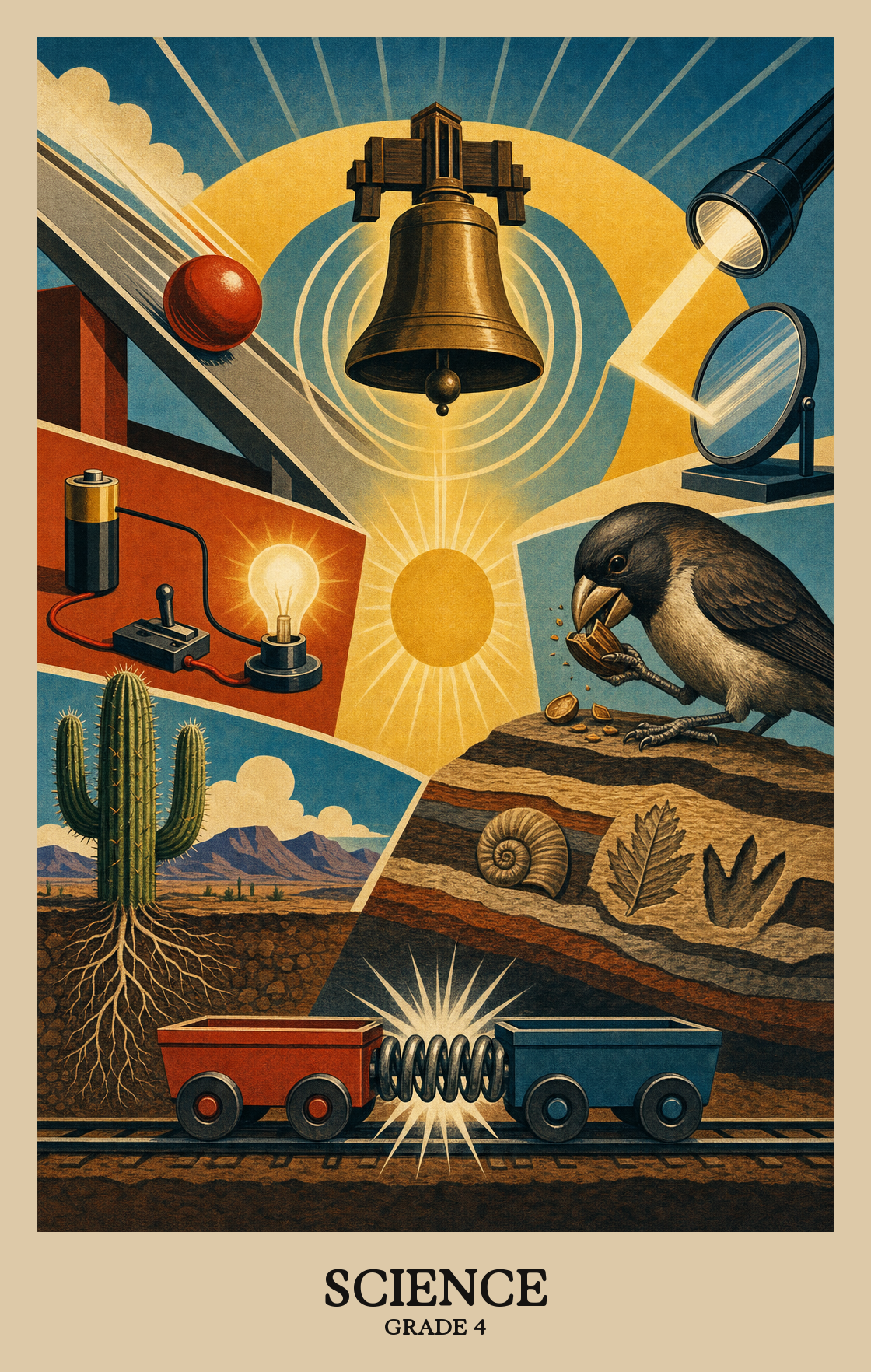
Students explore how fast-moving objects carry more energy than slow ones. They watch what happens when things collide and look at how energy shows up as sound, light, heat, and electricity.
Students learn how waves move through water and air, with bigger waves carrying more punch. They also look at how people send messages using patterns, from Morse code to today's devices.
Students study the parts of plants and animals that help them survive, from roots to eyes to ears. They trace how light bounces off objects into the eye and how animals use their senses to react to the world.
Students look at how rock layers and fossils tell the story of a place long ago. They watch how water, wind, and ice slowly wear land down, and read maps to spot mountains, rivers, and earthquake zones.
Students take on a real problem, sketch a few ways to solve it, and build something to try out. They run fair tests, see what breaks, and use what they learn to make the next version better.
Faster-moving objects carry more energy. Students look at real examples, like a slow-rolling ball versus a fast one, and use what they observe to explain the connection between speed and energy.
Students watch and record how energy moves from one place to another, using examples like a ringing bell, a lit lamp, a warm stove, or a working circuit. The goal is to show that energy travels, it doesn't just appear.
Students watch two objects crash into each other and predict what will happen to their speed, sound, or motion. The focus is on noticing how energy shifts when things collide.
Students design and test a device that changes energy from one form to another, such as a pinwheel that turns wind into movement or a circuit that turns stored energy into light. Then they use what they learned to improve it.
Waves are disturbances that move through water, sound, or light. Students build a model to show how waves repeat in a pattern, how tall each wave rises, how far apart the peaks are, and what happens to objects sitting in the wave's path.
Students practice sending information using patterns, like signals or codes, then compare different methods to see which one works best.
| Standard | Definition | Code |
|---|---|---|
| Use evidence to construct an explanation relating the speed of an object to the… | Faster-moving objects carry more energy. Students look at real examples, like a slow-rolling ball versus a fast one, and use what they observe to explain the connection between speed and energy. | S.4.1 |
| Make observations to provide evidence that energy can be transferred from place… | Students watch and record how energy moves from one place to another, using examples like a ringing bell, a lit lamp, a warm stove, or a working circuit. The goal is to show that energy travels, it doesn't just appear. | S.4.2 |
| Ask questions and predict outcomes about the changes in energy that occur when… | Students watch two objects crash into each other and predict what will happen to their speed, sound, or motion. The focus is on noticing how energy shifts when things collide. | S.4.3 |
| Apply scientific ideas to design, test | Students design and test a device that changes energy from one form to another, such as a pinwheel that turns wind into movement or a circuit that turns stored energy into light. Then they use what they learned to improve it. | S.4.4 |
| Develop a model of waves to describe patterns in terms of amplitude and… | Waves are disturbances that move through water, sound, or light. Students build a model to show how waves repeat in a pattern, how tall each wave rises, how far apart the peaks are, and what happens to objects sitting in the wave's path. | S.4.5 |
| Generate and compare multiple solutions that use patterns to transfer… | Students practice sending information using patterns, like signals or codes, then compare different methods to see which one works best. | S.4.6 |
Students build a diagram or drawing that shows how light bounces off an object and travels into the eye. That's what makes sight possible: without light hitting something first, the eye sees nothing.
Plants and animals have body parts inside and outside that each do a specific job. Students look at structures like roots, lungs, or eyes and explain how those parts help a living thing survive, grow, and reproduce.
Animals take in information through their senses, like sight, sound, and touch, then the brain processes that information and the body reacts. Students use models to show how that sensing, processing, and responding works together.
| Standard | Definition | Code |
|---|---|---|
| Develop a model to describe that light reflecting from objects and entering the… | Students build a diagram or drawing that shows how light bounces off an object and travels into the eye. That's what makes sight possible: without light hitting something first, the eye sees nothing. | S.4.7 |
| Construct an argument that plants and animals have internal and external… | Plants and animals have body parts inside and outside that each do a specific job. Students look at structures like roots, lungs, or eyes and explain how those parts help a living thing survive, grow, and reproduce. | S.4.8 |
| Use a model to describe that animals receive different types of information… | Animals take in information through their senses, like sight, sound, and touch, then the brain processes that information and the body reacts. Students use models to show how that sensing, processing, and responding works together. | S.4.9 |
Rock layers act like pages in a history book. Students read patterns in those layers, including fossils and rock types, to explain how a landscape changed over millions of years.
Fossils are clues about the past. Students study fossil evidence to figure out what plants and animals looked like millions of years ago and what kind of place they lived in, whether a swamp, a forest, or an ocean.
Rocks, soil, and land surfaces slowly change shape over time. Students observe and measure how water, ice, wind, or plant roots wear down and move earth materials, then use what they find as evidence to explain why the land looks the way it does.
Students read geological maps to spot patterns, like where mountain ranges line up or where earthquake zones cluster. They use those patterns to describe how Earth's surface is shaped and why features appear where they do.
| Standard | Definition | Code |
|---|---|---|
| Identify evidence from patterns in rock formations and fossils in rock layers… | Rock layers act like pages in a history book. Students read patterns in those layers, including fossils and rock types, to explain how a landscape changed over millions of years. | S.4.10 |
| Analyze and interpret data from fossils to provide evidence of the organisms… | Fossils are clues about the past. Students study fossil evidence to figure out what plants and animals looked like millions of years ago and what kind of place they lived in, whether a swamp, a forest, or an ocean. | S.4.11 |
| Make observations and/or measurements to provide evidence of the effects of… | Rocks, soil, and land surfaces slowly change shape over time. Students observe and measure how water, ice, wind, or plant roots wear down and move earth materials, then use what they find as evidence to explain why the land looks the way it does. | S.4.12 |
| Analyze and interpret data from maps to describe patterns of Earth's geological… | Students read geological maps to spot patterns, like where mountain ranges line up or where earthquake zones cluster. They use those patterns to describe how Earth's surface is shaped and why features appear where they do. | S.4.13 |
Students identify a real problem worth solving, then set clear rules for what a good solution looks like, including limits on what materials, time, or money can be used.
Students come up with more than one idea for solving a problem, then compare those ideas to see which one best fits the requirements and limits they were given.
Students test a model or prototype by changing one thing at a time, watching where it fails, and using what they learn to make it better.
| Standard | Definition | Code |
|---|---|---|
| Define a simple design problem reflecting a need or a want that includes… | Students identify a real problem worth solving, then set clear rules for what a good solution looks like, including limits on what materials, time, or money can be used. | EDS.4.14 |
| Generate and compare multiple possible solutions to a problem based on how well… | Students come up with more than one idea for solving a problem, then compare those ideas to see which one best fits the requirements and limits they were given. | EDS.4.15 |
| Plan and carry out fair tests in which variables are controlled and failure… | Students test a model or prototype by changing one thing at a time, watching where it fails, and using what they learn to make it better. | EDS.4.16 |
Dynamic Learning Maps alternate assessment for eligible students with significant cognitive disabilities, covering the same tested subjects as the general summative program.
Federally administered sample-based assessment in reading, mathematics, science, writing, and other subjects. NAEP results inform state-by-state comparisons rather than individual student or school accountability.
Students study four big areas: energy and motion, how plants and animals survive, how the Earth changes over time, and how to design and test simple inventions. A lot of the work is hands-on, with students making predictions, testing them, and explaining what they saw.
Talk through everyday science moments. Ask why a ball rolls faster down a steeper ramp, what happens when ice melts on the sidewalk, or why a flashlight lets you see a book in the dark. Short conversations like these build the habit of asking questions and looking for evidence.
Students can explain how energy moves through sound, light, heat, and electricity, and how living things use body parts and senses to survive. They can also read fossil and rock layer clues to describe how a place changed, and design a simple device that solves a problem.
Students define a small problem, sketch a few possible solutions, build one, and test it fairly to see what works and what fails. The point is learning to improve a design after testing, not getting it right on the first try.
Many teachers start with energy and waves because the ideas show up later in light, sound, and senses. Life science fits well in the middle, then Earth science in the spring when erosion and weather are easy to observe outside. Engineering tasks can be woven into every unit.
Waves and energy transfer trip students up because the ideas feel abstract. Fossils and rock layers also need extra time, since students often guess instead of using the layer order as evidence. Plan to revisit both with new examples later in the year.
Less than people expect. Students should know terms like energy, wave, fossil, and erosion, but the goal is using those words to explain what they observed. A child who can describe what happened in their own words is in good shape.
Set up a ramp with a book and a toy car. Have students roll the car from different heights and notice which crashes harder into a cup at the bottom. That ten-minute test covers speed, energy, and fair testing all at once.
Students should be able to plan a simple investigation, collect data, and use that data to back up a claim. They should also be comfortable reading a diagram or map and pulling out a pattern. Those habits matter more than any single topic.