Skip to content

What does a student learn in ?

This is the year social studies stops being a single story and turns into several big questions at once. Students dig into how the Constitution actually works, how money and trade shape daily life, how maps explain conflict, and how people behave in groups. They learn to back up an argument with real evidence from documents, data, and primary sources instead of just opinion. By spring, students can read a court case or news article, spot the bias, and write a short argument that uses specific evidence.

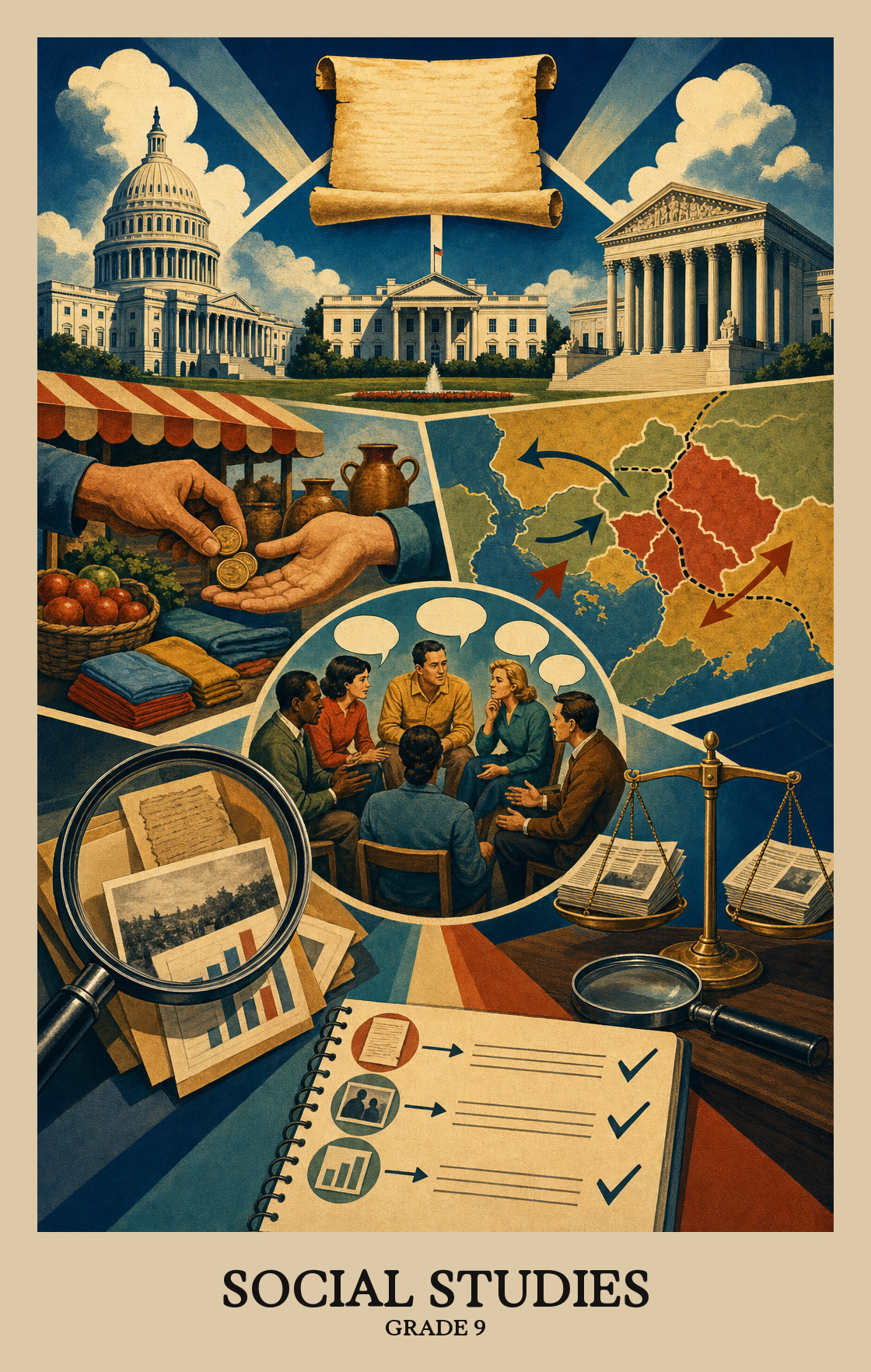
Illustration of what students learn in Grade 9 Social Studies
  • U.S. Constitution
  • Citizenship and rights
  • Supply and demand
  • World history
  • Maps and geography
  • Supreme Court cases
  • Reading primary sources
Source: West Virginia West Virginia College- and Career-Ready Standards
Year at a glance
How the year usually goes. Every school and district set their own curriculum, so treat this as a guide, not official pacing.
  1. 1

    Asking questions and using sources

    Students start the year learning how to think like social scientists. They ask their own questions about people and events, weigh whether a source is trustworthy, and back up their answers with evidence instead of opinion.

  2. 2

    Government and citizenship

    Students dig into how the country runs. They study the Constitution, the Bill of Rights, the courts, and elections, and they look at what it actually takes to be an active citizen, from voting to jury duty to community service.

  3. 3

    Economics and personal choices

    Students learn how money, jobs, and markets work. They look at supply and demand, banking, budgeting, taxes, and trade, and they connect those ideas to real choices families and businesses make every day.

  4. 4

    World and U.S. history

    Students trace the big story, from ancient civilizations through the Renaissance, Revolutions, the Civil War, two World Wars, and the Cold War. They look at how leaders, wars, and movements shaped the country and the world we live in now.

  5. 5

    Geography and global connections

    Students use maps, population data, and current events to see how place shapes people. They look at migration, resources, climate, and trade, and they compare daily life in wealthy and developing countries.

  6. 6

    Psychology and sociology basics

    Students get a first look at how minds and groups work. They study how memory, learning, and motivation shape behavior, and how culture, family, and social pressure shape the choices people make in groups.

Mastery Learning Standards
The required skills a student should display by the end of Grade 9.
  • 9-12 Social Studies Indicators

    SS

    Social studies in high school covers how governments work, how economies function, and how past events shape the world students live in today.

Civics
  • Evaluate the extent to which the U.S

    SS.US.1

    Students examine how the U.S. Constitution shapes real conflicts, from a person challenging a law to a community resisting an unjust rule. They weigh what the Constitution protects against what people believe is right, even when those two things clash.

  • Identify the issues regarding the evolution of United States citizenship and…

    SS.USC.1

    Citizenship in the U.S. has changed over time, expanding who counts and what rights they hold. Students trace those changes, from who could own land or vote, and weigh what rights and responsibilities come with citizenship today.

  • Be aware of the importance of informed citizens who actively participate in the…

    SS.C.1

    Informed citizens do more than vote. Students explore why showing up matters, whether through community projects, mock trials, or local volunteering, and how that participation keeps democratic government working.

  • Describe the roles of citizens and their responsibilities

    SS.W.1

    Students study what citizens were expected to do across different societies, from ancient Greece and Rome to feudal kingdoms to modern democracies. The focus is on how rights and responsibilities changed depending on who held power and how governments were organized.

  • Analyze the extent to which the fundamental United States democratic values and…

    SS.CS.1

    Students examine how core American ideals like representative government and constitutional limits on power shape real conflicts around the world, from community disputes to tensions between nations.

  • Analyze and connect the status, roles

    SS.W.2

    Students compare how free people, enslaved people, and migrants were treated differently across ancient and early civilizations, looking at what rights and daily responsibilities each group had and how those changed over time.

  • Evaluate, then defend the importance of the fundamental democratic values and…

    SS.USC.2

    Students examine core U.S. democratic values like free speech, equal rights, and majority rule, then build a reasoned argument for why those principles matter when individuals, communities, or nations clash.

  • Explore social contracts and the establishment of the rule of law

    SS.C.2

    Students examine why societies create rules and governments in the first place, then weigh how keeping government power limited helps protect individual freedoms. The focus is on what happens when that balance holds and what happens when it breaks down.

  • Demonstrate an understanding of the duties of citizens that are necessary to…

    SS.US.2

    Citizenship comes with real responsibilities. Students learn what citizens are expected to do to keep democracy working, from paying taxes and serving on a jury to voting and staying informed about public decisions.

  • Liberty and equality

    SS.CS.1.1

    Students examine how the American ideals of personal freedom and equal treatment under the law shape conflicts and agreements between countries, communities, and people around the world.

  • Analyze and evaluate various ways of organizing systems of government to…

    SS.W.3

    Students compare real documents, from Hammurabi's Code to the U.S. Constitution, to see how ideas about government power have shifted over thousands of years.

  • Demonstrate that the purpose of American government is the protection of…

    SS.C.3

    Students explain why the U.S. government exists: to protect the rights of its citizens. They use the Declaration of Independence, the Constitution, and its amendments to show how that purpose was built into the country's founding documents.

  • Individual rights and the common good

    SS.CS.1.2

    Students examine where individual rights end and shared community needs begin, then apply that tension to real conflicts around the world.

  • Analyze the changing perceptions of United States citizenship and evaluate…

    SS.US.3

    Students trace how the legal definition of citizenship has shifted over time, looking at who was left out and why. They also weigh what rights citizens hold today alongside the responsibilities that come with them.

  • Liberty and equality

    SS.USC.2.1

    Students examine what liberty and equality mean in the U.S. Constitution, then argue why those values still matter when countries, communities, or individuals clash over rights and power.

  • Consider factors that subvert liberty

    SS.C.4

    Students examine what weakens democracy, from voter apathy to unequal rights to government overreach, then work together to build a model showing how informed citizens can protect it.

  • Compare and contrast political ideologies in order to analyze the evolving role…

    SS.W.4

    Students compare types of governments from history, such as kingdoms, democracies, and rule by religious leaders, to understand how each shaped what governments did and who held power before 1900.

  • Majority rule and minority rights

    SS.CS.1.3

    Students examine how a democracy can act on what most people want while still protecting the rights of those in the minority. They look at where that balance holds and where it breaks down.

  • Examine, select, and participate in a volunteer service or project

    SS.US.4

    Students pick a real community need and do hands-on volunteer work to address it, then reflect on what that service taught them about civic responsibility.

  • Individual rights and the common good

    SS.USC.2.2

    Students look at real cases where one person's rights bump up against what's best for the community, then make and defend an argument about where the line should be drawn.

  • Rule of Law and ethics

    SS.CS.1.4

    Rule of law means everyone, including government officials, must follow the law. Students explore what happens when people believe a law is unjust and choose to break it openly, as a form of protest, to push for change.

  • Research and categorize multiple current and historical world aid organizations…

    SS.W.5

    Students research real aid organizations like the Red Cross or Doctors Without Borders, then weigh how volunteer work across countries shapes rights, health, and safety for people worldwide.

  • Majority rule and minority rights

    SS.USC.2.3

    Majority rule means the larger group's vote usually wins, but the Constitution still protects the rights of those who lost the vote. Students examine where those two ideas clash and why both matter in a democracy.

  • Examine and analyze the contributing factors to the drafting of the Declaration…

    SS.C.5

    Students study why colonists broke from Britain and how those tensions shaped the Declaration of Independence and the Constitution. The focus is on what pushed the founders to write those documents, not just what the documents say.

  • The rule of law (e.g., civil disobedience)

    SS.USC.2.4

    The rule of law means no one is above the law, including the government. Students examine what happens when people believe a law is unjust and choose to break it openly, as protesters did during the civil rights movement, and whether that kind of resistance strengthens or weakens democracy.

  • Patriotism

    SS.CS.1.5

    Students examine what patriotism means in a democracy and how loyalty to a country's founding values shapes the way citizens, communities, and nations respond to conflict at home and abroad.

  • Distinguish the powers and responsibilities of local, state, tribal, national

    SS.5

    Students learn which level of government handles which decisions, from fixing local roads to making national laws. They practice explaining why some powers belong to a city, a state, a tribe, or the federal government.

  • Leaders and philosophers

    SS.C.5.1

    Thinkers like John Locke shaped the ideas behind American democracy. Students examine how Locke's natural rights philosophy influenced leaders like Jefferson and Madison when they wrote the Declaration of Independence and the Constitution.

  • Ethics

    SS.USC.2.5

    Students examine real ethical conflicts, such as when individual rights clash with the common good, and explain why certain democratic values hold up even when they are difficult to apply.

  • Analyze the roles of citizens in the United States political system

    SS.6

    Citizens do more than vote. Students examine how people shape government through elections, civic participation, and community action at every level of the political system.

  • Analyze the duties of citizens that are necessary to promote global democracy

    SS.CS.2

    Citizens have duties that keep democracy working, from voting and paying taxes to staying informed and speaking up. Students examine which of those duties matter most when democracy is at stake beyond U.S. borders.

  • Events (e.g., Glorious Revolution, Reformation

    SS.C.5.2

    Historical events like the Glorious Revolution and the Enlightenment pushed thinkers to question who should hold power. Students learn how those ideas traveled from Europe to colonial America and shaped the arguments behind the Declaration of Independence.

  • Documents (e.g., English Bill of Rights, Petition of Right

    SS.C.5.3

    Earlier English documents like the Magna Carta and the English Bill of Rights shaped what the Founders wrote. Students trace how those older laws influenced the rights and limits on power built into America's founding documents.

  • Explain how the U.S. Constitution establishes a system of government that has…

    SS.7

    The U.S. Constitution sets up three branches of government, splits power among them, and puts limits on what each branch can do. Students learn how those rules have shifted over time and why Americans still argue about where the lines should be drawn.

  • Public forums (local, national, and/or global)

    SS.CS.2.1

    Students study how public forums work, from town halls to international debates, and explain why open civic conversation is essential to keeping democracy healthy.

  • Patriotism

    SS.USC.2.6

    Students examine what it means to love and support one's country, including how patriotism shapes civic life, drives public service, and sometimes conflicts with other values like justice or global responsibility.

  • Analysis of voting apathy and resulting consequences

    SS.CS.2.2

    Students examine why eligible voters skip elections and what happens when large numbers of people do. They connect low turnout to real outcomes: who wins, which issues get ignored, and how governments reflect only part of the population.

  • Classical periods (e.g., eras of Greece, Rome

    SS.C.5.4

    Students trace how ancient Greece and Rome shaped ideas about democracy, law, and self-governance that later influenced the founders when they wrote the Declaration of Independence and the Constitution.

  • Critique relationships among governments, civil societies

    SS.8

    Students examine how governments, businesses, and everyday civic life push and pull on each other. They practice making a reasoned argument about when those relationships work and when they break down.

  • Compare various citizens’ responses to controversial government policies and…

    SS.USC.3

    Students study real government controversies, weigh how citizens have pushed back or shown support, and work out a peaceful response of their own. The focus is on debate and cooperation, not just memorizing what happened.

  • Principles (e.g., popular sovereignty, federalism, limited government…

    SS.C.5.5

    Students read the core ideas baked into the U.S. Constitution, such as how power is split between branches of government, why no one branch can act alone, and what rights the government cannot take away.

  • Evaluate the social and political systems that, in different contexts, times

    SS.9

    Students look at how different governments and communities, across history and around the world, have encouraged fairness, participation, and respect for rights. They judge which systems actually put those values into practice.

  • Personal freedoms throughout the world

    SS.CS.2.3

    Students examine how personal freedoms like speech, religion, and assembly vary across countries and why those differences matter for people's daily lives.

  • Develop an understanding of civil public discourse

    SS.USC.3.1

    Students practice discussing a real policy disagreement respectfully, listening to opposing views without shutting the conversation down. The goal is to argue a position clearly and keep the exchange civil even when people strongly disagree.

  • Judeo-Christian influence

    SS.C.5.6

    Students examine how biblical ideas and religious traditions from Jewish and Christian thought shaped the values that the Founders wrote into documents like the Declaration of Independence and the Constitution.

  • Role of international government and non-government organizations

    SS.CS.2.4

    International organizations like the United Nations bring countries together to solve shared problems, settle disputes, and set rules that no single country can enforce alone. Students learn what these groups do and why they matter for keeping peace.

  • Analyze the impact and the appropriate roles of personal interests and…

    SS.10

    Students look at how personal beliefs and self-interest shape the way people apply democratic values and rights in real life. The focus is on when those interests help or get in the way of fair, principled citizenship.

  • Civic engagement

    SS.USC.3.2

    Students study real government decisions they disagree with, then practice making a case for change through debate, writing, or community action rather than conflict.

  • Evaluate multiple procedures for making governmental decisions at all levels

    SS.11

    Students compare how different levels of government, from a city council to Congress, actually make decisions. They look at the steps, rules, and tradeoffs involved in each process.

  • Analyze multiple media sources and their influence on public opinion and policy…

    SS.USC.4

    Students look at news articles, social media posts, and broadcasts side by side to figure out how each one shapes what people think and what lawmakers do.

  • Examine the compromises of the Constitutional Convention and how those…

    SS.C.6

    At the Constitutional Convention, delegates disagreed sharply and had to strike deals to get the Constitution written. Students study those deals and then read the arguments both sides made when Americans debated whether to approve the new document.

  • Analyze ways United States and world conflicts can be resolved in a cooperative…

    SS.CS.3

    Students look at real conflicts, past and present, and study how countries settled them without war. Focus areas include international organizations like the United Nations and the treaties, talks, and agreements that ended disputes peacefully.

  • Analyze how people use and influence local, state, national

    SS.12

    Students examine real laws (local, state, national, or international) and explain how ordinary people shape or challenge those laws to solve public problems.

  • Evaluate court cases essential to fundamental democratic principles and values

    SS.CS.4

    Students read landmark Supreme Court cases and decide what each ruling changed about rights in America. The focus is on cases that reshaped how the law treats everyday people.

  • Analyze media bias and reliability

    SS.USC.4.1

    Students look at a news article, social post, or broadcast and ask: who made this, what did they leave out, and why? They practice spotting one-sided framing and checking whether a source can be trusted.

  • Evaluate the elements in the U.S

    SS.C.7

    The Constitution was written to be updated over time. Students examine how amendments and reinterpretations have changed what the document actually means, and why those changes happened.

  • Analyze and evaluate court cases essential to fundamental democratic principles…

    SS.USC.5

    Students read landmark Supreme Court cases and explain what each ruling meant for rights, fairness, and how American democracy works in practice.

  • Select and participate in a volunteer service or project with a community or…

    SS.CS.5

    Students pick a real community group or cause and volunteer with it. The work might include helping at a veterans' organization, a local charity, or a youth program.

  • Evaluate public policies in terms of intended and unintended outcomes

    SS.13

    Students look at a law or government policy and ask whether it actually worked. They consider both the results lawmakers planned for and the side effects no one expected.

  • Investigate the system of government created by the Preamble, Seven Articles…

    SS.C.8

    Students read the U.S. Constitution closely, from the Preamble through the Amendments, to understand how the rules of American government were built and how they still shape daily life today.

  • Analyze historical, contemporary

    SS.14

    Students look at how societies change over time, from past revolutions to today's protests and new laws, and weigh whether those changes protect people's rights rather than harm them.

  • Select and participate in a volunteer service or project with a community or…

    SS.USC.6

    Students pick a real community organization and volunteer with it. The standard asks students to show up and do the work, not just learn about it in a classroom.

  • Analyze how the U.S. Constitution defines federalism and outlines a structure…

    SS.C.9

    The U.S. Constitution splits power between the federal government and the states. Students study how that balance works and how it shapes the three branches of government.

  • Analyze the protection of liberties in the Bill of Rights and their expansion…

    SS.C.10

    The Bill of Rights lists freedoms the government cannot take away. Students study how courts have used the Fourteenth Amendment to apply those protections to state governments, expanding civil liberties over time.

  • Analyze how the freedoms of speech and press in a democratic society enable…

    SS.C.11

    Free speech and a free press let citizens question leaders, share opinions, and push for change. Students examine how these rights work together to keep government accountable and help people participate in democracy.

  • Determine how conflicts between the rights of citizens and society’s need for…

    SS.C.12

    Students look at real conflicts where personal rights bump up against public safety, then work out how society can protect both at the same time.

  • Compare and contrast the original and appellate jurisdictions of local, state

    SS.C.13

    Courts in the U.S. operate at local, state, and federal levels. Students compare which courts hear a case first and which courts review decisions on appeal, covering both criminal charges and civil disputes.

  • Apply the concepts of legal precedent through past and present landmark Supreme…

    SS.C.14

    Students study real Supreme Court cases, from the past and today, to see how earlier rulings shape later ones. They trace how those decisions changed everyday life in the United States.

  • Develop an understanding of the American legal system through examining…

    SS.C.15

    Students learn how American law works, from local rules and federal acts down to the difference between a crime and a civil dispute. They also look at what citizens are legally required to do and what they can be held responsible for.

  • Critique the evolution of the two-party system in the United States, evaluate…

    SS.C.16

    Students trace how the Democratic and Republican parties grew, shifted their values over time, and shape elections and policy today. The focus is on why a two-party system took hold and what that means for how American government works.

  • Examine the influence of the media on public opinion and on the decisions of…

    SS.C.17

    Students look at how news, social media, and other outlets shape what the public thinks and how elected officials and government agencies decide to act.

  • Bias in reporting and editorials

    SS.C.17.1

    Students learn to spot when a news article or opinion piece leans toward one side of an issue. They look at word choice, missing facts, and framing to figure out whether a source is giving them the full picture.

  • Push-pull polls and selective reporting of citizen opinions

    SS.C.17.2

    Push-pull polls are surveys designed to nudge people toward a specific answer rather than measure honest opinion. Selective reporting means the media highlights certain responses and ignores others, shaping what the public thinks it believes.

  • Advertising and campaign ads

    SS.C.17.3

    Students look at how political ads and campaign commercials try to shape what people believe and how they vote. They learn to spot the persuasion tactics candidates and interest groups use to win public support.

  • Reporting news out of context

    SS.C.17.4

    Students learn to spot news stories that leave out key background information, making an event seem different than it really is. Missing context can shift public opinion and push officials toward decisions based on an incomplete picture.

  • Investigate the impact that special interest groups have on shaping public…

    SS.C.18

    Students look at how organized groups (industry associations, advocacy groups, unions) push lawmakers to write or change rules, and trace that influence from city hall up to Congress.

  • Assess how factors such as campaign finance, participation of the electorate

    SS.C.19

    Students look at what shapes election results: who donates money to campaigns, who actually shows up to vote, and how factors like age, income, or location affect which candidate wins.

  • Examine how decisions and policies of state and local government impact the…

    SS.C.20

    State and local governments make decisions that shape daily life, from zoning rules that determine where homes or businesses can be built to ordinances that set neighborhood rules. Students examine how those choices affect people in their community.

  • Explore cooperation, competition

    SS.C.21

    Students study how countries work together or clash through bodies like the United Nations, international treaties, and acts of terrorism, then weigh possible ways to address problems that cross borders.

  • Compare and contrast the values, ideals

    SS.C.22

    Students compare what makes a democracy work, such as elections and individual rights, with how non-democratic systems like communism or fascism actually govern people. The goal is to understand why the rules of government matter and what citizens can or cannot do under each system.

  • Examine how the First Amendment provides for freedom of religion and examine…

    SS.C.23

    The First Amendment stops the government from picking an official religion and protects people's right to practice their own faith. Students look at how courts have applied those two protections over time.

  • Free Exercise Clause

    SS.C.23.1

    The Free Exercise Clause says the government cannot stop people from practicing their religion. Students learn what this protection covers and where courts have drawn limits on it.

  • Establishment Clause

    SS.C.23.2

    The Establishment Clause stops the government from creating an official religion or favoring one religion over another. Students learn why this boundary between government and religion matters in a democratic society.

  • Develop an understanding of how the Fourth, Fifth, Sixth

    SS.C.24

    The Fourth, Fifth, Sixth, and Eighth Amendments spell out what the government can and cannot do when investigating or charging someone with a crime. Students learn how those rules protect ordinary people in court and in everyday run-ins with law enforcement.

  • Develop an understanding of how the Fourteenth Amendment provides for equal…

    SS.C.25

    The Fourteenth Amendment guarantees that the government must treat people equally under the law and follow fair procedures before taking away someone's rights. Students learn what those promises mean and how courts have applied them.

Economics
  • Analyze the role of economic choices in scarcity, supply and demand, resource…

    SS.E.1

    Making economic choices means weighing what you gain against what you give up. Students examine how scarcity, supply, demand, and trade shape everyday decisions about money, resources, and time.

  • Research, critique, and evaluate the roles of private and public institutions…

    SS.E.2

    Students examine what banks, businesses, and government agencies actually do in the economy, then weigh whether those roles help or hurt. The focus is on who makes economic decisions and how those institutions shape everyday life.

  • Compare and contrast various economic systems and analyze their impact on…

    SS.E.3

    Students compare how different countries decide who makes goods, who owns businesses, and who sets prices. The goal is to understand how those choices shape what everyday life looks like for ordinary people.

  • Describe and demonstrate how the factors of production apply to the United…

    SS.E.4

    Factors of production are the basic inputs any economy needs to make goods and services: land, labor, capital, and entrepreneurship. Students learn how each one shows up in the U.S. economy and how businesses combine them to produce what people buy.

  • Analyze the elements of competition and how they impact the economy

    SS.E.5

    Competition means multiple businesses selling similar products and trying to win the same customers. Students study how that rivalry pushes prices down, drives quality up, and shapes how a whole economy runs.

  • Examine and evaluate the interdependence of global economies

    SS.E.6

    Students look at how countries depend on each other to trade, produce goods, and stay financially stable. A decision made in one country's economy can ripple through markets on the other side of the world.

  • Identify the role of market factors in the settlement of the United States and…

    SS.US.5

    Students trace how buying, selling, and competition shaped where Americans settled and how the economy grew, from the colonial era through the early 1900s.

  • Explain and give examples showing how scarcity of goods and services forces…

    SS.E.7

    Scarcity means there is never enough of everything, so people have to choose what to buy or use. Students learn why those trade-offs happen and look at real examples of people picking between needs and wants.

  • Examine and illustrate the trade patterns

    SS.W.6

    Students trace how different regions traded goods and resources over centuries, from early mercantile empires to modern markets, and explain how those patterns shaped the global economy we have today.

  • Analyze the debate surrounding Alexander Hamilton’s economic policies and…

    SS.US.6

    Students read the arguments for and against Hamilton's economic plans, such as creating a national bank, and decide how those choices shaped the kind of economy the United States became.

  • Analyze how the scarcity of natural, technological, capital

    SS.E.8

    Resources like land, workers, and machines are always limited, so every economy has to make choices about what to produce and who gets it. This standard looks at how those trade-offs shape the goods and services people have access to.

  • Differentiate economic policy in the United States during each era

    SS.US.7

    Students trace how the U.S. government paid its bills across different periods of history, looking at what got taxed, what sparked fights over taxes, and how trade rules with other countries shaped the economy.

  • Identify types of exchange systems

    SS.W.7

    Students learn how people trade, from swapping goods directly to using coins, bills, or digital money. They look at why currency makes buying and selling easier than pure barter.

  • Analyze the evolution of American manufacturing and its impact on skilled and…

    SS.US.8

    Manufacturing in America shifted from small workshops where craftsmen trained apprentices to massive factories that hired unskilled workers for repetitive tasks. Students trace how those changes reshaped jobs and wages, and why workers eventually organized to demand better conditions.

  • Explain the role that supply and demand, prices, incentives

    SS.E.9

    Supply and demand shape what gets made and sold. Students learn how prices signal what buyers want, how profits motivate producers, and how incentives push businesses to make more or less of something.

  • Analyze the importance of family, labor specialization, industrialization

    SS.W.8

    Students trace how families, workers, factories, and regional markets gradually connected into the global trading system we have today.

  • Define scarcity, demonstrate the role of opportunity costs in decision making

    SS.W.9

    Scarcity means there is never enough of everything people want, so every choice means giving something else up. Students look at how those trade-offs shaped real decisions, and why economies strong enough to build empires can still collapse.

  • Explain and give examples of opportunity costs

    SS.E.10

    Every choice comes with a cost: what you give up to get something else. Students learn why scarcity forces these trade-offs and how that basic tension sits behind nearly every other idea in economics.

  • Analyze the impact of mercantilism and triangular trade on the emergence of…

    SS.US.9

    Students examine how European nations used their American colonies as economic engines, extracting raw materials and restricting manufacturing to keep wealth flowing back to the mother country. That system eventually cracked, pushing colonies toward free markets.

  • Demonstrate an understanding of the concept of capitalism and compare the basic…

    SS.US.10

    Capitalism is the system where people and businesses own property and compete to make money. Students compare it to other systems where governments control more of the economy, looking at who owns what, who sets prices, and who decides what gets made.

  • Compare and contrast examples of private and public goods and services

    SS.E.11

    Students compare everyday goods and services to figure out which ones anyone can use for free (like a public park or roads) and which ones people pay for individually (like a haircut or a car).

  • Evaluate the costs and benefits of allocating goods and services through public…

    SS.E.12

    Students weigh the tradeoffs of letting the government provide something, like roads or schools, versus letting businesses handle it, like grocery stores or gyms. The goal is to figure out which approach delivers more benefit at a lower cost.

  • Describe and compare relationships among economic institutions

    SS.E.13

    Students learn how households, businesses, banks, and government agencies connect and depend on each other in an economy. They compare how each group earns, spends, borrows, or sets rules that affect the others.

  • Explain how specialization and division of labor in economic systems increase…

    SS.E.14

    Specialization means workers or businesses focus on one task or product instead of doing everything themselves. Students learn why that focus, and dividing up the steps of a job, lets an economy produce more with the same amount of time and effort.

  • Describe the role of money and other forms of exchange in the economic process

    SS.E.15

    Money is how people trade value without swapping goods directly. Students learn how cash, credit, and other payment tools move through an economy and why those systems exist.

  • Compare and analyze how values and beliefs influence economic decisions in…

    SS.E.16

    Students look at how a society's values shape its economic rules. They compare systems where the government controls most decisions to systems where individuals and markets do, then ask why each society made those choices.

  • Analyze the impact the United States industrialized economy had on the outcome…

    SS.CS.6

    Students examine how America's factories, supply chains, and industrial output shaped the results of major 20th-century wars, from lending weapons to allies in World War II to building highways and weapons programs during the Cold War.

  • Evaluate economic systems according to how laws, rules and procedures deal with…

    SS.E.17

    Students look at how different economies set rules around buying, selling, and pricing goods. They judge whether those rules help or hurt the balance between what people want and what's available.

  • Assess how various executive initiatives and legislative acts have influenced…

    SS.CS.7

    Students look at how major government programs changed the U.S. economy, tracing what happened to jobs, spending, and industries when presidents and Congress acted during turning points like the New Deal or the Space Race.

  • Trace economic development throughout United States History

    SS.USC.7

    Students trace how the American economy changed from colonial trade and farming through westward expansion and industrialization. They look at how markets, competition, and private enterprise shaped where people settled and how the country grew.

  • Analyze how incentives influence choices that may result in policies with a…

    SS.15

    Incentives are rewards or consequences that push people toward certain choices. Students examine how those choices shape real policies, and why the same policy can benefit one group while costing another.

  • Demonstrate an understanding of supply and demand in various historic events…

    SS.CS.8

    Students study how changes in supply and demand sparked real economic crises, like the Great Depression or oil shortages, and explain why those shifts caused prices, jobs, and whole economies to collapse.

  • Evaluate the extent to which competition among sellers and among buyers exists…

    SS.16

    In specific markets, sellers compete to attract buyers, and buyers compete to get limited goods. Students judge how much that competition actually shapes prices and choices in real examples.

  • Evaluate historical and current social developments and issues from an economic…

    SS.E.18

    Students look at real events and social issues, past and present, through an economic lens. They ask how money, resources, and trade shaped what happened and what it means today.

  • Examine the history of the relations between business and labor from…

    SS.USC.8

    Students trace how the relationship between workers and employers changed from the factory era to today, including strikes, unions, and the leaders who pushed for safer conditions and fair pay.

  • Apply the concept of supply and demand in various historic events

    SS.USC.9

    Students trace how supply and demand shaped real historical moments, like wartime shortages, trade disputes, or economic booms. They explain why prices rose or fell and connect those shifts to bigger events in history.

  • Explain historical and current developments and issues in local, national

    SS.E.19

    Students look at real economic events, from past to present, and explain what caused them and why they matter. The focus can be a local business closing, a national recession, or a shift in global trade.

  • Describe the consequences of competition

    SS.17

    Competition pushes prices down and quality up. Students learn what happens to businesses, workers, and consumers when companies compete for the same customers.

  • Cite evidence of the economic and cultural impact of advertising and the growth…

    SS.CS.9

    Students look at real ads and explain how advertising shapes what people buy and what they think they need. They practice telling the difference between something they truly need and something they simply want.

  • Critique the competing ideologies of capitalism and socialism

    SS.CS.10

    Students compare capitalism and socialism, looking at what each system says about who should own businesses, set prices, and decide how resources get distributed.

  • Use benefits and costs to evaluate the effectiveness of government policies to…

    SS.18

    Students weigh the real-world trade-offs when government steps in to fix a market problem, asking whether the benefits of a policy actually outweigh what it costs society to carry it out.

  • Define inflation and explain its effects on economic systems

    SS.E.20

    Inflation means prices rise over time so the same amount of money buys less. Students learn what causes this and how it ripples through an economy, affecting workers, businesses, and savings.

  • Analyze the causes and consequences of the United States’ national debt and its…

    SS.USC.10

    Students trace how the U.S. government runs up debt by spending more than it collects in taxes, then examine what that debt means for interest rates, borrowing, and economies in other countries.

  • Define and analyze the use of fiscal and monetary policy in the national…

    SS.E.21

    Fiscal policy is how the government decides to tax and spend. Monetary policy is how the central bank controls interest rates and the money supply. Students learn what each tool does and how leaders use them to respond to recession or inflation.

  • Describe the roles of banks and other financial institutions

    SS.19

    Banks and other financial institutions are where people borrow money, save it, and move it around. Students explain what these businesses do and how they fit into the broader economy.

  • Assess how various executive initiatives and legislative acts have influenced…

    SS.USC.11

    Students look at how presidential plans and laws, like the New Deal or the Great Society, changed the U.S. economy. They explain what the government did and what shifted in how Americans worked, spent, or were supported as a result.

  • Analyze the causes and consequences of the United States’ national debt and its…

    SS.CS.11

    Students examine why the U.S. government borrows money, how that debt has grown, and what it means for other countries and American foreign policy.

  • Understand and cite evidence of the economic and cultural impact of advertising…

    SS.USC.12

    Students study how advertising shapes what people buy and want. They look at real examples to separate genuine needs like food and shelter from wants, and explain how marketing has changed everyday spending habits.

  • Explain the process of international trade from an economic perspective

    SS.E.22

    International trade is when countries buy and sell goods across borders. Students learn why nations specialize in certain products, how prices and currency affect those deals, and what happens when governments add taxes or limits on imports.

  • Describe the roles institutions play in such things as clearly defined property…

    SS.20

    Institutions like courts and governments set the rules that make a market economy work. Students learn how property rights and consistent laws let people buy, sell, and own things with confidence.

  • Identify various developed countries and developing countries and evaluate…

    SS.CS.12

    Students compare wealthy and less wealthy countries by looking at how much each country produces and earns. That number helps explain what life looks like there: how healthy people are, how far most kids go in school, and what jobs are available.

  • Identify various developed countries and developing countries and evaluate…

    SS.USC.13

    Students compare wealthy and lower-income countries by looking at how much each country produces and earns. That total (called GDP) helps explain whether citizens have reliable access to things like doctors, schools, and steady food supplies.

  • Use current data to explain the influence of changes in spending, production

    SS.21

    Students look at real economic data to explain how shifts in government spending, business output, or the amount of money in circulation affect prices, jobs, and growth.

  • Analyze and evaluate growth and stability in different economic systems

    SS.E.23

    Students study how different economies, like market systems and government-run systems, grow over time or struggle to stay stable. They weigh what makes each system work and where it breaks down.

  • Use key economic indicators to analyze the current and future state of the…

    SS.22

    Students read economic data, like unemployment rates and inflation figures, to judge whether the economy is growing, shrinking, or holding steady, and to make reasonable predictions about where it is headed.

  • Analyze a public issue from an economic perspective and propose a socially…

    SS.E.24

    Students pick a real public problem, like the cost of housing or a local tax, and use economic thinking to argue for a solution that works for the community.

  • Evaluate the selection of monetary and fiscal policies in a variety of economic…

    SS.23

    Students look at real economic situations (a recession, rising prices, a boom) and judge which government tools fit best: adjusting taxes and spending, or changing interest rates.

  • Evaluate the role of the factors of production in a market economy

    SS.E.25

    Students examine how land, labor, and capital work together to produce goods and services. They judge how each factor shapes what gets made, how much it costs, and who benefits in a market economy.

  • Compare, contrast, and evaluate different types of economies

    SS.E.26

    Students look at four types of economies and weigh how each one decides what to make, who makes it, and who gets it. The goal is to spot real differences and judge how well each system works.

  • Explain why advancements in capital goods and human capital increase economic…

    SS.24

    Better tools and better-trained workers help businesses produce more, which raises incomes and improves living conditions. Students explain how investing in equipment or education drives that growth.

  • Explain how current globalization trends and policies affect economic growth…

    SS.25

    Globalization connects countries through trade, jobs, and shared rules. Students examine how those connections shape wages, natural resources, and who benefits economically in different parts of the world.

  • Explain how and why people who start new businesses take risks to provide goods…

    SS.E.27

    Starting a business means risking your own money and time with no guarantee it pays off. Students learn why people take that chance and how those decisions shape the goods and services available in a community.

  • Identify, define and explain basic economic concepts

    SS.E.28

    Basic economic vocabulary: what scarcity means, why prices rise and fall, how supply and demand work, and the difference between a market economy and one the government controls. Students learn the terms that explain how money, goods, and labor move through the world.

  • Describe and explain the role of money, banking, savings

    SS.E.29

    Money, banking, savings, and budgeting all shape how people pay for daily needs and plan for the future. Students learn how banks work, why saving matters, and how to build a simple budget.

  • Distinguish between private goods and services

    SS.E.30

    Private goods belong to one person or business; public goods are shared by everyone. Students learn to tell the difference between something like a family car and something like a highway that anyone can use.

  • Compare and contrast how values and beliefs, such as economic freedom, economic…

    SS.E.31

    Students look at two different economic situations and explain how values like fairness, freedom, or job security push decision-makers in different directions. The same goal can mean different things depending on who is deciding and what they believe.

  • Explain the basic characteristics of international trade, including absolute…

    SS.E.32

    Students learn why countries trade with each other instead of making everything themselves. They study how exchange rates work, what tariffs and quotas do to trade, and how a country tracks what it sells versus what it buys from other nations.

  • Describe and explain global economic interdependence and competition, using…

    SS.E.33

    Countries depend on each other to buy, sell, and produce goods. Students look at real examples of trade and competition to explain why governments make the economic decisions they do.

  • Evaluate long-term and short-term costs in relationship to long and short-term…

    SS.E.34

    Weighing a decision means looking at what it costs now against what it pays off later. Students compare short-term sacrifices with long-term gains to judge whether a choice is worth making.

  • Identify different economic goals and the tradeoffs that must be made between…

    SS.E.35

    Economic goals often conflict. Students learn why choosing one goal (like lower prices) can mean giving something else up (like jobs or clean air), and how societies weigh those tradeoffs.

  • Describe the aims of government fiscal policies

    SS.E.36

    Fiscal policy is how a government decides to tax, borrow, and spend money. Students learn how those choices affect how many goods get made, how many people have jobs, and what things cost.

  • Explain the basic principles of the United States free enterprise system

    SS.E.37

    Students learn how the U.S. economy works: why businesses compete, why people trade, and why choosing one thing means giving up another. These ideas explain everyday decisions, from how a company sets prices to how families spend money.

  • Explain the characteristics, advantages and disadvantages of sole…

    SS.E.38

    Students compare three ways to own a business: on your own, with a partner, or as a corporation. They look at how each is set up, who takes on the risk, and what the drawbacks are.

  • Describe characteristics and give examples of pure competition, monopolistic…

    SS.E.39

    Students learn the difference between market types: a market with many sellers competing freely, one where similar products compete on branding, and one where a few large companies dominate. Real examples like grocery stores, fast-food chains, or phone carriers help make each type concrete.

  • Examine the opportunity costs in ever-present scarcity for individuals…

    SS.C.26

    When resources are limited, every choice means giving something else up. Students explore what individuals, businesses, and governments trade off when they decide how to spend money, time, or materials.

  • Analyze the factors involved in the process of acquiring consumer goods and…

    SS.E.40

    Buying things on credit means borrowing money and paying it back with extra charges called interest. Students learn how those costs add up, and how insurance protects buyers when something goes wrong.

  • Debate an effective allocation of the factors of production that encourages…

    SS.C.27

    Students argue which mix of land, labor, capital, and entrepreneurship best grows an economy without trashing the environment. The debate connects local production decisions to global consequences.

  • Explain how supply and demand affects prices, profits

    SS.C.28

    When supply goes up or demand drops, prices usually fall. Students learn how those shifts shape what things cost, whether businesses make money, and how easy something is to find and buy.

  • Describe how households, businesses

    SS.C.29

    Households earn money and spend it. Businesses use that spending to pay workers and earn profits. Students learn how these groups, along with government, keep a free-market economy moving.

  • Identify economic influences that impact business climate on the local, regional

    SS.C.30

    Students learn how economic conditions like interest rates, trade policies, and consumer demand shape whether businesses grow or struggle, from the local neighborhood up to international markets.

  • Track the evolution of currency throughout history to facilitate the exchange…

    SS.C.31

    Students trace how money changed over time, from bartered goods and metal coins to paper bills and digital payments, to understand why societies needed a common way to buy and sell things.

9-12 Social Studies Indicators
  • Develop questions through investigations

    SS.1

    Students practice forming real questions about a topic, not just answering someone else's. Good historical and civic thinking starts with asking the right things.

  • Apply disciplinary concepts and tools

    SS.2

    Students use the specific thinking habits of each social studies subject, such as reading a primary source like a historian or analyzing economic data like an economist.

  • Evaluate sources and use evidence

    SS.3

    Students find sources, judge whether they can be trusted, and use what they find to back up a point. The focus is on telling the difference between solid evidence and weak evidence.

  • Communicate conclusions and take informed action

    SS.4

    Students pull together what they've learned, form a clear position, and share it with an audience beyond the classroom. The goal is to move from understanding an issue to actually doing something about it.

Geography
  • Interpret, use and construct maps, globes

    SS.G.1

    Reading and drawing maps, globes, and charts to find real places, trace routes, and understand what the world looks like from different angles.

  • Describe the physical and human characteristics of place and explain how the…

    SS.G.2

    Places have physical features (like mountains or rivers) and human features (like language or landmarks). Students study how both shape daily life and identity for the people who live there.

  • Describe and explain the physical processes that shape the earth’s surface and…

    SS.G.3

    Physical processes like volcanoes, erosion, and shifting tectonic plates reshape the land over time. Students explain how those same forces influence where people settle, how they build, and how communities adapt.

  • Identify, explain, and analyze how the earth is shaped by the movement of…

    SS.G.4

    Students learn how people shape the planet, from the cities they build to the farms they plant and the routes they travel. Geography isn't just land and water. It's the mark people leave on it.

  • Analyze the interaction of society with the environment

    SS.G.5

    Students study how people change the land around them and how the environment shapes the way people live, work, and move.

  • Explain geographic perspective and the tools and techniques available for…

    SS.G.6

    Geographic perspective means looking at the world through the lens of place, space, and environment. Students learn how geographers ask questions and use tools like maps, satellite images, and data to understand why things are located where they are.

  • Analyze the world and account for consequences of human/environment…

    SS.G.7

    Students look at how human choices, like building cities or farming land, change the environment and how those changes ripple into global events. They explain what those geographic shifts mean for people in different parts of the world.

  • Explain components of the Earth’s physical systems and their interrelationships

    SS.G.8

    Students learn how Earth's physical parts connect and affect each other. How a mountain range shapes rainfall, why a river carves a valley, how the atmosphere interacts with the land below.

  • Identify factors that contribute to human and physical changes in places and…

    SS.G.9

    Students explain why places look different over time, connecting physical causes like erosion or climate to human choices like building, farming, or migration.

  • Identify and define the world’s physical and cultural regions, including…

    SS.G.10

    Students learn to identify the world's major regions by their physical features, history, and culture, then explain how those regions depend on each other through trade, migration, and shared values.

  • Analyze populations with regard to life expectancy, infant mortality rates…

    SS.G.11

    Students read charts and graphs to compare how long people live, how often babies die young, and how populations grow or shrink in different parts of the world.

  • Use different types of maps, terminology

    SS.W.10

    Students learn to read different kinds of maps and use geographic tools to answer real questions about places on Earth, like why a city grew where it did or how terrain shapes where people live.

  • Evaluate the impact of migration on physical and human systems

    SS.G.12

    Migration changes where people live and how the land around them gets used. Students study how movement of people reshapes cities, economies, and natural environments over time.

  • Explain how altering the environment has brought prosperity to some places and…

    SS.W.11

    Changing the environment, like draining wetlands or building dams, can create farms and cities that bring economic growth. Those same changes often cause problems like flooding, pollution, or habitat loss somewhere else.

  • Apply correct vocabulary and geographic tools to determine and illustrate…

    SS.US.11

    Students use maps, globes, and geographic terms to locate and describe places by their exact coordinates, physical features, and climate. Think latitude and longitude lines, landforms, bodies of water, and state capitals.

  • Analyze growth, decline

    SS.G.13

    Students study why cities grow or shrink over time, looking at how jobs, migration, and land use shape a place across generations.

  • Apply geography skills to help investigate issues and justify possible…

    SS.W.12

    Students use maps, climate data, and other geographic tools to dig into real-world problems, such as where to build housing or how drought affects a region, and then explain which solutions make the most sense.

  • Compare and contrast the impact of competition for limited resources on an…

    SS.G.14

    Countries compete over resources like oil, water, and farmland. Students study how that competition shapes trade, causes conflict, and pushes nations to find solutions that keep the global economy running.

  • Determine the most appropriate maps and graphics in an atlas for analyzing…

    SS.US.12

    Students pick the right map or chart for a geographic question, such as choosing a population map to study how cities grew or a topography map to understand why settlers chose certain routes.

  • Evaluate how people express attachment to places and regions

    SS.US.13

    Students look at essays, songs, films, and stories to understand why people feel a deep connection to specific places. They explain what those attachments reveal about identity and belonging.

  • Explain how migration of people and movement of goods and ideas can enrich…

    SS.W.13

    Migration and trade spread food, language, music, and technology across cultures. But those same movements can create conflict when newcomers and established communities compete for jobs, land, or political power.

  • Examine global social and political factors and their implications

    SS.G.15

    Students look at how events like wars, elections, or population shifts in one part of the world ripple into other countries. The focus is on spotting those connections and thinking through what they mean.

  • Explain how the uneven distribution of resources in the world can lead to…

    SS.W.14

    Some parts of the world have oil, water, or farmland that others lack. Students study how those gaps push countries and groups to fight over resources, compete for them, or work together to share them.

  • Analyze the impact of migration on the quality of life over different…

    SS.US.14

    Students study how moving to a new place changed daily life for people across different eras of American history. They look at what people gained and lost when whole communities relocated, and how disease sometimes shaped where and how people settled.

  • Analyze ethnicity, nationalism

    SS.G.16

    Students examine how ethnicity, religion, and nationalism shape what life looks like in different parts of the world. They look at how cultural identity influences daily norms, group loyalties, and conflict between and within societies.

  • Analyze the characteristics of the cultural contributions of indigenous and…

    SS.US.15

    Students examine how Native American nations, immigrant communities, and other groups each shaped American food, language, art, and traditions. The goal is to see which contributions came from whom and how those influences still show up today.

  • Use maps, charts, and graphs to depict the geographic implications of world…

    SS.W.15

    Students read maps, charts, and graphs to show how world events play out across places. They connect what happened to where it happened and what changed on the ground.

  • Analyze the influence of geographical features on the evolution of significant…

    SS.G.17

    Geography shapes history. Students look at how rivers, mountains, deserts, and coastlines influenced where major wars were fought, where civilizations grew, and why some movements succeeded or failed.

  • Analyze the impact of technology or its lack on environments and societies over…

    SS.G.18

    Students examine how tools and technology, from irrigation ditches to smartphones, have changed landscapes, economies, and daily life across history. They also look at what happens to communities that lack access to those same advances.

  • Analyze the impact of the environment, including the location of natural…

    SS.US.16

    Students study how land, water, and natural resources shaped where people settled and why they moved across the United States. A river, a coalfield, or fertile soil could pull thousands of migrants toward one region and leave another nearly empty.

  • Analyze connections between physical geography and isolation from the world…

    SS.G.19

    Students look at how mountains, deserts, or other physical barriers cut a place off from its neighbors, then explain how that isolation can fuel conflict, weak governments, or cultures that develop separately from the rest of the world.

  • Analyze the ways in which physical and cultural geography have influenced…

    SS.US.17

    Students look at how landforms, climate, and cultural differences shaped major turning points in U.S. history. A mountain range, a river, or a shared language can determine where people settled, why conflicts started, and how movements spread.

  • Identify causes and draw conclusions about landless cultures

    SS.G.20

    Students examine cultures that have no land of their own, tracing how that happened and what it means for how those groups live, govern themselves, and maintain identity.

  • Compare and contrast standards of living in poverty-stricken areas with…

    SS.G.21

    Students compare living conditions in wealthy and poor parts of the world, looking at access to food, schooling, jobs, and basic technology to understand why quality of life differs so much from place to place.

  • Utilize various geographic information systems to gain insight into people and…

    SS.G.22

    Students use digital maps, satellite images, and location data to study how people live in different places and why geography shapes their lives.

  • Analyze and evaluate the changing boundaries of world maps as a result of wars

    SS.CS.13

    Students study how wars redrew national borders across history, looking at maps before and after major conflicts to understand why countries shrank, split, or disappeared entirely.

  • Apply census data to analyze the demographics of population growth that lead to…

    SS.CS.14

    Students use real census numbers to study why fast population growth strains water, farmland, and food supplies, and how that pressure can spark conflict between communities.

  • Apply correct vocabulary and geographic tools to determine and illustrate…

    SS.USC.14

    Students use maps, globes, and coordinate grids to find and describe real places, from a river delta to a state capital. That means reading latitude and longitude lines, naming landforms, and matching climate regions to the right spots on a map.

  • Determine the most appropriate maps and graphics in an atlas for analyzing…

    SS.USC.15

    Students choose the right map or chart from an atlas to answer a specific question about how the U.S. grew and changed over time, such as where people settled, how cities expanded, or how transportation routes spread across the country.

  • Explain how natural resources of various world regions impact foreign and…

    SS.CS.15

    Students learn how a country's oil, water, or farmland shapes the deals it makes with other nations and the economic rules it sets at home.

  • Demonstrate an understanding of the events that illustrate the United States’…

    SS.CS.16

    Starting in 1914, students trace how the United States shifted from staying out of world conflicts to becoming a major force in global events. They look at wars, alliances, and political decisions that pulled the country onto the world stage.

  • Evaluate the impact of health and cultural considerations on the quality of…

    SS.USC.16

    Students look at how disease, medicine, food, and cultural practices shaped everyday life in different eras. They weigh which factors raised or lowered living standards and explain how those conditions changed over time.

  • Analyze United States isolationism, neutrality and entanglement in world…

    SS.CS.16.1

    Students examine why the U.S. stayed out of world conflicts for long stretches of history, and what eventually pulled the country into them. The focus is on the tensions between keeping out of other nations' affairs and getting drawn in anyway.

  • Analyze the characteristics of cultural contributions of Native Americans…

    SS.USC.17

    Students examine how Native American, African American, Hispanic, and immigrant communities shaped American culture through language, food, art, music, and tradition. The goal is understanding how those contributions built the country students live in today.

  • Analyze the ways in which physical and cultural geography have influenced…

    SS.USC.18

    Students look at how rivers, mountains, and climate shaped where people settled, how armies moved, and why borders formed the way they did.

  • List and explain underlying causes, major players and the effects of World War…

    SS.CS.16.2

    Students learn what started World War I, who fought in it, and what changed when it ended. The focus is on the hidden tensions that set off the war and the consequences that reshaped borders and governments across the world.

  • Use geospatial and related technologies to create maps to display and explain…

    SS.26

    Students use digital mapping tools to show where cultural and environmental patterns appear across the world. They build and read maps that reveal why certain features cluster in some places and not others.

  • Use maps, satellite images, photographs

    SS.27

    Students read maps, satellite images, and photos to explain why a place's location shapes how it's governed, what culture looks like there, and how people make a living.

  • Evaluate the changing boundaries of world maps as a result of wars

    SS.USC.19

    Wars redraw borders. Students look at world maps from different eras and explain how conflicts shifted country boundaries, created new nations, or erased old ones.

  • Explain the connection between the introduction of modern warfare, advancement…

    SS.CS.16.3

    Students connect the new weapons of World War I, such as poison gas, machine guns, and artillery barrages, to the staggering death tolls armies suffered. They explain why older battlefield tactics failed against modern firepower.

  • Analyze relationships and interactions within and between human and physical…

    SS.28

    Students study how people and their surroundings shape each other. A city built near a river, or a drought that changes farming patterns, are the kinds of connections students learn to explain.

  • Analyze the primary motivations behind Wilson’s idealistic Fourteen Points and…

    SS.CS.16.4

    Students examine why Woodrow Wilson proposed his Fourteen Points plan after World War I and why the U.S. Senate rejected the League of Nations he championed. The focus is on the gap between Wilson's goals and what Congress and other nations were willing to accept.

  • Evaluate how past political and economic decisions have influenced cultural and…

    SS.29

    Past choices about laws, trade, and land use shaped what places look like and how people live there today. Students study real examples to explain how those decisions left a lasting mark on a region's culture and environment.

  • Compare relief efforts and interventions of the 1918 pandemic to modern global…

    SS.CS.16.5

    Students compare how the world responded to the 1918 flu pandemic with how it responds to health crises today, looking at what changed and what stayed the same across a century of global outbreaks.

  • Evaluate the impact of human settlement activities on the environmental and…

    SS.30

    Students look at how building cities, farming, and other human activity change the land, wildlife, and culture of a place. They weigh what was gained and what was lost.

  • Explain how changes in transportation and communication technology influence…

    SS.31

    Students study how new roads, phones, and the internet change which towns and cities stay connected, and how those links spread languages, foods, and customs from one place to another.

  • Analyze the reciprocal nature of how historical events and the spatial…

    SS.32

    Students examine how wars, inventions, and cultural shifts push people to move, and how those migrations then reshape where ideas and technologies spread next. It works in both directions.

  • Evaluate how economic globalization and the expanding use of scarce resources…

    SS.33

    Students examine how countries compete or cooperate when resources like oil, water, or land run short, and how global trade makes those tensions harder to ignore.

  • Evaluate the effects of human-made and natural catastrophes on global trade…

    SS.34

    Students look at how disasters, wars, and industrial accidents reshape trade routes, shift political power, and push people to leave their homes.

  • Use census data and public records to identify patterns of change and…

    SS.C.32

    Census records and public data (birth rates, migration numbers, housing counts) show how a community has changed over time and what has stayed the same. Students use that data to explain why those shifts matter for society.

  • Zoning

    SS.C.32.1

    Zoning laws divide a city or town into areas for homes, businesses, and factories. Students read census data and public records to see how those boundaries shape where people live, work, and shop over time.

  • Migration

    SS.C.32.2

    Students study migration patterns using census data and public records, tracing where people moved, why they left, and how those shifts changed the communities they came from and settled in.

  • Ethnicity

    SS.C.32.3

    Students read census data to see how the ethnic makeup of a community has shifted over time and what those shifts mean for neighborhoods, schools, and local policy.

  • Income

    SS.C.32.4

    Students study census and public records to see how income levels have shifted across neighborhoods and regions over time, and what those shifts mean for access to jobs, housing, and schools.

  • Gender Differences

    SS.C.32.5

    Students read census data and public records to spot where men and women have had different experiences over time, such as in jobs, education, or voting rights, and explain what those gaps reveal about how society has changed.

  • Age Differences

    SS.C.32.6

    Students compare census data across age groups to spot patterns, such as whether a community is growing older or younger, and explain what those shifts mean for schools, healthcare, and local services.

  • Education

    SS.C.32.7

    Students look at census data to see how education levels in a community have shifted over time, then explain what those changes mean for how people live and work.

  • Voting Behavior

    SS.C.32.8

    Students study who votes, who doesn't, and why, using real census and election records to see how voting patterns have shifted over time and what those shifts mean for communities and policy.

  • Family Structure

    SS.C.32.9

    Students study census records and public data to see how household makeup (married couples, single parents, multigenerational families) has shifted over time and what those changes mean for communities.

  • Conduct research using demographic data to interpret, debate

    SS.C.33

    Students research real population data (like migration trends or birth rates) to explain how global issues shape borders, alliances, and political power. They don't just describe the patterns; they argue what those patterns mean for countries and people.

  • Environment and Environmental Protection

    SS.C.33.1

    Students research how human activity affects the natural world and debate what governments and communities should do about it. The focus is on real policy questions: pollution, conservation, climate, and who decides the rules.

  • Political and Cultural Boundaries

    SS.C.33.2

    Students examine how national borders are drawn and why they don't always match where cultural groups actually live. That gap between political lines and cultural reality shapes conflict, migration, and identity across the world today.

  • Women’s Rights

    SS.C.33.3

    Students research how legal protections and social conditions for women vary across countries, then use that data to debate what those differences mean for political power, economic opportunity, and global policy.

  • Cultural Diversity and Assimilation

    SS.C.33.4

    Students examine how people from different backgrounds shape a society, and how much individuals adapt to or hold onto their own customs when they move to a new place.

  • Religion

    SS.C.33.5

    Students research how religion shapes borders, laws, conflicts, and alliances around the world, then debate what those patterns mean for global politics today.

  • Standard of Living

    SS.C.33.6

    Students compare income, access to healthcare, and education levels across countries to understand why quality of life varies so widely around the world.

  • Analyze the role of sustainable development in the lives of 21st Century…

    SS.C.34

    Sustainable development means growing economies without destroying the environment. Students look at real choices like renewable energy and land use rules to understand how communities decide what to build, use, and protect.

  • Analyze the consequences of human and environmental interaction using…

    SS.C.35

    Students use digital mapping tools to study how people and their surroundings affect each other, such as how building roads changes land use or how flooding shifts where people live.

  • Explore various routes of personal travel and topography using geographic…

    SS.C.36

    Students use digital mapping tools to trace real travel routes and read the shape of the land, hills, valleys, and elevation changes, the way a hiker would study a trail map before heading out.

  • Compare and contrast the factors of development for developed and developing…

    SS.C.37

    Students compare wealthy and less-wealthy countries to understand why some have better roads, hospitals, and schools, and what leads to those differences in the first place.

  • population (including migration, immigration, birth rate

    SS.C.37.1

    Students compare how population size, birth rates, and life expectancy differ between wealthier and poorer countries, and examine how migration and immigration shift those numbers over time.

  • natural resources and environmental protection

    SS.C.37.2

    Students compare how rich natural resources can help a country grow economically, while also examining the tradeoffs countries make between using those resources and protecting their environment.

  • income, industry, trade

    SS.C.37.3

    Students compare how wealthy and developing countries differ in what people earn, what they make and sell, and how much a whole country's economy produces in a year.

  • climate and geographic conditions

    SS.C.37.4

    Students compare how a country's location, terrain, and weather patterns shape its economy and quality of life. A landlocked desert nation, for example, faces different development challenges than a coastal country with fertile farmland.

  • cultural and social factors

    SS.C.37.5

    Students compare how a country's traditions, religions, languages, and social structures shape whether it grows wealthy or stays poor. The focus is on what culture and society make easier or harder for a country to develop.

  • political management, legal system

    SS.C.37.6

    Students compare how a country's government structure, courts, and day-to-day political stability shape whether that country develops economically or stays poor.

  • educational opportunities

    SS.C.37.7

    Students compare how access to schools and higher education shapes whether a country grows wealthy or stays poor. More schooling tends to mean higher wages, stronger economies, and better health outcomes across a population.

  • standard of living

    SS.C.37.8

    Students compare why people in some countries live longer, earn more, and access better healthcare and schools than people in other countries, and what economic or political conditions drive those differences.

Sociology
  • Explain the origins of sociology, the sociological perspective, research…

    SS.S.1

    Sociology is the study of how people behave in groups and why societies work the way they do. Students learn where the field came from, how sociologists ask research questions, and the main theories used to explain social life.

  • Analyze and evaluate the development and evolution of culture and socialization…

    SS.S.2

    Students examine how cultures form and change over time, and how people learn the rules, values, and expectations of the groups they belong to.

  • Analyze causes and effects of social inequality, theories of deviance and crime

    SS.S.3

    Students examine why gaps in wealth, status, and opportunity exist, how societies define rule-breaking and crime, and what keeps communities stable. They look at real patterns in data and competing explanations for why inequality persists.

  • Examine social changes and summarize the impact on society

    SS.S.4

    Students look at how major shifts in society (like new technology, movements, or laws) changed how people live and work together. They explain what those changes meant for everyday life.

  • Trace the origins of sociology and the sociological perspective

    SS.S.5

    Sociology is the study of how groups, institutions, and societies shape human behavior. Students trace where the field came from and see how it connects to related fields like economics, psychology, and history.

  • Identify major research methods in sociology and the ethical practices used to…

    SS.S.6

    Students learn how sociologists gather information about people and groups, from surveys and interviews to field observation, and why researchers follow rules that protect the people they study.

  • Compare and evaluate the theoretical perspectives of Structural Functionalism…

    SS.S.7

    Students learn three big lenses sociologists use to study society: one that asks how parts work together, one that asks how symbols shape meaning, and one that asks who holds power and who doesn't. Students then weigh the strengths of each view.

  • Identify the basic components of culture and evaluate the importance of culture…

    SS.S.8

    Culture covers the beliefs, customs, and shared ways of life that hold a group together. Students learn what makes up a culture and why it shapes how people see the world and each other.

  • Analyze the components of cultural change and diversity

    SS.S.9

    Students examine why cultures shift over time and how groups within a society can hold very different beliefs, customs, and values. They look at what happens when cultures clash, borrow from each other, or push back against the mainstream.

  • Compare and contrast material and non-material culture

    SS.S.10

    Students sort everyday objects like clothing and tools into one category, then sort ideas like beliefs and customs into another. They look at how these two sides of culture shape each other.

  • Analyze the impact of globalization on the United States and other world…

    SS.S.11

    Students examine how global trade, travel, and technology change everyday life in the U.S. and abroad, then draw conclusions about where those changes are headed.

  • Explain the components of social structure

    SS.S.12

    Social structure describes how society is organized. Students learn what a status is (like being a student, parent, or worker), what roles those statuses carry, and how institutions like schools, families, and governments hold the whole system together.

  • Research theories and stereotypes of poverty

    SS.S.13

    Students research why poverty exists and where it clusters, looking at how much access people have to jobs, schools, doctors, and stable housing in different places.

  • Identify the various social institutions in society

    SS.S.14

    Students learn to name the major institutions that shape daily life, from family and school to government, medicine, and the media. The goal is recognizing how each one organizes a key part of how society works.

  • Investigate the evolution of family structures and their impact on the…

    SS.S.15

    Students trace how family structures have changed over time and examine how those changes shape how people grow up, form relationships, and fit into the wider community.

  • Investigate aging and the process of death and dying in historical and…

    SS.S.16

    Students examine how different cultures and time periods have understood growing old and facing death. They look at rituals, attitudes, and social roles tied to aging across history and around the world today.

  • Compare and contrast various types of societies

    SS.S.17

    Students look at two different societies side by side and explain how they differ. They might compare a farming village to a major city, or a wealthy industrial nation to a country still building its economy.

  • Categorize groups within a society by comparing primary and secondary groups…

    SS.S.18

    Students sort the groups people belong to into types: close personal circles like family, wider groups like coworkers, and the outside groups people compare themselves to. The goal is understanding how those connections shape behavior.

  • Analyze the components, varieties

    SS.S.19

    Students examine how groups form and function, looking at what happens when groups grow larger, who takes on leadership roles, and how authority shapes behavior inside the group.

  • Evaluate the strengths and weaknesses of formal organizations and bureaucracies

    SS.S.20

    Students look at real organizations like unions, universities, and churches and decide what those groups do well and where they fall short.

  • Identify and evaluate the stages of socialization

    SS.S.21

    Students trace how people learn the rules, roles, and expectations of their society at each stage of life, from childhood through adulthood, and weigh how those lessons shape behavior.

  • Evaluate the factors that socialize the individual

    SS.S.22

    Students examine why people think and behave differently based on where they grew up, who raised them, what religion they practiced, and what media they consumed. The goal is to understand how those forces shape identity and values over a lifetime.

  • Describe how norms and values aid in the development of social control in…

    SS.S.23

    Norms are the unwritten rules a group expects people to follow; values are the beliefs behind those rules. Students explain how both work together to keep social order and shape what people see as acceptable behavior.

  • Analyze and evaluate the causes and consequences of deviant behavior on both…

    SS.S.24

    Deviant behavior means acting outside what a society considers normal or acceptable. Students look at why people break social norms and what happens as a result, both to the person involved and to the wider community.

  • Examine the methods of social control in different types of societies and…

    SS.S.25

    Students study how societies keep people in line, from laws and rules to peer pressure and cultural norms. They evaluate how schools, governments, and other institutions push people to follow the rules and conform to expected behavior.

  • Analyze the functions and inequalities of the criminal justice system in…

    SS.S.26

    Students examine how courts, policing, and prisons work in practice, and why people from different backgrounds often experience the system differently. The focus is on how society decides what counts as a crime and who gets punished.

  • Evaluate the effectiveness of institutions in the rehabilitation and…

    SS.S.27

    Students look at whether prisons, schools, and treatment programs actually help people rejoin society. They weigh evidence and form a judgment about what works and what doesn't.

  • Explain how unequal distribution of power and resources affects the life chance…

    SS.S.28

    Unequal access to money, connections, and opportunity shapes what kind of life a person can realistically expect. Students examine how where you start affects where you can go, and why some people face bigger barriers than others.

  • Research the sources and effects of global stratification society

    SS.S.29

    Students look at why some groups of people have more wealth, opportunity, or power than others across the world, and what that gap means for real lives. The research covers differences tied to race, gender, age, and disability.

  • List the various forms of collective behavior

    SS.S.30

    Students identify the different ways large groups of people act together outside of normal routines, from a crowd gathering at an event to a rumor spreading across a town or a fad sweeping a school.

  • Evaluate the impact of technology on social change

    SS.S.31

    Students look at how new technology, from smartphones to social media, shifts the way people live, work, and relate to one another, then weigh whether those changes make society better or worse.

  • Analyze the impact of demographic changes and changes in settlement patterns on…

    SS.S.32

    Students look at how a place changes when people move in, move out, or die at higher rates, and what those shifts mean for schools, jobs, and daily life in that community.

Scientific Inquiry
  • Development of psychology as an empirical science

    SS.P.1

    Psychology shifted from philosophy and guesswork to a science built on experiments and evidence. Students learn how researchers began testing ideas about human behavior instead of just theorizing about them.

  • Define psychology as a discipline and identify its goals as a science

    SS.P.1.1

    Psychology is the scientific study of how people think, feel, and behave. Students learn what psychologists actually do and what questions they are trying to answer through research and observation.

  • Describe the emergence of psychology as a scientific discipline

    SS.P.1.2

    Psychology started as philosophy and religion, then became a science in the late 1800s when researchers began running controlled experiments on how the mind works. Students trace that shift from speculation to evidence.

  • Describe perspectives employed to understand behavior and mental processes

    SS.P.1.3

    Students learn the main schools of thought psychologists use to explain why people think and act the way they do, from biological causes to childhood experiences to social pressures.

  • Explain how psychology evolved as a scientific discipline

    SS.P.1.4

    Psychology did not start as a science. Students trace how it grew from philosophy and observation into a field that tests ideas through experiments and evidence.

  • Major subfields within psychology

    SS.P.2

    Psychology covers several branches, each focused on a different slice of human behavior. Students learn how areas like clinical, developmental, and social psychology ask different questions and use different methods.

  • Discuss the value of both basic and applied psychological research with human…

    SS.P.2.1

    Students learn why psychologists study both people and animals, and why some research aims to build general knowledge while other research solves specific real-world problems.

  • Describe the major subfields of psychology

    SS.P.2.2

    Psychology covers several branches, each focused on a different slice of human behavior. Students learn what separates clinical, developmental, social, and cognitive psychology from one another.

  • Identify the important role psychology plays in benefiting society and…

    SS.P.2.3

    Psychology touches nearly every part of daily life. Students explore how research in psychology shapes medicine, education, workplaces, and public policy to improve how people live and work together.

  • Research methods and measurements used to study behavior and mental processes

    SS.P.3

    Students learn how psychologists collect data and measure human behavior. That means understanding tools like surveys, experiments, and observation, and knowing why the method a researcher chooses affects what the results can actually tell us.

  • Describe the scientific method and its role in psychology

    SS.P.3.1

    The scientific method is a step-by-step process psychologists use to ask questions, run studies, and check results. Students learn how that process shapes what we actually know about human behavior.

  • Describe and compare a variety of quantitative

    SS.P.3.2

    Students learn the difference between research methods that use numbers (like surveys and experiments) and methods that use conversations or stories (like interviews and focus groups). They compare how each approach works and when researchers use one over the other.

  • Define systematic procedures used to improve the validity of research findings…

    SS.P.3.3

    Systematic procedures are steps researchers follow to make sure a study's results hold up beyond the lab. Students learn why findings from one group or setting may or may not apply to other people and situations.

Biopsychology
  • Structure and function of the nervous system in human and non-human animals

    SS.P.4

    Students learn how the brain, spinal cord, and nerves work together to control movement, senses, and behavior. The lesson covers both humans and other animals, showing how nervous system structure shapes what a creature can do.

  • Identify the major divisions and subdivisions of the human nervous system

    SS.P.4.1

    Students learn the layout of the nervous system, from the brain and spinal cord down to the nerves that branch through the rest of the body. They can name each major division and explain what it controls.

  • Identify the parts of the neuron and describe the basic process of neural…

    SS.P.4.2

    Students learn the parts of a nerve cell (the branch-like dendrites, the cell body, and the long axon) and trace how a signal travels from one cell to the next to carry messages through the brain and body.

  • Differentiate between the structures and functions of the various parts of the…

    SS.P.4.3

    Students learn what each part of the brain and spinal cord actually does, and how those parts differ from one another. A biology lesson with real stakes: the central nervous system controls everything from breathing to memory.

  • Describe lateralization of brain functions

    SS.P.4.4

    Students learn that the left and right sides of the brain handle different jobs. For most people, the left side manages language and logic while the right side handles spatial tasks like reading a map or recognizing a face.

  • Discuss the mechanisms of

    SS.P.4.5

    Plasticity is the brain's ability to rewire itself after injury or learning. Students explore how the nervous system adapts when people recover from a stroke, learn a new skill, or adjust to a new environment.

  • Structure and function of the endocrine system

    SS.P.5

    Students learn how the glands of the endocrine system release hormones that regulate growth, mood, and energy. Think of it as the body's slow-moving messaging system, distinct from the faster signals sent by the nervous system.

  • Describe how the endocrine glands are linked to the nervous system

    SS.P.5.1

    Students learn how glands like the adrenal and thyroid connect to the brain and nerves to send chemical signals called hormones. Those signals tell the body to speed up, slow down, or respond to stress.

  • Describe the effects of hormones on behavior and mental processes

    SS.P.5.2

    Hormones are chemicals the body releases to regulate mood, stress, growth, and other functions. Students learn how those chemicals shape the way people think, feel, and act.

  • Describe hormone effects on the immune system

    SS.P.5.3

    Students learn how hormones like cortisol can slow down or speed up the immune system. Stress hormones in particular can suppress the body's ability to fight off illness.

  • The interaction between biological factors and experience

    SS.P.6

    Biopsychology looks at how the brain and body shape behavior, and how life experiences shape the brain in return. Students explore why people think, feel, and act the way they do by looking at both biology and personal history together.

  • Describe concepts in genetic transmission

    SS.P.6.1

    Students learn how traits pass from parents to children through genes. They study concepts like dominant and recessive genes to understand why family members share some features but not others.

  • Describe the interactive effects of heredity and environment

    SS.P.6.2

    Genes set a starting point, but environment shapes how those genes play out. Students learn how both heredity and lived experience work together to influence who a person becomes.

  • Explain how evolved tendencies influence behavior

    SS.P.6.3

    Evolved tendencies are built-in patterns humans inherited from ancestors, like reacting quickly to danger or seeking social connection. Students explain how these instincts shape everyday behavior even when people aren't aware of them.

  • Methods and issues related to biological advances

    SS.P.7

    Students look at how discoveries in biology and genetics raise real questions about privacy, fairness, and medical choice. They weigh what science can do against what society should allow.

  • Identify tools used to study the nervous system, including the brain

    SS.P.7.1

    Students learn what scientists use to study the brain and nervous system, such as MRI scanners, electrodes that record electrical activity, and other medical imaging tools.

  • Describe advances made in neuroscience

    SS.P.7.2

    Students learn about key discoveries in brain science, like how imaging tools let researchers watch the brain in action and how those findings changed what we know about memory, emotion, and behavior.

  • Discuss issues related to scientific advances in neuroscience and genetics

    SS.P.7.3

    Students read about real debates in brain science and genetics, such as who controls medical data or how far gene editing should go, and practice forming a clear position on those questions.

  • The processes of sensation and perception

    SS.P.8

    Sensation is how the body picks up raw information through the senses. Perception is how the brain turns that raw information into something meaningful, like recognizing a face or hearing your name in a crowd.

  • Discuss processes of sensation and perception and how they interact

    SS.P.8.1

    Sensation is what the body picks up through the senses. Perception is how the brain turns those signals into something meaningful. Students learn how the two work together to shape what people experience.

  • Explain the concepts of threshold and adaptation

    SS.P.8.2

    Students learn why a sound has to reach a certain volume before they notice it, and why that same sound seems to fade into the background after a while. These are the two ideas behind threshold and adaptation.

  • The capabilities and limitations of sensory processes

    SS.P.9

    Students learn how the senses, sight, hearing, touch, taste, and smell, gather information about the world, and why each sense has limits on what it can detect.

  • List forms of physical energy for which humans and non-human animals do and do…

    SS.P.9.1

    Students compare which physical signals humans can sense, like light and sound, and which they cannot, like magnetic fields. They also examine how other animals detect energies that human senses miss entirely.

  • Describe the visual sensory system

    SS.P.9.2

    Students learn how the eye takes in light and sends signals to the brain to create what we see. This covers the parts of the eye, how they work together, and why vision has blind spots and limits.

  • Describe the auditory sensory system

    SS.P.9.3

    Students learn how the ear captures sound waves and sends signals to the brain. This covers the parts of the ear, how vibrations travel through them, and why some sounds are too high or too low to hear.

  • Describe other sensory systems, such as olfaction, gustation

    SS.P.9.4

    Beyond sight and hearing, students describe how the body gathers information through smell, taste, touch, balance, and movement. Each sense has its own pathway for turning physical signals into something the brain can use.

  • Interaction of the person and the environment in determining perception

    SS.P.10

    Perception comes from both the person and their surroundings. Students explore how biology, past experience, and the immediate environment all shape what someone notices, interprets, and remembers about the world around them.

  • Explain Gestalt principles of perception

    SS.P.10.1

    Gestalt principles describe why the brain groups separate shapes, lines, or objects into a single whole image. Students learn to explain why a circle made of dots looks like one shape, not twelve separate dots.

  • Describe binocular and monocular depth cues

    SS.P.10.2

    Students learn to explain how the brain judges how far away objects are. Binocular cues use both eyes working together; monocular cues are clues a single eye can pick up, like the way distant objects look smaller or overlap closer ones.

  • Describe the importance of perceptual constancies

    SS.P.10.3

    Perceptual constancy is the brain's ability to recognize that an object stays the same size, shape, and color even when the lighting changes or it moves farther away. Students learn why this matters for how people make sense of the world around them.

  • Describe the nature of attention

    SS.P.10.4

    Attention is the brain's way of deciding what to focus on and what to ignore. Students learn why people can't process everything at once, and how factors like novelty, emotion, and habit shape what the mind picks up.

  • Explain how experiences and expectations influence perception

    SS.P.10.5

    Past experiences and expectations shape what people notice and how they interpret it. Students learn why two people can witness the same event and come away with different impressions.

History
  • Demonstrate an understanding of classical civilizations

    SS.W.16

    Students study powerful early civilizations like Ancient Greece, Rome, and Han Dynasty China, then trace how those societies shaped laws, language, architecture, and government in the world that followed.

  • Analyze the impact of the European settlement of North America

    SS.US.18

    Students examine how European settlers changed life in North America, looking at what that meant for Indigenous peoples, land use, and the spread of new cultures, conflicts, and trade across the continent.

  • Demonstrate an understanding of “post-classical” societies and the influence of…

    SS.W.17

    Students study civilizations from roughly 500 to 1500 CE, like the Islamic caliphates, Tang Dynasty China, and the Byzantine Empire, and trace how their trade networks, governments, and social structures shaped the world that came after them.

  • Account for the emergence of England as a global colonial power

    SS.US.18.1

    Students trace how England built a global empire, looking at the economic ambitions, naval strength, and rivalries with Spain and France that pushed English settlers across the Atlantic.

  • Analyze contributions of post-classical societies

    SS.W.17.1

    Students examine what medieval and early civilizations around the world built, traded, and governed, then explain how those choices shaped the societies that came after them.

  • Compare the growth of varying colonial regions

    SS.US.18.2

    Students compare how different colonial regions (New England, the Middle Colonies, and the South) grew at different rates and for different reasons, from religious settlers seeking refuge to planters building crop-based economies.

  • Identify and explain European imperial rivalries over land, trade, etc

    SS.US.18.3

    European nations competed fiercely for land and trade routes in North America. Students learn why Spain, France, and Britain clashed over territory and which nations ended up controlling different parts of the continent.

  • Compare and contrast societies in Europe, Asia

    SS.W.17.2

    Students compare how societies in Europe, Asia, and the Americas rebuilt and changed after Rome, Han China, and similar ancient empires collapsed. They look at what those regions had in common and where they went in different directions.

  • Summarize the distinct characteristics of each colonial region in the…

    SS.US.18.4

    Students compare the New England, Middle, and Southern colonies to see how each region developed its own religious practices, social structure, and economy. A fishing village in Massachusetts and a tobacco plantation in Virginia grew from very different priorities.

  • Examine social, political

    SS.W.17.3

    Students study how daily life, governments, and trade shifted across major civilizations between roughly 500 and 1500 CE, and trace how those changes shaped the world that came after.

  • Demonstrate an understanding of the establishment of the United States as an…

    SS.US.19

    Students learn how the American colonies broke from Britain and built a new country, covering the causes of the Revolution, the Declaration of Independence, and the decisions made to create a working government.

  • Evaluate how some societies are similar and different in the Post-Classical Era

    SS.W.17.4

    Students compare how different societies were organized during roughly 500, 1500 CE, looking at who held power, how land was controlled, and what made each empire or feudal system distinct from the others.

  • Demonstrate an understanding of the changes in society because of the…

    SS.W.18

    Students trace how the Renaissance, Reformation, Age of Exploration, and Enlightenment reshaped daily life, religious practice, and political ideas across Europe and beyond.

  • Explain the impact of the Declaration of Independence and the American…

    SS.US.19.1

    Students explain how the Declaration of Independence and the Revolutionary War changed life in the colonies and influenced other countries fighting for their own freedom.

  • Compare the impacts of the Renaissance on life in Europe

    SS.W.18.1

    The Renaissance shifted European life away from purely religious thinking toward art, science, and the individual. Students compare how that shift changed what people painted, wrote, and built across Europe.

  • Explain the strengths and weaknesses of government under the Articles of…

    SS.US.19.2

    Students examine America's first attempt at a national government and explain what worked, what didn't, and why the country eventually needed a new plan.

  • Summarize events leading to the creation of the U.S

    SS.US.19.3

    Students trace the problems that pushed the young country to write a new constitution, from debt and economic instability to armed uprisings like Shays' Rebellion, and explain what the Preamble says the government is meant to do.

  • Analyze the religious reformations and their effects on theology, politics

    SS.W.18.2

    The Protestant Reformation split Christianity into competing churches. Students examine how those splits reshaped who held power in European governments and how the church's loss of authority changed trade, taxation, and daily life.

  • Explain the fundamental principles and purposes of the U.S

    SS.US.19.4

    Students explain what the Constitution and Bill of Rights are for and where the ideas behind them came from. Earlier documents like the Magna Carta and thinkers from the Enlightenment shaped the rules the founders wrote down.

  • Summarize the origins and contributions of the scientific revolution

    SS.W.18.3

    Students trace how thinkers in the 1500s and 1600s stopped relying on ancient authorities and started testing ideas through observation and experiment. That shift produced new tools, new laws of nature, and a new way of asking questions about the world.

  • Explain how European needs/wants for foreign products contributed to the Age of…

    SS.W.18.4

    European demand for spices, silk, and other goods from Asia pushed rulers and merchants to fund voyages in search of faster trade routes. Students explain how that hunger for profit set off the Age of Exploration.

  • Trace the evolution of the American two-party political system

    SS.US.19.5

    Students trace how American politics settled into two dominant parties, from the Federalists and Democratic-Republicans of the founding era to the Democrats and Republicans of today.

  • Demonstrate an understanding of the European settlement of North America

    SS.USC.20

    Students learn how and why Europeans sailed to North America, who settled where, and what happened when those settlers met the people already living there.

  • Explain the ways that Enlightenment ideas spread through Europe and their…

    SS.W.18.5

    Students learn how Enlightenment thinkers like Locke and Rousseau spread new ideas about rights, government, and freedom across Europe, and why those ideas shook up how ordinary people thought about power and society.

  • Compare and contrast the position of the political parties and leaders on a…

    SS.US.19.6

    Students compare where major political parties and leaders stood on the big debates of early American history, like who could vote, whether slavery should spread, and how much power states should have over the federal government.

  • Analyze the impact of United States Supreme Court decisions

    SS.US.19.7

    Students study landmark Supreme Court rulings and trace how each decision shifted the balance of power between the federal government, the states, and individual rights. Cases range from early disputes over federal authority to later rulings on slavery and racial segregation.

  • Demonstrate an understanding of global politics after the 16th century focusing…

    SS.W.19

    Starting around 1500, kings and queens across Europe and beyond built powerful central governments. Students study how those shifts in royal power shaped borders, wars, and political systems that still influence the world today.

  • Compare and contrast the distinct characteristics of each colonial region in…

    SS.USC.20.1

    Students compare the three colonial regions of early America, looking at why settlers came, how they governed themselves, and how they made a living. The French and Indian War and the Proclamation of 1763 show how those regional differences shaped conflicts with Britain.

  • Demonstrate an understanding of society in the 1920s by examining the changing…

    SS.CS.17

    Students examine how American life shifted in the 1920s: new music, new money, new politics, and the fallout that followed. The goal is to understand why those changes happened and what they led to.

  • Demonstrate an understanding of westward movement and the resulting regional…

    SS.US.20

    Westward expansion in the 1800s pushed settlers across the continent, but that growth came with serious conflict. Students study how moving west reshaped the country and sparked tensions over land, slavery, and the displacement of Native peoples.

  • Identify and examine European colonial rivalries

    SS.USC.20.2

    Students learn which European powers (Spain, France, England, and others) competed to control land in North America, and what those rivalries meant for the people already living there.

  • Analyze the Industrial Revolution and determine its impact on the evolution of…

    SS.W.20

    The Industrial Revolution shifted most work from farms and hand tools to factories and machines. Students examine how that shift changed where people lived, how they worked, and how modern economies took shape.

  • Demonstrate an understanding of the establishment of the new Republic

    SS.USC.21

    Students learn how the United States was set up after independence, covering the Constitution, the first government offices, and the early decisions that shaped how the country would run.

  • Explain the impact and challenges of westward movement

    SS.US.20.1

    Students learn why settlers pushed west in the 1800s, how the railroads made that migration possible, and what Native Americans lost as a result.

  • Identify the Wall Street and United States banking practices that reform…

    SS.CS.17.1

    Students identify the risky lending and speculation habits on Wall Street and in American banks that led to financial collapse and pushed Congress to write new rules for the economy.

  • Explain the factors

    SS.W.20.1

    Students explain what caused the Industrial Revolution, looking at how geography, farming changes, new machines, and shifts in daily life pushed societies from handwork to factory production.

  • Trace the major events leading to the American Revolution including the writing…

    SS.USC.21.1

    Students trace the chain of events that pushed the American colonies toward breaking from Britain, ending with the writing of the Declaration of Independence.

  • Evaluate methods that helped the spread of Industrialization

    SS.W.20.2

    Students look at how new inventions, trade routes, and capital investment helped factories and industry spread from Britain to the rest of the world.

  • Trace land acquisitions and their significance as the U

    SS.US.20.2

    Students trace how the U.S. gained new territory through purchases, treaties, and war, and why each acquisition mattered. They learn what each land deal meant for the country's size, borders, and the people already living there.

  • Analyze the impact of the emerging independence of women

    SS.CS.17.2

    Students examine how women's lives changed in the 1920s: gaining the right to vote, entering the workforce in new ways, and pushing back against social rules that treated men and women differently.

  • Examine the contributions of key individuals in the development of the Republic

    SS.USC.21.2

    Students study the people who shaped the early United States government, looking at what specific leaders, thinkers, and founders actually did to build the country's laws and institutions.

  • Analyze the conflict over increased immigration

    SS.CS.17.3

    Students study why many Americans in the 1920s wanted to limit who could enter the country, looking at the fear of foreign ideas, new immigration laws, and the strict caps Congress set on how many people could come from each part of the world.

  • Analyze the influence of the Monroe Doctrine on foreign relations

    SS.US.20.3

    The Monroe Doctrine was a policy declaring that European powers should stay out of the Americas. Students study how that declaration shaped the way the United States dealt with other countries through the 1800s.

  • Analyze the causes and effects of political revolutions and determine their…

    SS.W.21

    Students examine what sparked major political revolutions and what changed afterward, looking at how new governments formed and how ordinary people's lives shifted as a result.

  • Many states had various motives for imperial expansion and its effects varied

    SS.W.22

    Empires grew for different reasons, from wanting land and resources to seeking military power. Students examine why nations expanded and how those choices affected the people and places they controlled.

  • Examine and evaluate the reform period prior to the United States Civil War

    SS.US.20.4

    Reform movements of the 1830s to 1850s pushed Americans to rethink slavery, women's rights, and religious life. Students examine who led those efforts, what they argued, and how those arguments sharpened the tensions that led to the Civil War.

  • Identify the social issues that led to the passage of the Eighteenth Amendment…

    SS.CS.17.4

    Students examine why Americans banned alcohol in 1920, including the reform movements and moral debates behind that decision, then look at why the ban failed and was reversed thirteen years later.

  • Determine the strengths and weaknesses in the Articles of Confederation

    SS.USC.21.3

    Students examine what the Articles of Confederation got wrong and why those flaws pushed the founders to scrap it and write the Constitution instead.

  • Identify specific examples of the literary, musical

    SS.CS.17.5

    Students identify real works and artists from the 1920s, including the Harlem Renaissance and jazz, to understand how writers, musicians, and artists responded to a rapidly changing America.

  • Demonstrate an understanding of the causes and the outcomes of the Civil War…

    SS.US.21

    Students trace what pushed the country into the Civil War, how the war ended, and what changed during Reconstruction. That means connecting slavery, secession, and the political fights over rebuilding the South.

  • Compare and contrast political ideologies and sectional differences in the…

    SS.USC.21.4

    Students compare what Northern and Southern leaders each wanted when writing the Constitution, including disagreements over slavery and economic policy, and explain how those regional rivalries shaped the final document.

  • Compare the political actions of European, Asian

    SS.W.22.1

    Students compare how European, Asian, and African nations competed for land, resources, and political power during the age of empire. The goal is to understand why each region pushed outward and what happened when those ambitions collided.

  • Demonstrate an understanding of westward movement and land acquisition

    SS.USC.22

    Westward expansion stretched the United States from coast to coast. Students learn how the country acquired new territories, why settlers moved west, and what that movement meant for the people already living there.

  • Assess the impact of colonization on both the mother countries and their…

    SS.W.22.2

    Students examine how colonization changed the countries doing the colonizing and the places they controlled, looking at shifts in wealth, culture, power, and daily life on both sides.

  • Analyze the social, political

    SS.US.21.1

    Students compare what daily life looked like in the North, South, and West before and after the Civil War, including how enslaved and free Black Americans lived, how work was organized, and how the war reshaped communities across the country.

  • Demonstrate an understanding of both the immediate and long-term impact of the…

    SS.CS.18

    Students trace how the Great Depression shook American life in the 1930s and kept shaping jobs, banking rules, and governments for decades after. They look at both the crash itself and the lasting changes it left behind.

  • Assess the prolonged impact of the stock market crash upon the social and…

    SS.CS.18.1

    The 1929 stock market crash wiped out savings and businesses almost overnight. Students examine how that collapse led to years of unemployment, poverty, and political change across the U.S. and beyond.

  • Explain how the political events and issues that divided the nation led to…

    SS.US.21.2

    Students trace the chain of political fights, failed compromises, and regional tensions over slavery and federal power that pushed the country toward war by 1861.

  • Examine the consequences of the expansion of the republic on the native…

    SS.USC.22.1

    Students study how U.S. westward expansion affected Native peoples, including forced removal from their lands and the collapse of traditional ways of life.

  • Explain the causes and effects of political, social

    SS.W.23

    Students trace how nationalism, factory-era economics, and the push for democratic rights reshaped Europe across the 1800s, then explain how those same forces eventually pulled countries into World War I.

  • Evaluate the impact of the New Deal and deficit spending on the expansion of…

    SS.CS.18.2

    Students examine how Roosevelt's New Deal programs grew the federal government, spending borrowed money to restart the economy. They weigh whether that expansion helped end the Depression and what it meant for the government's role going forward.

  • Summarize the United States’ relations with foreign powers during the…

    SS.USC.22.2

    Students learn how the U.S. dealt with other countries and grew its borders in the early 1800s, from buying the Louisiana Territory to fighting Mexico for land stretching to the Pacific.

  • Identify the causes of the secession and the subsequent formation of the…

    SS.US.21.3

    Students learn what pushed Southern states to leave the Union in the years before the Civil War and how those states came together to form a separate government.

  • Analyze the causes and effects of the Great Depression during the Interwar…

    SS.W.24

    The Great Depression crashed economies worldwide in the 1930s, leaving millions unemployed and desperate. Students examine how that collapse pushed people toward leaders who promised quick fixes, bringing dictators like Hitler, Mussolini, and Stalin to power.

  • Evaluate causes and effects of World War II on the 20th/21st century including…

    SS.W.25

    World War II reshaped nearly every country on earth. Students examine what pushed democratic and authoritarian governments into the conflict, then trace how the war's outcomes shaped borders, governments, and daily life through the present day.

  • Compare and contrast the social, economic

    SS.USC.22.3

    Students compare how the North, South, and West grew apart before the Civil War, looking at how people worked, what they earned, and how their governments made decisions. The differences set the stage for the conflict ahead.

  • Outline the course and outcome of the Civil War

    SS.US.21.4

    Students trace how the Civil War unfolded, from key battles and turning points to the Emancipation Proclamation, and explain what the war's end meant for the South politically, economically, and socially, including the role Black soldiers played.

  • Explain how the world economic crisis enabled the growth of totalitarian…

    SS.CS.18.3

    The Great Depression left millions unemployed and desperate, which made extreme political leaders easier to trust. Students study how that economic collapse helped totalitarian governments rise to power in countries like Germany, Italy, and the Soviet Union.

  • The East/West divide leading to the Cold War

    SS.W.25.1

    Students trace how the alliance between the United States and the Soviet Union collapsed after 1945, splitting the world into two rival blocs. That divide shaped nearly every major conflict, arms race, and political crisis for the next four decades.

  • Outline the major military events of the Civil War

    SS.US.21.5

    Students map out the key battles and turning points of the Civil War, from early clashes like Bull Run to the surrender at Appomattox, explaining what each event changed about the direction of the war.

  • Critique the role of sports, movies, radio and other forms of entertainment in…

    SS.CS.18.4

    Students examine how baseball, Hollywood films, and radio programs shaped everyday American life during the 1930s, and why those shared experiences mattered when times were hard.

  • Demonstrate an understanding of the course of the American Civil War and…

    SS.USC.23

    Students trace how the Civil War started, how it was fought, and what happened after it ended when the country tried to rebuild and reunite.

  • Evaluate effects of Reconstruction on the nation

    SS.US.21.6

    Reconstruction reshaped the country after the Civil War. Students study how new constitutional amendments expanded rights for formerly enslaved people, and how political battles in Congress shaped what those rights meant in practice.

  • Mass atrocities in the 20th century

    SS.W.25.2

    Students study genocides, forced labor camps, and other large-scale killings carried out by governments in the 1900s. They examine what made these events possible and what the world did, or failed to do, in response.

  • Demonstrate an understanding of the events surrounding World War II

    SS.CS.19

    Students learn what caused World War II, how the war unfolded across Europe and the Pacific, and what the world looked like when it ended.

  • Identify and analyze the events which led to the secession of the south from…

    SS.USC.23.1

    Students trace the political fights, failed compromises, and tensions over slavery that pushed Southern states to leave the Union and form their own government in the years before the war began.

  • Examine the reasons why appeasement efforts such as the Munich Agreement

    SS.CS.19.1

    Students look at why giving Hitler what he wanted in 1938 only encouraged more demands instead of stopping the conflict. The Munich Agreement is the main example.

  • Economic impact of World War II in the East and West because of World War II

    SS.W.25.3

    Students examine how World War II reshaped economies on both sides of the globe, from wartime factory production and government spending to the rebuilding of destroyed nations after the fighting ended.

  • Trace the major events of the Civil War and evaluate the impact of political…

    SS.USC.23.2

    Students trace the key battles and turning points of the Civil War, then weigh how decisions made by political and military leaders shaped the war's outcome.

  • Summarize the progress and impact made during Reconstruction by various…

    SS.US.21.7

    Students study the gains Black Americans, women, and other groups made after the Civil War, including new rights, political offices held, and schools built, then explain how lasting or limited that progress turned out to be.

  • Demonstrate an understanding of the term genocide and the causes and…

    SS.CS.19.2

    Students learn what genocide means and study the Holocaust: what led to it, what happened, and the scale of the destruction it caused.

  • Analyze causes, perspectives

    SS.W.26

    Students examine why the Cold War started, how the U.S. and Soviet Union each saw the conflict, and what changed in countries around the world because of it.

  • Trace societal changes in the United States brought about by the end of…

    SS.US.21.8

    Students trace how life changed for Black Americans after Reconstruction ended, including new schools and political openings, but also Jim Crow laws and the rise of groups that used violence to roll back those gains.

  • Evaluate short-term and long-term effects of Reconstruction on the nation

    SS.USC.23.3

    Students examine what changed after the Civil War, and what didn't. They weigh short-term gains like new constitutional amendments against long-term setbacks like Jim Crow laws, building a picture of why Reconstruction's promises took another century to fulfill.

  • Ideological differences between the East and West

    SS.W.26.1

    Students study why the United States and Soviet Union saw the world so differently, looking at how each side's beliefs about government, freedom, and economics put them on a collision course after World War II.

  • Assess Japan’s motives for attacking Pearl Harbor and its impact on the United…

    SS.CS.19.3

    Students look at why Japan attacked Pearl Harbor in 1941 and how that attack pulled the United States into World War II. The focus is on Japan's reasons and what changed for the U.S. after that day.

  • Demonstrate an understanding of changes that took place at the end of the 19th…

    SS.US.22

    Students study how America shifted in the late 1800s, from the rise of big industry and cities to new waves of immigration and the tensions those changes created.

  • Demonstrate an understanding of the industrialization and reform movements of…

    SS.USC.24

    Students study how factories and railroads reshaped American life after the Civil War, and how ordinary people pushed back through labor unions, women's rights campaigns, and other reform movements.

  • Analyze the contributions of business, industry

    SS.USC.24.1

    Students examine how business leaders and inventors of the late 1800s built industries that reshaped everyday American life, from railroads and steel to new ways of manufacturing goods.

  • Examine the consequences of war faced by the Japanese in the United States and…

    SS.CS.19.4

    Students look at what happened to Japanese Americans during the war, including forced relocation into internment camps, and what civilians in Japan faced as the war ended.

  • Analyze the developments in business and industry including the emergence of…

    SS.US.22.1

    Students learn how a handful of powerful companies came to control entire industries in the late 1800s, using examples like Rockefeller's oil empire and Carnegie's steel business to understand how monopolies formed and what that meant for competition.

  • The evolution of proxy wars and movements to redistribute land in Latin…

    SS.W.26.2

    Proxy wars were conflicts where the U.S. and Soviet Union backed opposing sides instead of fighting directly. Students examine how those outside powers shaped land reform movements and local rebellions across Latin America, Asia, and Africa.

  • Analyze decolonization and independence movements across the globe in the 20th…

    SS.W.27

    Students study how countries in Africa and Asia broke free from British rule in the 1900s. They look at specific examples like Gandhi's independence movement in India and the fight to end apartheid in South Africa.

  • Examine the effects of technological change on the United States

    SS.US.22.2

    New inventions in the late 1800s changed how Americans farmed, traveled, and worked in factories. Students examine how those changes shaped daily life and led workers to organize for better conditions.

  • Identify the domestic contributions from Americans during the war

    SS.CS.19.5

    Americans on the home front supported the war by taking factory jobs, growing food in backyard gardens, buying war bonds, and spreading wartime messages. Students identify how ordinary people kept the country running while soldiers were overseas.

  • Compare and contrast the societal, economic

    SS.USC.24.2

    Students compare how American life changed in the late 1800s as farms gave way to factories, small towns swelled into cities, and waves of immigrants and migrants reshaped who lived where and how people worked.

  • Demonstrate an understanding of the United States’ motivations for rebuilding…

    SS.CS.19.6

    Students examine why the United States spent money and resources helping rebuild countries after World War II, including how the U.S. occupied Japan and funded European recovery through the Marshall Plan.

  • Evaluate the global causes and consequences of globalization in the 20th…

    SS.W.28

    Students study why trade, technology, and migration pulled the world closer together in the 1900s, then weigh what that shift cost and what it gained. They look at real effects: jobs moving across borders, cultures mixing, and new tensions rising.

  • Identify the goals and accomplishments of reformers and reform movements

    SS.USC.24.3

    Students learn what late 1800s reform movements were fighting for and what they actually achieved. That includes the push for women's rights, fairer conditions for workers, and other efforts to change laws and public life.

  • Analyze the various periods and movements at the end of the 19th century

    SS.US.22.3

    Students learn what changed in America between roughly 1870 and 1900, from the rise of big business and wealthy industrialists to farmers, workers, and women pushing back through organized political movements.

  • Demonstrate an understanding of the competing ideologies of communism and…

    SS.CS.20

    Students study why the U.S. and Soviet Union spent nearly 50 years as rivals after World War II. They compare how communist and democratic governments work and trace how that tension shaped world events through the early 1990s.

  • Explain environmental interactions

    SS.W.28.1

    Students examine how disease outbreaks like the Spanish Flu and HIV/AIDS spread across countries, and how human activity shapes the natural world. The focus is on cause and effect across borders.

  • Identify and explain the goals and accomplishments of reformers and reform…

    SS.US.22.4

    Reform movements were organized efforts to fix problems in society. Students study groups like women's suffrage advocates and temperance campaigners, explaining what each group wanted and what they actually changed.

  • Demonstrate an understanding of the United States’ emergence as a world power

    SS.USC.25

    Students study how the U.S. shifted from staying out of world affairs to becoming a major force in global politics, trade, and military strength between the late 1800s and early 1900s.

  • Explain the transformation of America from an agrarian to an industrial…

    SS.US.22.5

    Farms got more productive with machines, factories multiplied, and American goods started selling overseas. Students explain how the U.S. shifted from a country built on agriculture to one built on industry in the late 1800s.

  • Examine continuities and changes in economies and new technologies

    SS.W.28.2

    Students look at how economies and technologies changed across the 20th century, tracing shifts like the rise of global trade agreements and companies that operate across many countries, while noting what stayed the same.

  • Assess the destructive capability of atomic and hydrogen weaponry

    SS.CS.20.1

    Students study how powerful atomic and hydrogen bombs actually were, looking at the scientists and tests behind their creation. The goal is to understand just how much destruction these weapons could cause and why that changed how the U.S. and Soviet Union dealt with each other.

  • Evaluate the impact of United States foreign policy on global affairs

    SS.USC.25.1

    Students study how U.S. decisions about dealing with other countries shaped world events in the early 1900s. They look at specific approaches, like using economic pressure or military threats, and weigh what those choices actually changed.

  • Trace the expansion of Soviet and Chinese communism to satellite nations

    SS.CS.20.2

    Students trace how the Soviet Union and China spread communist governments to neighboring countries, turning those nations into dependent states controlled from Moscow or Beijing.

  • Assess the impact of urbanization and immigration on social, economic and…

    SS.US.22.6

    Students study how millions of immigrants moving into American cities during the late 1800s changed daily work, neighborhood life, and who held political power. They look at how those shifts affected factory workers, farmers, and groups like women, children, and African Americans.

  • Discuss social and cultural changes resulting from globalization

    SS.W.28.3

    Students examine how globalization changed everyday life around the world, from the music people listen to and the foods they eat, to how social media connects strangers across continents.

  • Trace the shift from isolationism to intervention and imperialism

    SS.USC.25.2

    Around 1900, the United States stopped staying out of other countries' affairs and started claiming territory and fighting wars abroad. Students trace that shift through events like the Spanish-American War and the building of the Panama Canal.

  • Analyze the impact of the Truman Doctrine and containment policy through…

    SS.CS.20.3

    The Truman Doctrine committed the U.S. to stopping the spread of communism after World War II. Students trace how that policy shaped American decisions, from Korea and Vietnam to later Cold War standoffs, across multiple presidencies.

  • Demonstrate an understanding of global developments that influenced the United…

    SS.US.23

    Students study how events abroad, like European rivalries and imperial competition, pushed the United States into a larger role on the world stage between 1900 and 1920.

  • Analyze and explain how political, social

    SS.USC.25.3

    Students examine why the U.S. entered World War I, looking at how political alliances, economic ties to Europe, and rising nationalism pushed the country toward war.

  • Evaluate the impact of United States foreign policy on global affairs

    SS.US.23.1

    Students examine how U.S. foreign policy shaped world events in the early 1900s, looking at specific presidential strategies like using military threats, business investments, or moral pressure to extend American influence abroad.

  • List and explain underlying causes, major players

    SS.USC.25.4

    Students learn what set off World War I, who fought it, and what changed when it ended. They study the rivalries, alliances, and events that pulled nations into the conflict and the agreements that reshaped the map.

  • Identify major confrontations between the United States and the Soviet Union as…

    SS.CS.20.4

    Students examine real Cold War standoffs, from the Cuban Missile Crisis to the Space Race, and connect them to the fear of communism spreading inside the United States during that era.

  • Demonstrate an understanding of the United States’ emergence as a world power

    SS.USC.26

    Students study how the United States shifted from staying out of world affairs to becoming a major military and economic force in the late 1800s and early 1900s, through events like the Spanish-American War and the building of a global navy.

  • Analyze and explain the political, social

    SS.CS.20.5

    Students examine why the U.S. fought in Korea and Vietnam, then trace what those wars changed at home and abroad: which governments held power, how civilians lived, and what the conflicts cost economically.

  • Analyze the development of American expansionism, including the shift from…

    SS.US.23.2

    Students examine why the U.S. stopped staying out of world affairs and started acquiring territories and influence abroad. They look at the economic and political pressures that pushed American leaders toward expansion in the late 1800s and early 1900s.

  • Assess the impact of the Spanish-American War on the United States as a world…

    SS.US.23.3

    Students examine how the Spanish-American War pushed the United States onto the world stage, which countries and territories came under American control, and how other nations started seeing the U.S. differently after the war.

  • Analyze the impact of the United States’ policies of the 1980s on the collapse…

    SS.CS.20.6

    Students examine how U.S. decisions in the 1980s, such as military spending increases and support for anti-communist movements, put pressure on the Soviet Union and helped bring about its fall in the early 1990s.

  • Evaluate the impact of United States foreign policy on global affairs

    SS.USC.26.1

    Students examine how U.S. foreign policy decisions shaped relationships with other countries, from Roosevelt's "speak softly and carry a big stick" approach to Wilson's focus on democratic values. They weigh what those choices cost and gained for the world.

  • Trace the shift from isolationism to intervention and imperialism

    SS.USC.26.2

    Students learn why the U.S. stopped staying out of world affairs and started building an overseas empire. The Spanish-American War, Hawaii, and the Panama Canal are the main turning points.

  • Demonstrate an understanding of the origins, struggles

    SS.CS.21

    Students study how groups pushed out of mainstream American life, including Black Americans, women, and immigrants, fought for equal rights. They learn what sparked those struggles, what changed as a result, and what didn't.

  • Investigate the impact of technological advances and innovation in the early…

    SS.US.23.4

    Students examine how new inventions in the early 1900s, from cars and airplanes to new weapons and medicines, changed everyday life and shifted how countries competed, traded, and fought wars.

  • Examine and identify the foundations of the Civil Rights Movement through…

    SS.CS.21.1

    Students trace how the Civil Rights Movement grew out of founding documents like the Declaration of Independence and court rulings like Brown v. Board of Education. They look at why those decisions mattered and what conditions made the movement necessary.

  • Analyze and explain how political, social and economic factors influenced…

    SS.US.23.5

    Treaties, alliances, and a wave of nationalism pulled the United States into World War I. Students trace the political, social, and economic pressures that pushed a reluctant country into a global conflict.

  • Analyze and explain how political, social

    SS.USC.26.3

    Students look at why the United States entered World War I, tracing how alliances between countries, rising nationalism, and economic pressures pushed the country from the sidelines into the fight.

  • Investigate the legal justification and cite examples of intolerance…

    SS.CS.21.2

    Students study the Jim Crow laws that enforced racial segregation across the South, then trace the legal arguments used to defend them. They look at real examples of how those laws shaped daily life for Black Americans.

  • List and explain underlying causes, major players

    SS.USC.26.4

    Students identify what sparked World War I, who fought it, and what changed because of it. The focus is on the tensions and decisions that pulled nations into the conflict and the consequences that reshaped the map of Europe.

  • Demonstrate an understanding of the events surrounding World War II

    SS.USC.27

    Students learn what led to World War II, how major battles and turning points unfolded, and how the war ended. The focus is on understanding why it happened and what changed in the world because of it.

  • Debate the role of activists for and against the Civil Rights Movement

    SS.CS.21.3

    Students examine the people and groups who shaped the Civil Rights era, including those who fought for equality and those who resisted it, then debate how each side influenced what changed and what didn't.

  • Explain how the world economic crisis initiated worldwide political change

    SS.USC.27.1

    Students examine how the Great Depression left millions unemployed across multiple countries, then trace how that economic collapse pushed desperate populations toward extreme political leaders and movements like fascism and Nazism.

  • Design a timeline of the Civil Rights Movement in the United States that…

    SS.CS.21.4

    Students map out the Civil Rights Movement on a timeline, placing key figures, locations, and turning points in the order they happened. The goal is to see how the push for racial equality built over time.

  • Demonstrate an understanding of the social conflicts that challenged lifestyles…

    SS.CS.22

    Social conflicts like the civil rights movement, Vietnam War protests, and women's rights debates reshaped everyday life in America after 1950. Students examine how those tensions changed laws, communities, and what ordinary people expected from society.

  • Explore the causes and effects of World War II and describe the impact the war…

    SS.USC.27.2

    Students trace how decisions made after World War I, like a failed peace treaty and unchecked military buildup, fed the conditions that started World War II, then examine what changed politically and geographically when the war ended.

  • Investigate the abuse of human rights during World War II

    SS.USC.27.3

    Students examine real cases of governments and groups targeting people because of race or religion during World War II, including the forced removal of Japanese Americans and the Holocaust. They look at how propaganda and stereotypes made those abuses possible.

  • Investigate and identify the causes and effects of Americans migrating to the…

    SS.CS.22.1

    After World War II, millions of Americans left cities for new homes in the suburbs. Students examine why families made that move and what changed for cities, neighborhoods, and daily life as a result.

  • Identify and examine changes brought about by media sources to American…

    SS.CS.22.2

    Students look at how new media, from television to the internet, changed the way Americans thought, spent money, and voted. The focus is on how each new platform shifted everyday life and public opinion.

  • Identify contributions from the American-Homefront during the war

    SS.USC.27.4

    Americans at home supported the war effort by taking factory jobs, growing food in backyard gardens, and buying government bonds to fund the military. Students identify who these people were and what their work made possible.

  • Analyze the long-term consequences of the use of atomic weaponry to end the war

    SS.USC.27.5

    Students examine what happened after the U.S. dropped atomic bombs on Japan in 1945: why the decision remains debated, how it ended the war, and how the nuclear age that followed changed global politics and the threat of war for decades.

  • Summarize the various counterculture movements and their causes and effects on…

    SS.CS.22.3

    Students learn what drove movements like the hippies, civil rights activists, and anti-war protesters in the 1960s and 70s, and how those groups changed American laws, culture, and daily life.

  • Demonstrate an understanding of Post - World War II America

    SS.USC.28

    Students learn what life in America looked like after World War II ended: how the economy shifted, why suburbs grew, and how Cold War tensions shaped everyday decisions at home and in government.

  • Analyze the impact of federal government actions on citizens’ level of trust in…

    SS.CS.22.4

    Students look at specific government scandals and ask how each one changed whether ordinary Americans trusted Washington to be honest with them.

  • Demonstrate an understanding of United States foreign policy and global…

    SS.CS.23

    Students examine how the U.S. has handled relationships with other countries and global trade since 1990, including decisions about war, alliances, and international agreements that shaped the modern world.

  • Compare and contrast the United States and the Soviet Union following World War…

    SS.USC.28.1

    Students compare how the U.S. and Soviet Union each became the world's dominant powers after World War II, looking at what made them similar and what set them on a collision course.

  • Identify social, technological

    SS.USC.28.2

    Students examine how the Cold War shaped life inside the United States, from the space race and nuclear anxiety to civil defense policies and political crackdowns on suspected communist influence.

  • Evaluate American foreign policy concerning abuses of human rights

    SS.CS.23.1

    Students look at real cases where the U.S. government had to decide how to respond when other countries committed mass violence or systematic oppression. They weigh what America did, what it didn't do, and what the consequences were.

  • Debate the motivation for adopting NAFTA

    SS.CS.23.2

    Students study why the U.S. joined major trade deals in the 1990s that lowered barriers to buying and selling across borders. They weigh the arguments for and against those deals and judge how they changed jobs, prices, and economic growth at home and abroad.

  • Trace the events of the Cold War and confrontations between the United States…

    SS.USC.28.3

    Students follow the chain of standoffs and conflicts between the United States and rival nations after World War II, from the Korean War and the Space Race to Vietnam, tracing how each event raised or lowered the risk of a larger war.

  • Demonstrate an understanding of the social and political conflicts that brought…

    SS.USC.29

    Students study the clashes between Americans over civil rights, war, and political power that pushed the country to change its laws and leadership in the mid-twentieth century.

  • Evaluate the causes of 9/11 and the ensuing Global War on Terrorism

    SS.CS.23.3

    Students study what led to the September 11 attacks and how the United States responded with military action and policy changes at home and abroad.

  • Investigate key people, places

    SS.USC.29.1

    Students study the leaders, locations, and turning points of the Civil Rights Movement, from Rosa Parks and the Montgomery Bus Boycott to Martin Luther King Jr. and the March on Washington.

  • Demonstrate an understanding of America’s continued role in shaping the complex…

    SS.CS.24

    After 9/11, the U.S. made decisions that reshaped alliances, wars, and trade around the world. Students examine how those choices still affect other countries today.

  • Analyze the various political events that shaped this time period

    SS.USC.29.2

    Students trace how presidential elections and leadership changes from Nixon through George H.W. Bush shifted the direction of American politics. The focus is on what each shift meant for the country, not just who won.

  • Assess the results of American foreign policy relating to Middle Eastern…

    SS.CS.24.1

    Students look at the outcomes of U.S. decisions in the Middle East, including wars in Iraq and Afghanistan, and weigh whether those choices made the country safer or created new problems.

  • Connect events to continued questions of trust in federal government

    SS.USC.29.3

    Students examine real political scandals to understand why many Americans lost trust in the federal government. Looking at events like Watergate, students trace how government deception shaped public skepticism that still echoes today.

  • Outline provisions of the P.A.T.R.I.O.T

    SS.CS.24.2

    Students read the key rules in the PATRIOT Act, passed after 9/11, then argue whether the government's expanded powers to monitor and investigate people were a fair trade-off for national security.

  • Demonstrate an understanding of America’s continued role in the complex global…

    SS.USC.30

    Students study how the United States works with and responds to other countries on issues like trade, conflict, and foreign aid. The focus is on why American decisions abroad matter and how global events shape life at home.

  • Critique the effectiveness of the wars in Iraq and Afghanistan on the war…

    SS.CS.24.3

    Students weigh whether the wars in Iraq and Afghanistan actually reduced terrorism or made the threat harder to contain. They look at what the U.S. set out to do, what happened, and where the gaps were.

  • Analyze both the positive and negative aspects of the internet and social…

    SS.CS.24.4

    Students look at how the internet and social media have changed the way people organize, protest, and share ideas globally. They weigh the benefits alongside the risks, using real movements like the Arab Spring as examples.

  • Evaluate the causes and effects of acts of foreign and domestic terrorism…

    SS.USC.30.1

    Students examine what led to major terrorist attacks on American soil and abroad, and what changed in response. They look at events from the Iran hostage crisis through 9/11 and beyond, including the laws and military actions that followed.

  • Research and analyze United States and world responses to Islamic State in Iraq…

    SS.CS.24.5

    Students research how the U.S. and other countries responded when ISIS seized territory in Iraq and Syria, looking at military action, alliances, and policy decisions to understand what worked and what didn't.

  • Identify the positive and negative consequences of the advancement of…

    SS.USC.30.2

    Technology brings real trade-offs. Students look at how advances like the internet, medical tools, or weapons changed daily life and global relationships, then weigh what improved and what got worse.

  • Evaluate and explain modern American policies

    SS.USC.30.3

    Students look at real current issues, like immigration rules or environmental policy, and explain what the U.S. government is doing and why it matters. They practice weighing tradeoffs, not just memorizing what happened.

Application
  • Career options

    SS.G.23

    Students explore how geography shapes the kinds of jobs available in a region, connecting where people live to how they earn a living.

  • Identify careers in geography

    SS.G.23.1

    Students list real jobs that use geography skills, such as urban planner, cartographer, or environmental consultant, and explain what each one does.

  • Identify resources to help select geography programs for further study

    SS.G.23.2

    Students research colleges, programs, and career paths that involve geography. They practice finding the information they would actually use when deciding what to study after high school.

  • Educational requirements

    SS.G.24

    Students learn what schooling laws exist in their state, including how long students must attend school and what options count as meeting that requirement.

  • Identify degree requirements for geographers and geography-related careers

    SS.G.24.1

    Students learn what degrees and credentials are needed to work as a geographer or in a related career, such as urban planning or environmental consulting.

  • Identify resources to help select geography programs for further study

    SS.G.24.2

    Students find and compare resources, like college websites and career guides, to research geography programs they might pursue after high school.

  • Vocational applications of geography

    SS.G.25

    Geography skills show up in real jobs. Students explore how careers in planning, logistics, environmental work, and design depend on reading maps, analyzing land use, and understanding how place shapes decisions.

  • Discuss ways in which geography addresses domestic and global issues

    SS.G.25.1

    Geography shapes real-world decisions about jobs, trade, disasters, and conflict. Students explore how location, resources, and environment connect to problems people face at home and around the world.

  • Identify careers in geography that have evolved as a result of domestic and…

    SS.G.25.2

    Students look at real jobs, such as urban planner, climate analyst, or mapmaker, and trace how those careers grew out of problems like housing shortages, climate change, or international trade disputes.

  • Career options

    SS.S.33

    Students explore careers that connect to history, government, economics, or geography, such as lawyer, urban planner, journalist, or public servant.

  • Identify careers in sociology

    SS.S.33.1

    Students name real jobs that use sociology skills, such as social worker, counselor, urban planner, or researcher. The goal is to connect classroom ideas about how people and groups behave to work students might actually do.

  • Identify resources to help select sociology programs for further study

    SS.S.33.2

    Students learn where to look when researching college sociology programs, such as school websites, academic advisors, and career guides.

  • Educational requirements

    SS.S.34

    Students learn what education or training is legally required for different jobs and careers, and why those requirements exist.

  • Identify careers in sociology

    SS.S.34.1

    Students match careers like social worker, researcher, or counselor to the field of sociology. They learn what kinds of jobs draw on studying how people behave in groups.

  • Identify resources to help select sociology programs for further study

    SS.S.34.2

    Students learn where to look when researching sociology programs, such as college websites, academic advisors, and career guides, so they can make informed decisions about next steps after high school.

  • Vocational applications of sociology

    SS.S.35

    Students apply sociology concepts to real jobs and careers, looking at how workplaces, teams, and communities are shaped by group behavior, social roles, and culture.

  • Discuss ways in which sociology addresses domestic and global issues

    SS.S.35.1

    Sociology is the study of how people live together in groups and societies. Students explore how sociologists tackle real problems, from neighborhood poverty to international conflict, by looking at patterns in human behavior.

  • Identify careers in sociology that have evolved as a result of domestic and…

    SS.S.35.2

    Students look at jobs that have grown out of real-world problems, like public health work, immigration services, or conflict research, and explain how those problems shaped the careers.

  • Career options

    SS.E.41

    Students explore different careers and what kinds of education or training each one typically requires.

  • Identify careers in economics

    SS.E.41.1

    Students name real jobs that rely on economics knowledge, such as financial analyst, banker, or budget officer, and explain what those workers actually do.

  • Identify resources to help select economics programs for further study

    SS.E.41.2

    Students learn where to look when choosing an economics program to study after high school, such as college websites, career guides, and school counselors.

  • Educational requirements

    SS.E.42

    Students study how education level connects to job options and earnings. More schooling often opens doors to higher-paying work, and this standard asks students to think about why that link exists.

  • Identify degree requirements for economist and economics-related careers

    SS.E.42.1

    Students research what education and training it takes to become an economist or work in a related field, such as finance, policy, or business analysis.

  • Identify resources to help select economics programs for further study

    SS.E.42.2

    Students learn where to look for information about economics programs at colleges and trade schools, then practice choosing options that fit their goals after high school.

  • Vocational applications of economics

    SS.E.43

    Students apply economics to real jobs and career decisions, like figuring out whether a trade or a degree pays off, how wages are set, and what supply and demand mean for the work people actually do.

  • Discuss ways in which economics addresses domestic and global issues

    SS.E.43.1

    Students examine how economic ideas shape decisions about real-world problems, from local budgets and wages to international trade and poverty. They practice connecting classroom concepts to news they already see.

  • Identify careers in economics that have evolved as a result of domestic and…

    SS.E.43.2

    Students look at real jobs in finance, policy, and international trade and trace how those careers grew out of problems like recessions, supply chain disruptions, or climate policy.

  • Career options

    SS.P.25

    Students explore jobs and career paths that connect to what they're studying in social studies, such as roles in government, law, history, or public service.

  • Identify careers in psychological science and practice

    SS.P.25.1

    Students look at real jobs tied to psychology, from research scientists who study how the brain works to counselors who help people through difficult times.

  • Identify resources to help select psychology programs for further study

    SS.P.25.2

    Students research where to find information about psychology programs, such as college websites and school counselors, to help decide where to study after high school.

  • Educational requirements

    SS.P.26

    Students learn what education is legally required in their state and why those rules exist.

  • Identify degree requirements for psychologists and psychology-related careers

    SS.P.26.1

    Students identify the education and training needed to work as a psychologist or in a related career, such as how many years of college or graduate school the job typically requires.

  • Identify resources to help select psychology programs for further study

    SS.P.26.2

    Students research what different psychology programs require, such as coursework, test scores, or application steps, so they can figure out which programs fit their goals after high school.

  • Vocational applications of psychological science

    SS.P.27

    Students explore how psychology shows up in real jobs, from counseling and teaching to marketing and medicine, and learn how understanding human behavior shapes the decisions people make at work.

  • Discuss ways in which psychological science addresses domestic and global…

    SS.P.27.1

    Psychology isn't just theory. Students look at real domestic and global problems, like poverty or conflict, and explore how research on human behavior and decision-making can help explain or address them.

  • Identify careers in psychological science that have evolved as a result of…

    SS.P.27.2

    Students look at real-world problems, from public health crises to global conflict, and trace how those pressures created jobs that didn't exist a generation ago, like trauma counselors, disaster relief coordinators, and behavioral analysts.

History and Literacy
  • Evaluate how historical events and developments were shaped by unique…

    SS.35

    Students look at a historical event and explain why it happened when and where it did. They connect it to the bigger forces, like wars, economics, or ideas, already in motion at the time.

  • Use questions generated about individuals and groups to assess how the…

    SS.36

    Students look at a person or group from history and ask whether their actions mattered more or less depending on when and where they happened. The goal is to see how the same event can look very different from another time or place.

  • Analyze how historical contexts shaped and continue to shape people’s…

    SS.37

    Students read about a historical event and explain how the time and place people lived in shaped the way they saw the world, and why those same forces still influence how people think today.

  • Analyze the ways in which the perspectives of those writing history shaped the…

    SS.38

    The author's point of view shapes what ends up in the history books. Students examine who wrote a historical account, what that person believed, and how those beliefs changed what got recorded, left out, or spun a certain way.

  • Explain how the perspectives of people in the present shape interpretations of…

    SS.39

    How people look at history changes depending on when they live and what they've experienced. Students examine how modern values and current events can shift the way historians read and retell the same events from the past.

  • Analyze the relationship between historical sources and the secondary…

    SS.40

    Students look at original documents or artifacts, then compare them to what historians wrote about those events. The goal is to see where the historian's interpretation fits the evidence and where it goes beyond it.

  • Detect possible limitations in various kinds of historical evidence and…

    SS.41

    Students learn to question historical sources, spotting where a diary, photograph, or article might be incomplete or biased. They also compare how different historians interpret the same event and explain why those accounts don't always match.

  • Use questions generated about multiple historical sources to pursue further…

    SS.42

    Students start with a set of historical sources, notice what questions those sources raise, and then hunt down more evidence to answer them. It's how historians think: one source leads to the next.

  • Critique the validity of the historical sources used in a secondary…

    SS.43

    Students examine a history book, article, or documentary and ask whether the sources behind it are trustworthy. They look at who wrote the original sources, when, and whether the author used them fairly.

  • Distinguish between long-term causes and triggering events in developing a…

    SS.44

    Students learn to separate the slow-building conditions that made a historical event possible from the single moment that set it off. Both matter when building an argument about why something happened.

  • Integrate evidence from multiple relevant historical sources and…

    SS.45

    Students pull facts and quotes from several historical sources, then build a written argument that explains what happened and why. Sources can agree or conflict; the argument has to account for both.

  • Critique the central argument in secondary works of history on related topics…

    SS.46

    Students read history books, documentaries, or articles and judge whether the argument holds up against the actual historical record. They look for gaps, unsupported claims, or details the author got wrong.

  • Read and comprehend history/social studies texts at or above grade level text…

    SS.47

    Students read grade-level history and social studies texts on their own, without support, and understand what they've read well enough to discuss or write about it.

  • Write informative/explanatory texts, including the narration of historical…

    SS.48

    Students write explanatory paragraphs and essays about historical events, explaining what happened, why it mattered, and how different causes and effects connect.

  • Conduct short, as well as more sustained, research projects to answer a question

    SS.49

    Students pick a history question and research it using several sources. They adjust how broad or narrow their focus is as they go, then pull the key findings together into one clear answer.

Cognition
  • Encoding of memory

    SS.P.11

    Students practice moving new information from short-term memory into long-term memory by connecting it to what they already know, using repetition, or organizing it into patterns they can recall later.

  • Identify factors that influence encoding

    SS.P.11.1

    Encoding is how the brain decides what to save as a memory. Students learn what affects that process, like how focused you are, how emotional a moment feels, or how often you repeat something.

  • Characterize the difference between shallow

    SS.P.11.2

    Shallow processing means noticing basic details, like a word's spelling or sound. Deep processing means connecting new information to what students already know, which makes it stick longer in memory.

  • Discuss strategies for improving the encoding of memory

    SS.P.11.3

    Students learn concrete strategies for making new information stick in memory, such as repeating it, connecting it to something familiar, or writing it down. The goal is to move information from short-term to long-term memory on purpose.

  • Storage and retrieval of memory

    SS.P.12

    Students learn how the brain stores new information and pulls it back up when needed, like recalling a fact from class days later.

  • Describe the differences between working memory and long-term memory

    SS.P.12.1

    Working memory holds a small amount of information for a few seconds, like a phone number before you dial it. Long-term memory stores knowledge students can recall days or years later.

  • Identify and explain biological processes related to how memory is stored

    SS.P.12.2

    Students learn how the brain physically stores memories, covering what happens in the brain during learning and why some memories stick while others fade.

  • Analyze the importance of retrieval cues in memory

    SS.P.12.3

    Retrieval cues are the hints that help students pull a memory back up, like a smell, a word, or a familiar place. Students learn why those triggers matter and how to use them when studying or recalling information.

  • Discuss strategies for improving the retrieval of memories

    SS.P.12.4

    Students learn specific strategies for pulling memories back to mind more reliably, such as using mental cues, patterns, or rehearsal techniques to recall stored information when they need it.

  • Basic elements comprising thought

    SS.P.13

    Thinking has building blocks: concepts, facts, and reasoning. Students learn to recognize those pieces and use them to form clear, connected ideas rather than scattered opinions.

  • Define cognitive processes involved in understanding information

    SS.P.13.1

    Students learn to name and explain the mental steps people use to take in, sort, and make sense of new information, such as paying attention, comparing ideas, or drawing a conclusion.

  • Define processes involved in problem solving and decision making

    SS.P.13.2

    Students learn the steps people use to work through a problem or make a choice, such as identifying what the problem is, weighing options, and picking a course of action.

  • Discuss non-human problem-solving abilities

    SS.P.13.3

    Students look at how animals and machines solve problems, then compare those strategies to the way humans reason and make decisions.

  • Obstacles related to thought

    SS.P.14

    Obstacles related to thought covers the mental blocks and biases that get in the way of clear reasoning. Students learn to spot when emotions, assumptions, or habit push thinking in the wrong direction.

  • Describe obstacles to problem solving

    SS.P.14.1

    Students name the common roadblocks that make problems harder to solve, like assumptions that turn out to be wrong, missing information, or habits of thinking that push toward the wrong answer.

  • Describe obstacles to decision making

    SS.P.14.2

    Students identify the things that get in the way of making a good decision, such as missing information, peer pressure, or strong emotions that cloud judgment.

  • Describe obstacles to making good judgments

    SS.P.14.3

    Students learn to name the mental traps that lead to poor decisions, like assuming too quickly, ignoring evidence that disagrees, or letting emotions override facts.

Development and Learning
  • Classical conditioning

    SS.P.15

    Students learn how a neutral thing (like a bell) can trigger a response (like hunger) after being paired with something that already causes that response. This is the basic idea behind classical conditioning.

  • Describe the principles of classical conditioning

    SS.P.15.1

    Classical conditioning is how the brain learns to connect two things that happen together. Students learn how a neutral cue, like a bell, can trigger a real response, like hunger, after being paired with food enough times.

  • Describe clinical and experimental examples of classical conditioning

    SS.P.15.2

    Students learn what classical conditioning is by studying real examples: Pavlov's dogs salivating at a bell, or a person flinching at a sound linked to past pain. The focus is on how a neutral trigger becomes tied to an automatic response.

  • Apply classical conditioning to everyday life

    SS.P.15.3

    Classical conditioning explains why certain sights, sounds, or smells trigger automatic reactions. Students connect Pavlov's core ideas to real moments in daily life, like feeling hungry when they smell food or nervous before a test.

  • Explain the interaction of environmental and biological factors in development…

    SS.P.15.4

    Classical conditioning is one way the brain learns to connect experiences. Students study how biology and environment work together to shape behavior and development, from early childhood through adulthood.

  • Explain issues of continuity/discontinuity and stability/change

    SS.P.15.5

    Students learn whether behaviors and personality traits stay consistent across a lifetime or shift as people grow. The focus is on what stays the same from childhood to adulthood and what changes over time.

  • Distinguish methods used to study development

    SS.P.15.6

    Students learn to tell apart the main ways researchers study how people grow and change, such as watching behavior over time versus testing groups at one point in time.

  • Describe the role of sensitive and critical periods in development

    SS.P.15.7

    Certain skills and behaviors are much easier to learn at specific ages, like language in early childhood. Students learn when these windows open, why they matter, and what happens when they close.

  • Operant conditioning

    SS.P.16

    Operant conditioning explains how rewards and punishments shape behavior over time. Students learn why people repeat actions that bring good results and stop behaviors that bring negative ones.

  • Describe the Law of Effect

    SS.P.16.1

    The Law of Effect says that behaviors followed by good outcomes tend to be repeated, while behaviors followed by bad outcomes tend to stop. Students learn how rewards and consequences shape what people do next.

  • Describe the principles of operant conditioning

    SS.P.16.2

    Operant conditioning explains how rewards and punishments shape behavior. Students learn how giving a dog a treat for sitting, or taking away a privilege for misbehaving, follows patterns B.F. Skinner identified in the mid-1900s.

  • Describe clinical and experimental examples of operant conditioning

    SS.P.16.3

    Students learn what operant conditioning looks like in real life, from lab experiments where animals earn rewards for pressing levers to therapy programs where people change behavior through consistent consequences.

  • Apply operant conditioning to everyday life

    SS.P.16.4

    Operant conditioning is the idea that behavior changes based on rewards and consequences. Students look at real situations, like why a student studies harder after getting a good grade, and explain the pattern using this framework.

  • Physical, cognitive, and social development across the life span

    SS.P.16.5

    Operant conditioning is a learning process where behavior changes based on its consequences. Students study how rewards and punishments shape what people do, and why a person keeps doing something that works and stops doing something that doesn't.

  • Identify key features of physical development from prenatal through older…

    SS.P.16.6

    Physical development covers the body's changes from before birth through old age. Students identify what typically happens at each life stage, from brain growth in infancy to changes in strength and reflexes in later adulthood.

  • Identify key features of cognitive development from prenatal through older…

    SS.P.16.7

    Cognitive development covers how thinking, memory, and problem-solving change from before birth through old age. Students identify what that growth looks like at each stage of life.

  • Identify key features of social development from prenatal through older…

    SS.P.16.8

    Social development covers how people learn to relate to others, from before birth through old age. Students trace how relationships, emotions, and social roles shift at each stage of life.

Sociocultural Context
  • Social cognition

    SS.P.17

    Social cognition is how people read and interpret each other. Students study how stereotypes, group identity, and social roles shape the way we see other people and make sense of the world around us.

  • Describe attributional explanations of behavior

    SS.P.17.1

    Students learn why people explain others' actions the way they do, including why we blame individuals for mistakes while overlooking the situation that shaped their choices.

  • Describe the relationship between attitudes

    SS.P.17.2

    Students learn how hidden biases and stated opinions shape the way people act. The goal is to see why someone might say one thing and do another.

  • Identify persuasive methods used to change attitudes

    SS.P.17.3

    Students study the techniques people use to change minds, like emotional appeals, repetition, and social pressure. They learn to spot these moves in ads, speeches, and everyday conversations.

  • Social influence and relations

    SS.P.18

    Students examine how people shape each other's beliefs and actions, from peer pressure and family expectations to media and cultural norms.

  • Describe effects of others’ presence on individuals’ behavior

    SS.P.18.1

    When other people are around, individuals often act differently than they would alone. Students study why that happens and what it means for group behavior and everyday decisions.

  • Discuss how an individual influences group behavior

    SS.P.18.2

    One person can shift how a whole group acts, through leadership, peer pressure, or example. Students examine real situations where a single voice changed what others said, decided, or did.

  • Discuss the nature and effects of stereotyping, prejudice

    SS.P.18.3

    Students examine what stereotypes, prejudice, and discrimination are, where they come from, and what they do to people and communities. The focus is on recognizing these patterns and understanding their real effects on everyday life.

  • Describe determinants of prosocial behavior

    SS.P.18.4

    Students learn what makes people more or less likely to help others. That includes things like feeling connected to a group, seeing other people step up, or being in a situation where responsibility is clear.

  • Discuss influences upon aggression and conflict

    SS.P.18.5

    Students examine what causes people to act aggressively or get into conflict, including peer pressure, media, frustration, and group dynamics. They discuss how these forces shape behavior in real situations.

  • Discuss factors influencing attraction and relationships

    SS.P.18.6

    Students examine why people are drawn to each other and what keeps relationships going. They look at factors like shared interests, proximity, and how people's backgrounds shape who they connect with.

  • Social and cultural diversity

    SS.P.19

    Students examine how differences in race, religion, language, and background shape communities and influence how people live and relate to one another.

  • Define culture and diversity

    SS.P.19.1

    Culture means the shared beliefs, traditions, and ways of life a group of people pass down over time. Diversity means the range of differences among people in a community. Students learn both terms as the foundation for studying how societies are built and how they change.

  • Identify how cultures change over time and vary within nations as well as…

    SS.P.19.2

    Cultures shift as people move, mix, and trade ideas across borders and generations. Students look at how a single country can hold many different ways of life, and how those ways change over time.

  • Discuss the relationship between culture and conceptions of self and identity

    SS.P.19.3

    Culture shapes how people see themselves. Students explore how the traditions, language, and beliefs someone grows up with influence their sense of who they are and how they fit into the world around them.

  • Discuss psychological research examining race and ethnicity

    SS.P.19.4

    Students look at real psychology studies to understand what researchers have found about race, ethnicity, and how these identities shape people's experiences and behavior.

  • Discuss psychological research examining socioeconomic status

    SS.P.19.5

    Students look at research on how income and social class shape thinking, behavior, and mental health. They discuss what psychologists have found about how money and opportunity affect people's lives.

  • Discuss how privilege and social power structures relate to stereotypes…

    SS.P.19.6

    Students examine how unequal power in society connects to stereotypes and discrimination. They look at who holds advantages, why those advantages exist, and how they shape the way different groups are treated.

Individual Variations
  • Perspectives on motivation

    SS.P.20

    Students examine why people make the choices they do, looking at how personal values, emotions, and circumstances shape what drives someone to act.

  • Explain biologically based theories of motivation

    SS.P.20.1

    Students explain theories that link motivation to biology, such as how hunger, sleep, or survival instincts push people to act. The focus is on what the body drives people to do, not just what they choose.

  • Explain cognitively based theories of motivation

    SS.P.20.2

    Students learn how thoughts and beliefs drive behavior. They study theories that explain why people set goals, expect success or failure, and decide whether a task is worth their effort.

  • Explain humanistic theories of motivation

    SS.P.20.3

    Students study humanistic theories, like Maslow's hierarchy of needs, to understand why people seek safety, belonging, and personal growth before other goals.

  • Explain the role of culture in human motivation

    SS.P.20.4

    Culture shapes what people want and value. Students examine how the traditions, beliefs, and community norms someone grows up with influence what they work toward, what they avoid, and why people in different places make different choices.

  • Perspectives on emotion

    SS.P.21

    Students examine how different people experience and express emotions differently, shaped by personality, culture, and personal history.

  • Explain the biological and cognitive components of emotion

    SS.P.21.1

    Students learn what happens inside the body and mind when an emotion kicks in: why the heart races during fear, how the brain names what it feels, and how those two things work together.

  • Discuss psychological research on basic human emotions

    SS.P.21.2

    Students read and discuss real psychology research about emotions like fear, joy, and anger, looking at what scientists have found about why humans feel what they feel.

  • Differentiate among theories of emotional experience

    SS.P.21.3

    Students learn that psychologists disagree about where emotions come from. Some theories say the body reacts first, others say the mind does. Students compare those ideas and explain what makes each one different.

  • Perspectives on abnormal behavior

    SS.P.22

    Students examine how ideas about "abnormal" behavior shift depending on culture, time period, and who holds power. What one society labels a disorder, another may treat as normal or even valued.

  • Define psychologically abnormal behavior

    SS.P.22.1

    Students learn what makes a behavior "abnormal" in a psychological sense, looking at how it differs from typical patterns and when it causes real distress or interferes with daily life.

  • Describe historical and cross-cultural views of abnormality

    SS.P.22.2

    Students study how different cultures and time periods have explained unusual behavior, from ancient spiritual beliefs to modern medical thinking. What counts as "normal" has changed a lot depending on where and when you lived.

  • Describe major models of abnormality

    SS.P.22.3

    Students learn the main ways psychologists explain unusual behavior, such as blaming biology, life experiences, or social pressures. Each model shapes how people diagnose and treat mental health problems.

  • Discuss how stigma relates to abnormal behavior

    SS.P.22.4

    Students look at how labels like "crazy" or "mentally ill" can change the way people treat someone, and why those labels make it harder to ask for help.

  • Discuss the impact of psychological disorders on the individual, family

    SS.P.22.5

    Psychological disorders affect more than the person diagnosed. Students examine how conditions like depression or anxiety shape a person's daily life, strain family relationships, and create broader challenges in communities.

  • Categories of psychological disorders

    SS.P.23

    Students learn to recognize and name the main categories of mental health disorders, such as anxiety, mood disorders, and psychosis, and understand what sets each category apart.

  • Describe the classification of psychological disorders

    SS.P.23.1

    Students learn how mental health professionals sort psychological disorders into categories, such as anxiety, mood, or personality disorders, so that doctors and therapists can identify and treat them more consistently.

  • Discuss the challenges associated with diagnosis

    SS.P.23.2

    Diagnosing a psychological disorder is harder than it sounds. Symptoms overlap between disorders, people describe the same feelings differently, and a diagnosis can carry social stigma that affects how a person is treated.

  • Describe symptoms and causes of major categories of psychological disorders

    SS.P.23.3

    Students learn to recognize the signs and possible causes of major mental health conditions, including mood disorders, anxiety disorders, personality disorders, and schizophrenia.

  • Evaluate how different factors influence an individual’s experience of…

    SS.P.23.4

    Students look at how factors like family history, stress, and culture shape the way a person experiences a mental health disorder. The same diagnosis can look very different from one person to the next.

  • Perspectives on treatment of psychological disorders

    SS.P.24

    Students compare how different people and cultures approach treating mental health problems, from therapy and medication to community or spiritual practices.

  • Explain how psychological treatments have changed over time and among cultures

    SS.P.24.1

    Students trace how mental health treatment has changed across history and cultures, from early practices to modern therapy and medicine. What counts as effective care has looked very different depending on the era and the society.

  • Match methods of treatment to psychological perspectives

    SS.P.24.2

    Students match a mental health treatment, like talk therapy or medication, to the psychological theory behind it, such as behaviorism or the biological approach.

  • Explain why psychologists use a variety of treatment options

    SS.P.24.3

    Psychologists treat mental health problems the way doctors treat physical ones: no single method works for everyone. Students learn why therapists combine talk therapy, medication, and other approaches depending on what each person needs.

No state assessments at this grade
Students take their next one in Grade 12.
National Monitoring

NAEP (National Assessment of Educational Progress)

Federally administered sample-based assessment in reading, mathematics, science, writing, and other subjects. NAEP results inform state-by-state comparisons rather than individual student or school accountability.

When given:
biennial in winter
Frequency:
every two years
Official source
Common Questions
  • What does ninth grade social studies actually cover?

    Ninth grade social studies pulls from civics, geography, economics, world and U.S. history, sociology, and psychology. Students study how governments work, how economies make choices, how cultures shape people, and how past events still shape today. Expect a wide year that builds research and argument skills along the way.

  • How can families help with this much content at home?

    Watch the news together once or twice a week and ask what caused the event and who it affects. Talk through a current law, election, or trade story at dinner. Ten minutes of real conversation does more than flashcards for this kind of class.

  • What writing should students be doing this year?

    Students write short research pieces and explanatory essays that use evidence from real sources. They should be able to state a claim, back it with two or three sources, and notice bias in what they read. Strong note-taking and source checking matter more than memorising dates.

  • How do teachers sequence civics, history, economics, and the social sciences across one year?

    Most teachers anchor the year in either U.S. history or world history and weave civics, geography, and economics into each unit. Sociology and psychology topics often land in shorter case studies or end-of-unit projects. Pick the anchor first, then map where the other strands fit best.

  • Which topics usually need the most reteaching?

    Supply and demand, the structure of the Constitution, and the difference between primary and secondary sources tend to need a second pass. Cause-and-effect reasoning across long time spans is also slow to build. Plan short review tasks in later units instead of one big reteach week.

  • How can a parent help with reading that feels too hard?

    Read the first paragraph aloud together and stop to define any unfamiliar word. Then ask the student to say the main idea in one sentence before moving on. Doing this with one source a week makes long readings feel less heavy.

  • What does the research and inquiry work look like?

    Students pick a question, find several sources, weigh them against each other, and share a conclusion. Teachers often grade the process as much as the final product: the question, the sources chosen, and how bias was handled. At home, ask students to show the sources behind any claim they make.

  • How do teachers know students are ready for tenth grade?

    By spring, students should be able to read a primary source, summarise it, and use it as evidence in a written argument. They should also explain how government, economics, and geography connect in a real event. If those skills are steady, the next grade's content will land.

  • My student says history is boring. What helps?

    Tie the unit to something they already care about: music, sports, food, money, or social media. Ask what part of the story feels unfair or surprising and follow that thread. Curiosity does the heavy lifting once a student finds one thread worth pulling.