Cells and body systems
Students start with the idea that every living thing is built from cells. They look at how parts of a cell do specific jobs and how systems like the heart, lungs, and gut work together to keep a body running.
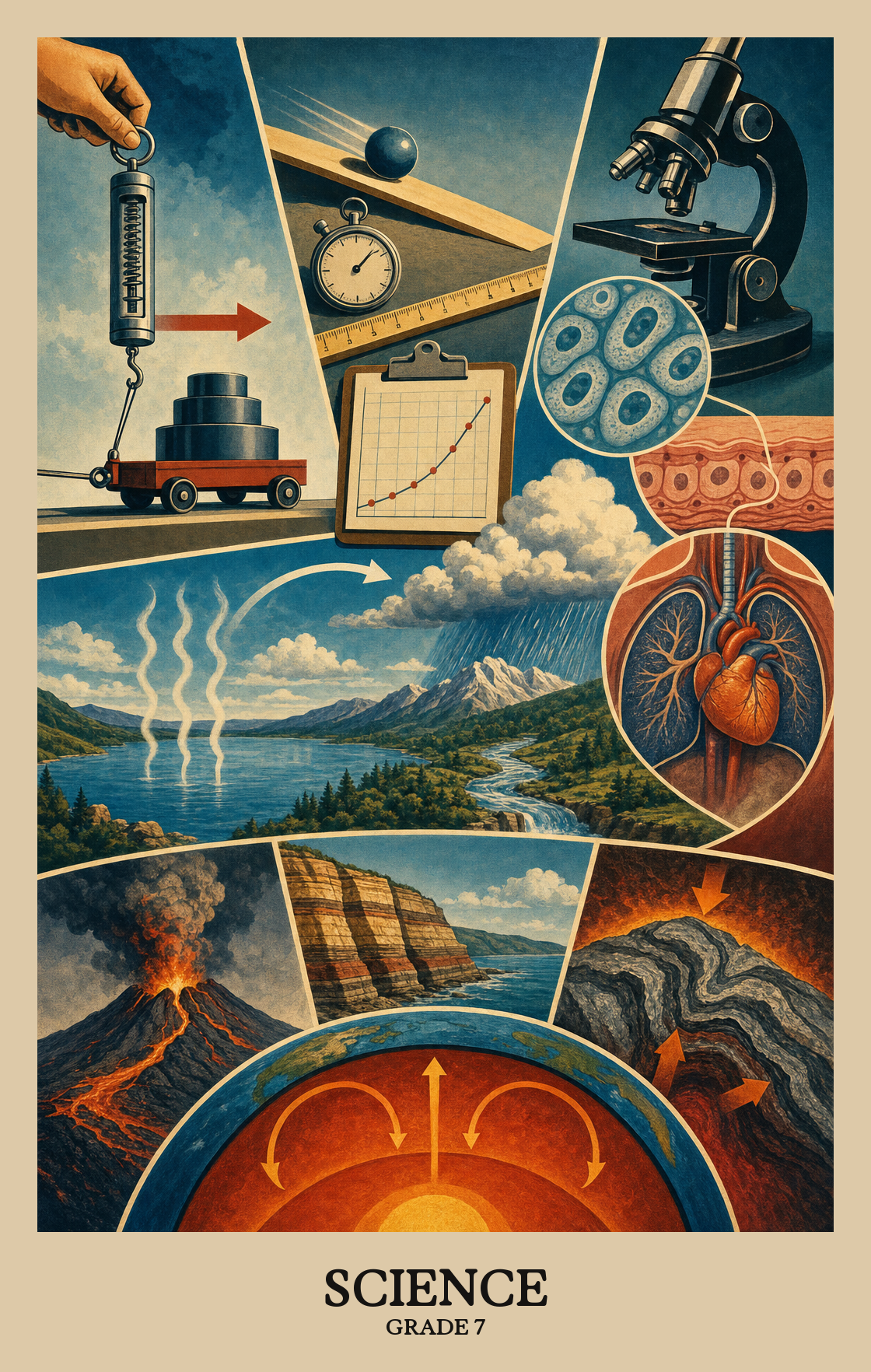
This is the year science gets quantitative. Students start measuring how energy, force, and motion actually work, using graphs and experiments to back up what they claim. They look inside the body to see how cells build the systems that keep a person alive, and they zoom out to see how water, rock, and heat move across the planet over billions of years. By spring, students can run a fair test, gather the data, and explain what it proves.
Students start with the idea that every living thing is built from cells. They look at how parts of a cell do specific jobs and how systems like the heart, lungs, and gut work together to keep a body running.
Students follow how the eyes, ears, and skin send signals to the brain. They look at how the brain reacts in the moment and how some of those signals get stored as memories.
Students study how speed and weight change the energy of a moving object, and how heat moves between things. They build and test something that keeps heat in or out, like a cooler or a cup.
Students push, pull, and crash objects to see how forces change motion. They explore magnets and static electricity, and look at why gravity pulls bigger objects together more strongly.
Students model how rocks, water, and energy move through the planet over time. They read rock layers and fossils like a timeline and look at why oil, minerals, and groundwater sit where they do.
Students finish the year by tackling a real problem people cause for the environment. They define what a good solution needs to do, test ideas, and combine the best parts into a stronger design.
Students read and build graphs that show how a moving object's energy changes when it gets heavier or faster. A heavier car rolling downhill has more energy than a lighter one; a faster car has more energy than a slower one.
Objects that interact at a distance, like magnets or a ball above the ground, store energy based on how far apart they are. Move them closer or farther and the stored energy changes.
Students design and build a device to control heat transfer, then test whether it works. Think of it as engineering an insulated lunchbox or a heat-collecting solar panel and measuring how well it does the job.
Students plan and run an experiment to see how the type and amount of a material affects how much its temperature changes when heat is added. More mass or a different material can mean a bigger or smaller temperature shift.
When a moving object speeds up or slows down, energy is moving too. Students argue, using real examples, that the change in motion means energy either flowed into the object or left it.
When two objects collide, each one pushes the other with equal force in the opposite direction. Students use that principle to design a solution, like padding or a barrier, that controls what happens when the objects hit.
Students plan and run a test to show that a heavier object needs more force to speed up or slow down, and that multiple forces on the same object add together to decide how it moves.
Students look at data to figure out what makes electric and magnetic forces stronger or weaker, such as how distance or the size of a current changes the pull or push between objects.
Students build a written or oral argument explaining why gravity pulls objects toward each other and why heavier objects pull harder. They back up that claim with evidence, not just a guess.
Students test how magnets or electrically charged objects push and pull each other without touching. They also judge whether the experiment was set up fairly and what the results actually show.
| Standard | Definition | Code |
|---|---|---|
| Construct and interpret graphical displays of data to describe the… | Students read and build graphs that show how a moving object's energy changes when it gets heavier or faster. A heavier car rolling downhill has more energy than a lighter one; a faster car has more energy than a slower one. | S.7.5 |
| Develop a model to describe that when the arrangement of objects interacting at… | Objects that interact at a distance, like magnets or a ball above the ground, store energy based on how far apart they are. Move them closer or farther and the stored energy changes. | S.7.6 |
| Apply scientific principles to design, construct | Students design and build a device to control heat transfer, then test whether it works. Think of it as engineering an insulated lunchbox or a heat-collecting solar panel and measuring how well it does the job. | S.7.7 |
| Plan an investigation to determine the relationships among the energy… | Students plan and run an experiment to see how the type and amount of a material affects how much its temperature changes when heat is added. More mass or a different material can mean a bigger or smaller temperature shift. | S.7.8 |
| Construct, use, and present arguments to support the claim that when the… | When a moving object speeds up or slows down, energy is moving too. Students argue, using real examples, that the change in motion means energy either flowed into the object or left it. | S.7.9 |
| Apply Newton's Third Law to design a solution to a problem involving the motion… | When two objects collide, each one pushes the other with equal force in the opposite direction. Students use that principle to design a solution, like padding or a barrier, that controls what happens when the objects hit. | S.7.10 |
| Plan an investigation to provide evidence that the change in an object's motion… | Students plan and run a test to show that a heavier object needs more force to speed up or slow down, and that multiple forces on the same object add together to decide how it moves. | S.7.11 |
| Ask questions about data to determine the factors that affect the strength of… | Students look at data to figure out what makes electric and magnetic forces stronger or weaker, such as how distance or the size of a current changes the pull or push between objects. | S.7.12 |
| Construct and present arguments using evidence to support the claim that… | Students build a written or oral argument explaining why gravity pulls objects toward each other and why heavier objects pull harder. They back up that claim with evidence, not just a guess. | S.7.13 |
| Conduct an investigation and evaluate the experimental design to provide… | Students test how magnets or electrically charged objects push and pull each other without touching. They also judge whether the experiment was set up fairly and what the results actually show. | S.7.14 |
Students gather evidence that every living thing is built from cells. They run investigations to see that some organisms are a single cell while others are made of many cells working together.
Students learn how a cell works as a living unit and what each part inside it does. Think of it like a tiny factory: every compartment has a job, and the cell only runs when those jobs work together.
Students build an argument, backed by evidence, for how body systems like the heart, lungs, and digestive tract work together as one system. The focus is on how groups of cells form each organ system and how those systems depend on each other to keep the body running.
Sensory receptors pick up signals from the world around us, then send those signals to the brain. The brain uses them to react on the spot or store them as memories students can draw on later.
| Standard | Definition | Code |
|---|---|---|
| Conduct an investigation to provide evidence that living things are made of… | Students gather evidence that every living thing is built from cells. They run investigations to see that some organisms are a single cell while others are made of many cells working together. | S.7.1 |
| Develop and use a model to describe the function of a cell as a whole and ways… | Students learn how a cell works as a living unit and what each part inside it does. Think of it like a tiny factory: every compartment has a job, and the cell only runs when those jobs work together. | S.7.2 |
| Use argument supported by evidence for how the body is a system of interacting… | Students build an argument, backed by evidence, for how body systems like the heart, lungs, and digestive tract work together as one system. The focus is on how groups of cells form each organ system and how those systems depend on each other to keep the body running. | S.7.3 |
| Gather and synthesize information that sensory receptors respond to stimuli by… | Sensory receptors pick up signals from the world around us, then send those signals to the brain. The brain uses them to react on the spot or store them as memories students can draw on later. | S.7.4 |
Students build a diagram or model showing how rock, water, and soil move through Earth over time, and what energy sources (like heat from inside Earth or sunlight) keep those cycles going.
Students build a diagram or model showing how water moves through rain, rivers, oceans, and clouds. The sun's heat and gravity keep that cycle running.
Students explain why oil, minerals, and freshwater aren't spread evenly across Earth by connecting those patterns to geologic processes like volcanic activity, erosion, and the movement of tectonic plates over millions of years.
Rock layers act like pages in Earth's history book. Students use evidence from those layers to explain how scientists divide Earth's 4.6-billion-year past into chunks of time, from the oldest buried rock to the surface.
Geoscience processes like erosion, volcanic eruptions, and shifting tectonic plates have reshaped Earth's surface over millions of years. Students explain how these forces work differently depending on the size of the area and the span of time involved.
Fossils, rock layers, and the shapes of continents all leave clues about how Earth's surface has shifted over millions of years. Students read maps and data to piece together how the plates once fit together and where they moved.
Students design a real plan to track and reduce a human impact on the environment, like pollution or habitat loss, using science to back up each step.
| Standard | Definition | Code |
|---|---|---|
| Develop a model to describe the cycling of Earth's materials and the flow of… | Students build a diagram or model showing how rock, water, and soil move through Earth over time, and what energy sources (like heat from inside Earth or sunlight) keep those cycles going. | S.7.15 |
| Develop a model to describe the cycling of water through Earth's systems driven… | Students build a diagram or model showing how water moves through rain, rivers, oceans, and clouds. The sun's heat and gravity keep that cycle running. | S.7.16 |
| Construct a scientific explanation based on evidence for how the uneven… | Students explain why oil, minerals, and freshwater aren't spread evenly across Earth by connecting those patterns to geologic processes like volcanic activity, erosion, and the movement of tectonic plates over millions of years. | S.7.17 |
| Construct a scientific explanation based on evidence from rock strata for how… | Rock layers act like pages in Earth's history book. Students use evidence from those layers to explain how scientists divide Earth's 4.6-billion-year past into chunks of time, from the oldest buried rock to the surface. | S.7.18 |
| Construct an explanation based on evidence for how geoscience processes have… | Geoscience processes like erosion, volcanic eruptions, and shifting tectonic plates have reshaped Earth's surface over millions of years. Students explain how these forces work differently depending on the size of the area and the span of time involved. | S.7.19 |
| Analyze and interpret data on the distribution of fossils and rocks… | Fossils, rock layers, and the shapes of continents all leave clues about how Earth's surface has shifted over millions of years. Students read maps and data to piece together how the plates once fit together and where they moved. | S.7.20 |
| Apply scientific principles to design a method for monitoring and minimizing a… | Students design a real plan to track and reduce a human impact on the environment, like pollution or habitat loss, using science to back up each step. | S.7.21 |
Students spell out exactly what a solution must do and what it cannot do before building anything. That means naming real limits like cost, materials, and safety, and thinking through how the design might affect people or the environment.
Students look at test results from several design ideas and decide which parts worked best. Then they combine those parts into one improved design that meets the goal better than any single idea did on its own.
| Standard | Definition | Code |
|---|---|---|
| Define the criteria and constraints of a design problem with sufficient… | Students spell out exactly what a solution must do and what it cannot do before building anything. That means naming real limits like cost, materials, and safety, and thinking through how the design might affect people or the environment. | EDS.7.22 |
| Analyze data from tests to determine which characteristics of design can be… | Students look at test results from several design ideas and decide which parts worked best. Then they combine those parts into one improved design that meets the goal better than any single idea did on its own. | EDS.7.23 |
Dynamic Learning Maps alternate assessment for eligible students with significant cognitive disabilities, covering the same tested subjects as the general summative program.
Students study three big areas: physical science (energy, forces, and motion), life science (cells and body systems), and earth science (rocks, water, and plate motion). They also design and test simple devices, like a cup that keeps a drink warm. Expect more lab work and more writing about evidence than in past years.
Ask students to explain what happened in a lab and why. A few minutes of real talk at dinner does more than a worksheet. When something breaks, spills, or bounces, ask what forces or energy were at work. Cooking, gardening, and weather all give easy openings.
Students should be able to explain how energy moves between objects, how forces change motion, and how cells work together as body systems. They should also describe how water, rocks, and heat cycle through Earth. Most of all, they should back up claims with evidence from data.
A common path is cells and body systems first, then energy and forces, then Earth systems and plate motion. Engineering design fits well at the end of each unit, since students can apply what they just learned. Save the heat transfer device for after kinetic energy and temperature.
Potential energy, the difference between heat and temperature, and Newton's Third Law tend to be sticky. Students also confuse correlation with cause when reading graphs. Plan extra time for these and use repeated, varied examples rather than longer lectures.
Some terms matter, like cell, force, energy, and gravity. But the goal is using the words to explain real things, not reciting definitions. If students can describe a magnet, a roller coaster, or a heartbeat in their own words, the vocabulary will stick.
Plan for regular investigations, not just demos. Students need to plan an experiment, collect data, and argue from evidence several times across the year. Simple materials are fine. Ramps, rubber bands, thermometers, and magnets cover most of the physical science standards.
Look for students who can read a graph, explain a cause, and support an idea with data from a lab. They should also be comfortable revising a design after a test fails. If those habits are in place, the next grade's chemistry and biology topics will land more smoothly.