Forces and motion
Students push, pull, and roll objects to see how forces change motion. They watch patterns in how things move and start predicting what will happen next.
This is the year science becomes a real investigation. Students push and pull objects to see how forces change motion, test magnets without touching them, and show that gravity pulls things toward the ground. They look at how animals survive in groups, how traits pass from parents to offspring, and how weather follows patterns across seasons. By spring, students can plan a fair test, collect data, and use it to back up a claim.
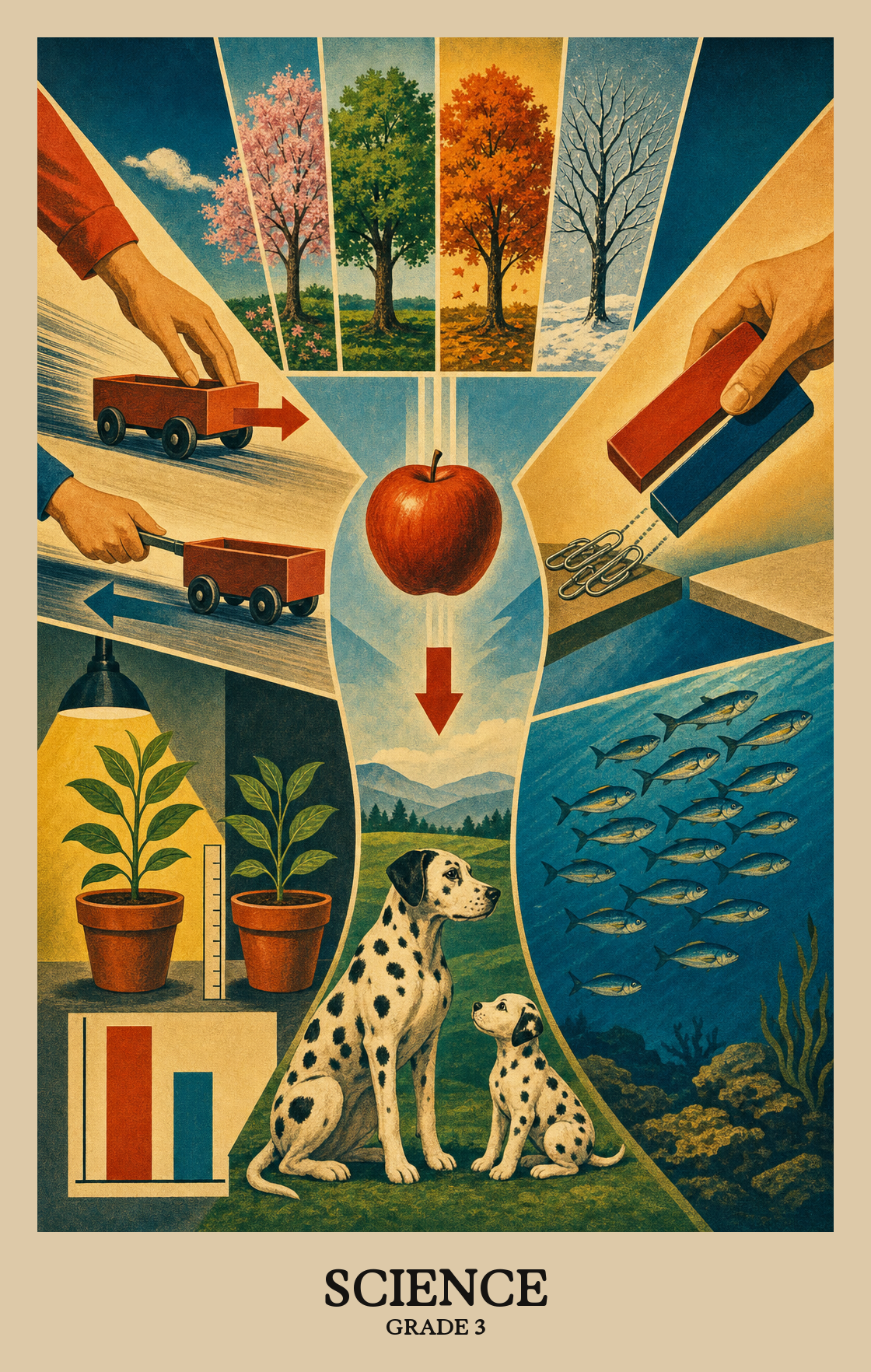
Students push, pull, and roll objects to see how forces change motion. They watch patterns in how things move and start predicting what will happen next.
Students explore how magnets attract and repel without touching, and why dropped objects fall down. They use these ideas to solve a small design problem with magnets.
Students look at how animals live in groups, and why some plants and animals thrive in a habitat while others struggle. They build arguments using what they observe.
Students compare how plants and animals are born, grow, reproduce, and die. They notice which traits come from parents and which are shaped by where an organism lives.
Students chart weather across the seasons and compare climates in different parts of the world. They also weigh ideas for protecting people from storms, floods, and other weather dangers.
Students take on a small design problem with clear rules about materials and time. They sketch options, build a prototype, run fair tests, and improve the parts that did not work.
Students push, pull, and observe objects to learn what happens when forces are equal on both sides (the object stays still) versus when one side wins out (the object moves or changes direction).
Students watch how an object moves, then use that pattern to predict where it will go next. A ball that rolls the same way each time is a good example.
Students ask questions about why magnets attract or repel each other without touching, or why a charged balloon sticks to a wall. The goal is to figure out what causes these invisible forces to push or pull.
Students identify a real problem, like a door that won't stay shut, and explain how magnets could solve it. They connect what they know about magnetic push and pull to a simple fix.
Students learn why dropped objects always fall straight down: Earth pulls everything toward its center. They practice explaining this with simple evidence, like watching a ball fall or water flow downhill.
| Standard | Definition | Code |
|---|---|---|
| Plan and conduct an investigation to provide evidence of the effects of… | Students push, pull, and observe objects to learn what happens when forces are equal on both sides (the object stays still) versus when one side wins out (the object moves or changes direction). | S.3.1 |
| Make observations and/or measurements of an object's motion to provide evidence… | Students watch how an object moves, then use that pattern to predict where it will go next. A ball that rolls the same way each time is a good example. | S.3.2 |
| Ask questions to determine cause and effect relationships of electric or… | Students ask questions about why magnets attract or repel each other without touching, or why a charged balloon sticks to a wall. The goal is to figure out what causes these invisible forces to push or pull. | S.3.3 |
| Define a simple design problem that can be solved by applying scientific ideas… | Students identify a real problem, like a door that won't stay shut, and explain how magnets could solve it. They connect what they know about magnetic push and pull to a simple fix. | S.3.4 |
| Support an argument that the gravitational force exerted by Earth on objects is… | Students learn why dropped objects always fall straight down: Earth pulls everything toward its center. They practice explaining this with simple evidence, like watching a ball fall or water flow downhill. | S.3.5 |
Students study why some animals live in groups instead of alone. They use examples like wolves hunting together or fish swimming in schools to explain how the group helps each member stay safer or find food more easily.
Students look at a specific habitat and use evidence to explain why some animals and plants thrive there, others struggle, and others can't live there at all. A desert, for example, suits a cactus but not a frog.
Students pick a real-world fix for what happens when a habitat changes and some plants or animals can no longer survive there. Then they explain, using evidence, why that fix is worth trying.
Every living thing is born, grows, reproduces, and dies. Students build models showing how that pattern plays out differently across animals and plants, from a frog's tadpole stage to a seed becoming a tree.
Plants and animals get their looks and features from their parents, but not every offspring turns out identical. Students study data to explain why siblings in a litter or seedlings from the same plant can still look different from one another.
Traits like height or leaf size don't come only from parents. Students look at real examples to explain how growing conditions, food, or climate can change how a living thing turns out.
Some animals in a species look or act slightly differently from others. Students examine why those differences can help certain individuals survive longer or find a mate, using real examples as evidence.
| Standard | Definition | Code |
|---|---|---|
| Construct an argument that some animals form groups that help members survive | Students study why some animals live in groups instead of alone. They use examples like wolves hunting together or fish swimming in schools to explain how the group helps each member stay safer or find food more easily. | S.3.6 |
| Construct an argument with evidence that in a particular habitat some organisms… | Students look at a specific habitat and use evidence to explain why some animals and plants thrive there, others struggle, and others can't live there at all. A desert, for example, suits a cactus but not a frog. | S.3.7 |
| Make a claim about the merit of a solution to a problem caused when the… | Students pick a real-world fix for what happens when a habitat changes and some plants or animals can no longer survive there. Then they explain, using evidence, why that fix is worth trying. | S.3.8 |
| Develop models to describe that organisms have unique and diverse life cycles… | Every living thing is born, grows, reproduces, and dies. Students build models showing how that pattern plays out differently across animals and plants, from a frog's tadpole stage to a seed becoming a tree. | S.3.9 |
| Analyze and interpret data to provide evidence that plants and animals have… | Plants and animals get their looks and features from their parents, but not every offspring turns out identical. Students study data to explain why siblings in a litter or seedlings from the same plant can still look different from one another. | S.3.10 |
| Use evidence to support the explanation that traits can be influenced by the… | Traits like height or leaf size don't come only from parents. Students look at real examples to explain how growing conditions, food, or climate can change how a living thing turns out. | S.3.11 |
| Use evidence to construct an explanation for how the variations in… | Some animals in a species look or act slightly differently from others. Students examine why those differences can help certain individuals survive longer or find a mate, using real examples as evidence. | S.3.12 |
Students collect weather data and display it in a table or bar graph to show what conditions are typical in a given season, like cold and snowy in winter or hot and dry in summer.
Students research and compare weather patterns across different parts of the world, then put that information together to describe what the climate is like in each place.
Students look at a real design (like a seawall or a storm drain) and argue whether it actually does a good job protecting people from dangerous weather. They back up their opinion with evidence.
| Standard | Definition | Code |
|---|---|---|
| Represent data in tables and graphical displays to describe typical weather… | Students collect weather data and display it in a table or bar graph to show what conditions are typical in a given season, like cold and snowy in winter or hot and dry in summer. | S.3.13 |
| Obtain and combine information to describe climates in different regions of the… | Students research and compare weather patterns across different parts of the world, then put that information together to describe what the climate is like in each place. | S.3.14 |
| Make a claim about the merit of a design solution that reduces the impacts of a… | Students look at a real design (like a seawall or a storm drain) and argue whether it actually does a good job protecting people from dangerous weather. They back up their opinion with evidence. | S.3.15 |
Students pick a real problem to solve, then set the rules for what a good solution looks like. Those rules include what materials they can use, how much time they have, or how much it can cost.
Students think up more than one way to solve a problem, then compare their ideas to see which one best fits the rules and limits they were given.
Students test a prototype by changing one thing at a time, watching for what breaks or fails, and using what they learn to make the design better.
| Standard | Definition | Code |
|---|---|---|
| Define a simple design problem reflecting a need or a want that includes… | Students pick a real problem to solve, then set the rules for what a good solution looks like. Those rules include what materials they can use, how much time they have, or how much it can cost. | EDS.3.16 |
| Generate and compare multiple possible solutions to a problem based on how well… | Students think up more than one way to solve a problem, then compare their ideas to see which one best fits the rules and limits they were given. | EDS.3.17 |
| Plan and carry out fair tests in which variables are controlled and failure… | Students test a prototype by changing one thing at a time, watching for what breaks or fails, and using what they learn to make the design better. | EDS.3.18 |
Dynamic Learning Maps alternate assessment for eligible students with significant cognitive disabilities, covering the same tested subjects as the general summative program.
Students study forces and motion, magnets, gravity, animal groups and survival, life cycles, traits, and weather and climate. They also work on small design problems, like building something that solves a real need. Most of the year is hands-on investigation, not just reading from a book.
Ask questions about what students notice outside: why a magnet sticks to the fridge but not the table, why a ball rolls faster down a steeper ramp, or how a puppy looks like its parents. Five minutes of wondering out loud builds the same thinking used in class.
Not really. The focus is on making observations, looking for patterns, and using evidence to back up an idea. Knowing that magnets attract iron matters less than being able to test which objects a magnet pulls and explain what happened.
Forces and motion work well in the fall because the investigations are concrete and easy to set up. Life cycles and traits fit the spring when plants and animals are active outside. Weather and climate can run all year as a data-collection routine.
Two areas tend to slow students down: controlling variables in a fair test, and using evidence to support a claim instead of stating an opinion. Both improve with short, repeated practice across different topics, not one big unit.
Students ask a question, change one thing at a time, record what happened, and explain the result using what they observed. The setup can be simple, like rolling cars down ramps or testing which materials a magnet pulls.
When something breaks or annoys someone at home, ask students how they would fix it with materials on hand. Talk about what would count as a good fix and what limits they have, such as time or tape. That mirrors the design thinking used in class.
By spring, students should be able to plan a simple fair test, use a data table or graph to spot a pattern, and write an explanation that points to specific evidence. Comfort with these habits matters more than mastery of any single topic.