Sorting and describing objects
Students look closely at everyday objects and group them by what they notice: color, shape, size, texture, and what they are made of. They start using careful words to describe what they see.
This is the year science becomes something students test, not just read about. Students start asking questions and running small investigations to figure out how things work, from how a shadow moves across the playground to how a push or pull changes where a ball rolls. They watch real cycles unfold, like a seed growing into a plant or the moon changing shape over a month. By spring, students can explain how heating or cooling changes matter and tell which changes can be undone.
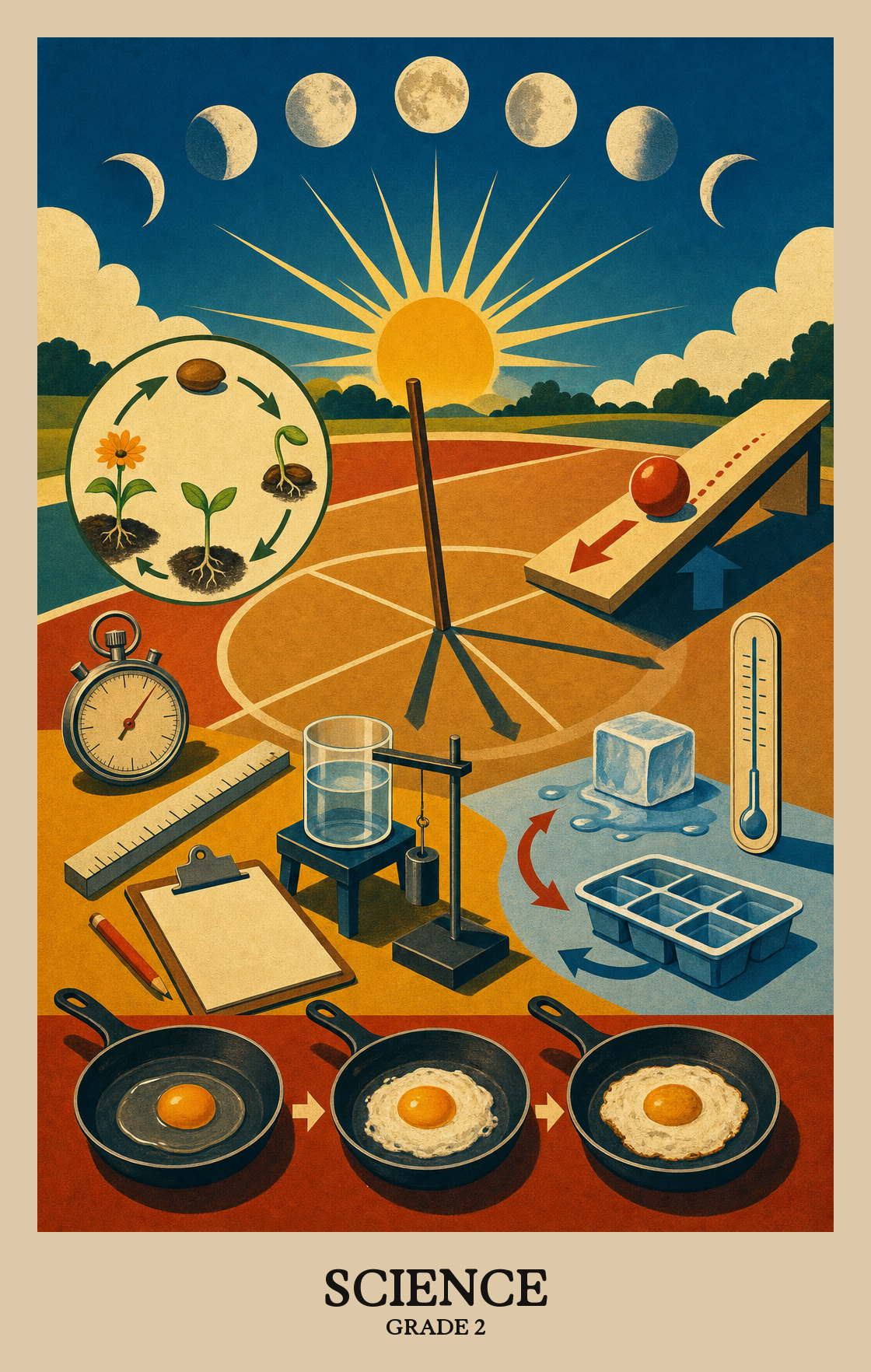
Students look closely at everyday objects and group them by what they notice: color, shape, size, texture, and what they are made of. They start using careful words to describe what they see.
Students experiment with how a push or pull changes the way an object moves. They build simple devices like ramps or launchers to speed something up, slow it down, or change its direction.
Students take things apart and put them back together in new ways with blocks and other small pieces. They also watch what happens when things heat up or cool down, and notice which changes can be undone and which cannot.
Students track the sun across the sky, watch shadows shrink and stretch during the day, and follow how the moon changes shape over a month. They learn that the sun is a star, and that other stars come in different sizes and brightness.
Students grow a plant from a seed and keep a record as it changes week by week. They compare how a cat, a chicken, a frog, and a butterfly each grow up, and learn how animals help plants by spreading seeds and pollen.
Students look at how weather, plants, animals, and people change the land around their community. They ask questions about a real change they can see nearby and try to explain what caused it.
Stars look different from each other in the night sky. Students learn why some stars appear brighter or bigger, comparing real examples to see how stars vary in size and brightness.
Stars look different in the night sky. Students ask questions about why some stars appear larger or brighter than others, then describe what they notice about a star's size and brightness.
Students build an argument explaining why the sun looks so big and bright compared to other stars. The sun is actually a medium-sized star. It looks larger and brighter only because it is much closer to Earth than any other star.
Students learn how the sun and moon follow predictable patterns across the sky, and how the sun's light and heat affect life on Earth.
Students track how a shadow from one fixed object (like a fence post or a tree) changes length and direction as the sun moves across the sky throughout the day.
Students build a structure outside and track how its shadow moves and changes size as the sun crosses the sky during the day.
Students record how many hours of daylight and darkness occur across different times of year, then look at the data to see why the seasons change.
Students track how the moon's shape seems to change night by night, then use that pattern to predict what it will look like next.
Students learn how rain, wind, animals, and people change the land and environment around them. They look at real examples and explain what caused each change.
Students look into big changes happening in their local environment, like a forest being cleared or a wetland flooding, and practice asking questions to find out what caused those changes.
Students pick a real change happening in their local environment, such as a pond drying up or a field being cleared, and explain what caused it and what happened as a result.
| Standard | Definition | Code |
|---|---|---|
| Obtain, evaluate, and communicate information about stars having different… | Stars look different from each other in the night sky. Students learn why some stars appear brighter or bigger, comparing real examples to see how stars vary in size and brightness. | S2E1 |
| Ask questions to describe the physical attributes | Stars look different in the night sky. Students ask questions about why some stars appear larger or brighter than others, then describe what they notice about a star's size and brightness. | S2E1.a |
| Construct an argument to support the claim that although the sun appears to be… | Students build an argument explaining why the sun looks so big and bright compared to other stars. The sun is actually a medium-sized star. It looks larger and brighter only because it is much closer to Earth than any other star. | S2E1.b |
| Obtain, evaluate, and communicate information to develop an understanding of… | Students learn how the sun and moon follow predictable patterns across the sky, and how the sun's light and heat affect life on Earth. | S2E2 |
| Plan and carry out an investigation to determine the effect of the position of… | Students track how a shadow from one fixed object (like a fence post or a tree) changes length and direction as the sun moves across the sky throughout the day. | S2E2.a |
| Design and build a structure that demonstrates how shadows change throughout… | Students build a structure outside and track how its shadow moves and changes size as the sun crosses the sky during the day. | S2E2.b |
| Represent data in tables and/or graphs of the length of the day and night to… | Students record how many hours of daylight and darkness occur across different times of year, then look at the data to see why the seasons change. | S2E2.c |
| Use data from personal observations to describe, illustrate | Students track how the moon's shape seems to change night by night, then use that pattern to predict what it will look like next. | S2E2.d |
| Obtain, evaluate, and communicate information about how weather, plants, animals | Students learn how rain, wind, animals, and people change the land and environment around them. They look at real examples and explain what caused each change. | S2E3 |
| Ask questions to obtain information about major changes to the environment in… | Students look into big changes happening in their local environment, like a forest being cleared or a wetland flooding, and practice asking questions to find out what caused those changes. | S2E3.a |
| Construct an explanation of the causes and effects of a change to the… | Students pick a real change happening in their local environment, such as a pond drying up or a field being cleared, and explain what caused it and what happened as a result. | S2E3.b |
Students sort and describe everyday objects by their physical properties (color, texture, weight, hardness) and observe what happens when those objects bend, break, or change shape.
Students sort everyday objects by their physical properties: color, shape, size, texture, and weight. Asking questions about what they notice helps them group objects that share the same traits.
Building blocks taken apart can be put back together in a completely different way. Students explain how the same pieces that made one structure can become a new one.
Heating and cooling can change matter in ways that can be undone (ice melting back to water) or ways that cannot (a burned log stays ash). Students sort everyday examples into reversible and irreversible changes and explain what they observed.
Students learn what happens when you push or pull an object. They explore how those forces change how fast something moves and which way it goes.
Students push and pull objects to see how force changes the way things move. They plan the investigation themselves, then run it and describe what they observe.
Students design a simple device, like a ramp or bumper, that can make a moving object go faster, slower, or turn in a different direction.
Students test a design, record what happens when they push or pull an object, then look at their results to decide if the design did what it was supposed to do.
| Standard | Definition | Code |
|---|---|---|
| Obtain, evaluate, and communicate information about the properties of matter… | Students sort and describe everyday objects by their physical properties (color, texture, weight, hardness) and observe what happens when those objects bend, break, or change shape. | S2P1 |
| Ask questions to describe and classify different objects according to their… | Students sort everyday objects by their physical properties: color, shape, size, texture, and weight. Asking questions about what they notice helps them group objects that share the same traits. | S2P1.a |
| Construct an explanation for how structures made from small pieces | Building blocks taken apart can be put back together in a completely different way. Students explain how the same pieces that made one structure can become a new one. | S2P1.b |
| Provide evidence from observations to construct an explanation that some… | Heating and cooling can change matter in ways that can be undone (ice melting back to water) or ways that cannot (a burned log stays ash). Students sort everyday examples into reversible and irreversible changes and explain what they observed. | S2P1.c |
| Obtain, evaluate, and communicate information to explain the effect of a force | Students learn what happens when you push or pull an object. They explore how those forces change how fast something moves and which way it goes. | S2P2 |
| Plan and carry out an investigation to demonstrate how pushing and pulling on… | Students push and pull objects to see how force changes the way things move. They plan the investigation themselves, then run it and describe what they observe. | S2P2.a |
| Design a device to change the speed or direction of an object | Students design a simple device, like a ramp or bumper, that can make a moving object go faster, slower, or turn in a different direction. | S2P2.b |
| Record and analyze data to decide if a design solution works as intended to… | Students test a design, record what happens when they push or pull an object, then look at their results to decide if the design did what it was supposed to do. | S2P2.c |
Students learn that all living things (plants, animals, insects) go through a life cycle, from birth or sprout to growth, reproduction, and death. They compare how different organisms grow and change at each stage.
Students learn that animals go through stages as they grow, from birth to adult, and that each type of animal follows its own pattern. They compare how a frog's life looks different from a butterfly's or a dog's.
Students grow a plant from a seed and keep a written or drawn record of how it changes over time. The goal is to see the full cycle, from seed to sprout to full-grown plant, with their own observations as evidence.
Students explain how animals help plants spread seeds or carry pollen from flower to flower. A squirrel burying acorns or a bee visiting a bloom are the kinds of real examples students use to build that explanation.
Students draw or diagram the life cycles of plants, insects, frogs, or other living things, showing how each organism is born, grows, reproduces, and dies in its own way.
| Standard | Definition | Code |
|---|---|---|
| Obtain, evaluate, and communicate information about the life cycles of… | Students learn that all living things (plants, animals, insects) go through a life cycle, from birth or sprout to growth, reproduction, and death. They compare how different organisms grow and change at each stage. | S2L1 |
| Ask questions to determine the sequence of the life cycle of common animals in… | Students learn that animals go through stages as they grow, from birth to adult, and that each type of animal follows its own pattern. They compare how a frog's life looks different from a butterfly's or a dog's. | S2L1.a |
| Plan and carry out an investigation of the life cycle of a plant by growing a… | Students grow a plant from a seed and keep a written or drawn record of how it changes over time. The goal is to see the full cycle, from seed to sprout to full-grown plant, with their own observations as evidence. | S2L1.b |
| Construct an explanation of an animal's role in dispersing seeds or in the… | Students explain how animals help plants spread seeds or carry pollen from flower to flower. A squirrel burying acorns or a bee visiting a bloom are the kinds of real examples students use to build that explanation. | S2L1.c |
| Develop models to illustrate the unique and diverse life cycles of organisms… | Students draw or diagram the life cycles of plants, insects, frogs, or other living things, showing how each organism is born, grows, reproduces, and dies in its own way. | S2L1.d |
Federally administered sample-based assessment in reading, mathematics, science, writing, and other subjects. NAEP results inform state-by-state comparisons rather than individual student or school accountability.
Students study the sun, moon, and stars, weather and changes to their community, how matter can be sorted and changed, how pushes and pulls move things, and the life cycles of plants and animals. It is a year of noticing patterns outside and testing ideas with hands-on materials.
Step outside at the same spot a few times in one day and notice where the sun is and how shadows have moved. At night, draw the shape of the moon once a week on a calendar. After a month, look back and talk about the pattern you see.
Most of this year is about asking questions and trying things, not memorizing facts. Pick one small thing to investigate together, like why ice melts faster on the counter than in the freezer. Ten minutes of real curiosity beats an hour of worksheets.
Many teachers open with properties of matter because it sets up careful observation habits. Pushes and pulls fit well in the middle when students can handle data recording. Save life cycles for spring so plant growth investigations line up with warmer weather and longer daylight.
Reversible versus irreversible changes trip up a lot of students, especially telling melting apart from burning or baking. Moon phase patterns also take repeated observation over weeks before students can predict what comes next. Plan for spiral review rather than one-and-done lessons.
Not really. Second grade focuses on the sun, moon, and stars rather than the full solar system. Words like reversible, life cycle, force, and shadow will come up often, but students learn them by using them, not by studying lists.
Roll a ball down a stack of books and change the height to see what happens to the speed. Build a ramp from cardboard and test which toy cars go farthest. Ask what changed and what stayed the same after each try.
By spring, students should be able to ask a testable question, gather observations, and explain what they noticed using evidence. They should describe patterns in shadows and the moon, sort objects by physical properties, and sequence the life cycle of a plant or animal.
A good second grade investigation has one question, one thing being changed, and a simple way to record what happens. Drawings, tally marks, and short tables all work. The goal is for students to point at their own data when they explain what they found.