Georgia's land and regions
Students start the year mapping their home state. They find Georgia's mountains, hills, plains, and coast, and trace the Savannah, Flint, and Chattahoochee rivers on a map.
This is the year social studies zooms in on Georgia itself. Students meet the people who shaped the state, from Oglethorpe and Tomochichi to Jackie Robinson and Jimmy Carter, and they learn how the Creek and Cherokee lived on this land long before. Students locate Georgia's mountains, plains, and major rivers on a map, and they start to understand why people save money instead of spending every penny. By spring, they can name Georgia's regions and explain why a mayor, a governor, and a president each have different jobs.
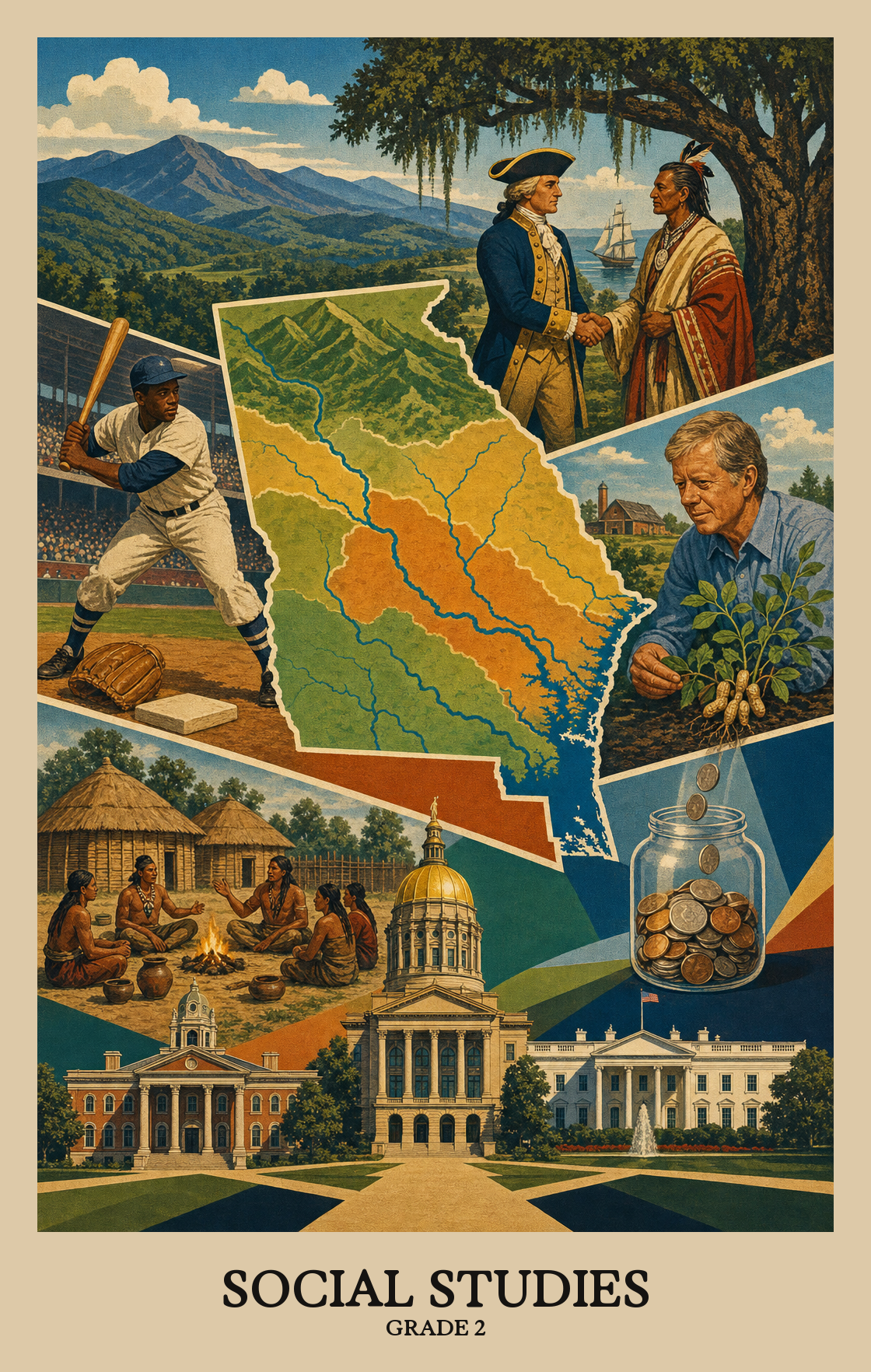
Students start the year mapping their home state. They find Georgia's mountains, hills, plains, and coast, and trace the Savannah, Flint, and Chattahoochee rivers on a map.
Students learn how the Creek and Cherokee lived in Georgia long ago, including the homes they built, the clothes they wore, and the work they did. They compare that life with daily life in Georgia today.
Students meet figures from Georgia's past, from Oglethorpe and Tomochichi to Sequoyah, Jackie Robinson, Martin Luther King Jr., Juliette Gordon Low, and Jimmy Carter. They look at where each person lived and the good they did for others.
Students talk about why families, classrooms, and towns need rules. They learn who the president, governor, and mayor are, and where each one works.
Students see that no one can have everything, so people pick what matters most. They practice why money makes buying easier than trading one thing for another, and they weigh saving against spending.
Students learn about real people who shaped Georgia's history, from James Oglethorpe helping found the colony to Martin Luther King, Jr. fighting for civil rights. They study what each person did and why it still matters.
Students learn how the Creek and Cherokee peoples who lived in Georgia built their homes, made their clothing, used tools, and earned a living before European settlers arrived.
Students look at how the Creek and Cherokee peoples of Georgia lived long ago, including their homes, clothing, and work, then compare that to how Georgians live today.
| Standard | Definition | Code |
|---|---|---|
| Describe the lives and contributions of historical figures in Georgia… | Students learn about real people who shaped Georgia's history, from James Oglethorpe helping found the colony to Martin Luther King, Jr. fighting for civil rights. They study what each person did and why it still matters. | SS2H1 |
| Describe the Georgia Creek and Cherokee cultures of the past in terms of tools… | Students learn how the Creek and Cherokee peoples who lived in Georgia built their homes, made their clothing, used tools, and earned a living before European settlers arrived. | SS2H2 |
| Compare and contrast the Georgia Creek and Cherokee cultures of the past to… | Students look at how the Creek and Cherokee peoples of Georgia lived long ago, including their homes, clothing, and work, then compare that to how Georgians live today. | SS2H2.a |
Students find mountains, rivers, and plains on a Georgia map, then explain how those landforms shape what the state's land actually looks like.
Georgia is divided into five land regions, each with its own shape and feel. Students learn where each region sits on a map and what makes it different from the others.
Students find the Savannah, Flint, and Chattahoochee rivers on a map of Georgia and learn where each one flows through the state.
Students connect people from history to the places they lived and the traditions they carried. For each historical figure and Georgia's Creek and Cherokee peoples, students learn how location shaped daily life and culture.
Students find places on a map that mattered to historical figures like MLK Jr. or Sequoyah, and to the Creek and Cherokee peoples, such as the towns where they lived or the land they called home.
Students learn how people in history shaped their daily lives around the land, weather, and natural resources around them. A farmer, a chief, or a whole community made choices about food, shelter, and work based on where they lived.
Students look at where a historical figure grew up (mountains, coast, farmland) and explain how that landscape shaped daily life. Then they compare that place to their own neighborhood or region.
Students learn where the Creek and Cherokee people lived in Georgia and what the land around them looked like. They explore how each group used nearby rivers, forests, and soil to meet their needs.
| Standard | Definition | Code |
|---|---|---|
| Locate and compare major topographical features of Georgia and describe how… | Students find mountains, rivers, and plains on a Georgia map, then explain how those landforms shape what the state's land actually looks like. | SS2G1 |
| Locate and compare the geographic regions of Georgia | Georgia is divided into five land regions, each with its own shape and feel. Students learn where each region sits on a map and what makes it different from the others. | SS2G1.a |
| Locate on a physical map the major rivers | Students find the Savannah, Flint, and Chattahoochee rivers on a map of Georgia and learn where each one flows through the state. | SS2G1.b |
| Describe the cultural and geographic systems associated with the historical… | Students connect people from history to the places they lived and the traditions they carried. For each historical figure and Georgia's Creek and Cherokee peoples, students learn how location shaped daily life and culture. | SS2G2 |
| Identify specific locations significant to the life and times of each historic… | Students find places on a map that mattered to historical figures like MLK Jr. or Sequoyah, and to the Creek and Cherokee peoples, such as the towns where they lived or the land they called home. | SS2G2.a |
| Describe how each historic figure and the Creek and Cherokee adapted to and… | Students learn how people in history shaped their daily lives around the land, weather, and natural resources around them. A farmer, a chief, or a whole community made choices about food, shelter, and work based on where they lived. | SS2G2.b |
| Describe how the region in which these historic figures lived affected their… | Students look at where a historical figure grew up (mountains, coast, farmland) and explain how that landscape shaped daily life. Then they compare that place to their own neighborhood or region. | SS2G2.c |
| Describe the regions in Georgia where the Creek and Cherokee lived and how the… | Students learn where the Creek and Cherokee people lived in Georgia and what the land around them looked like. They explore how each group used nearby rivers, forests, and soil to meet their needs. | SS2G2.d |
Students learn what a government is and why communities need rules and laws. They explore how rules protect people and keep daily life fair and orderly.
Students learn who runs the country, the state, and the city. They match each leader (President, Governor, Mayor) to the building where that person works.
Students look at real historical figures and point to moments that show good character, like keeping a promise, treating others with respect, or showing patience in a hard situation.
| Standard | Definition | Code |
|---|---|---|
| Define the concept of government and the need for rules and laws | Students learn what a government is and why communities need rules and laws. They explore how rules protect people and keep daily life fair and orderly. | SS2CG1 |
| Identify the following elected officials of the executive branch and where they… | Students learn who runs the country, the state, and the city. They match each leader (President, Governor, Mayor) to the building where that person works. | SS2CG2 |
| Give examples of how the historical figures in SS2H1 demonstrate positive… | Students look at real historical figures and point to moments that show good character, like keeping a promise, treating others with respect, or showing patience in a hard situation. | SS2CG3 |
Scarcity means there isn't enough of something for everyone to have all they want. Students learn that choosing one thing means giving up another, and that what you give up is called the opportunity cost.
Goods are things you can buy or touch; services are things people do for you. Students learn the different ways those things get distributed, like paying a price, waiting in line, or winning a contest.
People buy things with money instead of trading other items directly. Students learn why paying with coins or dollars is simpler than swapping goods, and how that system helps buyers and sellers agree faster.
Saving money means giving something up now to have more later. Students learn to weigh that trade-off against spending right away, and practice explaining why each choice has a cost and a benefit.
| Standard | Definition | Code |
|---|---|---|
| Explain that because of scarcity, people must make choices that result in… | Scarcity means there isn't enough of something for everyone to have all they want. Students learn that choosing one thing means giving up another, and that what you give up is called the opportunity cost. | SS2E1 |
| Identify some ways in which goods and services are allocated | Goods are things you can buy or touch; services are things people do for you. Students learn the different ways those things get distributed, like paying a price, waiting in line, or winning a contest. | SS2E2 |
| Explain that people usually use money to obtain the goods and services they… | People buy things with money instead of trading other items directly. Students learn why paying with coins or dollars is simpler than swapping goods, and how that system helps buyers and sellers agree faster. | SS2E3 |
| Describe the costs and benefits of personal saving and spending choices | Saving money means giving something up now to have more later. Students learn to weigh that trade-off against spending right away, and practice explaining why each choice has a cost and a benefit. | SS2E4 |
Federally administered sample-based assessment in reading, mathematics, science, writing, and other subjects. NAEP results inform state-by-state comparisons rather than individual student or school accountability.
Students learn about people who shaped this state, the five land regions and three major rivers, the Creek and Cherokee, and how government and money work. The year mixes history, geography, civics, and basic economics so students start to see how these connect.
Students learn about James Oglethorpe, Tomochichi, Mary Musgrove, Sequoyah, Jackie Robinson, Martin Luther King Jr., Juliette Gordon Low, and Jimmy Carter. The focus is on what each person did and the character traits they showed, such as honesty, courage, and compassion.
Read a short picture book or watch a kid-friendly video about one figure, then ask students to tell the story back in their own words. Linking each person to a place on a state map helps the names stick.
A common path starts with map skills and the five regions, then layers in the Creek and Cherokee, then moves through the historical figures in rough chronological order. Civics and economics work well as shorter units woven between the longer history blocks.
The five regions and the three major rivers tend to blur together, and students often confuse the roles of mayor, governor, and president. Repeated map work and a simple chart of who leads what, and from where, help these stick.
Keep a state map on the fridge and find the region where students live, then locate places connected to a figure students just studied. Pointing out the Savannah, Flint, and Chattahoochee rivers a few times a month is enough.
Students learn that people cannot have everything, so every choice gives something up. At home, let students pick between two small items with a set amount of money, then talk about what they chose and what they gave up.
Students can name each historical figure and one thing that person did, point to the five regions and three rivers on a map, explain why rules and laws matter, and describe a simple trade-off between saving and spending.
Next year shifts to studying other parts of the country, so a solid grasp of regions, map reading, and the basic roles of leaders gives students a foundation to build on. The economics ideas also carry forward into more detailed work on producers and consumers.