Sorting living things
Students start the year looking at how scientists group living things by shared traits. They learn the six big groups of life and why those categories have shifted over time as scientists found new evidence.
This is the year science zooms in on living things, from the cell to the whole ecosystem. Students learn how the parts of a cell keep it alive, how organs work together inside the body, and how traits pass from parents to offspring. They also study how plants and animals depend on each other and how species change over long stretches of time. By spring, students can explain how a trait gets inherited and trace the path of energy through a food web.
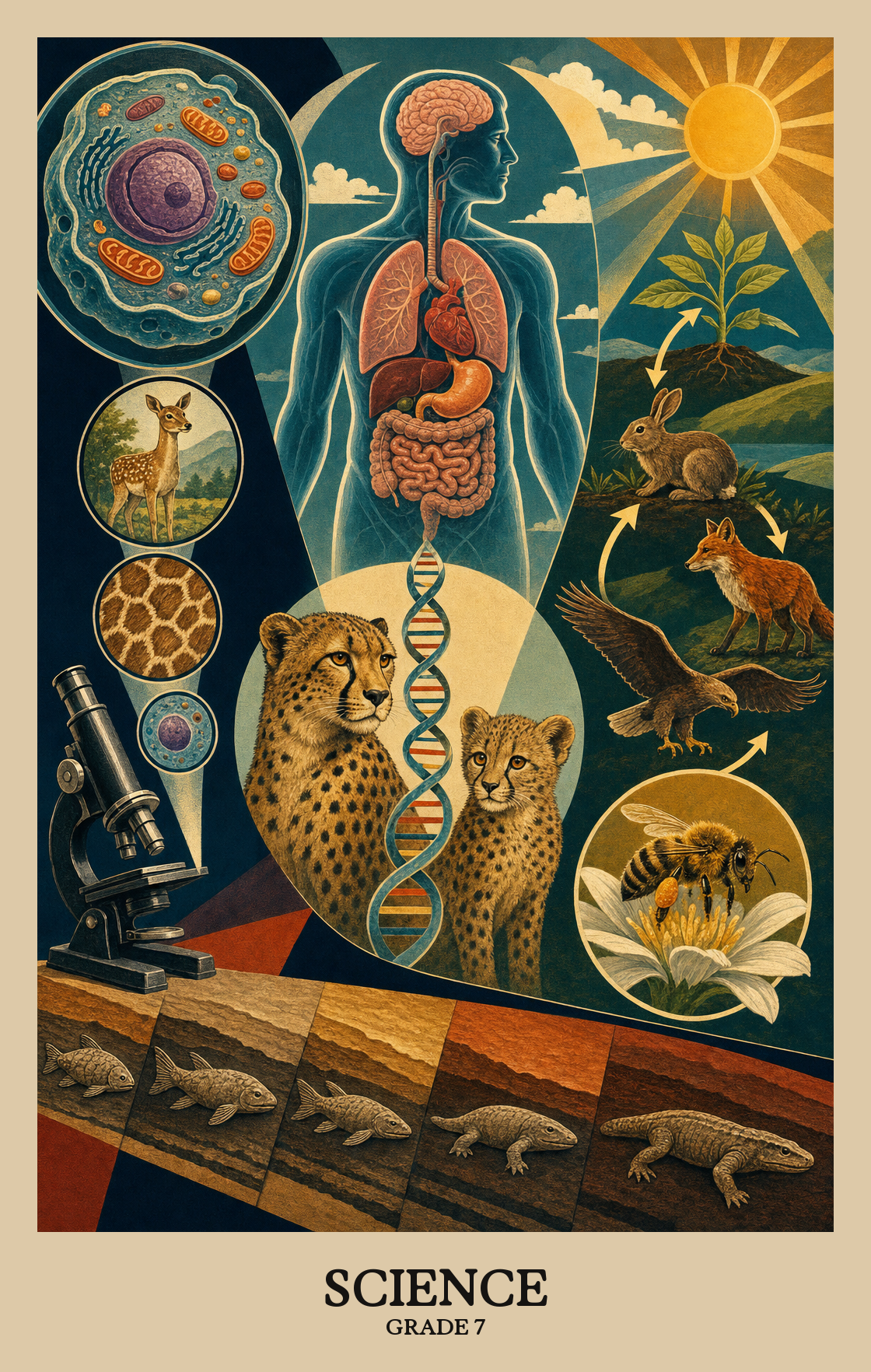
Students start the year looking at how scientists group living things by shared traits. They learn the six big groups of life and why those categories have shifted over time as scientists found new evidence.
Students zoom in on the parts of a cell and what each part does. Then they zoom back out to see how cells build tissues, organs, and the body systems that keep a person breathing, moving, and eating.
Students look at why kids resemble their parents. They study how genes pass from parent to offspring, the difference between sexual and asexual reproduction, and how farmers and breeders choose for traits like sweeter corn or calmer dogs.
Students look at how living things depend on each other and on their surroundings. They trace how energy and matter move through a food web and compare places like rain forests, deserts, and oceans.
Students close the year with how species change over long stretches of time. They use data and fossils as evidence for natural selection and see why some traits become more common while others fade out.
Students learn to research and compare living things, from bacteria to plants to animals, using scientific evidence to explain how organisms are alike and different.
Students sort living things into groups based on shared traits, then explain why each organism belongs where it does. The focus is on building a system that holds up when questioned.
Students learn how scientists sorted living things into groups over time, and why the system eventually split into six kingdoms. The focus is on how new evidence changed older classification models.
Cells group together to form tissues, tissues form organs, and organs work together in systems that keep the body running. Students learn how those layers connect, from the smallest cell structure up to full organ systems like digestion or circulation.
Students draw or diagram a cell and explain what each part does, from the nucleus directing the cell to the mitochondria producing energy, showing how the parts work together to keep the cell fed, growing, and clean.
Cells group together into tissues, tissues form organs, and organs work together as systems that keep a whole organism alive. Students build a model that shows how each level connects to the next.
Students build a case for how body systems work together to keep a person alive. For example, the lungs pull in oxygen while the heart pumps it through the blood, and the kidneys filter out what the body no longer needs.
Students learn how living things pass traits to their offspring, whether through two parents sharing genetic information or one parent copying itself. They look at real examples to explain why offspring end up looking similar to, but not always identical to, their parents.
Genes are sections of DNA stored on chromosomes, and they carry the instructions that determine a specific trait, like eye color or height. Students explain how those instructions pass from parent to offspring using real scientific evidence.
Students use diagrams or models to show why offspring from asexual reproduction are genetic copies of one parent, while offspring from sexual reproduction can look different from either parent.
Selective breeding is when humans choose which plants or animals reproduce together to encourage specific traits. Students explain how farmers, breeders, and scientists have used this practice to shape traits like crop size, disease resistance, or animal behavior over generations.
Students study how living things depend on each other and their surroundings to survive. They look at what happens when one part of an ecosystem changes and how that ripples through the rest.
Students study how living things in an ecosystem depend on each other and on nonliving factors like water, sunlight, and soil. They explain why those relationships follow predictable patterns across different environments.
Students build a diagram or model showing how energy moves through a food web and how matter like water, carbon, or nutrients cycles between living things and their surroundings.
Resource changes, disease, weather shifts, and human activity all affect living things. Students study real data to explain how those pressures change individual animals, whole populations, and the broader ecosystems they live in.
Students compare Earth's major biomes, from tropical rain forests and deserts to tundra and open ocean, by gathering information from multiple sources. The goal is explaining how climate, plants, and animals differ from one place to the next.
Students learn why living things look and behave the way they do by studying how useful traits get passed from parents to offspring across many generations. Over time, those inherited traits can shift a whole species.
Students use graphs or data tables to show how a useful trait, like camouflage or disease resistance, spreads through a population over generations when organisms with that trait survive and reproduce more often.
Genetic variation means individuals in a species differ slightly from one another. Students explain how those differences, combined with environmental pressures like food scarcity or predators, make some individuals more likely to survive and have offspring.
Fossils leave a record of which creatures lived, changed, and died out over time. Students read that record to find patterns and connect ancient organisms to the living things we recognize today.
| Standard | Definition | Code |
|---|---|---|
| Obtain, evaluate, and communicate information to investigate the diversity of… | Students learn to research and compare living things, from bacteria to plants to animals, using scientific evidence to explain how organisms are alike and different. | S7L1 |
| Develop and defend a model that categorizes organisms based on common… | Students sort living things into groups based on shared traits, then explain why each organism belongs where it does. The focus is on building a system that holds up when questioned. | S7L1.a |
| Evaluate historical models of how organisms were classified based on physical… | Students learn how scientists sorted living things into groups over time, and why the system eventually split into six kingdoms. The focus is on how new evidence changed older classification models. | S7L1.b |
| Obtain, evaluate, and communicate information to describe how cell structures… | Cells group together to form tissues, tissues form organs, and organs work together in systems that keep the body running. Students learn how those layers connect, from the smallest cell structure up to full organ systems like digestion or circulation. | S7L2 |
| Develop a model and construct an explanation of how cell structures | Students draw or diagram a cell and explain what each part does, from the nucleus directing the cell to the mitochondria producing energy, showing how the parts work together to keep the cell fed, growing, and clean. | S7L2.a |
| Develop and use a conceptual model of how cells are organized into tissues… | Cells group together into tissues, tissues form organs, and organs work together as systems that keep a whole organism alive. Students build a model that shows how each level connects to the next. | S7L2.b |
| Construct an argument that systems of the body | Students build a case for how body systems work together to keep a person alive. For example, the lungs pull in oxygen while the heart pumps it through the blood, and the kidneys filter out what the body no longer needs. | S7L2.c |
| Obtain, evaluate, and communicate information to explain how organisms… | Students learn how living things pass traits to their offspring, whether through two parents sharing genetic information or one parent copying itself. They look at real examples to explain why offspring end up looking similar to, but not always identical to, their parents. | S7L3 |
| Construct an explanation supported with scientific evidence of the role of… | Genes are sections of DNA stored on chromosomes, and they carry the instructions that determine a specific trait, like eye color or height. Students explain how those instructions pass from parent to offspring using real scientific evidence. | S7L3.a |
| Develop and use a model to describe how asexual reproduction can result in… | Students use diagrams or models to show why offspring from asexual reproduction are genetic copies of one parent, while offspring from sexual reproduction can look different from either parent. | S7L3.b |
| Ask questions to gather and synthesize information about the ways humans… | Selective breeding is when humans choose which plants or animals reproduce together to encourage specific traits. Students explain how farmers, breeders, and scientists have used this practice to shape traits like crop size, disease resistance, or animal behavior over generations. | S7L3.c |
| Obtain, evaluate, and communicate information to examine the interdependence of… | Students study how living things depend on each other and their surroundings to survive. They look at what happens when one part of an ecosystem changes and how that ripples through the rest. | S7L4 |
| Construct an explanation for the patterns of interactions observed in different… | Students study how living things in an ecosystem depend on each other and on nonliving factors like water, sunlight, and soil. They explain why those relationships follow predictable patterns across different environments. | S7L4.a |
| Develop a model to describe the cycling of matter and the flow of energy among… | Students build a diagram or model showing how energy moves through a food web and how matter like water, carbon, or nutrients cycles between living things and their surroundings. | S7L4.b |
| Analyze and interpret data to provide evidence for how resource availability… | Resource changes, disease, weather shifts, and human activity all affect living things. Students study real data to explain how those pressures change individual animals, whole populations, and the broader ecosystems they live in. | S7L4.c |
| Ask questions to gather and synthesize information from multiple sources to… | Students compare Earth's major biomes, from tropical rain forests and deserts to tundra and open ocean, by gathering information from multiple sources. The goal is explaining how climate, plants, and animals differ from one place to the next. | S7L4.d |
| Obtain, evaluate, and communicate information from multiple sources to explain… | Students learn why living things look and behave the way they do by studying how useful traits get passed from parents to offspring across many generations. Over time, those inherited traits can shift a whole species. | S7L5 |
| Use mathematical representations to evaluate explanations of how natural… | Students use graphs or data tables to show how a useful trait, like camouflage or disease resistance, spreads through a population over generations when organisms with that trait survive and reproduce more often. | S7L5.a |
| Construct an explanation based on evidence that describes how genetic variation… | Genetic variation means individuals in a species differ slightly from one another. Students explain how those differences, combined with environmental pressures like food scarcity or predators, make some individuals more likely to survive and have offspring. | S7L5.b |
| Analyze and interpret data for patterns in the fossil record that document the… | Fossils leave a record of which creatures lived, changed, and died out over time. Students read that record to find patterns and connect ancient organisms to the living things we recognize today. | S7L5.c |
End-of-grade science assessment in grades 5 and 8, aligned to Georgia's state-adopted science standards.
Federally administered sample-based assessment in reading, mathematics, science, writing, and other subjects. NAEP results inform state-by-state comparisons rather than individual student or school accountability.
This is a life science year. Students study how living things are sorted into groups, how cells and body systems work, how traits pass from parents to offspring, how organisms depend on each other in an ecosystem, and how species change over long stretches of time.
Watch a nature show together and ask what eats what, or look at family photos and talk about which traits got passed down. A walk in the yard, a trip to the zoo, or a few minutes with a backyard bug count all give students something real to talk about in class.
Students learn the main parts inside a cell and what each part does, like the part that holds the instructions and the part that makes energy. Drawing a labeled cell on paper or building one from snacks at the kitchen table is a fair way to practice.
Students should be able to explain that genes and chromosomes carry traits from parents to offspring, that sexual reproduction mixes traits while asexual reproduction makes copies, and that people use selective breeding to get traits they want in plants and animals.
A common order is cells and body systems first, then classification, then genetics and reproduction, then ecology, and finally evolution and the fossil record. Saving evolution for last lets it pull together genetics, ecology, and classification in one place.
Cell parts and their jobs, the difference between sexual and asexual reproduction, and how energy moves through a food web tend to slip. Short retrieval warm-ups every few weeks help more than reteaching the whole unit later.
Students can build and defend a model, like a food web or a cell diagram, and use it to explain a real situation. They can also pull evidence from data or the fossil record to back up a claim about how living things change or interact.
Students should be able to explain how a body system works, predict which traits offspring might inherit, and describe what happens to an ecosystem when one part changes. If they can talk through these without notes, they are in good shape.