Skip to content

What does a student learn in ?

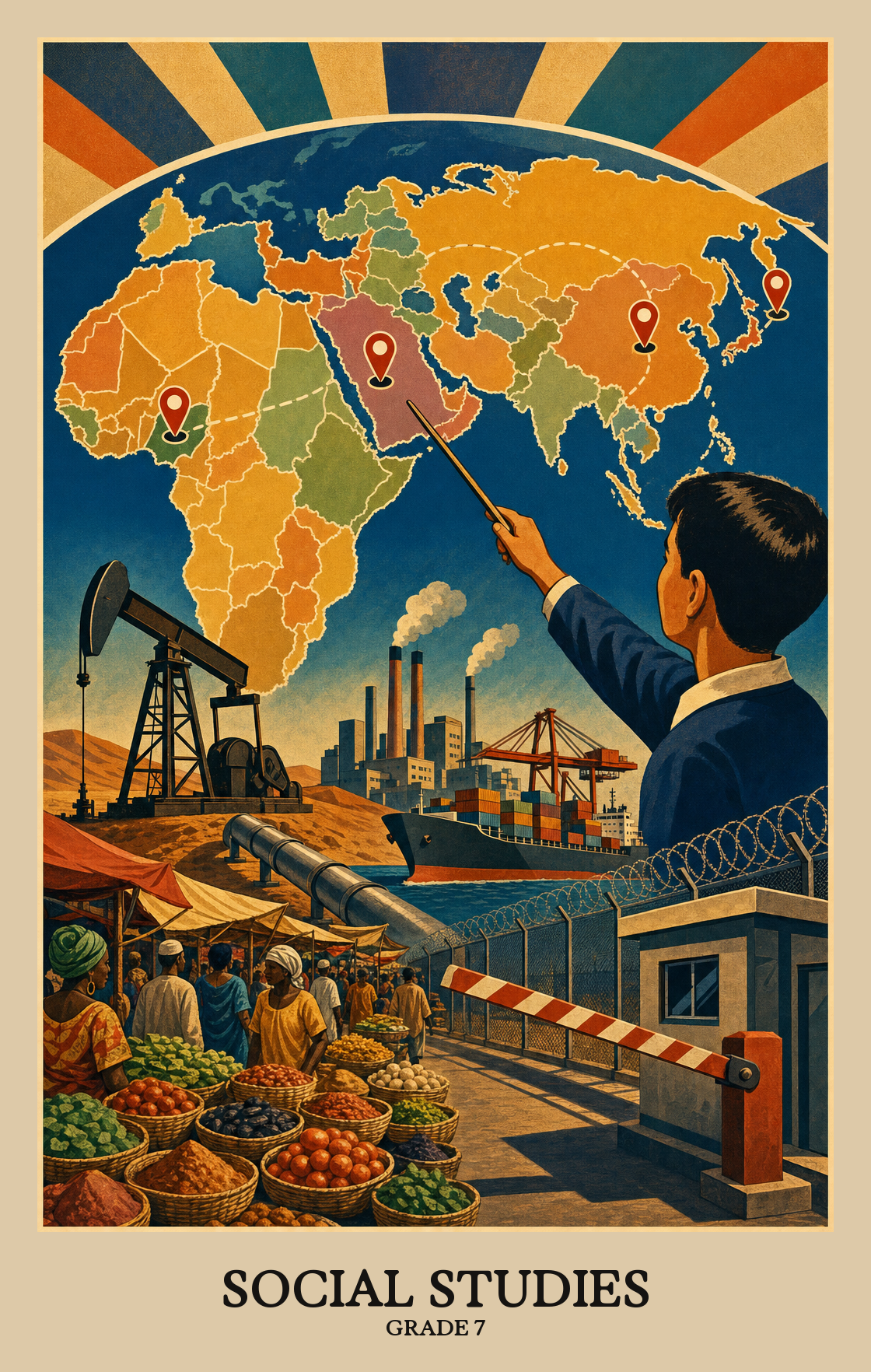
This is the year students step outside the Americas and study Africa, the Middle East, and Asia as real places with real people. Students trace how borders drawn by outside powers still shape conflicts today, from South Africa to Israel to India. They compare how countries like Nigeria, Saudi Arabia, China, and Japan are run and how their economies work. By spring, students can point to these regions on a map and explain why a country there is rich or poor, peaceful or in conflict.

Illustration of what students learn in Grade 7 Social Studies
  • Africa
  • Middle East
  • Asia
  • Map skills
  • Government types
  • World economies
  • Religion and culture
Source: Georgia Georgia Standards of Excellence
Year at a glance
How the year usually goes. Every school and district set their own curriculum, so treat this as a guide, not official pacing.
  1. 1

    Mapping Africa and its people

    Students start the year with Africa. They find major rivers, deserts, and countries on a map, then look at how the land shapes where people live and how groups with different languages and religions share the same country.

  2. 2

    Africa's history, government, and economy

    Students study how European countries drew borders across Africa and how leaders like Nelson Mandela helped end apartheid. They compare how people pick leaders in Kenya, Nigeria, and South Africa, and look at what helps a country's economy grow.

  3. 3

    The Middle East today

    Students move to Southwest Asia. They locate countries and rivers, study how Israel was founded after the Holocaust, and look at conflicts over land and religion. They also compare governments in Israel, Saudi Arabia, and Turkey.

  4. 4

    Oil, trade, and money in the Middle East

    Students look at how oil shapes life and trade across the region. They learn what OPEC does, why countries trade with each other, and how tariffs and other trade barriers can get in the way.

  5. 5

    Southern and Eastern Asia

    Students turn to China, India, Japan, and the Koreas. They study Gandhi and Indian independence, communism under Mao, and the Korean and Vietnam wars. They also compare religions and belief systems like Buddhism, Hinduism, and Confucianism.

  6. 6

    Asian economies and personal money

    Students compare how China, India, Japan, and the Koreas run their economies and what makes some grow faster than others. The year ends with personal finance: living on an income, building a budget, saving, and using credit carefully.

Mastery Learning Standards
The required skills a student should display by the end of Grade 7.
Africa
  • Analyze continuity and change in Africa

    SS7H1

    Students trace how African societies changed over time and what stayed the same, from early kingdoms and colonial rule through independence movements to the present.

  • Explain how the European partitioning across Africa contributed to conflict…

    SS7H1.a

    European countries divided Africa into colonies in the late 1800s, drawing borders that split ethnic groups or forced rivals together. Many of today's conflicts and civil wars in Africa trace back to those imposed boundaries.

  • Explain how the Pan-African movement and nationalism led to independence in…

    SS7H1.b

    Students learn how a shared sense of African identity and the push for self-rule drove Kenya and Nigeria to break from colonial rule. The focus is on the ideas and movements that made independence possible, not just the dates.

  • Explain the creation and end of apartheid in South Africa and the roles of…

    SS7H1.c

    Students learn how South Africa's apartheid system legally separated people by race, why it ended, and what Nelson Mandela and F.W. de Klerk each did to bring that change about.

  • Locate selected features of Africa

    SS7G1

    Students find and name specific countries, rivers, deserts, and mountain ranges on a map of Africa.

  • Locate on a world and regional political-physical map

    SS7G1.a

    Students find and name Africa's major landforms and waterways on a map, including deserts, grasslands, rivers, lakes, and mountain ranges.

  • Locate on a world and regional political-physical map the countries of…

    SS7G1.b

    Students find and name six specific African countries on a world map and a regional map. The six countries are Democratic Republic of the Congo, Egypt, Kenya, Nigeria, South Africa, and Sudan.

  • Explain environmental issues across the continent of Africa

    SS7G2

    Students explain the major environmental problems facing Africa, such as deforestation, drought, and desertification. They look at where these problems occur and why they matter for the people and land affected.

  • Explain how water pollution and unequal access to water impacts irrigation…

    SS7G2.a

    Dirty or scarce water shapes daily life across Africa. Students learn how polluted rivers and uneven water access limit what farmers can grow, what goods get traded, which industries survive, and whether families have safe water to drink.

  • Explain the relationship between poor soil and deforestation in Sub-Saharan…

    SS7G2.b

    Poor soil pushes farmers to clear forests looking for better land to grow crops. Students explain how that cycle of clearing and moving makes deforestation worse across Sub-Saharan Africa.

  • Explain the impact of desertification on the environment of Africa

    SS7G2.c

    Desertification turns fertile land into dry, barren ground as deserts slowly expand. Students explain how this process shrinks farmland, displaces communities, and strains water and food supplies across Africa.

  • Explain the impact of location, climate

    SS7G3

    Students learn why people in Africa live where they do. They look at how rivers, deserts, rainfall, and terrain make some areas crowded and others nearly empty.

  • Explain how the characteristics in the Sahara, Sahel, savanna

    SS7G3.a

    Students study four African regions (the Sahara desert, the Sahel, the savanna, and the tropical rain forest) to explain how each region's climate and terrain shape where people settle and what goods they can trade.

  • Analyze the diverse cultural characteristics of the people who live in Africa

    SS7G4

    Students examine how Africa's many ethnic groups, languages, and religious traditions shape daily life across the continent. The focus is on real differences between communities, not a single African identity.

  • Explain the differences between an ethnic group and a religious group

    SS7G4.a

    Students learn to tell apart two ideas that often get confused: an ethnic group shares ancestry, language, or culture, while a religious group shares beliefs and practices. The two can overlap, but they are not the same thing.

  • Describe the diversity of religions within African ethnic groups

    SS7G4.b

    Students learn that Africa's ethnic groups practice many different religions, including Christianity, Islam, and traditional local beliefs. One region or group often includes people of several faiths living alongside each other.

  • Compare and contrast different forms of citizen participation in government

    SS7CG1

    Students look at how people in different African countries influence their government, comparing places where citizens vote freely with places where participation is limited or controlled.

  • Explain the role of citizen participation in autocratic and democratic…

    SS7CG1.a

    Students learn the difference between governments where citizens vote and shape decisions versus governments where one leader holds all the power and citizens have little say.

  • Describe the two predominant forms of democratic governments

    SS7CG1.b

    Students compare two ways democracies can be organized: a presidential system, where voters elect a separate leader to run the country, and a parliamentary system, where the legislature chooses the prime minister from among its own members.

  • Explain the role of citizens in choosing the leaders of South Africa

    SS7CG1.c

    Students learn how citizens vote to pick leaders in South Africa, Nigeria, and Kenya, and why the voting process works differently in each country. South Africa elects a parliament that then chooses the president; Nigeria and Kenya let citizens vote for the president directly.

  • Analyze how government instability in Africa impacts standard of living

    SS7CG2

    Students study why unstable governments in African countries often lead to lower living conditions for ordinary people, such as less access to clean water, schools, or reliable jobs.

  • Describe the impact of government instability on access to education and the…

    SS7CG2.a

    When a government collapses or loses control, schools close and aid stops reaching people who need it. Students learn how political instability in African countries cuts off access to education, medicine, and food.

  • Analyze different economic systems

    SS7E1

    Students compare how different countries decide what to make, who makes it, and who gets it. Some economies let people and businesses decide freely; others have the government in charge.

  • Compare how traditional, command

    SS7E1.a

    Students compare three ways a society decides what goods to make, how to make them, and who gets them. In a traditional economy, custom drives those choices; in a command economy, the government does; in a market economy, buyers and sellers do.

  • Explain that countries have a mixed economic system located on a continuum…

    SS7E1.b

    Countries don't run on a purely free market or pure government control. Students learn how African nations mix both, landing somewhere between the two extremes depending on how much the government steps in.

  • Compare and contrast the economic systems in South Africa, Nigeria

    SS7E1.c

    Students compare how South Africa, Nigeria, and Kenya organize their economies, looking at who owns businesses, how prices are set, and how much the government controls trade and production.

  • Explain how voluntary trade benefits buyers and sellers in Africa

    SS7E2

    When buyers and sellers trade by choice, both sides get something they value more than what they gave up. Students learn why African countries and their trading partners both come out ahead in a voluntary exchange.

  • Explain how specialization encourages trade between countries

    SS7E2.a

    Specialization means a country focuses on making what it does best, then trades for the rest. Students explain why that exchange benefits both sides more than trying to produce everything at home.

  • Compare and contrast different types of trade barriers, such as tariffs, quotas

    SS7E2.b

    Students learn how countries block or limit trade with each other. A tariff adds a tax on imported goods, a quota caps how much can come in, and an embargo cuts off trade with a country entirely.

  • Explain why international trade requires a system for exchanging currencies…

    SS7E2.c

    When countries buy and sell goods across borders, they need a way to swap their different currencies, like exchanging dollars for euros or naira. Without a shared exchange system, nations could not agree on what anything costs.

  • Describe factors that influence economic growth and examine their presence or…

    SS7E3

    Students look at what helps or slows economic growth in Nigeria, South Africa, and Kenya. They compare things like natural resources, education, and trade to explain why some countries develop faster than others.

  • Evaluate how literacy rates affect the standard of living

    SS7E3.a

    Students study how reading and writing skills connect to income, jobs, and daily life. In places where more people can read, workers tend to earn more and communities tend to have better access to healthcare and education.

  • Explain the relationship between investment in human capital

    SS7E3.b

    Spending money on education and job training tends to raise a country's GDP per capita, meaning the average person earns more. Students explain why a workforce with better skills produces more goods and services.

  • Explain the relationship between investment in capital goods

    SS7E3.c

    Investing in factories, machines, and technology tends to grow a country's economy. Students explain why nations that spend more on these tools usually produce more goods and services, which raises the average income per person.

  • Explain how the distribution of natural resources affects the economic…

    SS7E3.d

    Where oil, diamonds, or farmland happen to be found shapes which countries grow wealthy and which stay poor. Students learn how Africa's uneven spread of natural resources drives economic opportunity across the continent.

  • Describe the role of entrepreneurship

    SS7E3.e

    Starting a business is one way people in Africa improve their lives and their communities. Students learn what it takes to be an entrepreneur: spotting a need, taking a financial risk, and building something new.

Southwest Asia (Middle East)
  • Analyze continuity and change in Southwest Asia

    SS7H2

    Students trace how power, religion, and conflict have shaped the Middle East over centuries, and explain what has stayed the same versus what has shifted.

  • Explain how European partitioning in the Middle East following WWI led to…

    SS7H2.a

    After World War I, European powers drew new borders across the Middle East without regard for who already lived there. Students explain how those artificial lines created tensions between groups that still drive conflict in the region today.

  • Explain the historical factors contributing to the establishment of the modern…

    SS7H2.b

    Students learn why the modern State of Israel was founded in 1948, tracing Jewish ties to the land, the long history of antisemitism in Europe, the rise of the Zionist movement, and the urgent push for a homeland after the Holocaust.

  • Describe how land and religion plays a role in continuing conflicts in the…

    SS7H2.c

    Land ownership and religious differences fuel ongoing disputes in the Middle East. Students learn why Palestinians and Israelis contest the same territory, why Sunni and Shia Muslims have clashed for centuries, and why Kurds have pushed for a homeland of their own.

  • Explain U.S. presence and interest in Southwest Asia, including the Persian…

    SS7H2.d

    Students learn why the U.S. sent troops to the Middle East, covering the Persian Gulf War, the invasion of Afghanistan after 9/11, and the 2003 invasion of Iraq. Each conflict gets its own causes and outcomes.

  • Locate selected features in Southwest Asia

    SS7G5

    Students find and label key physical and political features of Southwest Asia on a map, such as major rivers, bodies of water, and country borders.

  • Locate on a world and regional political-physical map

    SS7G5.a

    Students find and name key waterways of the Middle East on a map, including major rivers like the Tigris and Euphrates, and bodies of water like the Persian Gulf and Red Sea.

  • Locate on a world and regional political-physical map

    SS7G5.b

    Students locate countries like Iran, Iraq, Israel, Saudi Arabia, and Turkey on a map of the Middle East. They can also find smaller territories like the Gaza Strip and West Bank.

  • Explain the impact of environmental issues across Southwest Asia

    SS7G6

    Students examine how water shortages, oil production, and desert expansion affect daily life and economies across the region. The focus is on real environmental problems and why they matter to the people living there.

  • Explain how water pollution and the unequal access to water impacts irrigation…

    SS7G6.a

    Students learn why clean water is scarce in parts of the Middle East and how pollution or unequal distribution leaves some communities without enough water for crops or daily use.

  • Explain the impact of location, climate, physical characteristics, distribution…

    SS7G7

    Students learn how the region's geography shapes daily life: where people settle, what resources are available, and why deserts, rivers, and oil fields matter to the countries found there.

  • Describe how the deserts and rivers of Southwest Asia

    SS7G7.a

    Deserts cover much of Southwest Asia, pushing people and trade routes toward rivers like the Tigris, Euphrates, and Jordan. Students explain how those water sources shape where cities grew and how goods moved across the region.

  • Analyze the diverse cultural characteristics of the people who live in…

    SS7G8

    Students study the different religions, languages, and ways of life found across countries like Saudi Arabia, Iran, and Israel. The goal is to understand why the region is home to so many distinct groups, not just one shared culture.

  • Explain the differences between an ethnic group and a religious group

    SS7G8.a

    Students learn to tell apart two ideas that often get confused: ethnic groups share ancestry, language, or culture, while religious groups share the same faith. A person's ethnicity and religion can be different things.

  • Describe the diversity of religions within Southwest Asian

    SS7G8.b

    Arabs, Persians, and Kurds each have their own history and culture, but people within each group follow different religions. Students learn that ethnicity and religion are not the same thing, and that no single ethnic group practices just one faith.

  • Compare and contrast the prominent religions in Southwest Asia

    SS7G8.c

    Students compare Judaism, Islam, and Christianity by looking at what each religion believes, how followers worship, and where each faith originated. All three began in the same region and share some roots, but differ in key ways.

  • Compare and contrast various forms of government

    SS7CG3

    Students compare how countries in Southwest Asia are governed, looking at who holds power and how decisions get made. A monarchy, a theocracy, and a republic each work differently, and this standard asks students to explain those differences.

  • Explain citizen participation in autocratic and democratic governments [i.e…

    SS7CG3.a

    Citizens in a democracy like Israel or Turkey vote to choose their leaders. In an autocratic monarchy like Saudi Arabia, one ruler holds power and citizens have no vote in selecting who governs them.

  • Describe the two predominant forms of democratic governments

    SS7CG3.b

    Students learn the difference between two types of democracy. In a parliamentary system, the legislature chooses the leader. In a presidential system, voters elect the president separately from the legislature.

  • Analyze different economic systems

    SS7E4

    Students compare how different countries decide what to make, who makes it, and who gets it. Some economies leave those decisions to businesses and buyers; others leave them to the government.

  • Compare how traditional, command

    SS7E4.a

    Students compare three ways a society decides what goods to make, how to make them, and who gets them. In one system, custom drives those choices; in another, the government does; in a third, buyers and sellers do.

  • Explain that countries have a mixed economic system located on a continuum…

    SS7E4.b

    Most countries run a mix of free-market and government-controlled economics, not a purely one or the other. Students learn where different Southwest Asian countries fall on that spectrum.

  • Compare and contrast the economic systems in Israel, Saudi Arabia

    SS7E4.c

    Students compare how Israel, Saudi Arabia, and Turkey organize their economies, looking at who controls prices, businesses, and resources in each country.

  • Explain how voluntary trade benefits buyers and sellers in Southwest Asia

    SS7E5

    Trade is a choice, not a requirement. Students explain why buyers and sellers in Southwest Asia both gain when they agree to exchange goods or services, even across national borders.

  • Explain how specialization encourages trade between countries

    SS7E5.a

    When a country focuses on making what it produces best, it ends up needing things other countries make better. That gap is what drives trade between nations.

  • Compare and contrast different types of trade barriers, such as tariffs, quotas

    SS7E5.b

    Students study how countries block or limit trade with each other. They compare tools like taxes on imported goods, caps on how much of a product can enter, and full bans on trade with certain countries.

  • Explain why international trade requires a system for exchanging currencies…

    SS7E5.c

    When countries buy and sell goods with each other, they need a way to convert one country's money into another's. Students learn why a shared system for exchanging currencies makes international trade possible.

  • Explain the primary function of the Organization of Petroleum Exporting…

    SS7E5.d

    OPEC is a group of oil-producing countries that work together to decide how much oil to sell and at what price. Students learn why that cooperation gives member countries more control over global oil markets than any one country could have alone.

  • Describe factors that influence economic growth and examine their presence or…

    SS7E6

    Students look at why some countries in the Middle East grow wealthier over time and others don't. They compare what Israel, Saudi Arabia, and Turkey each have, such as oil, educated workers, or trade routes, and how those advantages shape each country's economy.

  • Evaluate how literacy rates affect the standard of living

    SS7E6.a

    Literacy rates measure how many people in a region can read and write. Students examine why countries where more adults are literate tend to have higher incomes, better health outcomes, and more economic opportunity.

  • Explain the relationship between investment in human capital

    SS7E6.b

    Spending more on education and job training tends to raise a country's average income over time. Students explore why nations that invest in their people often see stronger economic growth than those that don't.

  • Explain the relationship between investment in capital goods

    SS7E6.c

    When a country builds factories, buys better machinery, or adopts new technology, it can produce more goods and services. That increase in output tends to raise GDP per capita, the average income per person.

  • Explain how the distribution of oil has affected the development of Southwest…

    SS7E6.d

    Oil is not spread evenly across the Middle East. Countries sitting on large reserves, like Saudi Arabia and the UAE, have used oil wealth to build modern cities and infrastructure, while countries with little oil have developed more slowly.

  • Describe the role of entrepreneurship

    SS7E6.e

    Entrepreneurs start businesses to solve problems or meet a need, taking on financial risk in hopes of earning a profit. Students learn how entrepreneurship shapes the economies of Southwest Asia.

Southern and Eastern Asia
  • Analyze continuity and change in Southern and Eastern Asia

    SS7H3

    Students trace how countries in Southern and Eastern Asia changed over time, from ancient empires and colonization through independence movements and modern governments. They look at what stayed the same and what shifted across centuries.

  • Describe how nationalism led to independence in India

    SS7H3.a

    Students learn how a growing sense of Indian identity, led by figures like Gandhi, pushed back against British rule and eventually won India's independence in 1947.

  • Describe the impact of Mohandas Gandhi's belief in non-violent protest

    SS7H3.b

    Gandhi led India's independence movement by refusing to use violence. Students study how his methods, like peaceful marches and strikes, pressured the British to leave India and later inspired protest movements around the world.

  • Explain the role of the United States in the rebuilding of Japan after WWII

    SS7H3.c

    After World War II, the U.S. occupied Japan and guided the country through rebuilding its government, economy, and military rules. Students explain what changed in Japan because of that American influence and why those changes still matter today.

  • Describe the impact of communism in China in terms of Mao Zedong, the Great…

    SS7H3.d

    Students learn how China changed under communist rule, from Mao Zedong's mass farming and factory campaigns to a government crackdown on protesters in Tiananmen Square. Each event shows how political control shaped millions of lives.

  • Explain the reasons for foreign involvement in Korea and Vietnam in terms of…

    SS7H3.e

    Students learn why the U.S. and other countries sent troops to Korea and Vietnam. The short answer: both wars were attempts to stop communism from spreading to new countries during the Cold War.

  • Locate selected features in Southern and Eastern Asia

    SS7G9

    Students find and name key physical and political features across Southern and Eastern Asia on a map, including rivers, mountain ranges, and country borders.

  • Locate on a world and regional political-physical map

    SS7G9.a

    Students find and name rivers, seas, deserts, and mountain ranges across Southern and Eastern Asia on a map. This includes major waterways like the Ganges and Yangtze, bodies of water like the South China Sea, and landmarks like the Himalayas and Gobi Desert.

  • Locate on a world and regional political-physical map the countries of China…

    SS7G9.b

    Students find and identify China, India, Japan, North Korea, South Korea, and Vietnam on a world map. The focus is on recognizing where each country sits relative to its neighbors and major geographic features.

  • Explain the impact of environmental issues across Southern and Eastern Asia

    SS7G10

    Students examine how pollution, deforestation, and water shortages affect daily life across countries in Southern and Eastern Asia, and why those problems spill across borders.

  • Explain the causes and effects of pollution on the Chang Jiang

    SS7G10.a

    Students learn why the Yangtze and Ganges rivers became so polluted and what that pollution has done to the people, wildlife, and land that depend on them.

  • Explain the causes and effects of air pollution and flooding in India and China

    SS7G10.b

    Students study why air pollution and flooding happen in India and China, and what those problems do to the people who live there.

  • Explain the impact of location, climate, physical characteristics, distribution…

    SS7G11

    Geography shapes how and where people live. Students study how Southern and Eastern Asia's mountains, rivers, monsoons, and uneven spread of resources explain why some areas are densely packed with people and others are nearly empty.

  • Describe how the mountain, desert

    SS7G11.a

    Mountains, deserts, and rivers shape where people settle and how goods move across Southern and Eastern Asia. Students explain why some areas are densely populated while others are nearly empty, and how geography has directed trade routes for centuries.

  • Analyze the diverse cultural characteristics of the people who live in Southern…

    SS7G12

    Students study the religions, languages, and ways of life found across Southern and Eastern Asia. They look at what makes each group distinct and how those differences shape daily life across the region.

  • Explain the differences between an ethnic group and a religious group

    SS7G12.a

    Students learn what separates an ethnic group (people who share ancestry, language, or culture) from a religious group (people who share a faith). The distinction matters because a person can belong to both at once.

  • Compare and contrast the belief systems originating in Southern and Eastern Asia

    SS7G12.b

    Students compare four major belief systems from Asia, Buddhism, Hinduism, Shintoism, and Confucianism, looking at what makes each one distinct and where they share common ground.

  • Compare and contrast various forms of government

    SS7CG4

    Students look at how countries in Southern and Eastern Asia run their governments, comparing who holds power, how leaders are chosen, and whether citizens have a say.

  • Explain the role of citizen participation in autocratic and democratic…

    SS7CG4.a

    Students compare how much say ordinary people have in picking their leaders across five Asian countries. In some, like Japan and India, citizens vote in real elections. In others, like North Korea and China, the government controls who holds power.

  • Describe the two predominant forms of democratic governments

    SS7CG4.b

    Students compare two ways democracies can be structured. In a presidential system, voters elect a separate leader to run the government. In a parliamentary system, the legislature chooses that leader from among its own members.

  • Analyze different economic systems

    SS7E7

    Students compare how different countries decide what to make, how to make it, and who gets it. Some governments control those decisions; others leave them mostly to businesses and individuals.

  • Compare how traditional, command

    SS7E7.a

    Students compare three types of economies: ones where custom decides what gets made, ones where the government decides, and ones where buyers and sellers decide. The goal is understanding who controls what gets produced and who gets it.

  • Explain that countries have a mixed economic system located on a continuum…

    SS7E7.b

    Most real economies mix free-market choices with government control. Students learn where countries like China, Japan, and India fall on that spectrum, from mostly government-directed to mostly market-driven.

  • Compare and contrast the economic systems in China, India, Japan, North Korea

    SS7E7.c

    Students compare how China, India, Japan, North Korea, and South Korea each organize their economies, from government-controlled systems to free markets, looking at who owns businesses and how prices and production are decided.

  • Explain how voluntary trade benefits buyers and sellers in Southern and Eastern…

    SS7E8

    When two people trade willingly, both sides gain something they value more than what they gave up. Students explain how that exchange helps buyers and sellers across Southern and Eastern Asia.

  • Explain how specialization encourages trade between countries

    SS7E8.a

    When a country focuses on making what it does best, it ends up needing goods it doesn't make. That need pushes countries to trade with each other.

  • Compare and contrast different types of trade barriers, such as tariffs, quotas

    SS7E8.b

    Students learn the difference between the main tools governments use to control trade. A tariff adds a tax to imported goods, a quota caps how much can come in, and an embargo blocks trade with a country entirely.

  • Explain why international trade requires a system for exchanging currencies…

    SS7E8.c

    When countries buy and sell goods with each other, they need a way to convert one country's money into another's. A Japanese company paid in dollars, for example, still needs yen to pay its workers and suppliers.

  • Describe factors that influence economic growth and examine their presence or…

    SS7E9

    Students learn what makes economies grow or stall, looking at education, trade, natural resources, and government policy in China, India, Japan, South Korea, and North Korea.

  • Evaluate how literacy rates affect the standard of living

    SS7E9.a

    Students learn how the share of people who can read and write in a country connects to wages, health, and quality of life. Places with higher literacy tend to have stronger economies and better living conditions.

  • Explain the relationship between investment in human capital

    SS7E9.b

    Spending money on schools and job training tends to make a country richer over time. Students explain why nations that invest in education usually see higher average incomes than those that don't.

  • Explain the relationship between investment in capital goods

    SS7E9.c

    Building factories, buying new machines, and adopting better technology helps a country produce more goods. When a country produces more, its GDP per capita, the average income per person, tends to rise.

  • Describe the role of natural resources in a country's economy

    SS7E9.d

    Natural resources like oil, timber, or farmland shape what a country produces and trades. Students explain how having or lacking those resources drives economic choices in Southern and Eastern Asia.

  • Describe the role of entrepreneurship

    SS7E9.e

    Starting a business takes risk. Students learn what entrepreneurs do, why they matter to an economy, and what drives someone to build something new instead of working for someone else.

  • Understand that a basic principle of effective personal money management is to…

    SS7E10

    Spending less than you earn is the foundation of managing money well. Students learn why keeping expenses below their income, whether from a job, an allowance, or any other source, matters for financial stability.

  • Understand that income is received from work and is limited

    SS7E10.a

    Students learn that the money people earn from working has a limit. A worker can only earn so much based on hours worked, wages paid, and the job available.

  • Understand that a budget is a tool to plan the spending and saving of income

    SS7E10.b

    A budget is a written plan for how to spend and save money. Students learn how to decide in advance where income goes, so spending stays in check and savings can grow.

  • Understand the reasons and benefits of saving

    SS7E10.c

    Students learn why saving money matters and what it makes possible, like handling an unexpected expense or reaching a goal that costs more than one paycheck.

  • Understand the uses and costs of credit

    SS7E10.d

    Students learn what it means to borrow money, including how interest adds to the total amount owed and when taking on debt helps or hurts a person financially.

No state assessments at this grade
Students take their next one in Grade 8.
State Summative

Georgia Milestones EOG: Social Studies

End-of-grade social studies assessment in grade 8, aligned to Georgia's state-adopted social studies standards.

When given:
spring
Frequency:
annual
Official source
National Monitoring

NAEP (National Assessment of Educational Progress)

Federally administered sample-based assessment in reading, mathematics, science, writing, and other subjects. NAEP results inform state-by-state comparisons rather than individual student or school accountability.

When given:
biennial in winter
Frequency:
every two years
Official source
Common Questions
  • What does this year cover?

    Students study three world regions: Africa, the Middle East, and Southern and Eastern Asia. For each region they look at the same four lenses: history, geography and environment, government, and economics. The goal is to compare how different countries solve similar problems.

  • How can families help with all the map work?

    Keep a world map or globe somewhere visible at home. When a river, desert, or country comes up in the news or in a show, find it together. Quick five-minute map check-ins do more than long study sessions the night before a test.

  • How should the year be paced across the three regions?

    Most teachers spend roughly a trimester on each region and teach the four strands in the same order each time, so students get used to the pattern. Front-loading map and vocabulary work for each region pays off, since later history and economics lessons lean on that geography.

  • There is a lot of religion in this course. How is it taught?

    Students learn about religions as part of culture and history, not as belief. They compare Judaism, Islam, and Christianity in the Middle East and look at Buddhism, Hinduism, Shintoism, and Confucianism in Asia. The focus is on where these groups live and how they shape daily life.

  • Which topics usually need the most reteaching?

    The economics standards trip students up the most, especially the differences between traditional, command, and market economies and the link between human capital and GDP. Plan to revisit those ideas in each region rather than teaching them once and moving on.

  • How can families help with current events?

    Pick one country from the course, such as Nigeria, Israel, or China, and follow a news story about it together for a few weeks. Ask what kind of government runs the country and how people make a living. Real headlines make the standards stick.

  • How is government taught in seventh grade?

    Students compare autocratic and democratic governments and learn the difference between parliamentary and presidential systems. They look at how citizens choose leaders in specific countries, such as South Africa, Israel, Japan, and China, rather than memorizing abstract definitions.

  • What does mastery look like by the end of the year?

    A student ready for eighth grade can locate the major rivers, deserts, and countries in each region and explain how geography shapes where people live. They can also compare two countries' governments or economies and back the comparison with a concrete example.

  • What is the personal finance piece at the end?

    Students learn that income from work is limited, that a budget plans spending and saving, why saving matters, and what credit costs. At home, talking through a small budget for a birthday or a trip gives students a real example to anchor the ideas.