Our place in space
Students start the year looking outward. They compare the planets, study how gravity keeps things in orbit, and learn how ideas about the universe have changed as scientists gathered new evidence.
This is the year science zooms out to the whole planet and the sky above it. Students study the solar system, the phases of the moon, and what causes seasons and eclipses. They also dig into how weather forms, why oceans move in waves and tides, and how mountains, earthquakes, and soil come from slow changes in rock. By spring, students can explain why we have seasons and how a rock can change form over time.
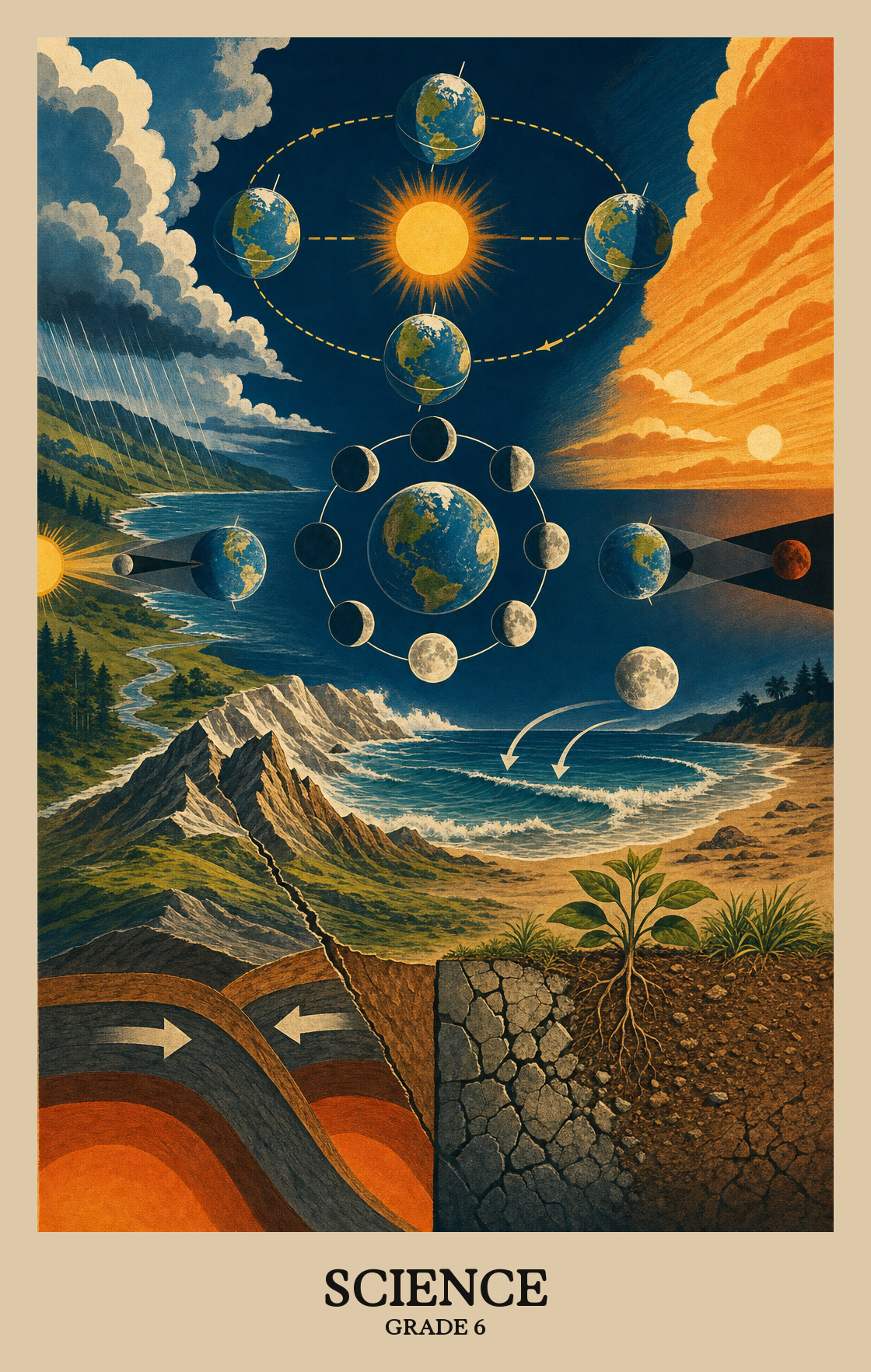
Students start the year looking outward. They compare the planets, study how gravity keeps things in orbit, and learn how ideas about the universe have changed as scientists gathered new evidence.
Students figure out why the moon seems to change shape, what causes an eclipse, and why summer feels different from winter. Expect questions at home about why it gets dark earlier.
Students track where water sits on the planet and how the sun moves it through clouds, rain, and oceans. They also study the layers of the atmosphere and how heat from the sun stirs up wind and weather.
Students dig into what causes thunderstorms, tornadoes, and hurricanes. They read weather maps, study air pressure and fronts, and look at how oceans feed big storms.
Students study what the planet is made of, from the crust down to the core. They learn how rocks form and change, how plates shift to cause earthquakes and volcanoes, and how fossils tell the story of a changing Earth.
Students wrap up the year by looking at energy sources such as solar, wind, oil, and coal. They weigh the trade-offs, design ways to protect water, soil, and air, and examine evidence about rising global temperatures.
Students study how humans figured out the size, shape, and age of the universe, from early star charts to modern telescopes. They look at the evidence scientists used and how those ideas changed over time.
Scientists don't always get it right the first time. Students trace how big ideas shifted over time, like why we stopped thinking Earth sat at the center of everything, and what new discoveries changed the story.
Students place the solar system within the Milky Way galaxy, then place the Milky Way within the broader universe. The goal is to build a mental picture of where our corner of space sits in the larger structure.
Students compare the eight planets using data: how big each one is next to Earth, what its surface and atmosphere look like, how far it sits from the sun, and whether conditions there could support life.
Gravity pulls planets and moons inward while inertia keeps them moving forward. Students use models to show how these two forces working together keep objects in steady orbits around the sun or a planet.
Comets, asteroids, and meteoroids are three different kinds of objects traveling through space. Students compare what each one is made of, what it looks like, and where in the solar system it tends to be found.
Students study how the positions of the sun, Earth, and moon create day and night, the phases of the moon, and solar and lunar eclipses. The focus is on how those three bodies line up and what changes when they do.
Students build or draw a model showing where the sun, Earth, and moon sit relative to each other, then use it to explain why the moon appears to change shape across a month.
Students explain why the sky goes dark during a solar eclipse (the moon blocks sunlight) and why the moon dims during a lunar eclipse (Earth's shadow falls across it).
Students study why Earth's tilt causes some parts of the planet to receive more direct sunlight at certain times of year. That uneven distribution of sunlight is what drives the seasons.
Water shapes nearly everything on Earth's surface. Students study how water moves through the environment, carves landscapes, and drives weather patterns.
Students identify where water is found on Earth's surface (oceans, rivers, lakes, swamps, underground, and ice) and compare how much water sits in each location. Most of it is ocean saltwater, with only a small share in freshwater sources.
The sun heats water on Earth's surface, turning it into vapor that rises, cools, and falls back as rain or snow. Students investigate how solar energy drives that cycle by designing and running a simple experiment.
Students read graphs and maps to describe what ocean water is made of, where the major oceans sit, and what the seafloor looks like beneath the surface.
Students read ocean data and draw graphs or diagrams showing what causes waves, currents, and tides and what effects they have on Earth.
Students study how the sun's heat, land surfaces, and oceans work together to shape local weather patterns and longer-term climate. They read, compare, and discuss sources to explain why some places are hotter, wetter, or stormier than others.
Students learn what the atmosphere is made of, layer by layer, and how certain gases trap heat near Earth's surface the way a blanket holds in warmth at night.
Students investigate why sand gets hotter than water on a sunny day. They design a test to see how sunlight warms soil, water, and air at different speeds.
Students build a model to show why wind forms: the sun heats land and water unevenly, and Earth's rotation bends that moving air into the wind patterns we feel locally and see on global weather maps.
Students learn how differences in air pressure move weather fronts and air masses across the sky, and why those shifts can set off thunderstorms or tornados.
Students look at real weather data to explain how water evaporating from the ocean fuels storms. This includes tracing how that ocean moisture drives weather patterns and builds powerful storms like hurricanes.
Students study how Earth's surface takes shape, from shifting tectonic plates and volcanic activity to erosion and rock formation. They read real data, weigh sources, and explain the evidence behind what shaped the ground beneath our feet.
Students compare the four layers inside Earth, noting how each one differs in temperature, thickness, density, and what it's made of. Think of it as cutting through Earth like an apple and describing each layer from skin to core.
Students investigate real minerals, observing their color, hardness, and texture, then connect what they find to how those minerals make up the rocks around them.
Rocks fall into three groups based on how they formed: from cooled magma, from compressed sediment, or from existing rock changed by heat and pressure. Students learn how rocks shift between those groups over time through the rock cycle.
Weathering breaks rocks apart; erosion moves the pieces by wind, water, or ice; and deposition drops them somewhere new. Students learn to tell these three processes apart and name what causes each one.
Students build or draw a model showing how wind, water, and ice slowly break down rocks and move the pieces somewhere new. They also show how human activity, like construction or mining, changes the land.
Moving pieces of Earth's outer layer grind together, pull apart, or collide. Students explain how those movements trigger earthquakes and volcanic eruptions.
Fossils found in rock layers tell a story about what Earth looked like millions of years ago. Students use maps and fossil data to argue how land and climate have shifted over time.
Students dig into or examine soil samples to find evidence that soil is built from layers: broken-down rock at the bottom and decomposed plant or animal material closer to the surface.
Students study where natural resources like water, soil, and minerals come from, how people use them, and what happens to the land, air, and water when those resources run out or get damaged.
Students sort energy sources into two groups: ones that replenish naturally, like sunlight and wind, and ones that run out, like oil and coal. They also connect each source to real everyday uses.
Students design and test solutions to protect resources like clean water, healthy soil, and breathable air, then weigh the trade-offs of each approach.
Students look at data from the past 100 years and build an argument explaining what has caused global temperatures to rise, weighing evidence from human activity and natural sources.
| Standard | Definition | Code |
|---|---|---|
| Obtain, evaluate, and communicate information about current scientific views of… | Students study how humans figured out the size, shape, and age of the universe, from early star charts to modern telescopes. They look at the evidence scientists used and how those ideas changed over time. | S6E1 |
| Ask questions to determine changes in models of Earth's position in the solar… | Scientists don't always get it right the first time. Students trace how big ideas shifted over time, like why we stopped thinking Earth sat at the center of everything, and what new discoveries changed the story. | S6E1.a |
| Develop a model to represent the position of the solar system in the Milky Way… | Students place the solar system within the Milky Way galaxy, then place the Milky Way within the broader universe. The goal is to build a mental picture of where our corner of space sits in the larger structure. | S6E1.b |
| Analyze and interpret data to compare and contrast the planets in our solar… | Students compare the eight planets using data: how big each one is next to Earth, what its surface and atmosphere look like, how far it sits from the sun, and whether conditions there could support life. | S6E1.c |
| Develop and use a model to explain the interaction of gravity and inertia that… | Gravity pulls planets and moons inward while inertia keeps them moving forward. Students use models to show how these two forces working together keep objects in steady orbits around the sun or a planet. | S6E1.d |
| Ask questions to compare and contrast the characteristics, composition | Comets, asteroids, and meteoroids are three different kinds of objects traveling through space. Students compare what each one is made of, what it looks like, and where in the solar system it tends to be found. | S6E1.e |
| Obtain, evaluate, and communicate information about the effects of the relative… | Students study how the positions of the sun, Earth, and moon create day and night, the phases of the moon, and solar and lunar eclipses. The focus is on how those three bodies line up and what changes when they do. | S6E2 |
| Develop and use a model to demonstrate the phases of the moon by showing the… | Students build or draw a model showing where the sun, Earth, and moon sit relative to each other, then use it to explain why the moon appears to change shape across a month. | S6E2.a |
| Construct an explanation of the cause of solar and lunar eclipses | Students explain why the sky goes dark during a solar eclipse (the moon blocks sunlight) and why the moon dims during a lunar eclipse (Earth's shadow falls across it). | S6E2.b |
| Analyze and interpret data to relate the tilt of the Earth to the distribution… | Students study why Earth's tilt causes some parts of the planet to receive more direct sunlight at certain times of year. That uneven distribution of sunlight is what drives the seasons. | S6E2.c |
| Obtain, evaluate, and communicate information to recognize the significant role… | Water shapes nearly everything on Earth's surface. Students study how water moves through the environment, carves landscapes, and drives weather patterns. | S6E3 |
| Ask questions to determine where water is located on Earth's surface | Students identify where water is found on Earth's surface (oceans, rivers, lakes, swamps, underground, and ice) and compare how much water sits in each location. Most of it is ocean saltwater, with only a small share in freshwater sources. | S6E3.a |
| Plan and carry out an investigation to illustrate the role of the sun's energy… | The sun heats water on Earth's surface, turning it into vapor that rises, cools, and falls back as rain or snow. Students investigate how solar energy drives that cycle by designing and running a simple experiment. | S6E3.b |
| Ask questions to identify and communicate, using graphs and maps, the… | Students read graphs and maps to describe what ocean water is made of, where the major oceans sit, and what the seafloor looks like beneath the surface. | S6E3.c |
| Analyze and interpret data to create graphic representations of the causes and… | Students read ocean data and draw graphs or diagrams showing what causes waves, currents, and tides and what effects they have on Earth. | S6E3.d |
| Obtain, evaluate, and communicate information about how the sun, land | Students study how the sun's heat, land surfaces, and oceans work together to shape local weather patterns and longer-term climate. They read, compare, and discuss sources to explain why some places are hotter, wetter, or stormier than others. | S6E4 |
| Analyze and interpret data to compare and contrast the composition of Earth's… | Students learn what the atmosphere is made of, layer by layer, and how certain gases trap heat near Earth's surface the way a blanket holds in warmth at night. | S6E4.a |
| Plan and carry out an investigation to demonstrate how energy from the sun… | Students investigate why sand gets hotter than water on a sunny day. They design a test to see how sunlight warms soil, water, and air at different speeds. | S6E4.b |
| Develop a model demonstrating the interaction between unequal heating and the… | Students build a model to show why wind forms: the sun heats land and water unevenly, and Earth's rotation bends that moving air into the wind patterns we feel locally and see on global weather maps. | S6E4.c |
| Construct an explanation of the relationship between air pressure, weather… | Students learn how differences in air pressure move weather fronts and air masses across the sky, and why those shifts can set off thunderstorms or tornados. | S6E4.d |
| Analyze and interpret weather data to explain the effects of moisture… | Students look at real weather data to explain how water evaporating from the ocean fuels storms. This includes tracing how that ocean moisture drives weather patterns and builds powerful storms like hurricanes. | S6E4.e |
| Obtain, evaluate, and communicate information to show how Earth's surface is… | Students study how Earth's surface takes shape, from shifting tectonic plates and volcanic activity to erosion and rock formation. They read real data, weigh sources, and explain the evidence behind what shaped the ground beneath our feet. | S6E5 |
| Ask questions to compare and contrast the Earth's crust, mantle, inner and… | Students compare the four layers inside Earth, noting how each one differs in temperature, thickness, density, and what it's made of. Think of it as cutting through Earth like an apple and describing each layer from skin to core. | S6E5.a |
| Plan and carry out an investigation of the characteristics of minerals and how… | Students investigate real minerals, observing their color, hardness, and texture, then connect what they find to how those minerals make up the rocks around them. | S6E5.b |
| Construct an explanation of how to classify rocks by their formation and how… | Rocks fall into three groups based on how they formed: from cooled magma, from compressed sediment, or from existing rock changed by heat and pressure. Students learn how rocks shift between those groups over time through the rock cycle. | S6E5.c |
| Ask questions to identify types of weathering, agents of erosion and… | Weathering breaks rocks apart; erosion moves the pieces by wind, water, or ice; and deposition drops them somewhere new. Students learn to tell these three processes apart and name what causes each one. | S6E5.d |
| Develop a model to demonstrate how natural processes | Students build or draw a model showing how wind, water, and ice slowly break down rocks and move the pieces somewhere new. They also show how human activity, like construction or mining, changes the land. | S6E5.e |
| Construct an explanation of how the movement of lithospheric plates, called… | Moving pieces of Earth's outer layer grind together, pull apart, or collide. Students explain how those movements trigger earthquakes and volcanic eruptions. | S6E5.f |
| Construct an argument using maps and data collected to support a claim of how… | Fossils found in rock layers tell a story about what Earth looked like millions of years ago. Students use maps and fossil data to argue how land and climate have shifted over time. | S6E5.g |
| Plan and carry out an investigation to provide evidence that soil is composed… | Students dig into or examine soil samples to find evidence that soil is built from layers: broken-down rock at the bottom and decomposed plant or animal material closer to the surface. | S6E5.h |
| Obtain, evaluate, and communicate information about the uses and conservation… | Students study where natural resources like water, soil, and minerals come from, how people use them, and what happens to the land, air, and water when those resources run out or get damaged. | S6E6 |
| Ask questions to determine the differences between renewable/sustainable energy… | Students sort energy sources into two groups: ones that replenish naturally, like sunlight and wind, and ones that run out, like oil and coal. They also connect each source to real everyday uses. | S6E6.a |
| Design and evaluate solutions for sustaining the quality and supply of natural… | Students design and test solutions to protect resources like clean water, healthy soil, and breathable air, then weigh the trade-offs of each approach. | S6E6.b |
| Construct an argument evaluating contributions to the rise in global… | Students look at data from the past 100 years and build an argument explaining what has caused global temperatures to rise, weighing evidence from human activity and natural sources. | S6E6.c |
End-of-grade science assessment in grades 5 and 8, aligned to Georgia's state-adopted science standards.
Federally administered sample-based assessment in reading, mathematics, science, writing, and other subjects. NAEP results inform state-by-state comparisons rather than individual student or school accountability.
This year focuses on Earth and space. Students study the solar system, the moon's phases, oceans and the water cycle, weather and climate, rocks and plate tectonics, and how people use natural resources.
Watch the moon together over a month and sketch what it looks like each week. Talk about the weather on the drive to school. Look up where rivers near your house end up. Short, real conversations beat flashcards at this age.
Students should explain why we have seasons, describe the phases of the moon, trace water through the water cycle, name the layers of the Earth, and give a clear example of a renewable and a non-renewable energy source.
A common order is space first, then Earth's water and weather, then rocks and plate tectonics, and finally natural resources. Space hooks students early, and saving resources for the end lets them pull from every prior unit.
Moon phases, eclipses, and seasons trip students up because they confuse what causes what. The rock cycle and the difference between weathering, erosion, and deposition also need a second pass. Build in time for models and quick checks.
No. Sixth grade science asks students to explain how things work, like why hurricanes form over warm ocean water or why one side of a mountain gets more rain. Ask them to explain something in their own words instead of repeating a definition.
A flashlight and a ball for moon phases. A pan of water under a lamp for the water cycle. Sorting rock samples by how they formed. These cheap setups do more for understanding than a worksheet on the same topic.
Students should be comfortable reading a simple graph or map, building a basic model to show an idea, and writing a short explanation backed by what they observed. Comfort with those skills matters more than remembering every term.