Sound and vibrations
Students explore how sound is made. They strum rubber bands, tap drums, and feel their throats hum to see that things that shake make sound, and loud sounds can shake things back.
This is the year science becomes about patterns students can test and predict. Students explore how sound comes from things that shake, and how light has to hit an object before they can see it. They notice how baby animals look a lot like their parents but not exactly, and they track how the sun and moon move in steady ways. By spring, they can sketch a simple invention that copies a plant or animal part to solve a real problem.
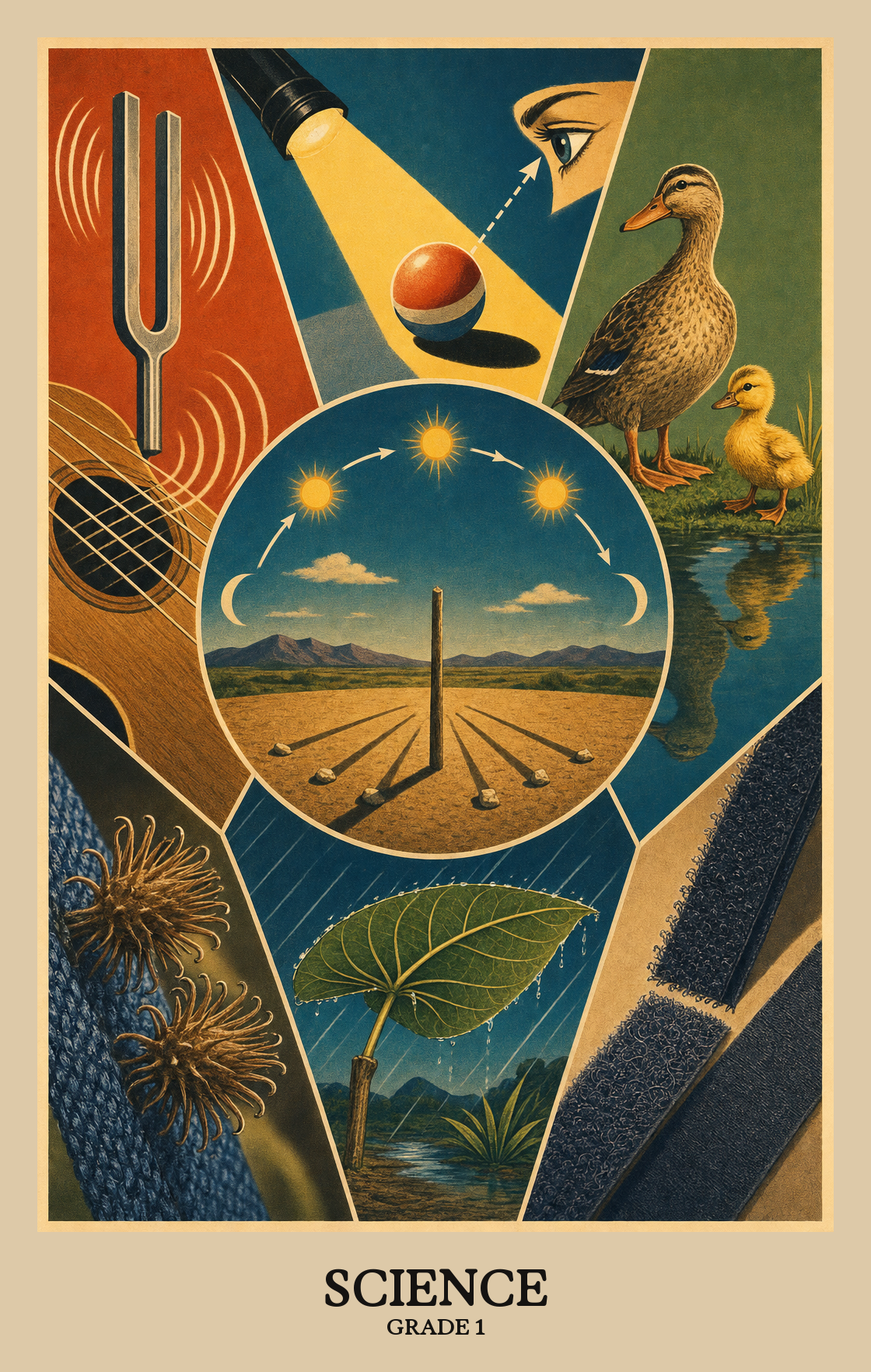
Students explore how sound is made. They strum rubber bands, tap drums, and feel their throats hum to see that things that shake make sound, and loud sounds can shake things back.
Students figure out that a room has to be lit for eyes to see anything. They shine flashlights through paper, plastic, and foil to sort what light passes through, bounces off, or gets blocked.
Students use what they learned about light and sound to design a way to send a message across the room. Think string telephones, flashlight signals, and simple sketches of their ideas before they build.
Students notice how animals use claws, beaks, fins, and shells to survive, and borrow those ideas to solve a human problem. They also compare baby animals and plants to their parents to see what matches and what does not.
Students watch the sun, moon, and stars and track what shows up where. Over the year they notice that summer days feel long and winter days feel short, and they learn to predict what comes next in the sky.
Students learn how light and sound move in waves. They explore how those waves carry information, like how a phone call travels or how a mirror reflects light across a room.
Plants and animals have body parts that help them survive. Students learn what those parts do, like how roots pull in water or how eyes help an animal find food.
Students look at how young animals and plants resemble their parents and where differences show up. A puppy looks like its parents but not exactly like either one.
Students learn what the sun, moon, and stars are and how they seem to move across the sky. They notice patterns in daylight and darkness and connect those patterns to the difference between day and night.
Students identify a problem, think of a solution, and build or draw something to test whether their idea works.
| Standard | Definition | Code |
|---|---|---|
| Waves and their Applications in Technologies for Information Transfer | Students learn how light and sound move in waves. They explore how those waves carry information, like how a phone call travels or how a mirror reflects light across a room. | 1-PS4 |
| From Molecules to Organisms | Plants and animals have body parts that help them survive. Students learn what those parts do, like how roots pull in water or how eyes help an animal find food. | 1-LS1 |
| Heredity: Inheritance and Variation of Traits | Students look at how young animals and plants resemble their parents and where differences show up. A puppy looks like its parents but not exactly like either one. | 1-LS3 |
| Earth's Place in the Universe | Students learn what the sun, moon, and stars are and how they seem to move across the sky. They notice patterns in daylight and darkness and connect those patterns to the difference between day and night. | 1-ESS1 |
| Engineering Design | Students identify a problem, think of a solution, and build or draw something to test whether their idea works. | K-2-ETS1 |
Students shake or tap objects to discover that vibrating things make sound. Then they listen to see if sound can make other objects move or vibrate in return.
Students observe objects in a dark room and a lit room to figure out why light is needed to see anything at all.
Students shine a beam of light and test what happens when different objects block or stand in its path. They find out which materials let light pass through, which slow it down, and which stop it completely.
Students build a simple device, like a flashlight signal or a string telephone, that sends a message to someone far away. The focus is on using light or sound to solve a real communication problem.
| Standard | Definition | Code |
|---|---|---|
| Plan and conduct investigations to provide evidence that vibrating materials… | Students shake or tap objects to discover that vibrating things make sound. Then they listen to see if sound can make other objects move or vibrate in return. | 1-PS4-1 |
| Make observations to construct an evidence-based account that objects can be… | Students observe objects in a dark room and a lit room to figure out why light is needed to see anything at all. | 1-PS4-2 |
| Plan and conduct an investigation to determine the effect of placing objects… | Students shine a beam of light and test what happens when different objects block or stand in its path. They find out which materials let light pass through, which slow it down, and which stop it completely. | 1-PS4-3 |
| Use tools and materials to design and build a device that uses light or sound… | Students build a simple device, like a flashlight signal or a string telephone, that sends a message to someone far away. The focus is on using light or sound to solve a real communication problem. | 1-PS4-4 |
Students look at how animals and plants use their body parts to survive, then build something that copies that idea to solve a real problem. A mitten inspired by fur, or a tool shaped like a bird's beak, counts as a solution.
Students look at books and videos to find patterns in how parent animals care for their young. The goal is understanding which behaviors, like feeding or protecting, help offspring survive.
| Standard | Definition | Code |
|---|---|---|
| Use materials to design a solution to a human problem by mimicking how plants… | Students look at how animals and plants use their body parts to survive, then build something that copies that idea to solve a real problem. A mitten inspired by fur, or a tool shaped like a bird's beak, counts as a solution. | 1-LS1-1 |
| Read texts and use media to determine patterns in behavior of parents and… | Students look at books and videos to find patterns in how parent animals care for their young. The goal is understanding which behaviors, like feeding or protecting, help offspring survive. | 1-LS1-2 |
Students look at pictures or real examples of baby animals and parent animals, then explain in words or drawings how offspring look similar to their parents but also have small differences.
| Standard | Definition | Code |
|---|---|---|
| Make observations to construct an evidence-based account that young plants and… | Students look at pictures or real examples of baby animals and parent animals, then explain in words or drawings how offspring look similar to their parents but also have small differences. | 1-LS3-1 |
Students watch how the sun moves across the sky each day and how the moon's shape seems to change each month. Over time, they spot patterns that repeat on a reliable schedule.
Students track how daylight changes across the seasons, noticing that some months bring long sunny days and others bring early sunsets. They connect those patterns to the time of year.
| Standard | Definition | Code |
|---|---|---|
| Use observations of the sun, moon | Students watch how the sun moves across the sky each day and how the moon's shape seems to change each month. Over time, they spot patterns that repeat on a reliable schedule. | 1-ESS1-1 |
| Make observations at different times of year to relate the amount of daylight… | Students track how daylight changes across the seasons, noticing that some months bring long sunny days and others bring early sunsets. They connect those patterns to the time of year. | 1-ESS1-2 |
Students look at something that isn't working well, ask questions about it, and gather information to figure out exactly what problem needs to be fixed before building or improving a tool.
Students draw or build a simple model to show how an object's shape helps it do its job. A wide base keeps something from tipping; a pointed tip helps something push through.
Students test two different solutions to the same problem and compare how well each one works, noting what each does well and where it falls short.
| Standard | Definition | Code |
|---|---|---|
| Ask questions, make observations | Students look at something that isn't working well, ask questions about it, and gather information to figure out exactly what problem needs to be fixed before building or improving a tool. | K-2-ETS1-1 |
| Develop a simple sketch, drawing | Students draw or build a simple model to show how an object's shape helps it do its job. A wide base keeps something from tipping; a pointed tip helps something push through. | K-2-ETS1-2 |
| Analyze data from tests of two objects designed to solve the same problem to… | Students test two different solutions to the same problem and compare how well each one works, noting what each does well and where it falls short. | K-2-ETS1-3 |
Federally administered sample-based assessment in reading, mathematics, science, writing, and other subjects. NAEP results inform state-by-state comparisons rather than individual student or school accountability.
Four big topics: light and sound, how plants and animals use their body parts to survive, how baby plants and animals compare to their parents, and patterns in the sun, moon, and stars. Students also try simple engineering, like sketching a model to solve a small problem.
Look and wonder together. Tap a spoon on a glass and feel it buzz. Notice the moon at dinner and again at bedtime. Compare a puppy to its parent dog. Ask what students noticed and what they think might happen next.
Not really. The goal is noticing patterns and explaining them in their own words. Words like vibrate, shadow, and offspring will come up, but students should be able to point to an example before worrying about the term.
Light and sound work well in fall when students are eager to tinker. Sun, moon, and daylight patterns fit best as a yearlong observation thread. Save plant and animal parts for spring when outdoor walks are easier, and weave engineering tasks into every unit.
Short, hands-on, and guided. Students plan one small change, try it, and talk about what happened. Plucking a rubber band, shining a flashlight through wax paper, or tracking shadows on the playground all count. Writing can be a drawing with a label.
Two ideas stick slowly. First, that we see objects only when light reaches them, not because eyes send something out. Second, that babies look like their parents but are not identical. Plan to revisit both with fresh examples across the year.
Drawing is how first graders record what they notice, the way older students take notes. A labeled sketch of a bird's beak or a shadow at noon is real science thinking. Ask students to explain the picture, and you will hear the learning.
Students should be able to describe a pattern they observed, suggest a simple test for a question, and explain that animals and plants have parts that help them survive. They should also sketch a basic model to show how something works.