Energy in motion and collisions
Students start the year noticing how faster objects carry more energy. They roll balls, watch them crash, and predict what will happen when things bump into each other.
This is the year science starts to feel like engineering. Students dig into energy: how a faster ball hits harder, how sound and light and electricity carry energy from one place to another, and how to build a small device that turns one kind of energy into another. They also study how plants and animals use their parts to survive, and how wind and water slowly reshape the land. By spring, they can design and test a working model, then explain with evidence why it works.
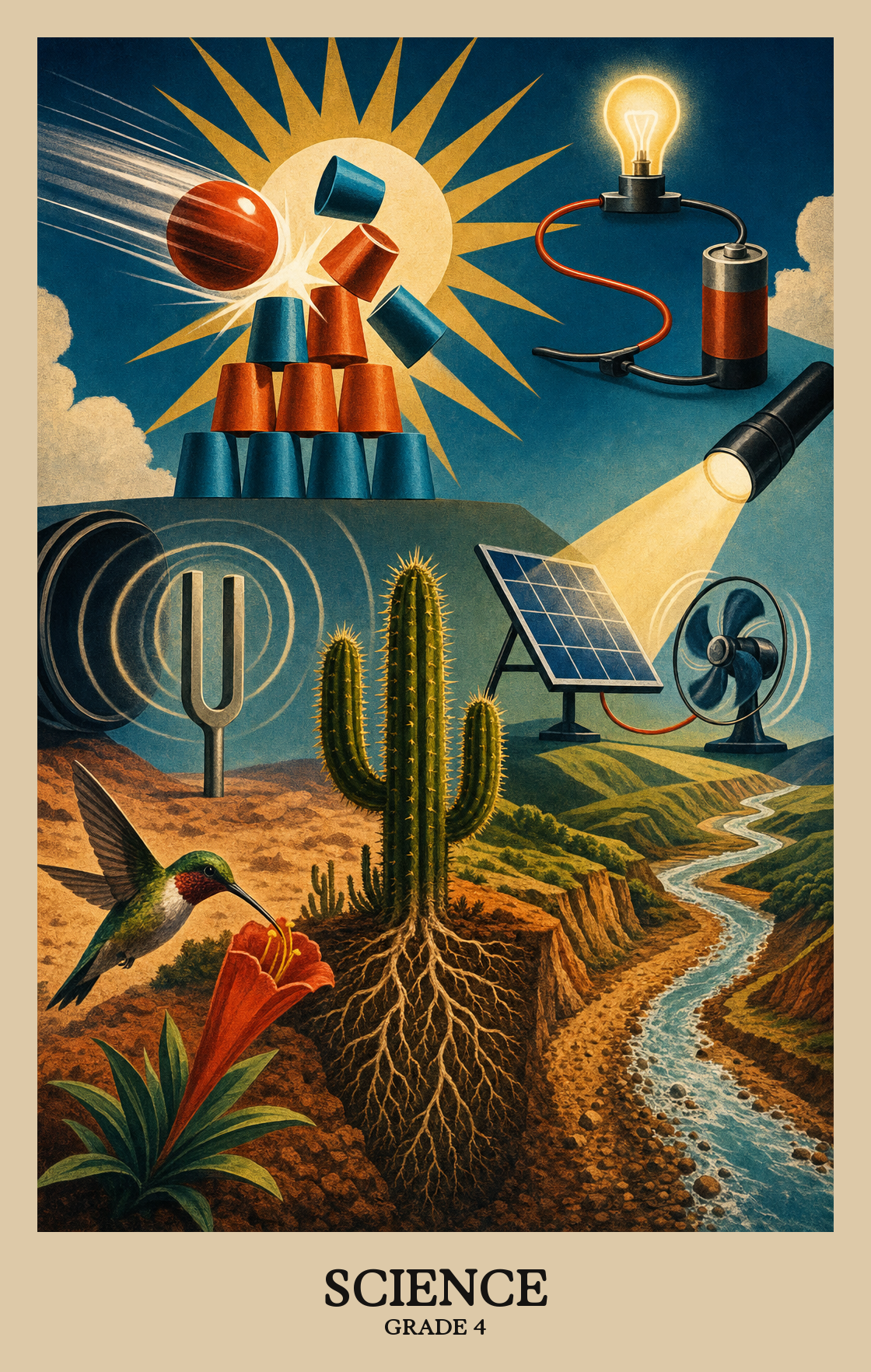
Students start the year noticing how faster objects carry more energy. They roll balls, watch them crash, and predict what will happen when things bump into each other.
Students see how energy travels through sound, light, heat, and electricity. They build a small device, like a simple circuit or a windmill, that turns one kind of energy into another.
Students study waves in water and sound, looking at how tall and how spread out they are. They figure out how light bounces off objects into the eye, which is what lets people see.
Students look at how parts of plants and animals help them live, grow, and stay safe. They also trace how the senses send messages to the brain and how the body responds.
Students read clues in rock layers and fossils to picture what a place used to look like. They watch water, wind, and ice wear land down, and use maps to spot patterns in mountains, rivers, and coasts.
Students close out the year looking at where fuel and energy come from and how using them changes the land, air, and water. They compare ways to protect people from floods, storms, and earthquakes.
Students study how energy moves and changes form, like when a moving ball pushes another object or sunlight warms a surface. They learn what energy does, not just what it is.
Students study how waves carry energy and information, from sound traveling through air to light bouncing off objects. This leads into how phones, radios, and cameras use those same wave properties to send and store information.
Students learn how plants and animals are built to survive. They study body parts like roots, lungs, and eyes, and explain what each one does to keep the organism alive.
Students learn how Earth moves through space and how the sun, moon, and stars follow patterns in the sky. That includes day and night cycles, seasons, and the shapes the moon seems to take each month.
Rocks, water, wind, and living things all shape the land over time. Students study how these forces work together to change Earth's surface through processes like erosion, weathering, and the water cycle.
Students study how humans use natural resources like water, soil, and land, and how those choices can protect or damage the environment. They also look at how people reduce the impact of natural hazards like floods or earthquakes.
| Standard | Definition | Code |
|---|---|---|
| Energy | Students study how energy moves and changes form, like when a moving ball pushes another object or sunlight warms a surface. They learn what energy does, not just what it is. | 4-PS3 |
| Waves and their Applications in Technologies for Information Transfer | Students study how waves carry energy and information, from sound traveling through air to light bouncing off objects. This leads into how phones, radios, and cameras use those same wave properties to send and store information. | 4-PS4 |
| From Molecules to Organisms | Students learn how plants and animals are built to survive. They study body parts like roots, lungs, and eyes, and explain what each one does to keep the organism alive. | 4-LS1 |
| Earth's Place in the Universe | Students learn how Earth moves through space and how the sun, moon, and stars follow patterns in the sky. That includes day and night cycles, seasons, and the shapes the moon seems to take each month. | 4-ESS1 |
| Earth's Systems | Rocks, water, wind, and living things all shape the land over time. Students study how these forces work together to change Earth's surface through processes like erosion, weathering, and the water cycle. | 4-ESS2 |
| Earth and Human Activity | Students study how humans use natural resources like water, soil, and land, and how those choices can protect or damage the environment. They also look at how people reduce the impact of natural hazards like floods or earthquakes. | 4-ESS3 |
Students explain why a faster-moving object has more energy than a slower one. They use observations or data as evidence to back up their explanation.
Students observe everyday examples, like a warm lightbulb or a ringing bell, to show that energy moves from one place to another. Sound, light, heat, and electricity are the main ways that transfer happens.
Students watch what happens when objects crash into each other, then predict how the energy changes. They ask questions about why a harder hit makes a bigger change than a softer one.
Students design and test a device that changes energy from one form to another, like turning movement into electricity or light into heat. Then they use what they learn from testing to improve it.
| Standard | Definition | Code |
|---|---|---|
| Use evidence to construct an explanation relating the speed of an object to the… | Students explain why a faster-moving object has more energy than a slower one. They use observations or data as evidence to back up their explanation. | 4-PS3-1 |
| Make observations to provide evidence that energy can be transferred from place… | Students observe everyday examples, like a warm lightbulb or a ringing bell, to show that energy moves from one place to another. Sound, light, heat, and electricity are the main ways that transfer happens. | 4-PS3-2 |
| Ask questions and predict outcomes about the changes in energy that occur when… | Students watch what happens when objects crash into each other, then predict how the energy changes. They ask questions about why a harder hit makes a bigger change than a softer one. | 4-PS3-3 |
| Apply scientific ideas to design, test | Students design and test a device that changes energy from one form to another, like turning movement into electricity or light into heat. Then they use what they learn from testing to improve it. | 4-PS3-4 |
Waves carry energy through water, sound, and light. Students model how waves move, measuring how tall a wave rises (amplitude) and how far apart the peaks are (wavelength), and show how a wave can push or rock an object in its path.
Students explain why you can see a ball, a chair, or a face: light bounces off the object and travels into the eye. They build or draw a model showing that path from object to eye.
Students design and compare different ways to send information using patterns, like light signals or sound codes. The goal is to figure out which method works best.
| Standard | Definition | Code |
|---|---|---|
| Develop a model of waves to describe patterns in terms of amplitude and… | Waves carry energy through water, sound, and light. Students model how waves move, measuring how tall a wave rises (amplitude) and how far apart the peaks are (wavelength), and show how a wave can push or rock an object in its path. | 4-PS4-1 |
| Develop a model to describe that light reflecting from objects and entering the… | Students explain why you can see a ball, a chair, or a face: light bounces off the object and travels into the eye. They build or draw a model showing that path from object to eye. | 4-PS4-2 |
| Generate and compare multiple solutions that use patterns to transfer… | Students design and compare different ways to send information using patterns, like light signals or sound codes. The goal is to figure out which method works best. | 4-PS4-3 |
Students study the body parts plants and animals have on the outside and inside, such as roots, lungs, or bones, and explain how those parts help a living thing survive, grow, and reproduce.
Students use a diagram or model to show how an animal's senses pick up information, the brain sorts it out, and the animal reacts. A dog hears a sound, processes it, and runs toward it.
| Standard | Definition | Code |
|---|---|---|
| Construct an argument that plants and animals have internal and external… | Students study the body parts plants and animals have on the outside and inside, such as roots, lungs, or bones, and explain how those parts help a living thing survive, grow, and reproduce. | 4-LS1-1 |
| Use a model to describe that animals' receive different types of information… | Students use a diagram or model to show how an animal's senses pick up information, the brain sorts it out, and the animal reacts. A dog hears a sound, processes it, and runs toward it. | 4-LS1-2 |
Students look at rock layers and the fossils inside them to figure out how a place has changed over millions of years. A cliff or canyon is basically a timeline you can read with your eyes.
| Standard | Definition | Code |
|---|---|---|
| Identify evidence from patterns in rock formations and fossils in rock layers… | Students look at rock layers and the fossils inside them to figure out how a place has changed over millions of years. A cliff or canyon is basically a timeline you can read with your eyes. | 4-ESS1-1 |
Students observe rocks, soil, and land to find evidence of how wind, water, ice, or plant roots slowly break things apart or carry material away. The goal is to spot patterns in how fast or slow that change happens.
Students read maps to find patterns in where mountains, valleys, volcanoes, and ocean trenches show up on Earth. The goal is to see that these features aren't random; they cluster in specific places.
| Standard | Definition | Code |
|---|---|---|
| Make observations and/or measurements to provide evidence of the effects of… | Students observe rocks, soil, and land to find evidence of how wind, water, ice, or plant roots slowly break things apart or carry material away. The goal is to spot patterns in how fast or slow that change happens. | 4-ESS2-1 |
| Analyze and interpret data from maps to describe patterns of Earth's features | Students read maps to find patterns in where mountains, valleys, volcanoes, and ocean trenches show up on Earth. The goal is to see that these features aren't random; they cluster in specific places. | 4-ESS2-2 |
Students learn where energy comes from, such as sunlight, wind, and oil, and look at what happens to the land, water, or air when people use those resources.
Students think up and compare different ways to protect people from natural events like floods, earthquakes, or erosion. The goal is to weigh which solution works best, not just pick one.
| Standard | Definition | Code |
|---|---|---|
| Obtain and combine information to describe that energy and fuels are derived… | Students learn where energy comes from, such as sunlight, wind, and oil, and look at what happens to the land, water, or air when people use those resources. | 4-ESS3-1 |
| Generate and compare multiple solutions to reduce the impacts of natural Earth… | Students think up and compare different ways to protect people from natural events like floods, earthquakes, or erosion. The goal is to weigh which solution works best, not just pick one. | 4-ESS3-2 |
Federally administered sample-based assessment in reading, mathematics, science, writing, and other subjects. NAEP results inform state-by-state comparisons rather than individual student or school accountability.
Students study energy, waves, light and sound, plants and animals, rocks and fossils, and how Earth changes over time. A lot of the work is hands-on: rolling balls down ramps, looking at fossils, tracking weather, and building small devices that turn one kind of energy into another.
Ask questions while doing everyday things. Why does the light bulb get warm? Why does the swing slow down? What happens to a puddle after the sun comes out? Five minutes of wondering out loud teaches the same thinking skills used in class.
Students should explain that faster objects carry more energy and that energy moves around through sound, light, heat, and electricity. They should also be able to predict what happens when two objects crash and build a simple device, such as a rubber band car, that changes one form of energy into another.
Many teachers start with energy and collisions, then move into waves, light, and sound since the ideas build on each other. Life science and Earth science can come later in the year, with fossils and erosion pairing well with outdoor weather. End with the engineering work on natural hazards and energy resources.
Some words matter, such as energy, wave, reflect, erosion, and fossil. But the goal is using the words to explain what happens, not reciting definitions. If students can describe an idea in their own words first, the vocabulary sticks more easily.
Waves and light tend to confuse students, especially the idea that we see objects because light bounces off them and into the eye. Energy transfer during collisions also needs extra time. Plan for repeated hands-on work with mirrors, flashlights, and ramps rather than one big lesson.
Ask what evidence the student has seen so far and what they could try to find out more. Science work at this age is about noticing patterns and making careful guesses, not getting the right answer fast. A trip outside or a quick kitchen experiment often helps more than a textbook.
Students should be able to ask a question, plan a simple test, collect observations, and use that evidence to explain what happened. They should also be comfortable drawing models, such as a diagram of light hitting a mirror or a map of a landscape changing over time.