People, places, and connections
Students start the year by noticing how people, places, and ideas connect in their own community. They look at maps, neighborhoods, and local landmarks to see how one place shapes life there.
This is the year students zoom in on Kansas and see how people, places, and the land shape each other over time. Students study how settlers, Native nations, and the prairie itself changed the state, and they connect those stories to questions Kansans still argue about today. By spring, students can read a map of Kansas, explain why a town grew where it did, and back up an opinion about a local issue with real evidence.
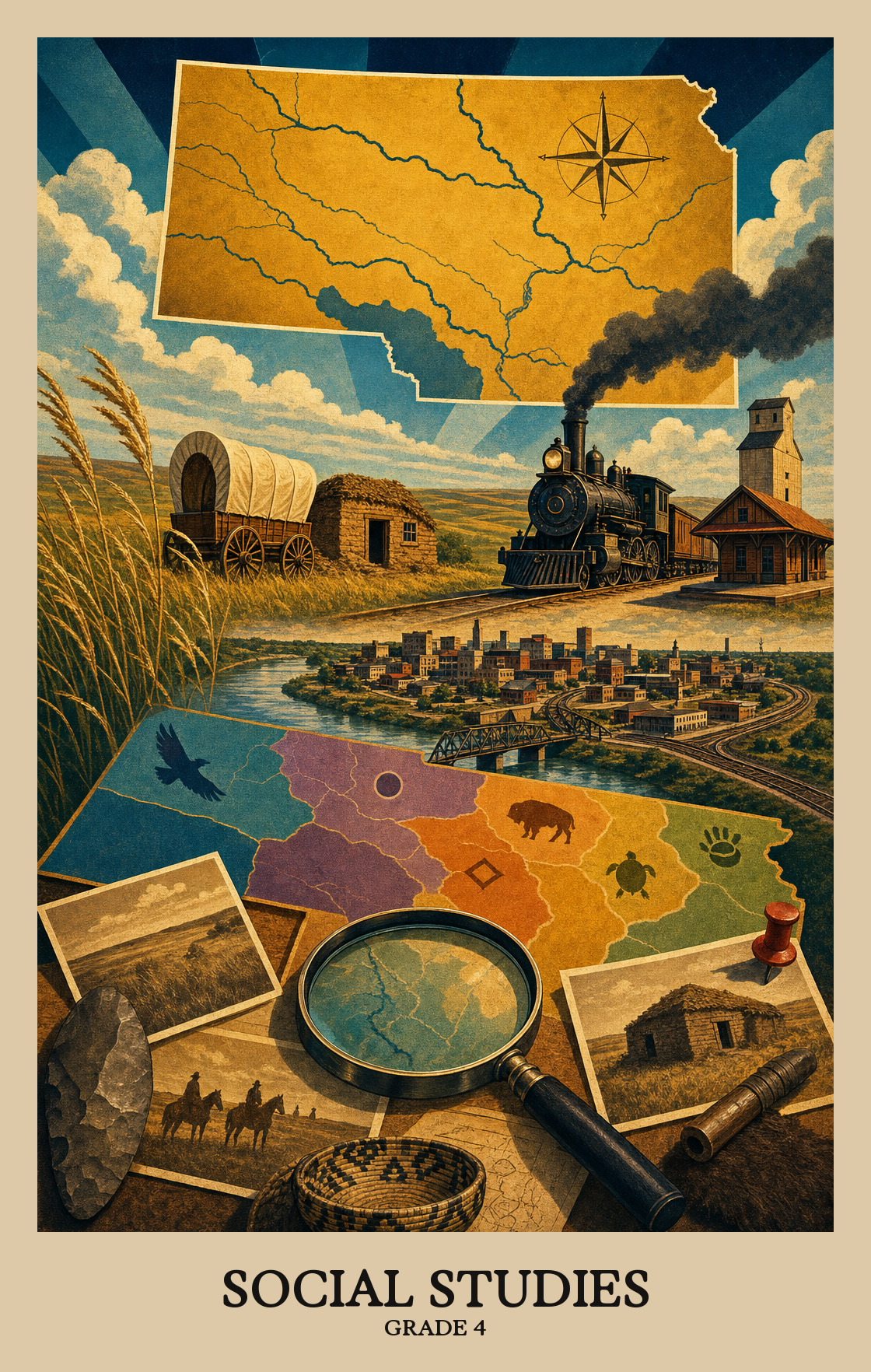
Students start the year by noticing how people, places, and ideas connect in their own community. They look at maps, neighborhoods, and local landmarks to see how one place shapes life there.
Students dig into how the land, rivers, and weather of Kansas shaped where towns grew and how people lived. They compare farm towns, cities, and Native nations across the state.
Students read short passages, photos, and timelines to figure out why things happened the way they did. They practice backing up their ideas with details from what they read or saw.
Students link what they learned about the past to issues in the news and in their own town. They look at how choices made long ago still affect roads, schools, and neighborhoods now.
Students wrap up the year by taking a stand on a real question about their community or state. They write or present a short argument and use facts from class to back it up.
People, places, and ideas change each other over time. Students explore how a river shapes a town, how a town shapes its people, and how those connections keep shifting.
Students look at how changes in one place, like a new road or a factory closing, ripple out and affect people in nearby towns or across a whole state. They practice spotting those connections and deciding whether the change helped or hurt.
Students look at how two or more things (like a river, a settlement, or a trade route) affect each other over time, then explain what changed and why.
Students look at how people, places, and ideas change over time, then connect those changes to problems and events happening in the world today.
Students pick a position on a social studies topic and back it up with facts and details from what they've studied. The goal is a clear argument, not just a summary.
| Standard | Definition | Code |
|---|---|---|
| Relationships among people, places, ideas | People, places, and ideas change each other over time. Students explore how a river shapes a town, how a town shapes its people, and how those connections keep shifting. | 4.5 |
| The student will recognize and evaluate dynamic relationships that impact lives… | Students look at how changes in one place, like a new road or a factory closing, ripple out and affect people in nearby towns or across a whole state. They practice spotting those connections and deciding whether the change helped or hurt. | 4.5.1 |
| The student will analyze the context and draw conclusions about dynamic… | Students look at how two or more things (like a river, a settlement, or a trade route) affect each other over time, then explain what changed and why. | 4.5.2 |
| The student will investigate and connect dynamic relationships to contemporary… | Students look at how people, places, and ideas change over time, then connect those changes to problems and events happening in the world today. | 4.5.3 |
| The student will use their understanding of dynamic relationships to make a… | Students pick a position on a social studies topic and back it up with facts and details from what they've studied. The goal is a clear argument, not just a summary. | 4.5.4 |
Federally administered sample-based assessment in reading, mathematics, science, writing, and other subjects. NAEP results inform state-by-state comparisons rather than individual student or school accountability.
Students look at how people, places, and ideas shape each other over time. They study how a community or state changes when something big happens, like a new road, a drought, or a new group of people moving in. The focus is on cause and effect, not memorizing dates.
Pick a small example from the news or the neighborhood and ask why it happened and who it affects. A closing store, a new park, or a school rule all work. Five minutes of back-and-forth at dinner builds the same thinking the class is practicing.
Skip the dates and ask questions instead. Why did people settle near this river? What changed when the railroad came through? Library picture books about Kansas towns, farms, and Indigenous nations give kids something concrete to react to.
Start with relationships students can see, like family, school, and town. Move outward to the state and country by spring. Save claim-and-evidence work for the second half of the year, once students have enough background to argue from facts instead of opinions.
A student can read or hear about an event, explain what caused it and who was affected, and connect it to something happening now. They can also back up an opinion with at least one piece of evidence from a source, not just personal feelings.
Drawing conclusions from a source trips up most fourth graders. They tend to retell what happened instead of explaining why it matters. Build in short routines where students read a paragraph or look at a photo and answer a single so-what question.
Ask the student to name the issue in one sentence, then list two groups of people it affects. From there, help them find one fact from a real source, like a local news site or a library book. The goal is one clear claim backed by one solid fact.
Some background knowledge matters, like major events and groups in the state, but the year is built around thinking, not trivia. A student who can explain how the land, the people, and the choices fit together is in good shape for fifth grade.