Atoms, matter, and reactions
Students start with the building blocks of everything around them. They use the periodic table to predict how elements behave, track what happens when substances react, and learn why mass is never lost along the way.
This is the year science stops being a tour of separate topics and starts asking students to explain how the world actually works. Students dig into atoms and the periodic table, trace how energy moves through forces, waves, and living cells, and follow DNA from a single molecule to whole ecosystems. They also study Earth's history, climate, and the trade-offs in human use of resources. By spring, students can build a model or run an investigation and defend their conclusions with real evidence.
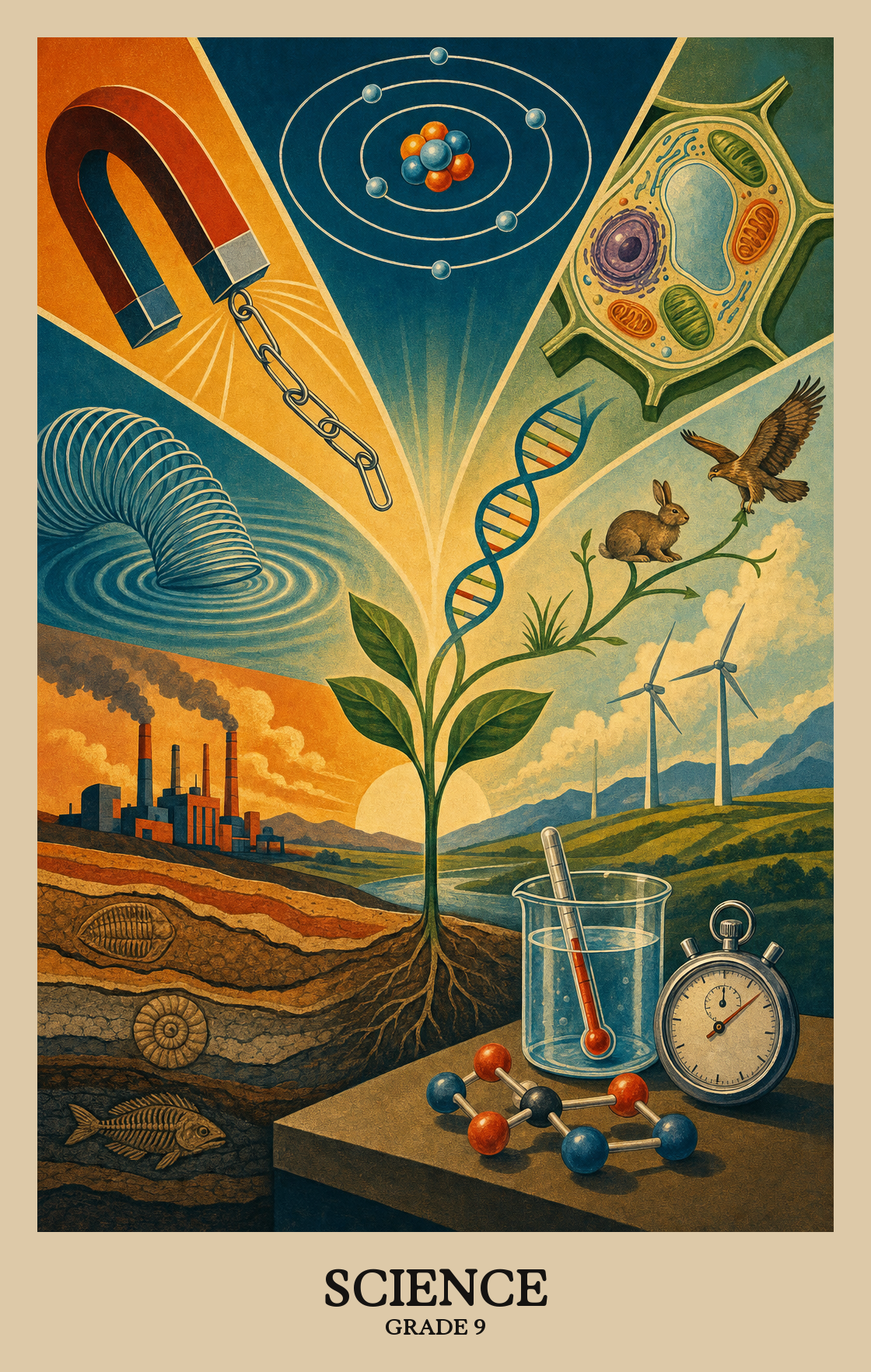
Students start with the building blocks of everything around them. They use the periodic table to predict how elements behave, track what happens when substances react, and learn why mass is never lost along the way.
Students study how things move, push, and pull. They work with Newton's laws, gravity, electricity, and magnetism, then look at how waves carry sound, light, and digital signals through the world.
Students zoom into living things. They see how DNA gives instructions for proteins, how cells divide and specialize, and how traits pass from parents to children through genes and chance.
Students look at how living things share energy, compete for resources, and change over generations. They use evidence to explain natural selection and the patterns that connect every species on the family tree of life.
Students step back to the largest scale. They study the life of stars, the formation of Earth, the slow motion of continents, and the climate data that shows how human choices are reshaping the planet.
Students study what matter is made of and how substances change when they interact. This covers atoms, chemical reactions, and why some materials behave differently than others.
Students study why things move, stop, or stay still. They learn how forces like gravity and friction act on objects and how those interactions explain everything from a rolling ball to a satellite in orbit.
Students study how energy moves, changes form, and stays constant across physical systems. That includes heat, motion, electricity, and the relationships between them.
Students study how waves move energy and information, from sound and light to radio signals and fiber optics. The focus is on how engineers use wave behavior to build the technologies that carry messages, images, and data.
Students study how living things are built and how they work, from the molecules inside a single cell up to the systems that keep a whole organism alive.
Students study how living things depend on each other and their environment to survive. They trace how energy moves through food webs and explore what happens when ecosystems are disrupted by natural events or human activity.
Students learn how traits pass from parents to offspring and why siblings can look different even when they share the same parents. The focus is on genes, DNA, and the mix of factors that shape how living things grow and develop.
Students study how life on Earth has changed over millions of years and why species share common traits. They look at fossil records, genetic evidence, and natural selection to explain both the variety of living things and the features they have in common.
Students study how the solar system, galaxy, and universe formed and how scientists use light from distant stars to figure out what space is made of and how old it is.
Students study how Earth's major systems (atmosphere, oceans, land, and living things) interact and shape each other. Think weather patterns, ocean currents, and how a volcanic eruption can affect climate across the planet.
Students study how human decisions about energy, land, and water shape Earth's systems. The focus is on real trade-offs: how mining, farming, and burning fuel change the planet, and what solutions might reduce the damage.
Students work through real design problems by identifying constraints, testing solutions, and improving their ideas based on what the evidence shows. The goal is a solution that actually works within the given limits.
| Standard | Definition | Code |
|---|---|---|
| Matter and Its Interactions | Students study what matter is made of and how substances change when they interact. This covers atoms, chemical reactions, and why some materials behave differently than others. | HS-PS1 |
| Motion and Stability | Students study why things move, stop, or stay still. They learn how forces like gravity and friction act on objects and how those interactions explain everything from a rolling ball to a satellite in orbit. | HS-PS2 |
| Energy | Students study how energy moves, changes form, and stays constant across physical systems. That includes heat, motion, electricity, and the relationships between them. | HS-PS3 |
| Waves and Their Applications in Technologies for Information Transfer | Students study how waves move energy and information, from sound and light to radio signals and fiber optics. The focus is on how engineers use wave behavior to build the technologies that carry messages, images, and data. | HS-PS4 |
| From Molecules to Organisms | Students study how living things are built and how they work, from the molecules inside a single cell up to the systems that keep a whole organism alive. | HS-LS1 |
| Ecosystems: Interactions, Energy | Students study how living things depend on each other and their environment to survive. They trace how energy moves through food webs and explore what happens when ecosystems are disrupted by natural events or human activity. | HS-LS2 |
| Heredity: Inheritance and Variation of Traits | Students learn how traits pass from parents to offspring and why siblings can look different even when they share the same parents. The focus is on genes, DNA, and the mix of factors that shape how living things grow and develop. | HS-LS3 |
| Biological Evolution | Students study how life on Earth has changed over millions of years and why species share common traits. They look at fossil records, genetic evidence, and natural selection to explain both the variety of living things and the features they have in common. | HS-LS4 |
| Earth's Place in the Universe | Students study how the solar system, galaxy, and universe formed and how scientists use light from distant stars to figure out what space is made of and how old it is. | HS-ESS1 |
| Earth's Systems | Students study how Earth's major systems (atmosphere, oceans, land, and living things) interact and shape each other. Think weather patterns, ocean currents, and how a volcanic eruption can affect climate across the planet. | HS-ESS2 |
| Earth and Human Activity | Students study how human decisions about energy, land, and water shape Earth's systems. The focus is on real trade-offs: how mining, farming, and burning fuel change the planet, and what solutions might reduce the damage. | HS-ESS3 |
| Engineering Design | Students work through real design problems by identifying constraints, testing solutions, and improving their ideas based on what the evidence shows. The goal is a solution that actually works within the given limits. | HS-ETS1 |
Students use the periodic table to predict how an element will behave chemically. The position of an element on the table reveals how many electrons sit in its outer shell, which drives how it bonds and reacts with other elements.
Students explain why certain substances react with each other by looking at how electrons are arranged in atoms and where elements sit on the periodic table. Patterns in the table predict which reactions will happen and which won't.
Students design and run an experiment to figure out why some substances are harder, denser, or have higher melting points than others. The goal is to connect what they can measure or observe to the invisible pull between atoms and molecules.
Chemical reactions break old bonds and form new ones. Students model how the energy released or absorbed in a reaction depends on whether the new bonds store more or less energy than the old ones did.
Students explain why reactions speed up or slow down when temperature or concentration changes. They use evidence to show how particle collisions drive reaction rate.
Students figure out how to get a chemical reaction to produce more of what you want. They adjust conditions like temperature or pressure to shift the reaction in their favor.
In a chemical reaction, no atoms appear or disappear. Students use numbers and equations to show that the total mass of the starting materials always equals the total mass of the products.
Students model what happens inside an atom's nucleus during nuclear reactions like splitting atoms apart or fusing them together. The focus is on how the nucleus changes and why those reactions release so much energy.
| Standard | Definition | Code |
|---|---|---|
| Use the periodic table as a model to predict the relative properties of… | Students use the periodic table to predict how an element will behave chemically. The position of an element on the table reveals how many electrons sit in its outer shell, which drives how it bonds and reacts with other elements. | HS-PS1-1 |
| Construct and revise an explanation for the outcome of a simple chemical… | Students explain why certain substances react with each other by looking at how electrons are arranged in atoms and where elements sit on the periodic table. Patterns in the table predict which reactions will happen and which won't. | HS-PS1-2 |
| Plan and conduct an investigation to gather evidence to compare the structure… | Students design and run an experiment to figure out why some substances are harder, denser, or have higher melting points than others. The goal is to connect what they can measure or observe to the invisible pull between atoms and molecules. | HS-PS1-3 |
| Develop a model to illustrate that the release or absorption of energy from a… | Chemical reactions break old bonds and form new ones. Students model how the energy released or absorbed in a reaction depends on whether the new bonds store more or less energy than the old ones did. | HS-PS1-4 |
| Apply scientific principles and evidence to provide an explanation about the… | Students explain why reactions speed up or slow down when temperature or concentration changes. They use evidence to show how particle collisions drive reaction rate. | HS-PS1-5 |
| Refine the design of a chemical system by specifying a change in conditions… | Students figure out how to get a chemical reaction to produce more of what you want. They adjust conditions like temperature or pressure to shift the reaction in their favor. | HS-PS1-6 |
| Use mathematical representations to support the claim that atoms | In a chemical reaction, no atoms appear or disappear. Students use numbers and equations to show that the total mass of the starting materials always equals the total mass of the products. | HS-PS1-7 |
| Develop models to illustrate the changes in the composition of the nucleus of… | Students model what happens inside an atom's nucleus during nuclear reactions like splitting atoms apart or fusing them together. The focus is on how the nucleus changes and why those reactions release so much energy. | HS-PS1-8 |
Students look at real data to show how force, mass, and acceleration are connected. A heavier object needs more force to reach the same speed as a lighter one, and Newton's second law puts that relationship into a single equation.
Students use math to show that when two objects collide or push off each other, their combined momentum stays the same as long as nothing outside the system is pushing or pulling on them.
Students design and test something (like padding or a bumper) that reduces the impact when two objects collide. The goal is to figure out what materials or shapes best protect an object from damage.
Students use formulas to calculate how strongly two objects pull on each other due to gravity, and how strongly charged objects push or pull each other. Both forces depend on mass or charge and how far apart the objects are.
Students run hands-on experiments to show that electricity flowing through a wire creates a magnetic field, and that moving a magnet near a wire can generate electricity. These two effects are the foundation of motors and generators.
Students explain why the arrangement of atoms and molecules in a material determines what that material can do. Think of why Kevlar stops a bullet or why a Gore-Tex jacket repels rain: the answer starts at a scale too small to see.
| Standard | Definition | Code |
|---|---|---|
| Analyze data to support the claim that Newton's second law of motion describes… | Students look at real data to show how force, mass, and acceleration are connected. A heavier object needs more force to reach the same speed as a lighter one, and Newton's second law puts that relationship into a single equation. | HS-PS2-1 |
| Use mathematical representations to support the claim that the total momentum… | Students use math to show that when two objects collide or push off each other, their combined momentum stays the same as long as nothing outside the system is pushing or pulling on them. | HS-PS2-2 |
| Apply scientific and engineering ideas to design, evaluate | Students design and test something (like padding or a bumper) that reduces the impact when two objects collide. The goal is to figure out what materials or shapes best protect an object from damage. | HS-PS2-3 |
| Use mathematical representations of Newton's Law of Gravitation and Coulomb's… | Students use formulas to calculate how strongly two objects pull on each other due to gravity, and how strongly charged objects push or pull each other. Both forces depend on mass or charge and how far apart the objects are. | HS-PS2-4 |
| Plan and conduct an investigation to provide evidence that an electric current… | Students run hands-on experiments to show that electricity flowing through a wire creates a magnetic field, and that moving a magnet near a wire can generate electricity. These two effects are the foundation of motors and generators. | HS-PS2-5 |
| Communicate scientific and technical information about why the molecular-level… | Students explain why the arrangement of atoms and molecules in a material determines what that material can do. Think of why Kevlar stops a bullet or why a Gore-Tex jacket repels rain: the answer starts at a scale too small to see. | HS-PS2-6 |
Students build a model or equation that tracks how energy moves between parts of a system. When they know how much energy one part gains or loses, they calculate what happened to the rest.
Moving objects, stretched springs, and warm surfaces all hold energy. Students model how that energy traces back to particles in motion or to invisible fields pulling and pushing between them.
Students design and build a real device that converts one form of energy into another, like turning motion into electricity or heat into light, then test and improve it until it works within the given limits.
Students mix two materials at different temperatures, then measure how heat moves between them until both reach the same temperature. The experiment shows that heat always flows from warmer to cooler, never the other way around.
Students build or draw a model showing how two objects push or pull each other through electric or magnetic fields, then trace how the energy of each object changes as a result of that force.
| Standard | Definition | Code |
|---|---|---|
| Create a computational model to calculate the change in the energy of one… | Students build a model or equation that tracks how energy moves between parts of a system. When they know how much energy one part gains or loses, they calculate what happened to the rest. | HS-PS3-1 |
| Develop and use models to illustrate that energy at the macroscopic scale can… | Moving objects, stretched springs, and warm surfaces all hold energy. Students model how that energy traces back to particles in motion or to invisible fields pulling and pushing between them. | HS-PS3-2 |
| Design, build, and refine a device that works within given constraints to… | Students design and build a real device that converts one form of energy into another, like turning motion into electricity or heat into light, then test and improve it until it works within the given limits. | HS-PS3-3 |
| Plan and conduct an investigation to provide evidence that the transfer of… | Students mix two materials at different temperatures, then measure how heat moves between them until both reach the same temperature. The experiment shows that heat always flows from warmer to cooler, never the other way around. | HS-PS3-4 |
| Develop and use a model of two objects interacting through electric or magnetic… | Students build or draw a model showing how two objects push or pull each other through electric or magnetic fields, then trace how the energy of each object changes as a result of that force. | HS-PS3-5 |
Students use equations to show how a wave's frequency and wavelength connect to its speed, and how those relationships change depending on what the wave travels through, like water, air, or glass.
Students compare digital and analog ways of storing and sending information, like music or images, and explain why digital formats are easier to copy, share, and keep accurate over time.
Students look at real scientific evidence to decide whether light acts more like a wave or a tiny particle in a given situation. Both descriptions are correct depending on what you're studying, and knowing which one to use is the skill.
Students read science articles and judge whether the evidence actually supports claims about how radiation (radio waves, microwaves, X-rays, visible light) affects living tissue or other materials. The focus is on spotting weak reasoning, not just accepting what a source says.
Students learn how real devices, like radios, phones, and solar panels, use waves to send signals and capture energy. They practice explaining the science behind those devices clearly enough that someone else could follow along.
| Standard | Definition | Code |
|---|---|---|
| Use mathematical representations to support a claim regarding relationships… | Students use equations to show how a wave's frequency and wavelength connect to its speed, and how those relationships change depending on what the wave travels through, like water, air, or glass. | HS-PS4-1 |
| Evaluate questions about the advantages of using a digital transmission and… | Students compare digital and analog ways of storing and sending information, like music or images, and explain why digital formats are easier to copy, share, and keep accurate over time. | HS-PS4-2 |
| Evaluate the claims, evidence | Students look at real scientific evidence to decide whether light acts more like a wave or a tiny particle in a given situation. Both descriptions are correct depending on what you're studying, and knowing which one to use is the skill. | HS-PS4-3 |
| Evaluate the validity and reliability of claims in published materials of the… | Students read science articles and judge whether the evidence actually supports claims about how radiation (radio waves, microwaves, X-rays, visible light) affects living tissue or other materials. The focus is on spotting weak reasoning, not just accepting what a source says. | HS-PS4-4 |
| Communicate technical information about how some technological devices use the… | Students learn how real devices, like radios, phones, and solar panels, use waves to send signals and capture energy. They practice explaining the science behind those devices clearly enough that someone else could follow along. | HS-PS4-5 |
DNA holds the instructions for building proteins, and proteins do the actual work inside cells. Students learn how that code gets read and turned into the specific molecules that run nearly every process in a living body.
Living things are built in layers: cells group into tissues, tissues into organs, organs into systems. Students build or interpret a model showing how each layer depends on the one below it to keep the organism alive.
Students design and run an experiment showing how the body keeps conditions stable, like how temperature or blood sugar returns to normal after a change. The goal is collecting real evidence that internal feedback systems do the correcting.
Cells copy themselves through mitosis so a single fertilized egg can grow into a full human body. Students use diagrams or models to show how dividing cells also specialize into skin, muscle, nerve, and other tissue types.
Students trace how a plant takes in sunlight, water, and carbon dioxide and converts them into sugar the plant stores for fuel. The focus is on drawing or explaining that energy transformation, not just naming the steps.
Sugar molecules carry the carbon, hydrogen, and oxygen that cells rearrange into amino acids and other large molecules. Students build and revise an explanation using evidence for how that chemical reorganization works.
Cells break down food and oxygen to release energy the body can use. Students trace how chemical bonds break apart and reform, showing where that energy goes.
| Standard | Definition | Code |
|---|---|---|
| Construct an explanation based on evidence for how the structure of DNA… | DNA holds the instructions for building proteins, and proteins do the actual work inside cells. Students learn how that code gets read and turned into the specific molecules that run nearly every process in a living body. | HS-LS1-1 |
| Develop and use a model to illustrate the hierarchical organization of… | Living things are built in layers: cells group into tissues, tissues into organs, organs into systems. Students build or interpret a model showing how each layer depends on the one below it to keep the organism alive. | HS-LS1-2 |
| Plan and conduct an investigation to provide evidence that feedback mechanisms… | Students design and run an experiment showing how the body keeps conditions stable, like how temperature or blood sugar returns to normal after a change. The goal is collecting real evidence that internal feedback systems do the correcting. | HS-LS1-3 |
| Use a model to illustrate the role of cellular division | Cells copy themselves through mitosis so a single fertilized egg can grow into a full human body. Students use diagrams or models to show how dividing cells also specialize into skin, muscle, nerve, and other tissue types. | HS-LS1-4 |
| Use a model to illustrate how photosynthesis transforms light energy into… | Students trace how a plant takes in sunlight, water, and carbon dioxide and converts them into sugar the plant stores for fuel. The focus is on drawing or explaining that energy transformation, not just naming the steps. | HS-LS1-5 |
| Construct and revise an explanation based on evidence for how carbon, hydrogen | Sugar molecules carry the carbon, hydrogen, and oxygen that cells rearrange into amino acids and other large molecules. Students build and revise an explanation using evidence for how that chemical reorganization works. | HS-LS1-6 |
| Use a model to illustrate that cellular respiration is a chemical process… | Cells break down food and oxygen to release energy the body can use. Students trace how chemical bonds break apart and reform, showing where that energy goes. | HS-LS1-7 |
Students calculate how many organisms a habitat can support, then use that math to explain what happens when food, water, or space runs short. The work connects local ponds and forests to patterns across entire regions.
Students use graphs, models, and data to explain what drives population changes in an ecosystem. They test their explanations against real evidence and revise when the numbers tell a different story.
Students explain how matter (like carbon or oxygen) cycles through living things and the environment, and how energy moves through that same system. They compare what happens when oxygen is present versus when it isn't, and revise their explanation as they gather more evidence.
Students use graphs, equations, or diagrams to show how energy moves through a food web and how matter like carbon or nitrogen cycles from one living thing to another.
Students trace how carbon moves between living things, air, water, and rock by modeling what happens during photosynthesis and cellular respiration. They show how the same carbon atoms cycle through an ecosystem over and over.
When conditions in an ecosystem stay stable, populations tend to hold steady. Students look at real evidence to judge whether that claim holds up, and to figure out what happens to the mix of plants and animals when conditions shift.
Students design and test a plan to reduce real-world human damage to ecosystems and the species living in them. The focus is on refining the plan based on evidence, not just proposing an idea.
Students look at real examples from nature to figure out how animals living or working in groups (like wolves hunting in packs or fish swimming in schools) survive and reproduce better than animals acting alone.
| Standard | Definition | Code |
|---|---|---|
| Use mathematical and/or computational representations to support explanations… | Students calculate how many organisms a habitat can support, then use that math to explain what happens when food, water, or space runs short. The work connects local ponds and forests to patterns across entire regions. | HS-LS2-1 |
| Use mathematical representations to support and revise explanations based on… | Students use graphs, models, and data to explain what drives population changes in an ecosystem. They test their explanations against real evidence and revise when the numbers tell a different story. | HS-LS2-2 |
| Construct and revise an explanation based on evidence for the cycling of matter… | Students explain how matter (like carbon or oxygen) cycles through living things and the environment, and how energy moves through that same system. They compare what happens when oxygen is present versus when it isn't, and revise their explanation as they gather more evidence. | HS-LS2-3 |
| Use a mathematical representation to support claims for the cycling of matter… | Students use graphs, equations, or diagrams to show how energy moves through a food web and how matter like carbon or nitrogen cycles from one living thing to another. | HS-LS2-4 |
| Develop a model to illustrate the role of photosynthesis and cellular… | Students trace how carbon moves between living things, air, water, and rock by modeling what happens during photosynthesis and cellular respiration. They show how the same carbon atoms cycle through an ecosystem over and over. | HS-LS2-5 |
| Evaluate the claims, evidence | When conditions in an ecosystem stay stable, populations tend to hold steady. Students look at real evidence to judge whether that claim holds up, and to figure out what happens to the mix of plants and animals when conditions shift. | HS-LS2-6 |
| Design, evaluate, and refine a solution for reducing the impacts of human… | Students design and test a plan to reduce real-world human damage to ecosystems and the species living in them. The focus is on refining the plan based on evidence, not just proposing an idea. | HS-LS2-7 |
| Evaluate the evidence for the role of group behavior on individual and species'… | Students look at real examples from nature to figure out how animals living or working in groups (like wolves hunting in packs or fish swimming in schools) survive and reproduce better than animals acting alone. | HS-LS2-8 |
DNA carries the instructions that make each living thing look and behave the way it does. Students explore how those instructions are packaged in chromosomes and passed from parents to offspring, explaining why children resemble their parents but aren't identical to them.
Students explain why offspring aren't identical copies of their parents. They look at how cell division shuffles genes, how copying errors creep into DNA, and how environmental factors can alter it.
Students use probability and basic statistics to explain why traits like eye color or height vary across a population. They look at real data to explain why not everyone in a group looks or functions the same.
| Standard | Definition | Code |
|---|---|---|
| Ask questions to clarify relationships about the role of DNA and chromosomes in… | DNA carries the instructions that make each living thing look and behave the way it does. Students explore how those instructions are packaged in chromosomes and passed from parents to offspring, explaining why children resemble their parents but aren't identical to them. | HS-LS3-1 |
| Make and defend a claim based on evidence that inheritable genetic variations… | Students explain why offspring aren't identical copies of their parents. They look at how cell division shuffles genes, how copying errors creep into DNA, and how environmental factors can alter it. | HS-LS3-2 |
| Apply concepts of statistics and probability to explain the variation and… | Students use probability and basic statistics to explain why traits like eye color or height vary across a population. They look at real data to explain why not everyone in a group looks or functions the same. | HS-LS3-3 |
Students gather and explain multiple types of evidence, such as fossils, DNA comparisons, and body structures, that show how living things share common ancestors and have changed over time.
Students build a written explanation for why evolution happens, using four real causes: populations can grow fast, offspring inherit random genetic differences, resources run short, and the individuals best suited to their environment survive to reproduce.
Students use basic probability and data to explain why a helpful inherited trait (like sharper vision or disease resistance) becomes more common in a population over time. The math backs up what natural selection actually does.
Natural selection is the process where traits that help survival get passed down more often. Students explain, using real evidence, how that pressure gradually shifts what a whole population looks like over generations.
When the environment changes, some species thrive, some slowly become new species, and others die out entirely. Students look at real evidence to decide which of those outcomes a given change would most likely cause.
Students build or adjust a computer simulation to test whether a proposed fix, like a wildlife corridor or a fishing limit, can reduce harm humans cause to plants and animals in an ecosystem.
| Standard | Definition | Code |
|---|---|---|
| Communicate scientific information that common ancestry and biological… | Students gather and explain multiple types of evidence, such as fossils, DNA comparisons, and body structures, that show how living things share common ancestors and have changed over time. | HS-LS4-1 |
| Construct an explanation based on evidence that the process of evolution… | Students build a written explanation for why evolution happens, using four real causes: populations can grow fast, offspring inherit random genetic differences, resources run short, and the individuals best suited to their environment survive to reproduce. | HS-LS4-2 |
| Apply concepts of statistics and probability to support explanations that… | Students use basic probability and data to explain why a helpful inherited trait (like sharper vision or disease resistance) becomes more common in a population over time. The math backs up what natural selection actually does. | HS-LS4-3 |
| Construct an explanation based on evidence for how natural selection leads to… | Natural selection is the process where traits that help survival get passed down more often. Students explain, using real evidence, how that pressure gradually shifts what a whole population looks like over generations. | HS-LS4-4 |
| Evaluate the evidence supporting claims that changes in environmental… | When the environment changes, some species thrive, some slowly become new species, and others die out entirely. Students look at real evidence to decide which of those outcomes a given change would most likely cause. | HS-LS4-5 |
| Create or revise a simulation to test a solution to mitigate adverse impacts of… | Students build or adjust a computer simulation to test whether a proposed fix, like a wildlife corridor or a fishing limit, can reduce harm humans cause to plants and animals in an ecosystem. | HS-LS4-6 |
Students map out the sun's life cycle and explain how nuclear fusion in the core produces the energy that travels to Earth as light and heat.
Students explain how the universe began by reading clues astronomers have gathered: the way starlight stretches as galaxies move away, and the hydrogen and helium spread across space. Both pieces of evidence point to a single explosive origin billions of years ago.
Stars act as factories for the elements that make up everything around us. Students explain how stars produce elements like carbon and iron during their lifetime and death, and why those elements end up scattered across the universe.
Students use math to predict where planets, moons, and other objects will be as they orbit the sun. The same calculations that guide spacecraft also explain why a solar eclipse happens on a specific date.
Continents and ocean floors are always moving, just very slowly. Students look at rock ages and locations to explain why the youngest rocks sit near mid-ocean ridges and the oldest are found deep in continental interiors.
Students use evidence from rocks, meteorites, and other planetary surfaces to piece together how Earth formed and what its earliest history looked like. The goal is building a reasoned explanation, not memorizing dates.
| Standard | Definition | Code |
|---|---|---|
| Develop a model based on evidence to illustrate the life span of the sun and… | Students map out the sun's life cycle and explain how nuclear fusion in the core produces the energy that travels to Earth as light and heat. | HS-ESS1-1 |
| Construct an explanation of the Big Bang theory based on astronomical evidence… | Students explain how the universe began by reading clues astronomers have gathered: the way starlight stretches as galaxies move away, and the hydrogen and helium spread across space. Both pieces of evidence point to a single explosive origin billions of years ago. | HS-ESS1-2 |
| Communicate scientific ideas about the way stars, over their life cycle… | Stars act as factories for the elements that make up everything around us. Students explain how stars produce elements like carbon and iron during their lifetime and death, and why those elements end up scattered across the universe. | HS-ESS1-3 |
| Use mathematical or computational representations to predict the motion of… | Students use math to predict where planets, moons, and other objects will be as they orbit the sun. The same calculations that guide spacecraft also explain why a solar eclipse happens on a specific date. | HS-ESS1-4 |
| Evaluate evidence of the past and current movements of continental and oceanic… | Continents and ocean floors are always moving, just very slowly. Students look at rock ages and locations to explain why the youngest rocks sit near mid-ocean ridges and the oldest are found deep in continental interiors. | HS-ESS1-5 |
| Apply scientific reasoning and evidence from ancient Earth materials, meteorites | Students use evidence from rocks, meteorites, and other planetary surfaces to piece together how Earth formed and what its earliest history looked like. The goal is building a reasoned explanation, not memorizing dates. | HS-ESS1-6 |
Students build diagrams or models showing how slow processes deep inside Earth (like magma moving through the mantle) and faster surface processes (like erosion) work together over millions of years to shape mountains, ocean trenches, and continents.
Geoscience data shows that one change on Earth's surface, like a melting glacier, can set off a chain of changes in other systems. Students analyze real data to explain how those ripple effects work.
Students build a diagram or model showing how heat deep inside the Earth moves rock and other material in slow, circular patterns, the same way hot soup rises and cool soup sinks in a pot.
Students use diagrams or models to explain how changes in the amount of energy entering or leaving Earth (from the sun, atmosphere, or oceans) can shift long-term weather patterns across regions.
Students test how water behaves differently from other liquids, then observe how those properties shape the land around us, from eroding soil to breaking down rock.
Students build a numbered, data-based model showing how carbon moves between the ocean, air, rocks, and living things. The goal is to track where carbon goes and how fast, not just name the parts of the cycle.
Students build a case, using fossils and rock layers as evidence, for how living things and Earth itself have changed each other over billions of years. Life shaped the atmosphere; shifting land and seas shaped life in return.
| Standard | Definition | Code |
|---|---|---|
| Develop a model to illustrate how Earth's internal and surface processes… | Students build diagrams or models showing how slow processes deep inside Earth (like magma moving through the mantle) and faster surface processes (like erosion) work together over millions of years to shape mountains, ocean trenches, and continents. | HS-ESS2-1 |
| Analyze geoscience data to make the claim that one change to Earth's surface… | Geoscience data shows that one change on Earth's surface, like a melting glacier, can set off a chain of changes in other systems. Students analyze real data to explain how those ripple effects work. | HS-ESS2-2 |
| Develop a model based on evidence of Earth's interior to describe the cycling… | Students build a diagram or model showing how heat deep inside the Earth moves rock and other material in slow, circular patterns, the same way hot soup rises and cool soup sinks in a pot. | HS-ESS2-3 |
| Use a model to describe how variations in the flow of energy into and out of… | Students use diagrams or models to explain how changes in the amount of energy entering or leaving Earth (from the sun, atmosphere, or oceans) can shift long-term weather patterns across regions. | HS-ESS2-4 |
| Plan and conduct an investigation of the properties of water and its effects on… | Students test how water behaves differently from other liquids, then observe how those properties shape the land around us, from eroding soil to breaking down rock. | HS-ESS2-5 |
| Develop a quantitative model to describe the cycling of carbon among the… | Students build a numbered, data-based model showing how carbon moves between the ocean, air, rocks, and living things. The goal is to track where carbon goes and how fast, not just name the parts of the cycle. | HS-ESS2-6 |
| Construct an argument based on evidence about the simultaneous coevolution of… | Students build a case, using fossils and rock layers as evidence, for how living things and Earth itself have changed each other over billions of years. Life shaped the atmosphere; shifting land and seas shaped life in return. | HS-ESS2-7 |
Students examine real examples, like drought zones or coal deposits, to explain how natural resources, disasters, and climate shifts have shaped where people settle, what they build, and how economies develop.
Students compare real proposals for mining or energy production, weighing what each option costs against what it delivers. The goal is to pick the approach that does the most good with the least harm or expense.
Students build a computer model that shows how decisions about land, water, or energy use affect both wildlife diversity and long-term human survival. The simulation makes visible what spreadsheets and maps alone can't show.
Students look at a real design (a flood barrier, a water filter, a bike lane) and judge whether it actually reduces harm to nature. They may suggest improvements based on evidence.
Students study real temperature records, sea-level measurements, and climate model outputs to predict how the climate will keep changing and what that means for coastlines, weather patterns, and ecosystems.
Students use data models or simulations to show how land, water, atmosphere, and living things connect, then trace how human actions like burning fuel or clearing forests are shifting those connections.
| Standard | Definition | Code |
|---|---|---|
| Construct an explanation based on evidence for how the availability of natural… | Students examine real examples, like drought zones or coal deposits, to explain how natural resources, disasters, and climate shifts have shaped where people settle, what they build, and how economies develop. | HS-ESS3-1 |
| Evaluate competing design solutions for developing, managing | Students compare real proposals for mining or energy production, weighing what each option costs against what it delivers. The goal is to pick the approach that does the most good with the least harm or expense. | HS-ESS3-2 |
| Create a computational simulation to illustrate the relationships among… | Students build a computer model that shows how decisions about land, water, or energy use affect both wildlife diversity and long-term human survival. The simulation makes visible what spreadsheets and maps alone can't show. | HS-ESS3-3 |
| Evaluate or refine a technological solution that reduces impacts of human… | Students look at a real design (a flood barrier, a water filter, a bike lane) and judge whether it actually reduces harm to nature. They may suggest improvements based on evidence. | HS-ESS3-4 |
| Analyze geoscience data and the results from global climate models to make an… | Students study real temperature records, sea-level measurements, and climate model outputs to predict how the climate will keep changing and what that means for coastlines, weather patterns, and ecosystems. | HS-ESS3-5 |
| Use a computational representation to illustrate the relationships among Earth… | Students use data models or simulations to show how land, water, atmosphere, and living things connect, then trace how human actions like burning fuel or clearing forests are shifting those connections. | HS-ESS3-6 |
Students pick a real-world problem, such as clean water access or energy use, and spell out exactly what a good solution must do and what limits it must work within, like cost, materials, or safety.
Students take a big, messy real-world problem and split it into smaller pieces that are actually solvable. Then they design a solution that tackles each piece.
Students pick the best solution to a real problem by weighing what matters most: cost, safety, and how it affects people and the environment. No solution is perfect, so students explain which trade-offs are worth making.
Students use computer simulations to test an engineering solution before building it in real life. The simulation shows how the solution affects different parts of a system, so students can weigh the tradeoffs before making a final design choice.
| Standard | Definition | Code |
|---|---|---|
| Analyze a major global challenge to specify qualitative and quantitative… | Students pick a real-world problem, such as clean water access or energy use, and spell out exactly what a good solution must do and what limits it must work within, like cost, materials, or safety. | HS-ETS1-1 |
| Design a solution to a complex real-world problem by breaking it down into… | Students take a big, messy real-world problem and split it into smaller pieces that are actually solvable. Then they design a solution that tackles each piece. | HS-ETS1-2 |
| Evaluate a solution to a complex real-world problem based on prioritized… | Students pick the best solution to a real problem by weighing what matters most: cost, safety, and how it affects people and the environment. No solution is perfect, so students explain which trade-offs are worth making. | HS-ETS1-3 |
| Use a computer simulation to model the impact of proposed solutions to a… | Students use computer simulations to test an engineering solution before building it in real life. The simulation shows how the solution affects different parts of a system, so students can weigh the tradeoffs before making a final design choice. | HS-ETS1-4 |
KAP science assessment in grades 5, 8, and 11, aligned to the Kansas Science Standards.
College-readiness assessment offered statewide to high school students, covering English, mathematics, reading, and science.
Students cover a wide span: atoms and chemical reactions, forces and motion, energy, waves, cells and DNA, ecosystems, evolution, and Earth and space. It is a big sweep of topics, so expect students to move between physical science, biology, and Earth science across the year.
Ask students to explain what they learned in their own words, without the textbook open. Cooking, weather, batteries, and news stories about climate or space are all fair game for short conversations. If students can teach it back at the kitchen table, they understand it.
Math shows up often this year, especially in motion, energy, waves, and genetics problems. Steady practice with fractions, ratios, basic algebra, and reading graphs will pay off. Ten minutes a few nights a week on shaky math skills helps more than cramming before a test.
Most schools start with chemistry (atoms, bonding, reactions), move into physics (forces, energy, waves), then biology (cells, genetics, evolution, ecosystems), and finish with Earth and space. Engineering design fits inside each unit rather than as a separate block. Pick an order that lets concepts build on each other.
Bonding and energy in reactions, momentum and force diagrams, and the difference between photosynthesis and cellular respiration are common sticking points. Genetics probability also trips students up. Plan extra practice and a second pass on these before moving on.
Plan for regular hands-on work, not just demonstrations. Several standards ask students to plan investigations, gather data, and argue from evidence, which means students need real practice designing tests and writing up results. Short, focused labs every week or two beat one long lab per quarter.
Start by asking what the question is actually asking and what numbers or facts are given. Then ask what idea from class might apply. The goal is to get students talking through their thinking, not to hand them the answer.
By spring, students should explain a phenomenon using evidence, build or revise a model, and use math to back up a claim. They should connect ideas across units, such as linking energy in reactions to energy in ecosystems. Memorizing facts is not enough.
Students should be able to read a science article, pull out the main claim and evidence, and explain whether it holds up. They should also be comfortable with graphs, units, and basic equations. If those skills are solid, the next course will go more smoothly.