Atoms, molecules, and matter
Students start the year looking at what stuff is made of. They learn how tiny particles arrange into the substances around them and how the periodic table groups similar materials together.
This is the year science gets physical. Students dig into how matter, motion, energy, and waves actually work, using experiments and models to explain what they see. They build atoms out of particles, track forces between colliding objects, and graph how speed and mass change the energy of a moving thing. By spring, students can explain why ice melts, why a heavier ball hits harder, and why magnets pull without touching.
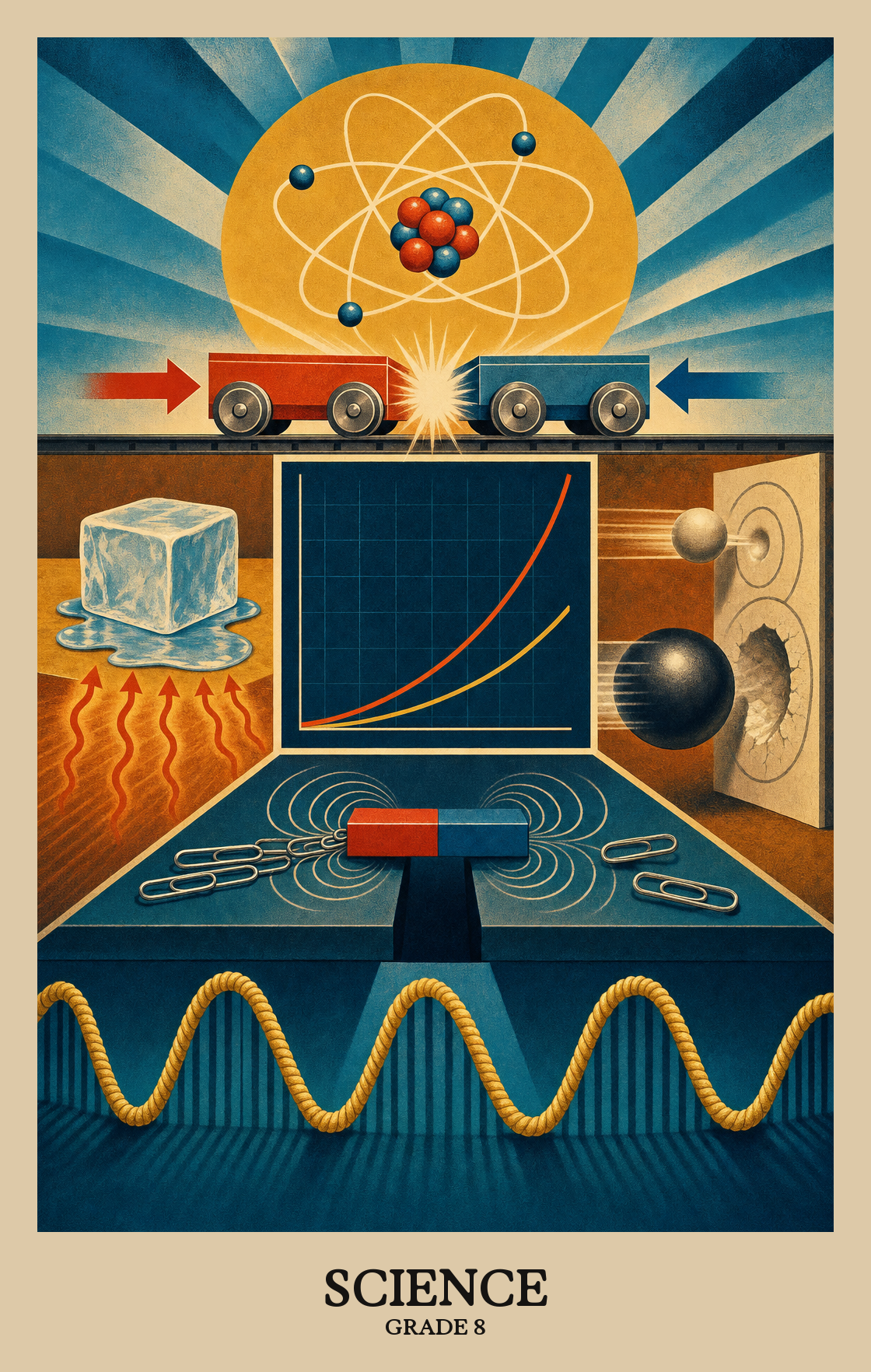
Students start the year looking at what stuff is made of. They learn how tiny particles arrange into the substances around them and how the periodic table groups similar materials together.
Students study what happens when things heat up, cool down, or react. They run experiments to see when a new substance has formed and notice that no atoms go missing along the way.
Students push, pull, and collide objects to see how forces change motion. They also look at forces that act at a distance, like gravity between two masses and the pull between magnets.
Students measure how speed and mass change the energy of a moving object. They graph their results and design a device that traps heat in or keeps it out, like a thermos or cooler.
Students wrap up the year with waves in water, sound, and light. They see how taller waves carry more energy and why phones and computers send information as digital signals instead of analog ones.
Students learn to ask clear, testable questions about matter and then frame those questions as problems worth investigating. This is the starting point for any science experiment.
Students form questions about what they observe, what their experiments show, and what they read. This skill runs through every part of science class, from looking at data to reading an article to hearing a classmate's idea.
Students look at the periodic table and ask questions about why elements in the same column share similar properties, like how sodium and potassium both react strongly with water.
Students plan and run experiments to test ideas about matter, then record what happens and explain what the results show.
Students design their own experiments to test a question, then collect and organize data to back up their conclusions. The investigation can happen in class, a lab, or outside.
Students heat and cool pure substances like water or metal, then explain what happens by describing how the particles inside speed up or slow down.
Students design and run an experiment to show how the total push or pull on an object, and how heavy that object is, determine how quickly it speeds up, slows down, or changes direction.
Students run an experiment to show that magnets, charged objects, or gravity can push or pull something without touching it. Then they check whether the experiment was set up well enough to trust the results.
Students read experiment results and look for patterns in the numbers and observations. They use those patterns to draw conclusions about what the data actually shows.
Students record measurements and observations from experiments, then look for patterns that suggest how one variable might affect another.
Students compare measurements, color, and other properties of materials before and after mixing to decide whether a new substance formed. A change in those properties is the evidence that a chemical reaction happened.
Students build diagrams or physical models to show how matter behaves at the particle level. The model becomes a tool they use to explain observations and make predictions about what will happen next.
Students build diagrams or other visual models to explain what they think is happening in a science phenomenon, then revise those models as they learn more and share their thinking with the class.
Students draw or build models of simple molecules and crystals to show how atoms connect and arrange inside them.
Students build or draw a model of a chemical reaction to show that atoms aren't created or destroyed, just rearranged. The total mass before and after the reaction stays the same.
Students take a scientific problem, build an explanation using evidence, and then propose a solution or design that addresses it. The focus is on reasoning through how and why, not just stating what happened.
Students use scientific rules and real evidence to explain why something happens in the physical world. They also look for gaps or mistakes in their own explanations and in explanations written by others.
Students pick a real, everyday event (like steam rising from a pot or a smell spreading across a room) and write an explanation for it using what they know about how molecules move.
Students build a real device that causes a chemical reaction to heat up or cool down, then test it and adjust it until it works better. Think hand warmers or instant cold packs.
Students read and compare sources to figure out how the properties of matter change during physical and chemical interactions. They pull out the key ideas and explain what the evidence shows.
Students read articles, data tables, and other sources to figure out whether a scientific claim holds up. Then they explain what they found, in writing, a diagram, or another format that fits the evidence.
Students research where synthetic materials (like plastic or nylon) come from in nature, then weigh what those materials have cost and given us as a society. They pull from more than one source and compare what they find.
| Standard | Definition | Code |
|---|---|---|
| Asking questions and defining problems | Students learn to ask clear, testable questions about matter and then frame those questions as problems worth investigating. This is the starting point for any science experiment. | 8PI.1.1 |
| Students will be able to ask questions about aspects of the phenomena they… | Students form questions about what they observe, what their experiments show, and what they read. This skill runs through every part of science class, from looking at data to reading an article to hearing a classmate's idea. | 8PI.1.1.1 |
| Ask questions about locations of common elements on the periodic table to note… | Students look at the periodic table and ask questions about why elements in the same column share similar properties, like how sodium and potassium both react strongly with water. | 8PI.1.1.1.1 |
| Planning and carrying out investigations | Students plan and run experiments to test ideas about matter, then record what happens and explain what the results show. | 8PI.1.2 |
| Students will be able to design and conduct investigations in the classroom… | Students design their own experiments to test a question, then collect and organize data to back up their conclusions. The investigation can happen in class, a lab, or outside. | 8PI.1.2.1 |
| Plan and conduct an investigation of changes in pure substances when thermal… | Students heat and cool pure substances like water or metal, then explain what happens by describing how the particles inside speed up or slow down. | 8PI.1.2.1.1 |
| Plan and conduct an investigation to provide evidence that the change in an… | Students design and run an experiment to show how the total push or pull on an object, and how heavy that object is, determine how quickly it speeds up, slows down, or changes direction. | 8PI.1.2.1.2 |
| Conduct an investigation and evaluate the experimental design to provide… | Students run an experiment to show that magnets, charged objects, or gravity can push or pull something without touching it. Then they check whether the experiment was set up well enough to trust the results. | 8PI.1.2.1.3 |
| Analyzing and interpreting data | Students read experiment results and look for patterns in the numbers and observations. They use those patterns to draw conclusions about what the data actually shows. | 8PI.2.1 |
| Students will be able to represent observations and data in order to recognize… | Students record measurements and observations from experiments, then look for patterns that suggest how one variable might affect another. | 8PI.2.1.1 |
| Analyze and interpret data on the properties of substances before and after the… | Students compare measurements, color, and other properties of materials before and after mixing to decide whether a new substance formed. A change in those properties is the evidence that a chemical reaction happened. | 8PI.2.1.1.1 |
| Developing and using models | Students build diagrams or physical models to show how matter behaves at the particle level. The model becomes a tool they use to explain observations and make predictions about what will happen next. | 8PI.3.1 |
| Students will be able to develop, revise | Students build diagrams or other visual models to explain what they think is happening in a science phenomenon, then revise those models as they learn more and share their thinking with the class. | 8PI.3.1.1 |
| Develop models to describe the atomic composition of simple molecules and… | Students draw or build models of simple molecules and crystals to show how atoms connect and arrange inside them. | 8PI.3.1.1.1 |
| Develop and use a model to describe how the total number of atoms does not… | Students build or draw a model of a chemical reaction to show that atoms aren't created or destroyed, just rearranged. The total mass before and after the reaction stays the same. | 8PI.8P.3.1.1.2 |
| Constructing explanations and designing solutions | Students take a scientific problem, build an explanation using evidence, and then propose a solution or design that addresses it. The focus is on reasoning through how and why, not just stating what happened. | 8PI.3.2 |
| Students will be able to apply scientific principles and empirical evidence | Students use scientific rules and real evidence to explain why something happens in the physical world. They also look for gaps or mistakes in their own explanations and in explanations written by others. | 8PI.8PI.3.2.1 |
| Construct an explanation based on evidence and scientific principles of a… | Students pick a real, everyday event (like steam rising from a pot or a smell spreading across a room) and write an explanation for it using what they know about how molecules move. | 8PI.3.2.1.1 |
| Construct, test and modify a device that either releases or absorbs thermal… | Students build a real device that causes a chemical reaction to heat up or cool down, then test it and adjust it until it works better. Think hand warmers or instant cold packs. | 8PI.3.2.2.1 |
| Obtaining, evaluating and communicating information | Students read and compare sources to figure out how the properties of matter change during physical and chemical interactions. They pull out the key ideas and explain what the evidence shows. | 8PI.4.2 |
| Students will be able to read and interpret multiple sources to obtain… | Students read articles, data tables, and other sources to figure out whether a scientific claim holds up. Then they explain what they found, in writing, a diagram, or another format that fits the evidence. | 8PI.4.2.1 |
| Gather and evaluate information from multiple sources to describe that… | Students research where synthetic materials (like plastic or nylon) come from in nature, then weigh what those materials have cost and given us as a society. They pull from more than one source and compare what they find. | 8PI.4.2.1.1 |
Students practice asking testable questions and framing problems clearly enough that an investigation can actually be designed to answer them. This is the starting point for most science work in eighth grade.
Asking questions is a core scientific habit. Students practice turning observations, experiment results, and things they read into specific questions worth investigating.
Students look at data and ask: what makes an electric or magnetic force stronger or weaker? They figure out which factors, like distance or current, actually change the force.
Students build explanations for why objects move the way they do, then design solutions to real problems involving forces. The focus is on using evidence from data, not just describing what happened.
Students apply what they know about forces and motion to design a solution to a real problem. The design has to meet specific requirements, like a size limit or a cost cap, before it counts as a success.
Students design a solution to a real collision problem, like two objects crashing into each other, by applying Newton's Third Law: every push or pull has an equal push or pull in the opposite direction.
Students back up their claims about forces and motion with data, not just ideas. They practice explaining why the evidence supports their reasoning and push back on explanations that don't hold up.
Students build a scientific argument using evidence, then defend or revise it when new information appears. They also critique other students' reasoning and explain why they agree or disagree.
Students build an argument, using data or examples, showing that gravity pulls objects toward each other and that heavier objects pull with more force.
| Standard | Definition | Code |
|---|---|---|
| Asking questions and defining problems | Students practice asking testable questions and framing problems clearly enough that an investigation can actually be designed to answer them. This is the starting point for most science work in eighth grade. | 8PF.1.1 |
| Students will be able to ask questions about aspects of the phenomena they… | Asking questions is a core scientific habit. Students practice turning observations, experiment results, and things they read into specific questions worth investigating. | 8PF.1.1.1 |
| Ask questions about data to determine the factors that affect the strength of… | Students look at data and ask: what makes an electric or magnetic force stronger or weaker? They figure out which factors, like distance or current, actually change the force. | 8PF.1.1.1.2 |
| Constructing explanations and designing solutions | Students build explanations for why objects move the way they do, then design solutions to real problems involving forces. The focus is on using evidence from data, not just describing what happened. | 8PF.3.2 |
| Students will be able to use their understanding of scientific principles and… | Students apply what they know about forces and motion to design a solution to a real problem. The design has to meet specific requirements, like a size limit or a cost cap, before it counts as a success. | 8PF.3.2.2 |
| Design a solution to a problem involving the motion of two colliding objects… | Students design a solution to a real collision problem, like two objects crashing into each other, by applying Newton's Third Law: every push or pull has an equal push or pull in the opposite direction. | 8PF.3.2.2.2 |
| Engaging in argument from evidence | Students back up their claims about forces and motion with data, not just ideas. They practice explaining why the evidence supports their reasoning and push back on explanations that don't hold up. | 8PF.4.1 |
| Students will be able to engage in argument from evidence for the explanations… | Students build a scientific argument using evidence, then defend or revise it when new information appears. They also critique other students' reasoning and explain why they agree or disagree. | 8PF.4.1.1 |
| Construct and present arguments using evidence to support the claim that… | Students build an argument, using data or examples, showing that gravity pulls objects toward each other and that heavier objects pull with more force. | 8PF.4.1.1.1 |
Students plan and run experiments to study how energy moves or changes, then record what they observe and use that data to explain what happened.
Students design their own experiments to test a question, then collect and organize data to back up their answer. The investigation can happen in a classroom, a lab, or outdoors.
Students heat or cool different materials and track how quickly the temperature changes based on how much material there is and what it's made of. The goal is to see how energy transfer drives those temperature changes.
Students read charts, graphs, and tables about energy to find patterns and draw conclusions. The data tells a story; students figure out what it means.
Students collect measurements from science investigations and look for patterns, like noticing that temperature rises each time a certain variable changes. Spotting those patterns helps students figure out whether two things in an experiment might actually be connected.
Students read and build graphs that show how an object's kinetic energy changes as its mass or speed changes. A heavier object or a faster one carries more kinetic energy, and the graphs make that relationship visible.
Students use math to describe or predict how energy moves and changes in a system, such as calculating how much heat transfers between objects or how fast something speeds up when a force is applied.
Students use math formulas to describe how physical things behave, like how speed, force, or energy relate to each other. Then they check whether those formulas match what actually happens in the real world.
Students write a simple computer program that shows how energy changes form inside a system, such as movement turning into heat. The code has to make the transformation visible, not just describe it.
Students build and use diagrams or physical models to show how energy moves or changes form, then use those models to explain what they observe or predict what might happen next.
Students build or sketch a model of a scientific idea, then update it as they learn more. The model helps them explain what they think is happening and share that thinking with others.
Students draw or diagram a system (two magnets, a ball above the ground) and update it to show how the stored energy changes when the objects move closer together or farther apart.
Students build written explanations for how energy moves or changes in a system, then sketch or describe a solution to an energy-related problem. The work connects evidence from data to a clear cause-and-effect claim.
Students apply science concepts to design a solution to a real problem, then check whether it meets the requirements given at the start. The solution has to work within set limits, like cost or materials.
Students design and build a device to control how heat moves, then test whether it actually works. The goal is either to trap heat in or keep it out.
Students look at data or observations and make a case for why one explanation makes more sense than another. The goal is to support a claim with actual evidence, not just opinion.
Students build a scientific argument, back it up with evidence, and defend it when challenged. When new evidence shows up, they revise their thinking and critique the arguments other students make.
Students look at data from moving objects and argue whether energy flowed into or out of the object when its speed changed. The evidence has to match the claim.
| Standard | Definition | Code |
|---|---|---|
| Planning and carrying out investigations | Students plan and run experiments to study how energy moves or changes, then record what they observe and use that data to explain what happened. | 8PE.1.2 |
| Students will be able to design and conduct investigations in the classroom… | Students design their own experiments to test a question, then collect and organize data to back up their answer. The investigation can happen in a classroom, a lab, or outdoors. | 8PE.1.2.1 |
| Plan and conduct an investigation to determine how the temperature of a… | Students heat or cool different materials and track how quickly the temperature changes based on how much material there is and what it's made of. The goal is to see how energy transfer drives those temperature changes. | 8PE.1.2.1.4 |
| Analyzing and interpreting data | Students read charts, graphs, and tables about energy to find patterns and draw conclusions. The data tells a story; students figure out what it means. | 8PE.2.1 |
| Students will be able to represent observations and data in order to recognize… | Students collect measurements from science investigations and look for patterns, like noticing that temperature rises each time a certain variable changes. Spotting those patterns helps students figure out whether two things in an experiment might actually be connected. | 8PE.2.1.1 |
| Construct and interpret graphical displays of data to describe the relationship… | Students read and build graphs that show how an object's kinetic energy changes as its mass or speed changes. A heavier object or a faster one carries more kinetic energy, and the graphs make that relationship visible. | 8PE.2.1.1.2 |
| Using mathematics and computational thinking | Students use math to describe or predict how energy moves and changes in a system, such as calculating how much heat transfers between objects or how fast something speeds up when a force is applied. | 8PE.2.2 |
| Students will be able to use mathematics to represent physical variables and… | Students use math formulas to describe how physical things behave, like how speed, force, or energy relate to each other. Then they check whether those formulas match what actually happens in the real world. | 8PE.2.2.1 |
| Create a computer program to illustrate the transfer of energy within a system… | Students write a simple computer program that shows how energy changes form inside a system, such as movement turning into heat. The code has to make the transformation visible, not just describe it. | 8PE.2.2.1.2 |
| Developing and using models | Students build and use diagrams or physical models to show how energy moves or changes form, then use those models to explain what they observe or predict what might happen next. | 8PE.3.1 |
| Students will be able to develop, revise | Students build or sketch a model of a scientific idea, then update it as they learn more. The model helps them explain what they think is happening and share that thinking with others. | 8PE.3.1.1 |
| Develop and revise a model to describe that when the arrangement of objects… | Students draw or diagram a system (two magnets, a ball above the ground) and update it to show how the stored energy changes when the objects move closer together or farther apart. | 8PE.3.1.1.3 |
| Constructing explanations and designing solutions | Students build written explanations for how energy moves or changes in a system, then sketch or describe a solution to an energy-related problem. The work connects evidence from data to a clear cause-and-effect claim. | 8PE.3.2 |
| Students will be able to use their understanding of scientific principles and… | Students apply science concepts to design a solution to a real problem, then check whether it meets the requirements given at the start. The solution has to work within set limits, like cost or materials. | 8PE.3.2.2 |
| Design, construct, and test a device that either minimizes or maximizes thermal… | Students design and build a device to control how heat moves, then test whether it actually works. The goal is either to trap heat in or keep it out. | 8PE.3.2.2.3 |
| Engaging in argument from evidence | Students look at data or observations and make a case for why one explanation makes more sense than another. The goal is to support a claim with actual evidence, not just opinion. | 8PE.4.1 |
| Students will be able to engage in argument from evidence for the explanations… | Students build a scientific argument, back it up with evidence, and defend it when challenged. When new evidence shows up, they revise their thinking and critique the arguments other students make. | 8PE.4.1.1 |
| Compare and evaluate evidence to support the claim that when the kinetic energy… | Students look at data from moving objects and argue whether energy flowed into or out of the object when its speed changed. The evidence has to match the claim. | 8PE.4.1.1.2 |
Students use math to describe how waves behave, calculating things like wave speed, frequency, and wavelength. The numbers show how those properties relate to each other.
Students use math equations to describe how waves behave, then check whether those equations match what actually happens in the real world. They also write step-by-step rules, similar to instructions for a recipe, to predict or explain wave patterns.
Students use numbers and graphs to show how waves work, focusing on one key idea: a wave with a bigger amplitude (taller peak) carries more energy. The taller the wave, the more powerful it is.
Students build or interpret diagrams and physical models to show how waves behave, such as how a water wave moves or how sound travels through air.
Students build or draw models of wave phenomena, then revise those models as they learn more. The goal is to use the model to explain what's happening and share that thinking with others.
Students draw or build a model showing what happens when a wave hits a material. Some waves bounce back, some pass through, and some are soaked up by the material itself.
Students read and compare sources to explain how digital signals store and send information more reliably than analog signals. They evaluate the evidence and explain the tradeoffs in their own words.
Reading articles, charts, or diagrams about waves, students judge whether a source's claims hold up and explain their findings in writing, diagrams, or presentations.
Students look at charts, diagrams, and written explanations to back up one central idea: digital signals hold up better during transmission than analog signals do, because digital information stays intact even when some noise gets in.
| Standard | Definition | Code |
|---|---|---|
| Using mathematics and computational thinking | Students use math to describe how waves behave, calculating things like wave speed, frequency, and wavelength. The numbers show how those properties relate to each other. | 8PW.2.2 |
| Students will be able to use mathematics to represent physical variables and… | Students use math equations to describe how waves behave, then check whether those equations match what actually happens in the real world. They also write step-by-step rules, similar to instructions for a recipe, to predict or explain wave patterns. | 8PW.2.2.1 |
| Use mathematical representations to describe a simple model for waves that… | Students use numbers and graphs to show how waves work, focusing on one key idea: a wave with a bigger amplitude (taller peak) carries more energy. The taller the wave, the more powerful it is. | 8PW.2.2.1.1 |
| Developing and using models | Students build or interpret diagrams and physical models to show how waves behave, such as how a water wave moves or how sound travels through air. | 8PW.3.1 |
| Students will be able to develop, revise | Students build or draw models of wave phenomena, then revise those models as they learn more. The goal is to use the model to explain what's happening and share that thinking with others. | 8PW.3.1.1 |
| Develop and use a model to qualitatively describe that waves are reflected… | Students draw or build a model showing what happens when a wave hits a material. Some waves bounce back, some pass through, and some are soaked up by the material itself. | 8PW.3.1.1.4 |
| Obtaining, evaluating and communicating information | Students read and compare sources to explain how digital signals store and send information more reliably than analog signals. They evaluate the evidence and explain the tradeoffs in their own words. | 8PW.4.2 |
| Students will be able to read and interpret multiple sources to obtain… | Reading articles, charts, or diagrams about waves, students judge whether a source's claims hold up and explain their findings in writing, diagrams, or presentations. | 8PW.4.2.1 |
| Integrate qualitative scientific and technical information to support the claim… | Students look at charts, diagrams, and written explanations to back up one central idea: digital signals hold up better during transmission than analog signals do, because digital information stays intact even when some noise gets in. | 8PW.4.2.1.2 |
Standards-based science assessment in grades 5 and 8 and once in high school, aligned to Minnesota Academic Standards.
Alternate standards-based assessment for eligible students with the most significant cognitive disabilities, administered in the same subjects and grades as the MCA program.
Federally administered sample-based assessment in reading, mathematics, science, writing, and other subjects. NAEP results inform state-by-state comparisons rather than individual student or school accountability.
The year covers four big areas: how matter is built from atoms, how forces and motion work, how energy moves and changes, and how waves carry information. Students spend a lot of time running investigations and building models, not just memorizing facts.
Ask students to explain the idea back using a quick sketch or a kitchen example. Heating water, dropping a ball, or watching a magnet pick up paperclips all connect to the year's topics. Five minutes of talking through what they observed often does more than rereading notes.
No. Students look at the periodic table to spot patterns, like which elements behave in similar ways, but they are not expected to recite it. Knowing how to read it and find an element matters more than memorizing the boxes.
Quite a bit, but mostly graphing, ratios, and simple calculations tied to real data. Students graph how speed and mass change kinetic energy, and they use math to describe waves. Comfort with algebra basics helps, though the science class reinforces those skills.
Matter and atoms work well first because they set up the particle thinking students need everywhere else. Forces and energy build on that foundation, and waves fit nicely at the end since they pull together energy, models, and data. Chemical reactions and conservation of mass usually need the most reteaching time.
Conservation of mass in chemical reactions, the difference between mass and weight in gravity problems, and reading graphs of kinetic energy. Students also struggle to separate potential and kinetic energy in a system. Plan extra investigations and quick check-ins for those topics.
Students can plan a simple investigation, collect data, and build a model that explains what they saw. They can argue from evidence about forces, energy, and reactions, and they can read a graph or diagram and pull out what it shows. The thinking matters as much as the right answer.
Students should be able to describe what atoms and molecules are, explain that energy changes form but does not disappear, and use evidence to back up a claim. If they can walk through a lab they did and say what they found and why, they are in good shape.
Watch a short science video together and ask one question: what would you test to find out more? Cooking, biking, and weather all bring up forces, energy, and reactions. Curiosity and follow-up questions matter more than having the right answer.