How government works
Students start the year looking at how the United States is set up to govern itself. They study the values behind the Constitution, the jobs of local, state, and federal government, and the standing of sovereign Tribal Nations.
This is the year social studies asks students to think like citizens, not just learn facts. Students dig into how the U.S. government actually works, why people disagree about laws, and how Tribal Nations hold their own sovereign authority. They weigh economic choices, read maps and data, and study history from more than one point of view. By spring, students can take a current issue, trace its roots, and back up an argument with real evidence.
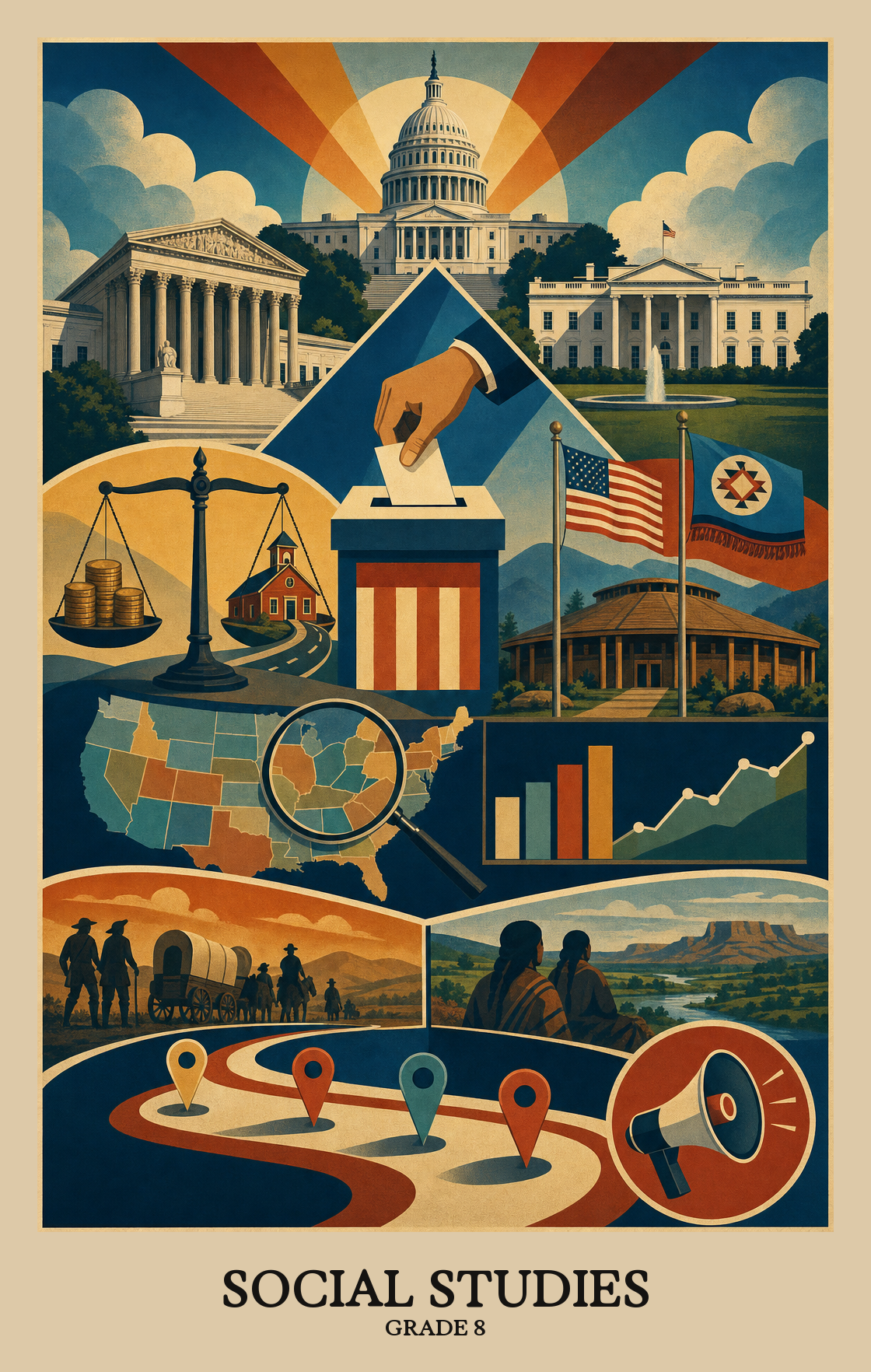
Students start the year looking at how the United States is set up to govern itself. They study the values behind the Constitution, the jobs of local, state, and federal government, and the standing of sovereign Tribal Nations.
Students look at the rights and responsibilities of people living in a democracy. They trace how a problem becomes a law and how regular people push for changes in their communities.
Students dig into how people, businesses, and countries make decisions when resources are limited. They look at prices, jobs, and the ups and downs of the economy, and weigh the trade-offs of buying and selling across borders.
Students use maps and mapping tools to ask questions about places. They study why people move, how cultures mix, and how communities shape and are shaped by the land and climate around them.
Students work like historians. They read letters, photos, and other firsthand sources, notice whose voices are missing, and build arguments about what happened and why it still matters today.
Students close the year by looking at how race, religion, gender, and other parts of identity have shaped life in Minnesota and beyond. They study people who organized for change and plan an action of their own.
Civic reasoning means thinking through public issues carefully and deciding how to act as a citizen. Students practice the skills behind voting, speaking up, and staying informed throughout their lives.
Students explain the core ideas behind democracy, such as equality, rights, and majority rule, then look at where those ideas create real friction inside the U.S. government and its laws.
Students explain what rights citizens have in a democracy and weigh them against personal duties, like following laws or participating in civic life. The focus is on how rights and responsibilities work together, not separately.
Students explain how laws are made and enforced at the city, state, and national levels, including within Tribal Nations. They also weigh whether those rules and processes are fair or effective.
Public policy is a law, rule, or plan that affects how a community works. Students study how governments, businesses, and groups push for or block those plans, and how ordinary people organize to change them.
Students examine how federally recognized tribes hold their own governing powers while also maintaining a legal relationship with the U.S. government. That balance is unlike any other political arrangement in the country.
| Standard | Definition | Code |
|---|---|---|
| Civic Skills: Apply civic reasoning and demonstrate civic skills for the… | Civic reasoning means thinking through public issues carefully and deciding how to act as a citizen. Students practice the skills behind voting, speaking up, and staying informed throughout their lives. | 8.1.1.1 |
| Democratic Values and Principles: Explain democratic values and principles that… | Students explain the core ideas behind democracy, such as equality, rights, and majority rule, then look at where those ideas create real friction inside the U.S. government and its laws. | 8.1.2.1 |
| Rights and Responsibilities | Students explain what rights citizens have in a democracy and weigh them against personal duties, like following laws or participating in civic life. The focus is on how rights and responsibilities work together, not separately. | 8.1.3.1 |
| Governmental Institutions and Political Processes: Explain and evaluate… | Students explain how laws are made and enforced at the city, state, and national levels, including within Tribal Nations. They also weigh whether those rules and processes are fair or effective. | 8.1.4.1 |
| Public Policy: Analyze how public policy is shaped by governmental and… | Public policy is a law, rule, or plan that affects how a community works. Students study how governments, businesses, and groups push for or block those plans, and how ordinary people organize to change them. | 8.1.5.1 |
| Tribal Nations: Evaluate the unique political status, trust relationships and… | Students examine how federally recognized tribes hold their own governing powers while also maintaining a legal relationship with the U.S. government. That balance is unlike any other political arrangement in the country. | 8.1.6.1 |
Students pick a real economic question, use data and economic models to build an argument, and propose a solution. Then they think through how that solution would affect different groups of people.
Scarcity means there is never enough of everything people want, so someone has to choose what to buy, fund, or build. Students examine what gets given up with each choice and how those decisions make the economy more fair or less fair for different groups.
Students study how different economies decide who gets what and why. They look at how rewards and penalties push buyers, businesses, and governments to make choices, then weigh what those choices actually produce, good and bad.
Students learn how economists measure whether a country is doing well financially, why recessions and booms happen, and how government decisions like taxes or spending ripple through everyday life.
Students explain why countries buy and sell goods across borders, then weigh the real trade-offs: lower prices and more jobs in some places, lost jobs and environmental strain in others.
| Standard | Definition | Code |
|---|---|---|
| Economic Inquiry: Use economic models and reasoning and data analysis to… | Students pick a real economic question, use data and economic models to build an argument, and propose a solution. Then they think through how that solution would affect different groups of people. | 8.2.7.1 |
| Fundamental Economic Concepts: Analyze how scarcity and artificial shortages… | Scarcity means there is never enough of everything people want, so someone has to choose what to buy, fund, or build. Students examine what gets given up with each choice and how those decisions make the economy more fair or less fair for different groups. | 8.2.8.1 |
| Microeconomics: Explain and evaluate how resources are used and how goods and… | Students study how different economies decide who gets what and why. They look at how rewards and penalties push buyers, businesses, and governments to make choices, then weigh what those choices actually produce, good and bad. | 8.2.10.1 |
| Macroeconomics: Measure and evaluate the well-being of nations and… | Students learn how economists measure whether a country is doing well financially, why recessions and booms happen, and how government decisions like taxes or spending ripple through everyday life. | 8.2.11.1 |
| Global and International | Students explain why countries buy and sell goods across borders, then weigh the real trade-offs: lower prices and more jobs in some places, lost jobs and environmental strain in others. | 8.2.12.1 |
Students use maps, satellite images, and digital tools to figure out why things are located where they are and how location affects real-world problems.
Students use maps, satellite images, and other geographic tools to ask location-based questions and work out real-world problems, like why a flood hits one neighborhood harder than another.
Students describe how power, like government control or economic inequality, shapes the character of a place or region. They explain why some areas thrive while others struggle based on who holds authority.
Students describe a place or region and explain how governments, laws, or powerful groups have shaped what it looks like and how it works.
Students look at why people, goods, and ideas move from place to place, then trace how those movements connect neighborhoods, countries, and economies to one another.
Students look at how people, goods, and ideas move between communities and countries, then explain what connects those movements across local, national, and global levels.
Students study how people, goods, and ideas move across the world and how local communities connect to bigger economic and political systems. They look for patterns in those connections, from a single neighborhood to a global network.
Students look at why people, goods, and ideas move from place to place, tracing how local decisions ripple outward and connect communities across the world.
Students look at how people shape the land, water, and air around them and how the environment shapes people back. That includes studying climate change and what drives it.
Students examine how the same neighborhood, landmark, or region can feel entirely different depending on who lives there and what that place means to them.
| Standard | Definition | Code |
|---|---|---|
| Geospatial Skills and Inquiry | Students use maps, satellite images, and digital tools to figure out why things are located where they are and how location affects real-world problems. | 8.3.13.1 |
| Geospatial Skills and Inquiry | Students use maps, satellite images, and other geographic tools to ask location-based questions and work out real-world problems, like why a flood hits one neighborhood harder than another. | 8.3.13.2 |
| Places and Regions: Describe places and regions, explaining how they are… | Students describe how power, like government control or economic inequality, shapes the character of a place or region. They explain why some areas thrive while others struggle based on who holds authority. | 8.3.14.1 |
| Places and Regions: Describe places and regions, explaining how they are… | Students describe a place or region and explain how governments, laws, or powerful groups have shaped what it looks like and how it works. | 8.3.14.2 |
| Human Systems: Analyze patterns of movement and interconnectedness within… | Students look at why people, goods, and ideas move from place to place, then trace how those movements connect neighborhoods, countries, and economies to one another. | 8.3.15.1 |
| Human Systems: Analyze patterns of movement and interconnectedness within… | Students look at how people, goods, and ideas move between communities and countries, then explain what connects those movements across local, national, and global levels. | 8.3.15.2 |
| Human Systems: Analyze patterns of movement and interconnectedness within… | Students study how people, goods, and ideas move across the world and how local communities connect to bigger economic and political systems. They look for patterns in those connections, from a single neighborhood to a global network. | 8.3.15.3 |
| Human Systems: Analyze patterns of movement and interconnectedness within… | Students look at why people, goods, and ideas move from place to place, tracing how local decisions ripple outward and connect communities across the world. | 8.3.15.4 |
| Human-Environment Interaction: Evaluate the relationship between humans and… | Students look at how people shape the land, water, and air around them and how the environment shapes people back. That includes studying climate change and what drives it. | 8.3.16.1 |
| Culture: Investigate how sense of place is impacted by different cultural… | Students examine how the same neighborhood, landmark, or region can feel entirely different depending on who lives there and what that place means to them. | 8.3.17.1 |
Students learn to ask "who's missing from this story?" They look at historical events from more than one point of view, including voices that textbooks have often left out.
Students learn to ask questions about why history looks different depending on whose story is being told. They compare the voices that get heard most often with the ones that get left out.
Students learn to ask questions about historical events that go beyond the official story. They look for perspectives that were left out or downplayed, then compare those accounts to understand what actually changed over time and what stayed the same.
Students learn that people in history saw events differently based on who they were and where they came from. They practice identifying those different viewpoints and explaining why a person's background shapes the way they tell a story.
Reading history means hearing more than one side. Students learn how a person's background, experiences, and position in society shape the way they interpret the same event differently from someone else.
Students read original documents and later accounts of historical events, then ask whose voices are missing and why the author wrote what they wrote. The goal is to read old sources the way a detective reads evidence.
Students pull facts and quotes from several historical sources, then build a written argument that explains why events happened the way they did.
Students pull facts and details from several historical sources, then use them to build a clear written argument or story about what happened and why.
Students trace a current problem (like inequality or immigration) back to its historical roots using primary sources and evidence. Then they draft a plan to address it today.
| Standard | Definition | Code |
|---|---|---|
| Context, Change, and Continuity: Ask historical questions about context… | Students learn to ask "who's missing from this story?" They look at historical events from more than one point of view, including voices that textbooks have often left out. | 8.4.18.1 |
| Context, Change, and Continuity: Ask historical questions about context… | Students learn to ask questions about why history looks different depending on whose story is being told. They compare the voices that get heard most often with the ones that get left out. | 8.4.18.2 |
| Context, Change, and Continuity: Ask historical questions about context… | Students learn to ask questions about historical events that go beyond the official story. They look for perspectives that were left out or downplayed, then compare those accounts to understand what actually changed over time and what stayed the same. | 8.4.18.3 |
| Historical Perspectives | Students learn that people in history saw events differently based on who they were and where they came from. They practice identifying those different viewpoints and explaining why a person's background shapes the way they tell a story. | 8.4.19.1 |
| Historical Perspectives | Reading history means hearing more than one side. Students learn how a person's background, experiences, and position in society shape the way they interpret the same event differently from someone else. | 8.4.19.2 |
| Historical Sources and Evidence: Investigate a variety of historical sources… | Students read original documents and later accounts of historical events, then ask whose voices are missing and why the author wrote what they wrote. The goal is to read old sources the way a detective reads evidence. | 8.4.20.1 |
| Causation and Argumentation: Integrate evidence from multiple… | Students pull facts and quotes from several historical sources, then build a written argument that explains why events happened the way they did. | 8.4.21.1 |
| Causation and Argumentation: Integrate evidence from multiple… | Students pull facts and details from several historical sources, then use them to build a clear written argument or story about what happened and why. | 8.4.21.2 |
| Connecting Past and Present | Students trace a current problem (like inequality or immigration) back to its historical roots using primary sources and evidence. Then they draft a plan to address it today. | 8.4.22.1 |
Students examine how the words society uses and who holds power shape labels like race, religion, and gender. Then they connect those patterns to communities in Minnesota whose histories have often been left out of the main story.
Students examine how the words people use and the power some groups hold shape labels like race, religion, and gender. Then they connect those ideas to their own identity and to communities in Minnesota whose histories have been left out of the main story.
Students examine how the words people use and the power some groups hold shape what race, religion, gender, and other identities mean in daily life. Then students apply that thinking to communities in Minnesota, with particular attention to groups whose histories have often been left out.
Students learn how people and communities pushed back against unfair systems, from local protests to global movements, and study which strategies led to real, lasting change.
Students research how ethnic and Indigenous communities have documented their own histories, then use those sources to trace where today's inequalities came from and what past efforts to fight them can teach us now.
| Standard | Definition | Code |
|---|---|---|
| Identity: Analyze the ways power and language construct the social identities… | Students examine how the words society uses and who holds power shape labels like race, religion, and gender. Then they connect those patterns to communities in Minnesota whose histories have often been left out of the main story. | 8.5.23.1 |
| Identity: Analyze the ways power and language construct the social identities… | Students examine how the words people use and the power some groups hold shape labels like race, religion, and gender. Then they connect those ideas to their own identity and to communities in Minnesota whose histories have been left out of the main story. | 8.5.23.2 |
| Identity: Analyze the ways power and language construct the social identities… | Students examine how the words people use and the power some groups hold shape what race, religion, gender, and other identities mean in daily life. Then students apply that thinking to communities in Minnesota, with particular attention to groups whose histories have often been left out. | 8.5.23.3 |
| Resistance: Describe how individuals and communities have fought for freedom… | Students learn how people and communities pushed back against unfair systems, from local protests to global movements, and study which strategies led to real, lasting change. | 8.5.24.1 |
| Ways of Knowing and Methodologies: Use ethnic and Indigenous studies methods… | Students research how ethnic and Indigenous communities have documented their own histories, then use those sources to trace where today's inequalities came from and what past efforts to fight them can teach us now. | 8.5.25.1 |
Federally administered sample-based assessment in reading, mathematics, science, writing, and other subjects. NAEP results inform state-by-state comparisons rather than individual student or school accountability.
Students study how government works, how the economy runs, how geography shapes communities, how history is told from different points of view, and how identity and power have shaped people's lives. Most of the work asks students to read sources, weigh evidence, and build an argument.
Watch or read the news together for ten minutes and ask who is affected and who is making the decision. Talking through a local issue at dinner does more than a worksheet. Ask students to explain a topic back in their own words.
Connect it to something they already care about, like a sport, a song, a neighborhood, or a family story. Ask where it came from and who was left out of the usual telling. A short visit to a local museum or historical marker often does more than a chapter of reading.
Students should be writing short arguments backed by evidence from at least two sources. The argument should name a claim, quote or paraphrase a source, and explain why that source supports the point. Sentence-level grammar matters less than whether the reasoning holds up.
Most teachers anchor the year in one strand, often United States history or civics, and weave economics, geography, and ethnic studies into each unit. Source analysis and argument writing belong in every unit, not a separate one. Build the civic skills early so students can use them all year.
Sourcing and corroboration are the biggest gaps. Students can summarize a source but often skip who wrote it, when, and why. Plan short, repeated practice with two or three sources on the same event rather than one long document study.
They are not a separate unit. Tribal Nations show up in government as sovereign nations with their own treaties and structures, and ethnic studies shows up whenever students ask whose story is being told and whose is missing. Plan to return to both questions in every unit.
Some anchor dates and names still matter, but the bigger expectation is explaining causes, effects, and different points of view. If students can tell the story of why something happened and who it affected, the dates tend to stick on their own.
By spring, students should read a primary source, identify the author's point of view, compare it to a second source, and write a short argument with evidence. They should also explain how a current issue connects to something earlier in history.