Asking questions and running tests
Students start the year acting like scientists. They ask questions about what they notice, plan simple experiments, and record what happens so they can back up what they say with evidence.
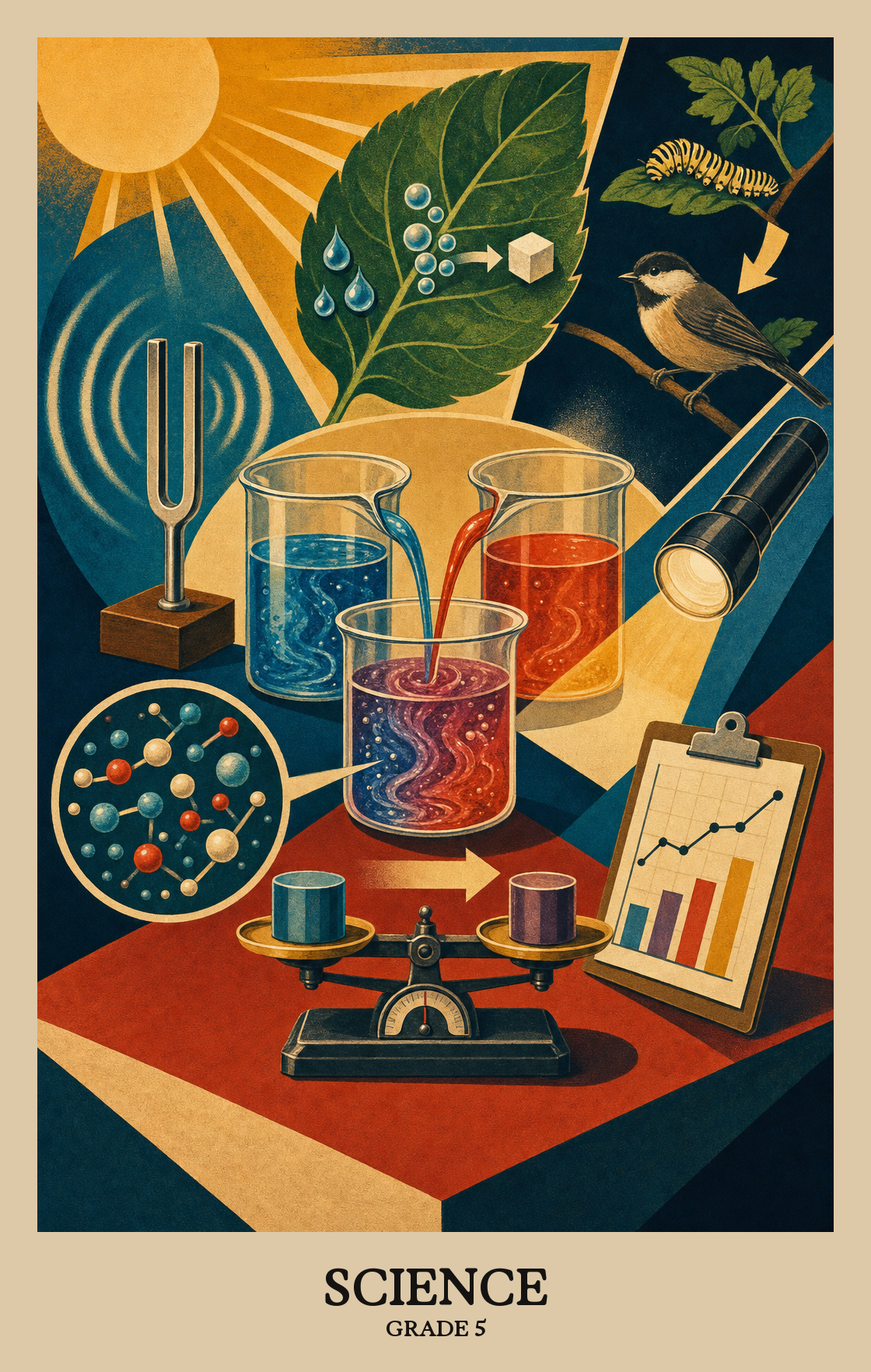
This is the year science starts adding up. Students run real experiments and use measurements to back up what they claim, from mixing substances and weighing the result to tracking how energy moves as sound, light, and heat. They study how plants make food from air and water, how that energy passes to animals, and how matter is made of particles too small to see. By spring, students can plan an investigation, graph the data, and explain what it shows.
Students start the year acting like scientists. They ask questions about what they notice, plan simple experiments, and record what happens so they can back up what they say with evidence.
Students learn that everything is made of tiny particles too small to see. They mix substances to find out when something new forms, and they weigh materials before and after to see that the total weight stays the same.
Students connect how fast something moves to how much energy it has. They track how energy travels through sound, light, heat, and electricity, then design and test a device that changes energy from one form to another.
Students investigate how plants grow mostly from air and water, not soil. They trace the path of food energy back to the Sun and build a visual that shows how matter moves between plants, animals, and decomposers.
Students look at what happens when something in an environment shifts and plants or animals are affected. They weigh different solutions to a real problem and use evidence to argue for the one that works best.
Students track shadows across a day, watch the pattern of day and night, and notice which stars show up in different seasons. They use evidence to explain why the Sun looks so much brighter than other stars.
Students practice asking clear, testable questions about the physical world, the kind that can actually be investigated with an experiment or observation rather than just looked up.
Students ask questions about what they observe, what they discover from experiments, and what they read. Those questions drive the rest of their science work.
Students ask questions about moving objects that can actually be tested, then predict what will happen to their speed and energy when those objects collide or push against each other.
Students plan and run simple experiments to test a question about the physical world, then record what happened and explain what the results show.
Students design their own experiments to test a question, then collect and organize data to back up what they think is happening. The evidence they gather supports the claim they make about what they observed.
Students mix common materials together (like baking soda and vinegar) and watch for signs that a new substance formed. They record what changed: color, smell, temperature, or bubbles.
Students look at a set of materials and decide which tools or tests to use before an experiment starts. For example, they might choose a scale to compare mass or a magnet to check if something is metal.
Students read charts and graphs from experiments to spot patterns and figure out what the numbers actually mean.
Students record measurements and observations in charts or graphs, then look for patterns that hint at how one thing might be affecting another.
Students look at data from experiments to explain how energy moves from one place to another, whether through sound, light, heat, or electric current. A ringing bell, a lamp, a warm stove, and a circuit are all examples of energy on the move.
Students use numbers and calculations to describe and explain what they observe in science, like measuring how fast something moves or how much force it takes to push an object.
Students use math to describe how physical things behave, like writing an equation to show how speed changes over time. Then they check whether the math actually matches what happens in the real world.
Students measure and weigh substances before and after heating, cooling, or mixing them, then graph the results to show the total weight stays the same no matter what changes happen.
Students build diagrams or physical models to show how something works, like a circuit, a water cycle, or a gear system. The model helps them explain ideas they can't fully see or test in person.
Students build and refine diagrams or physical models to explain how something in nature works, then use those models to ask questions, make predictions, and share their thinking.
Students build and improve a model showing that all matter, like water or air, is made of tiny particles too small to see with the naked eye. The model helps explain why those particles are real even though they're invisible.
Food energy in animals traces back to the Sun. Students use diagrams or models to show how sunlight powers plants, plants become food, and that food fuels an animal's growth, movement, and warmth.
Students look at a problem, use evidence from their investigations to explain what they observed, and then design or improve a solution that fits the constraints they were given.
Students back up a scientific claim with real evidence, then check whether that evidence actually holds up. If a classmate's explanation has a gap or a flaw, students name it and say why.
Students explain, using evidence, why a faster-moving object has more energy than a slower one. Think rolling a slow ball versus a fast one into a stack of blocks.
Students apply science ideas to design a solution to a real problem, then check whether it meets the rules and limits set for the challenge (like cost, size, or materials).
Students design and test a device that changes one kind of energy into another, like turning a hand crank into electrical power, then improve the design based on what they observe.
| Standard | Definition | Code |
|---|---|---|
| Asking questions and defining problems | Students practice asking clear, testable questions about the physical world, the kind that can actually be investigated with an experiment or observation rather than just looked up. | 5P.1.1 |
| Students will be able to ask questions about aspects of the phenomena they… | Students ask questions about what they observe, what they discover from experiments, and what they read. Those questions drive the rest of their science work. | 5P.1.1.1 |
| Ask investigatable questions and predict reasonable outcomes about the changes… | Students ask questions about moving objects that can actually be tested, then predict what will happen to their speed and energy when those objects collide or push against each other. | 5P.1.1.1.1 |
| Planning and carrying out investigations | Students plan and run simple experiments to test a question about the physical world, then record what happened and explain what the results show. | 5P.1.2 |
| Students will be able to design and conduct investigations in the classroom… | Students design their own experiments to test a question, then collect and organize data to back up what they think is happening. The evidence they gather supports the claim they make about what they observed. | 5P.1.2.1 |
| Conduct an investigation to determine whether the mixing of two or more… | Students mix common materials together (like baking soda and vinegar) and watch for signs that a new substance formed. They record what changed: color, smell, temperature, or bubbles. | 5P.1.2.1.1 |
| Evaluate appropriate methods and tools to identify materials based on their… | Students look at a set of materials and decide which tools or tests to use before an experiment starts. For example, they might choose a scale to compare mass or a magnet to check if something is metal. | 5P.1.2.1.2 |
| Analyzing and interpreting data | Students read charts and graphs from experiments to spot patterns and figure out what the numbers actually mean. | 5P.2.1 |
| Students will be able to represent observations and data in order to recognize… | Students record measurements and observations in charts or graphs, then look for patterns that hint at how one thing might be affecting another. | 5P.2.1.1 |
| Analyze and interpret data to show that energy can be transferred from place to… | Students look at data from experiments to explain how energy moves from one place to another, whether through sound, light, heat, or electric current. A ringing bell, a lamp, a warm stove, and a circuit are all examples of energy on the move. | 5P.2.1.1.1 |
| Using mathematics and computational thinking | Students use numbers and calculations to describe and explain what they observe in science, like measuring how fast something moves or how much force it takes to push an object. | 5P.2.2 |
| Students will be able to use mathematics to represent physical variables and… | Students use math to describe how physical things behave, like writing an equation to show how speed changes over time. Then they check whether the math actually matches what happens in the real world. | 5P.2.2.1 |
| Measure and graph quantities to provide evidence that regardless of the type of… | Students measure and weigh substances before and after heating, cooling, or mixing them, then graph the results to show the total weight stays the same no matter what changes happen. | 5P.2.2.1.1 |
| Developing and using models | Students build diagrams or physical models to show how something works, like a circuit, a water cycle, or a gear system. The model helps them explain ideas they can't fully see or test in person. | 5P.3.1 |
| Students will be able to develop, revise | Students build and refine diagrams or physical models to explain how something in nature works, then use those models to ask questions, make predictions, and share their thinking. | 5P.3.1.1 |
| Develop and refine a model to describe that matter is made of particles too… | Students build and improve a model showing that all matter, like water or air, is made of tiny particles too small to see with the naked eye. The model helps explain why those particles are real even though they're invisible. | 5P.3.1.1.1 |
| Use models to describe that energy in animals' food | Food energy in animals traces back to the Sun. Students use diagrams or models to show how sunlight powers plants, plants become food, and that food fuels an animal's growth, movement, and warmth. | 5P.3.1.1.2 |
| Constructing explanations and designing solutions | Students look at a problem, use evidence from their investigations to explain what they observed, and then design or improve a solution that fits the constraints they were given. | 5P.3.2 |
| Students will be able to apply scientific principles and empirical evidence | Students back up a scientific claim with real evidence, then check whether that evidence actually holds up. If a classmate's explanation has a gap or a flaw, students name it and say why. | 5P.3.2.1 |
| Construct an explanation based on evidence relating the speed of an object to… | Students explain, using evidence, why a faster-moving object has more energy than a slower one. Think rolling a slow ball versus a fast one into a stack of blocks. | 5P.3.2.1.1 |
| Students will be able to use their understanding of scientific principles and… | Students apply science ideas to design a solution to a real problem, then check whether it meets the rules and limits set for the challenge (like cost, size, or materials). | 5P.3.2.2 |
| Apply scientific ideas to design, test | Students design and test a device that changes one kind of energy into another, like turning a hand crank into electrical power, then improve the design based on what they observe. | 5P.3.2.2.1 |
Students plan and run simple experiments to answer science questions, choosing what to measure and how to record what they find.
Students design their own science experiments to test a question they care about, then collect and organize data to back up their answer. The work happens in class, a lab, or outdoors.
Students design and run an experiment to find out where plants get what they need to grow. The investigation builds evidence that air and water, not just soil, supply most of the materials plants use.
Students build or draw models to show how something in the living world works, then use those models to explain what they observe or predict what might happen next.
Students build diagrams or drawings to show how something in nature works, then update those models as they learn more. The goal is to explain their thinking, not just show a finished answer.
Students build a digital diagram showing how matter moves through a food web, tracing the path from plants to animals to decomposers and back into the soil or air.
Students look at data or observations and make a case for what they think is true, then defend that thinking when someone pushes back.
Students look at data or test results and use what they find to argue why one solution or design works better than another. The reasoning has to come from the evidence, not just an opinion.
Students look at real proposed solutions to problems like habitat loss or invasive species and decide which ones actually hold up. They back their opinion with evidence about how the change affected a plant or animal population.
| Standard | Definition | Code |
|---|---|---|
| Planning and carrying out investigations | Students plan and run simple experiments to answer science questions, choosing what to measure and how to record what they find. | 5L.1.2 |
| Students will be able to design and conduct investigations in the classroom… | Students design their own science experiments to test a question they care about, then collect and organize data to back up their answer. The work happens in class, a lab, or outdoors. | 5L.1.2.1 |
| Plan and conduct an investigation to obtain evidence that plants get the… | Students design and run an experiment to find out where plants get what they need to grow. The investigation builds evidence that air and water, not just soil, supply most of the materials plants use. | 5L.1.2.1.3 |
| Developing and using models | Students build or draw models to show how something in the living world works, then use those models to explain what they observe or predict what might happen next. | 5L.3.1 |
| Students will be able to develop, revise | Students build diagrams or drawings to show how something in nature works, then update those models as they learn more. The goal is to explain their thinking, not just show a finished answer. | 5L.3.1.1 |
| Create an electronic visualization of the movement of matter among plants… | Students build a digital diagram showing how matter moves through a food web, tracing the path from plants to animals to decomposers and back into the soil or air. | 5L.3.1.1.3 |
| Engaging in argument from evidence | Students look at data or observations and make a case for what they think is true, then defend that thinking when someone pushes back. | 5L.4.1 |
| Students will be able to argue from evidence to justify the best solution to a… | Students look at data or test results and use what they find to argue why one solution or design works better than another. The reasoning has to come from the evidence, not just an opinion. | 5L.4.1.2 |
| Evaluate the merit of a solution to a problem caused by changes in plant and… | Students look at real proposed solutions to problems like habitat loss or invasive species and decide which ones actually hold up. They back their opinion with evidence about how the change affected a plant or animal population. | 5L.4.1.2.1 |
Students use numbers, measurements, and basic calculations to study Earth and space patterns, like tracking how temperatures change across seasons or comparing distances between planets.
Students use math to describe how things in nature work, like calculating how fast wind moves or how much rain fell. They also follow step-by-step rules to solve real science problems and check whether their numbers match what they actually observe.
Students look at data to find patterns in how shadows grow and shrink through the day, why night follows day, and why certain stars appear only in certain seasons.
Students look at data, observations, or other findings and use them to back up a scientific claim. The goal is to support an argument with real evidence, not just a guess.
Students build a scientific explanation, then defend or revise it when new evidence shows up. They also poke holes in other students' reasoning and explain why a different conclusion makes more sense.
Students use data about distance to argue why the Sun looks so much brighter than other stars. The Sun isn't the biggest or hottest star; it just sits far closer to Earth than any other star does.
| Standard | Definition | Code |
|---|---|---|
| Using mathematics and computational thinking | Students use numbers, measurements, and basic calculations to study Earth and space patterns, like tracking how temperatures change across seasons or comparing distances between planets. | 5E.2.2 |
| Students will be able to use mathematics to represent physical variables and… | Students use math to describe how things in nature work, like calculating how fast wind moves or how much rain fell. They also follow step-by-step rules to solve real science problems and check whether their numbers match what they actually observe. | 5E.2.2.1 |
| Use data to describe patterns in the daily changes in length and direction of… | Students look at data to find patterns in how shadows grow and shrink through the day, why night follows day, and why certain stars appear only in certain seasons. | 5E.2.2.1.2 |
| Engaging in argument from evidence | Students look at data, observations, or other findings and use them to back up a scientific claim. The goal is to support an argument with real evidence, not just a guess. | 5E.4.1 |
| Students will be able to engage in argument from evidence for the explanations… | Students build a scientific explanation, then defend or revise it when new evidence shows up. They also poke holes in other students' reasoning and explain why a different conclusion makes more sense. | 5E.4.1.1 |
| Use evidence to support an argument that the apparent brightness of the Sun and… | Students use data about distance to argue why the Sun looks so much brighter than other stars. The Sun isn't the biggest or hottest star; it just sits far closer to Earth than any other star does. | 5E.4.1.1.1 |
Standards-based science assessment in grades 5 and 8 and once in high school, aligned to Minnesota Academic Standards.
Alternate standards-based assessment for eligible students with the most significant cognitive disabilities, administered in the same subjects and grades as the MCA program.
Students study three big areas: matter and energy, plants and ecosystems, and patterns in the sky like shadows, day and night, and stars. They also run real investigations, build models, and use evidence to back up their thinking.
Cook together and talk about what changes when ingredients mix or heat up. Step outside at different times of day and notice how shadows shift. Ask students to explain what they think is happening and why, then let them check their idea.
Students learn that everything is built from pieces too small to see, even air and water. At home, try dissolving sugar in water and ask where the sugar went. That conversation gets at the same idea students are building in class.
Many teachers start with matter and energy in fall, move into plants and ecosystems in winter when investigations can stretch over weeks, and save sky patterns for spring when students can track shadows and stars outside. Adjust based on field trips and weather.
Two ideas trip students up: that weight is conserved when substances mix or change, and that plants build themselves mostly from air and water, not soil. Plan extra hands-on time and revisit both ideas in more than one unit.
Students measure, graph, and look for patterns in their data. At home, weigh ingredients before and after mixing, time how long ice takes to melt, or chart the sunset over a week. Talking about what the numbers show is the goal.
Students can ask a testable question, run a fair investigation, record data, and use that data to argue for an explanation. They can also build and revise a simple model to show an idea, like energy moving through a food chain.
The habits matter more than the content. Students who can plan an investigation, measure carefully, and defend a claim with evidence are set up well. Practice having them explain their thinking out loud and respond to a different point of view.