Asking questions like a scientist
Students start the year by noticing the world around them and asking questions about what they see. They look closely at plants, animals, and weather, and learn to share what they observe with classmates.
This is the year students start acting like scientists about the world right outside the window. Students ask questions about how baby animals look like their parents, test how vibrating objects make sound, and notice how plants and animals use their parts to survive. They also look at how wind and water shape the land over time. By spring, students can build a simple model or device, like a tool that signals across the room, and explain what it shows using what they observed.
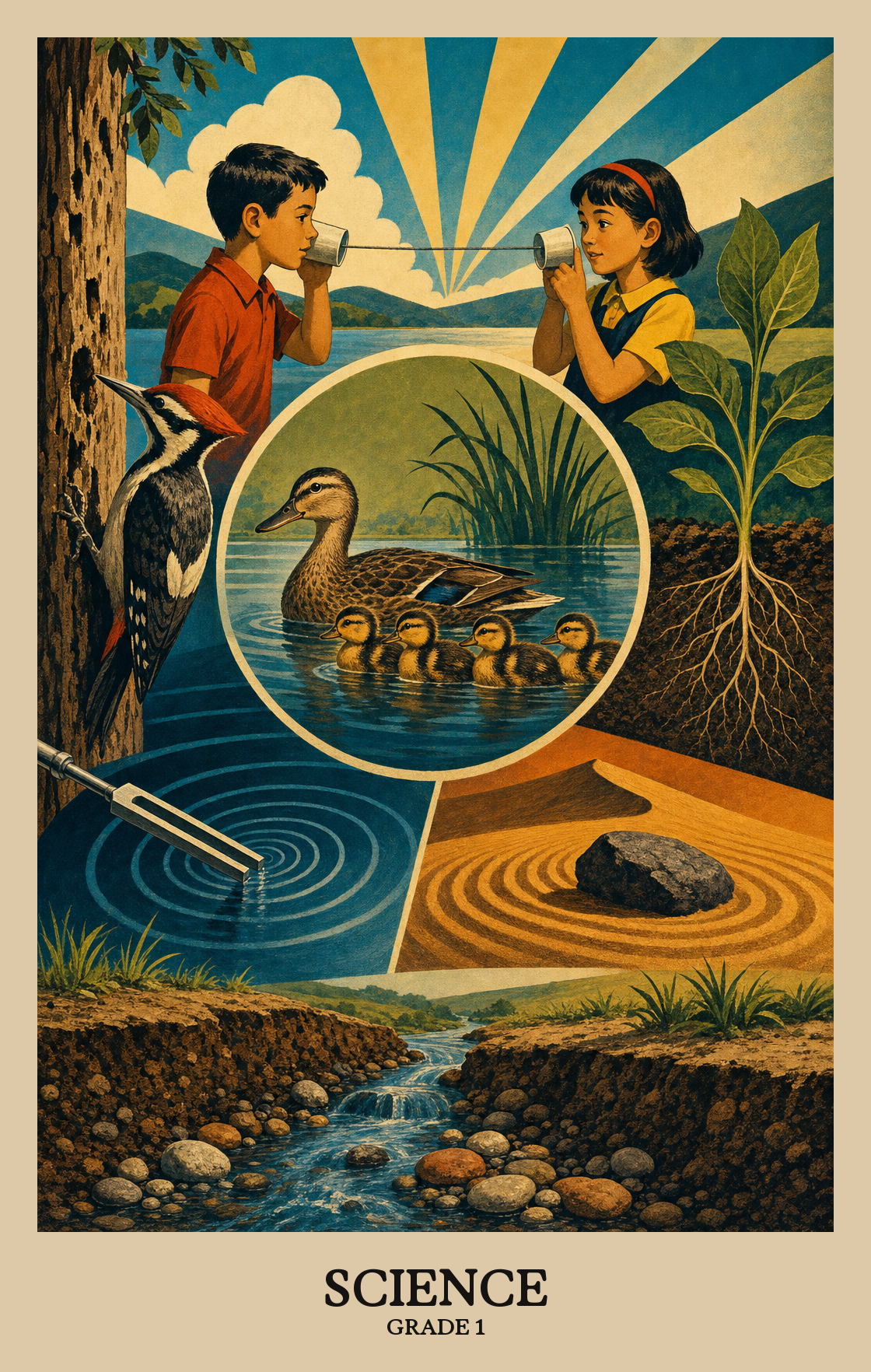
Students start the year by noticing the world around them and asking questions about what they see. They look closely at plants, animals, and weather, and learn to share what they observe with classmates.
Students study how baby plants and animals look like their parents and how they are different. They learn how living things use parts like roots, claws, or ears to find food, stay safe, and grow.
Students test how things vibrate to make sound and how light travels. They build a simple device that uses sound or light to send a message across the room, like a string telephone or a flashlight signal.
Students look at how living things change the places they live, and how wind and water reshape the ground over time. They learn about shelter and warmth, including practices of Minnesota American Indian communities, and suggest ways to care for the local environment.
Students practice asking questions about living things they observe, like plants, animals, or bugs. Good questions are the first step toward figuring out how the natural world works.
Students notice something in nature, then ask questions about what they saw, what a classmate thinks, or what they read. Asking good questions is how science gets started.
Students look at young plants or animals next to their parents and ask questions about what looks the same and what looks different. A puppy and its mother, a seedling and a full-grown plant.
Students draw or build simple models to show how living things look, grow, or behave. A model can be a diagram, a sketch, or a physical object that stands in for the real thing.
Students draw or build a simple model (like a diagram or labeled picture) to show how something in nature works, then update it as they learn more and explain their thinking to others.
Students pick a plant or animal and draw or build a simple model showing how a body part (like roots, claws, or leaves) helps it get food, water, or safety.
Students use what they have observed about living things to explain why something happens or to come up with a simple fix for a problem.
Students use what they know about living things to design a simple solution to a real problem, like keeping a plant alive or helping an animal stay warm. The design has to follow specific rules, such as using only certain materials.
Students pick a problem (staying warm, collecting water, moving around) and design a solution that copies how a plant or animal body part works. A beaver's flat tail, a cactus spine, a duck's webbed foot: any of these can spark the idea.
Students read books, watch videos, or look at pictures to find out about living things, then share what they learned with words or drawings.
Reading books, videos, or charts about living things, students figure out which facts hold up and which ones don't, then share what they found by drawing, talking, or writing.
Students look through books, videos, and pictures to find patterns in how parent animals care for their young. The goal is to see which behaviors help offspring survive.
| Standard | Definition | Code |
|---|---|---|
| Asking questions and defining problems | Students practice asking questions about living things they observe, like plants, animals, or bugs. Good questions are the first step toward figuring out how the natural world works. | 1L.1.1 |
| Students will be able to ask questions about aspects of the phenomena they… | Students notice something in nature, then ask questions about what they saw, what a classmate thinks, or what they read. Asking good questions is how science gets started. | 1L.1.1.1 |
| Ask questions based on observations about the similarities and differences… | Students look at young plants or animals next to their parents and ask questions about what looks the same and what looks different. A puppy and its mother, a seedling and a full-grown plant. | 1L.1.1.1.1 |
| Developing and using models | Students draw or build simple models to show how living things look, grow, or behave. A model can be a diagram, a sketch, or a physical object that stands in for the real thing. | 1L.3.1 |
| Students will be able to develop, revise | Students draw or build a simple model (like a diagram or labeled picture) to show how something in nature works, then update it as they learn more and explain their thinking to others. | 1L.3.1.1 |
| Develop a simple model based on evidence to represent how plants or animals use… | Students pick a plant or animal and draw or build a simple model showing how a body part (like roots, claws, or leaves) helps it get food, water, or safety. | 1L.3.1.1.1 |
| Constructing explanations and designing solutions | Students use what they have observed about living things to explain why something happens or to come up with a simple fix for a problem. | 1L.3.2 |
| Students will be able to use their understanding of scientific principles and… | Students use what they know about living things to design a simple solution to a real problem, like keeping a plant alive or helping an animal stay warm. The design has to follow specific rules, such as using only certain materials. | 1L.3.2.2 |
| Plan and design a solution to a human problem by mimicking how plants and/or… | Students pick a problem (staying warm, collecting water, moving around) and design a solution that copies how a plant or animal body part works. A beaver's flat tail, a cactus spine, a duck's webbed foot: any of these can spark the idea. | 1L.3.2.2.2 |
| Obtaining, evaluating and communicating information | Students read books, watch videos, or look at pictures to find out about living things, then share what they learned with words or drawings. | 1L.4.2 |
| Students will be able to read and interpret multiple sources to obtain… | Reading books, videos, or charts about living things, students figure out which facts hold up and which ones don't, then share what they found by drawing, talking, or writing. | 1L.4.2.1 |
| Obtain information using various features of texts and other media to determine… | Students look through books, videos, and pictures to find patterns in how parent animals care for their young. The goal is to see which behaviors help offspring survive. | 1L.4.2.1.2 |
Students plan a simple test, gather what they need, and record what happens. The focus is on asking a question, trying something out, and reporting what they found.
Students design simple tests to answer their own questions about the world around them, then record what they observe. The results become their evidence for explaining what happened.
Students shake or tap objects to discover that vibrating things make sound, then watch how sound waves can make other objects move in return.
Students sort and compare data from simple tests, like which block slides farther or which material feels warmer, to figure out what the results actually show.
Students look at what they noticed during a science activity, then organize it into a chart or drawing to spot patterns, like whether heavier objects always fall faster or whether plants near the window grow taller.
Students test everyday materials, like wood, metal, or fabric, to see which ones make sound travel well and which ones muffle it. They look for patterns in the results to figure out which material works best.
Students look at a problem, like a toy that breaks or a puddle that won't drain, and figure out why it happened. Then they come up with a simple fix and explain their thinking.
Students figure out how to solve a simple problem (like keeping an object dry or making something stand up) by testing ideas and checking whether the solution actually works.
Students design and build a device that sends a message using light or sound, such as a signal lamp or a simple horn, to reach someone too far away to hear or see normally.
Students read and talk about physical science topics to find answers and share what they learned. They practice gathering information from books, pictures, or observations and deciding whether it makes sense.
Students learn that people from many cultures, including Minnesota American Indian communities, use observation and experience to explain how the world works and solve everyday problems.
Students describe or draw solutions that use real materials to meet a community's needs for shelter, food, or warmth. This includes how Minnesota American Indian communities have met those same needs.
| Standard | Definition | Code |
|---|---|---|
| Planning and carrying out investigations | Students plan a simple test, gather what they need, and record what happens. The focus is on asking a question, trying something out, and reporting what they found. | 1P.1.2 |
| Students will be able to design and conduct investigations in the classroom… | Students design simple tests to answer their own questions about the world around them, then record what they observe. The results become their evidence for explaining what happened. | 1P.1.2.1 |
| Plan and conduct investigations to provide evidence that vibrating materials… | Students shake or tap objects to discover that vibrating things make sound, then watch how sound waves can make other objects move in return. | 1P.1.2.1.1 |
| Analyzing and interpreting data | Students sort and compare data from simple tests, like which block slides farther or which material feels warmer, to figure out what the results actually show. | 1P.2.1 |
| Students will be able to represent observations and data in order to recognize… | Students look at what they noticed during a science activity, then organize it into a chart or drawing to spot patterns, like whether heavier objects always fall faster or whether plants near the window grow taller. | 1P.2.1.1 |
| Identify and describe patterns obtained from testing different materials and… | Students test everyday materials, like wood, metal, or fabric, to see which ones make sound travel well and which ones muffle it. They look for patterns in the results to figure out which material works best. | 1P.2.1.1.1 |
| Constructing explanations and designing solutions | Students look at a problem, like a toy that breaks or a puddle that won't drain, and figure out why it happened. Then they come up with a simple fix and explain their thinking. | 1P.3.2 |
| Students will be able to use their understanding of scientific principles and… | Students figure out how to solve a simple problem (like keeping an object dry or making something stand up) by testing ideas and checking whether the solution actually works. | 1P.3.2.2 |
| Design and build a device that uses light or sound to solve the problem of… | Students design and build a device that sends a message using light or sound, such as a signal lamp or a simple horn, to reach someone too far away to hear or see normally. | 1P.3.2.2.1 |
| Obtaining, evaluating and communicating information | Students read and talk about physical science topics to find answers and share what they learned. They practice gathering information from books, pictures, or observations and deciding whether it makes sense. | 1P.4.2 |
| Students will be able to gather information about and communicate the methods… | Students learn that people from many cultures, including Minnesota American Indian communities, use observation and experience to explain how the world works and solve everyday problems. | 1P.4.2.2 |
| Communicate solutions that use materials to provide shelter, food | Students describe or draw solutions that use real materials to meet a community's needs for shelter, food, or warmth. This includes how Minnesota American Indian communities have met those same needs. | 1P.4.2.2.1 |
Students count, measure, or sort data about Earth's patterns, like tracking how many sunny or rainy days happen over a month. Numbers help them spot changes in weather and seasons.
Students use numbers and simple patterns to describe things they notice in nature, like how temperature changes or how many rainy days happen in a row. They also follow step-by-step rules to explain how something in the world works.
Students look at numbers and simple data to sort Earth events by speed: some things, like an earthquake or a rainstorm, happen fast, while others, like a canyon forming, take thousands of years.
Students look at simple clues from nature, like cloud shapes or puddle water, and use what they see to explain why something happens.
Students look at evidence, explain what they think it means, and defend or change their answer when they learn something new. They also listen to other students' ideas and respectfully push back when they disagree.
Students look at real examples of plants and animals changing their surroundings, then build a case explaining why. A bird gathering sticks for a nest or a tree's roots cracking sidewalk concrete counts as evidence.
Students look at real results, like which paper bridge held more weight or which material kept water out, and use what they saw to explain why one solution worked better than another.
Students look at different ways people try to stop wind or water from wearing down the land, then pick a side and back it up with evidence. Think of things like fences, plants, or barriers that hold soil in place.
Students find information from books, pictures, or a teacher, then share what they learned with words or drawings. The focus is on gathering facts about the world around them and explaining what those facts mean.
Reading books, charts, and pictures about Earth science, students figure out which facts hold up and which don't. Then they share what they found using words, drawings, or other formats.
Students pick a real problem in their neighborhood, like litter or dirty water, and explain a solution that would help the land, animals, or air. The focus is on sharing that idea clearly.
| Standard | Definition | Code |
|---|---|---|
| Using mathematics and computational thinking | Students count, measure, or sort data about Earth's patterns, like tracking how many sunny or rainy days happen over a month. Numbers help them spot changes in weather and seasons. | 1E.2.2 |
| Students will be able to use mathematics to represent physical variables and… | Students use numbers and simple patterns to describe things they notice in nature, like how temperature changes or how many rainy days happen in a row. They also follow step-by-step rules to explain how something in the world works. | 1E.2.2.1 |
| Use quantitative data to identify and describe patterns in the amount of time… | Students look at numbers and simple data to sort Earth events by speed: some things, like an earthquake or a rainstorm, happen fast, while others, like a canyon forming, take thousands of years. | 1E.2.2.1.1 |
| Engaging in argument from evidence | Students look at simple clues from nature, like cloud shapes or puddle water, and use what they see to explain why something happens. | 1E.4.1 |
| Students will be able to engage in argument from evidence for the explanations… | Students look at evidence, explain what they think it means, and defend or change their answer when they learn something new. They also listen to other students' ideas and respectfully push back when they disagree. | 1E.4.1.1 |
| Construct an argument based on observational evidence for how plants and animals | Students look at real examples of plants and animals changing their surroundings, then build a case explaining why. A bird gathering sticks for a nest or a tree's roots cracking sidewalk concrete counts as evidence. | 1E.4.1.1.1 |
| Students will be able to argue from evidence to justify the best solution to a… | Students look at real results, like which paper bridge held more weight or which material kept water out, and use what they saw to explain why one solution worked better than another. | 1E.4.1.2 |
| Construct an argument with evidence to evaluate multiple solutions designed to… | Students look at different ways people try to stop wind or water from wearing down the land, then pick a side and back it up with evidence. Think of things like fences, plants, or barriers that hold soil in place. | 1E.4.1.2.1 |
| Obtaining, evaluating and communicating information | Students find information from books, pictures, or a teacher, then share what they learned with words or drawings. The focus is on gathering facts about the world around them and explaining what those facts mean. | 1E.4.2 |
| Students will be able to read and interpret multiple sources to obtain… | Reading books, charts, and pictures about Earth science, students figure out which facts hold up and which don't. Then they share what they found using words, drawings, or other formats. | 1E.4.2.1 |
| Communicate solutions that will reduce the impact of humans on the land, water… | Students pick a real problem in their neighborhood, like litter or dirty water, and explain a solution that would help the land, animals, or air. The focus is on sharing that idea clearly. | 1E.4.2.1.1 |
Alternate standards-based assessment for eligible students with the most significant cognitive disabilities, administered in the same subjects and grades as the MCA program.
Students study three big areas: living things, sound and light, and the Earth around them. They watch how baby animals look like their parents, test how vibrations make sound, and notice how wind and water change the land. Most learning happens through hands-on activities, not reading.
Go outside and notice things together. Compare a puppy to a dog, tap on different objects to hear which ones buzz, or watch how rain moves dirt in the yard. Ask students what they notice and what they wonder. Five minutes of real curiosity beats a worksheet.
Yes. Asking questions about what they see is one of the main skills this year. When students ask why a bird builds a nest or why ice melts, encourage them to guess an answer and then look for clues. That is how scientists think.
Many teachers start with living things in fall, move to sound and light in winter, and finish with Earth changes in spring when students can go outside more. Each unit pairs an observation skill with a design task, so plan time for building, not just talking.
Drawing models and constructing arguments from evidence are the hardest lifts at this age. Students can observe well but struggle to show their thinking on paper or explain why their answer makes sense. Build in lots of practice with labeled drawings and sentence starters like "I think this because."
Not really. The focus is on observing, asking questions, and testing ideas, not memorizing vocabulary. Knowing the names of a few plant or animal parts helps, but explaining how those parts help the animal survive matters more.
Use materials created by Tribes and Native educators rather than generic resources. The standard asks students to learn how Native communities use local materials for shelter, food, and warmth. Reach out to district contacts for vetted lessons and invite community voices when possible.
By spring, students should be able to ask a science question, plan a simple test, record what they notice, and explain their thinking with a drawing or a sentence. They should also be able to design a simple solution, like a tool that copies how an animal solves a problem.
A model is usually a labeled drawing or a small build that shows how something works. A student might draw a duck and label the webbed feet and beak, or build a paper cup phone to show how sound travels. It does not need to be fancy to count.