Belonging in our community
Students start the year thinking about who they are and the groups they belong to, from family to classroom to neighborhood. They notice how people are alike and different and how everyone deserves to be treated fairly.
This is the year students start seeing themselves as part of a community with rules, leaders, and a shared history. They learn what fair rules look like at home and school, how families and neighbors make choices about money and trading, and how maps show where people live and move. Students also hear stories from many groups, including Tribal Nations in Minnesota. By spring, they can name a community leader, point out a basic feature on a map, and explain why a rule matters.
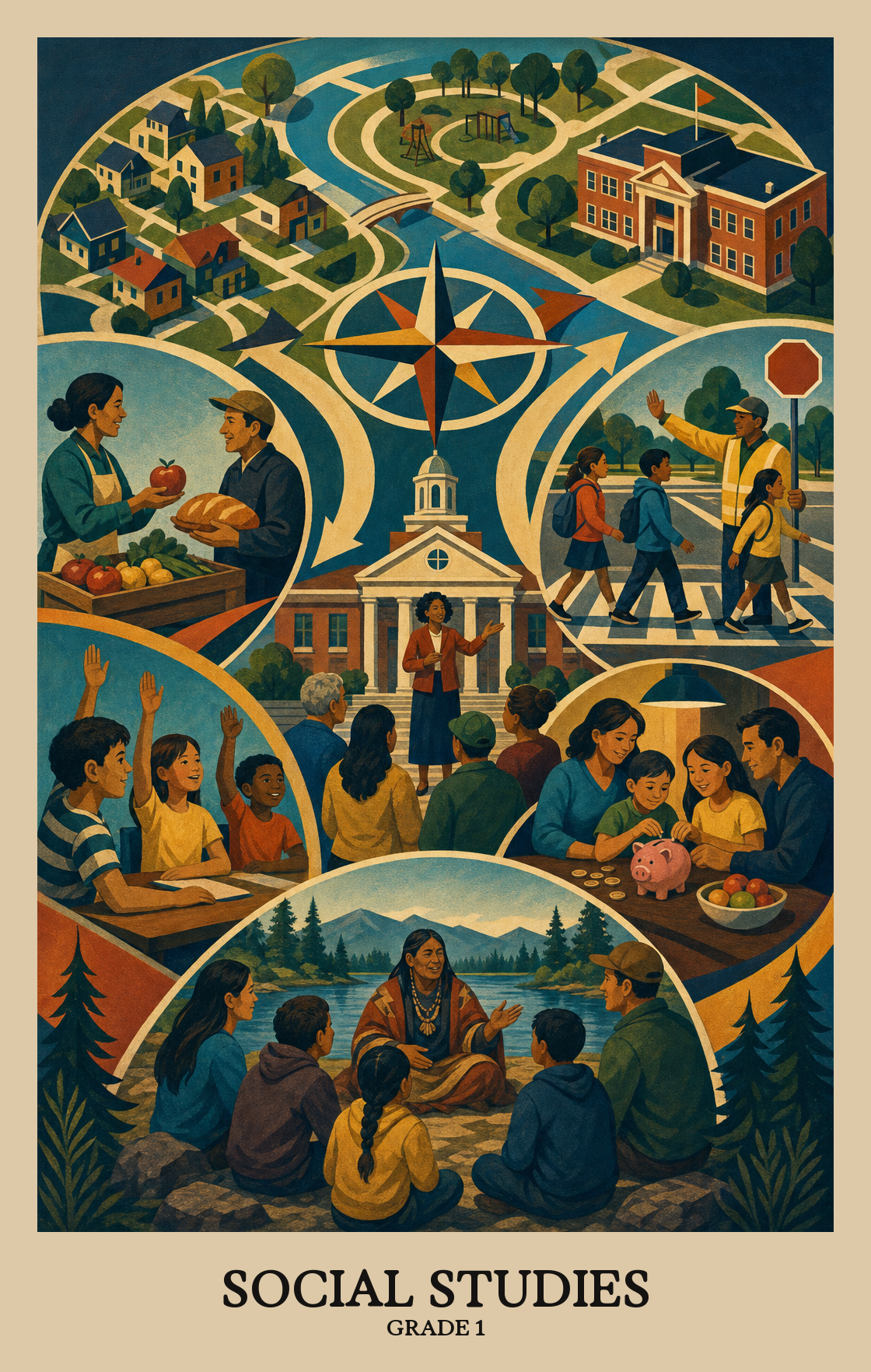
Students start the year thinking about who they are and the groups they belong to, from family to classroom to neighborhood. They notice how people are alike and different and how everyone deserves to be treated fairly.
Students learn why rules exist at home, at school, and in town. They talk about what is fair, what their responsibilities are, and the jobs of leaders and helpers who keep a community running.
Students use simple maps to find places in their school, town, and state. They learn that Minnesota is home to sovereign Tribal Nations and start noticing how land, water, and weather shape daily life.
Students explore needs and wants and the choices families make when they cannot have everything. They see how people earn, save, spend, and trade for the things they use every day.
Students compare life long ago with life now using pictures, objects, and stories. They hear from many points of view, including voices often left out, and notice how people have worked to make things more fair.
Students practice thinking through real decisions that affect their class or community. Over time, these habits help them grow into people who vote, speak up, and take part in public life.
Students learn what ideas like fairness, freedom, and equal treatment mean, and why communities make rules based on those ideas. They also look at moments when those values pull against each other in real life.
Students learn what rights and responsibilities mean in everyday life, like following classroom rules, treating others fairly, and having a say in group decisions.
Rules and laws come from different levels of government: your town, your state, and the whole country. Students learn what those rules are, where they come from, and whether they seem fair.
Rules and laws come from different levels of government: the city, the state, and the country. Students learn who makes those rules, why they exist, and how to decide whether they are fair.
Students learn that Native American tribes have their own governments and laws, separate from state and federal government. They explore what it means for tribes to govern themselves and how the United States has a special legal relationship with them.
| Standard | Definition | Code |
|---|---|---|
| Civic Skills: Apply civic reasoning and demonstrate civic skills for the… | Students practice thinking through real decisions that affect their class or community. Over time, these habits help them grow into people who vote, speak up, and take part in public life. | 1.1.1.1 |
| Democratic Values and Principles: Explain democratic values and principles that… | Students learn what ideas like fairness, freedom, and equal treatment mean, and why communities make rules based on those ideas. They also look at moments when those values pull against each other in real life. | 1.1.2.1 |
| Rights and Responsibilities | Students learn what rights and responsibilities mean in everyday life, like following classroom rules, treating others fairly, and having a say in group decisions. | 1.1.3.1 |
| Governmental Institutions and Political Processes: Explain and evaluate… | Rules and laws come from different levels of government: your town, your state, and the whole country. Students learn what those rules are, where they come from, and whether they seem fair. | 1.1.4.1 |
| Governmental Institutions and Political Processes: Explain and evaluate… | Rules and laws come from different levels of government: the city, the state, and the country. Students learn who makes those rules, why they exist, and how to decide whether they are fair. | 1.1.4.2 |
| Tribal Nations: Evaluate the unique political status, trust relationships and… | Students learn that Native American tribes have their own governments and laws, separate from state and federal government. They explore what it means for tribes to govern themselves and how the United States has a special legal relationship with them. | 1.1.6.1 |
Students look at a real money question, such as why a store might close or why lunch costs more, and use simple facts to explain their answer. They also think about how their idea would affect different people in the community.
Scarcity means there isn't enough of something for everyone who wants it. Students learn why people, families, and governments have to choose what to spend money on, and what they have to give up when they do.
Students learn to set simple money goals, like saving for something they want, and think about small steps to reach them. They also explore why some families find saving easier or harder than others.
Students learn why some years feel harder for families (less work, higher prices) and why some feel easier. They also look at how decisions made by leaders can change what people can afford and how communities grow.
Trading with other countries lets people get things their own country doesn't make well, but it can also affect local jobs and the environment. Students learn why countries choose to buy from and sell to each other, and what those choices cost.
| Standard | Definition | Code |
|---|---|---|
| Economic Inquiry: Use economic models and reasoning and data analysis to… | Students look at a real money question, such as why a store might close or why lunch costs more, and use simple facts to explain their answer. They also think about how their idea would affect different people in the community. | 1.2.7.1 |
| Fundamental Economic Concepts: Analyze how scarcity and artificial shortages… | Scarcity means there isn't enough of something for everyone who wants it. Students learn why people, families, and governments have to choose what to spend money on, and what they have to give up when they do. | 1.2.8.1 |
| Personal Finance: Apply economic concepts and models to develop individual… | Students learn to set simple money goals, like saving for something they want, and think about small steps to reach them. They also explore why some families find saving easier or harder than others. | 1.2.9.1 |
| Macroeconomics: Measure and evaluate the well-being of nations and… | Students learn why some years feel harder for families (less work, higher prices) and why some feel easier. They also look at how decisions made by leaders can change what people can afford and how communities grow. | 1.2.11.1 |
| Global and International | Trading with other countries lets people get things their own country doesn't make well, but it can also affect local jobs and the environment. Students learn why countries choose to buy from and sell to each other, and what those choices cost. | 1.2.12.1 |
Students use maps, globes, and simple tools to figure out where places are and how they connect. They practice asking geographic questions and finding answers by looking at the world around them.
Students learn that the rules and leaders in a place, like a mayor or a principal, shape what that place looks like and how people live there.
Students look at how people, goods, and ideas move from one place to another, from their own neighborhood to faraway countries, and figure out how those connections shape daily life.
| Standard | Definition | Code |
|---|---|---|
| Geospatial Skills and Inquiry | Students use maps, globes, and simple tools to figure out where places are and how they connect. They practice asking geographic questions and finding answers by looking at the world around them. | 1.3.13.1 |
| Places and Regions: Describe places and regions, explaining how they are… | Students learn that the rules and leaders in a place, like a mayor or a principal, shape what that place looks like and how people live there. | 1.3.14.1 |
| Human Systems: Analyze patterns of movement and interconnectedness within… | Students look at how people, goods, and ideas move from one place to another, from their own neighborhood to faraway countries, and figure out how those connections shape daily life. | 1.3.15.1 |
Students ask questions about why things happened and whose story is being told. They start to notice that history looks different depending on who is sharing it.
Reading history means seeing it through someone's eyes. Students learn that different people experienced the same event in different ways, and that where you come from shapes what you notice and remember.
Students look at old photos, letters, and books to figure out who made them, why, and whose voices might be missing from the story.
Students look at more than one source about a past event, then use what they find to explain what happened and why. They back up their explanation with evidence from those sources.
Students trace a problem happening today back to its roots in the past, using maps, stories, or other sources. Then they come up with a plan to help fix it.
| Standard | Definition | Code |
|---|---|---|
| Context, Change, and Continuity: Ask historical questions about context… | Students ask questions about why things happened and whose story is being told. They start to notice that history looks different depending on who is sharing it. | 1.4.18.1 |
| Historical Perspectives | Reading history means seeing it through someone's eyes. Students learn that different people experienced the same event in different ways, and that where you come from shapes what you notice and remember. | 1.4.19.1 |
| Historical Sources and Evidence: Investigate a variety of historical sources… | Students look at old photos, letters, and books to figure out who made them, why, and whose voices might be missing from the story. | 1.4.20.1 |
| Causation and Argumentation: Integrate evidence from multiple… | Students look at more than one source about a past event, then use what they find to explain what happened and why. They back up their explanation with evidence from those sources. | 1.4.21.1 |
| Connecting Past and Present | Students trace a problem happening today back to its roots in the past, using maps, stories, or other sources. Then they come up with a plan to help fix it. | 1.4.22.1 |
Students look at how the words people use and who holds power shape the way groups are labeled and treated. They connect those ideas to their own identity and to communities in Minnesota whose histories haven't been told.
Students learn how people and groups have stood up against unfair treatment to win rights and dignity. They look at what actions led to real change and practice working with others toward fairness.
| Standard | Definition | Code |
|---|---|---|
| Identity: Analyze the ways power and language construct the social identities… | Students look at how the words people use and who holds power shape the way groups are labeled and treated. They connect those ideas to their own identity and to communities in Minnesota whose histories haven't been told. | 1.5.23.1 |
| Resistance: Describe how individuals and communities have fought for freedom… | Students learn how people and groups have stood up against unfair treatment to win rights and dignity. They look at what actions led to real change and practice working with others toward fairness. | 1.5.24.1 |
Federally administered sample-based assessment in reading, mathematics, science, writing, and other subjects. NAEP results inform state-by-state comparisons rather than individual student or school accountability.
Students learn how to be part of a group, both at school and at home. They talk about fairness, rules, jobs people do, and the places where they live. Most of the work happens through stories, pictures, and class conversations.
Talk about the rules in your home and why they exist. Point out community helpers when you are out running errands, like the bus driver, librarian, or mail carrier. Ask students what was fair or unfair about something that happened during the day.
Not at this age. The focus is on understanding that the past is different from today and that people remember the same events in different ways. Sharing family stories and looking at old family photos counts as history practice.
Start with self, family, and classroom in the fall, then widen out to neighborhood and community by winter. Save bigger ideas like state, Tribal Nations, and trade for spring once students have language for groups and rules. Revisit fairness and decision-making all year.
Use the names of the Dakota and Ojibwe nations and the lands they govern today, not just stories from long ago. Picture books by Native authors work well for read-alouds. Keep the message simple: Tribal Nations are governments with their own leaders and rules.
Students learn that people cannot have everything they want, so they make choices. They practice the idea of trading by swapping items in class or talking about wants and needs at home. Counting coins and saving for a small goal fits here too.
The difference between a want and a need trips up most students, and so does the idea that two people can see the same event differently. Plan to come back to both several times with new examples rather than teaching them once.
By spring, students should be able to name a few rules and why they matter, point out their city and state on a map, and describe a job someone in the community does. They should also be able to share an opinion and listen when someone disagrees.
Take the complaint seriously and ask what would feel more fair. This is the exact thinking the year is building. Then talk through why the rule might exist and who it is trying to protect, so students see that rules and fairness are connected.