Asking questions like scientists
Students start the year practicing how to ask sharp questions about what they see and how to spot what is actually being tested. They learn to plan a fair test where one thing changes at a time.
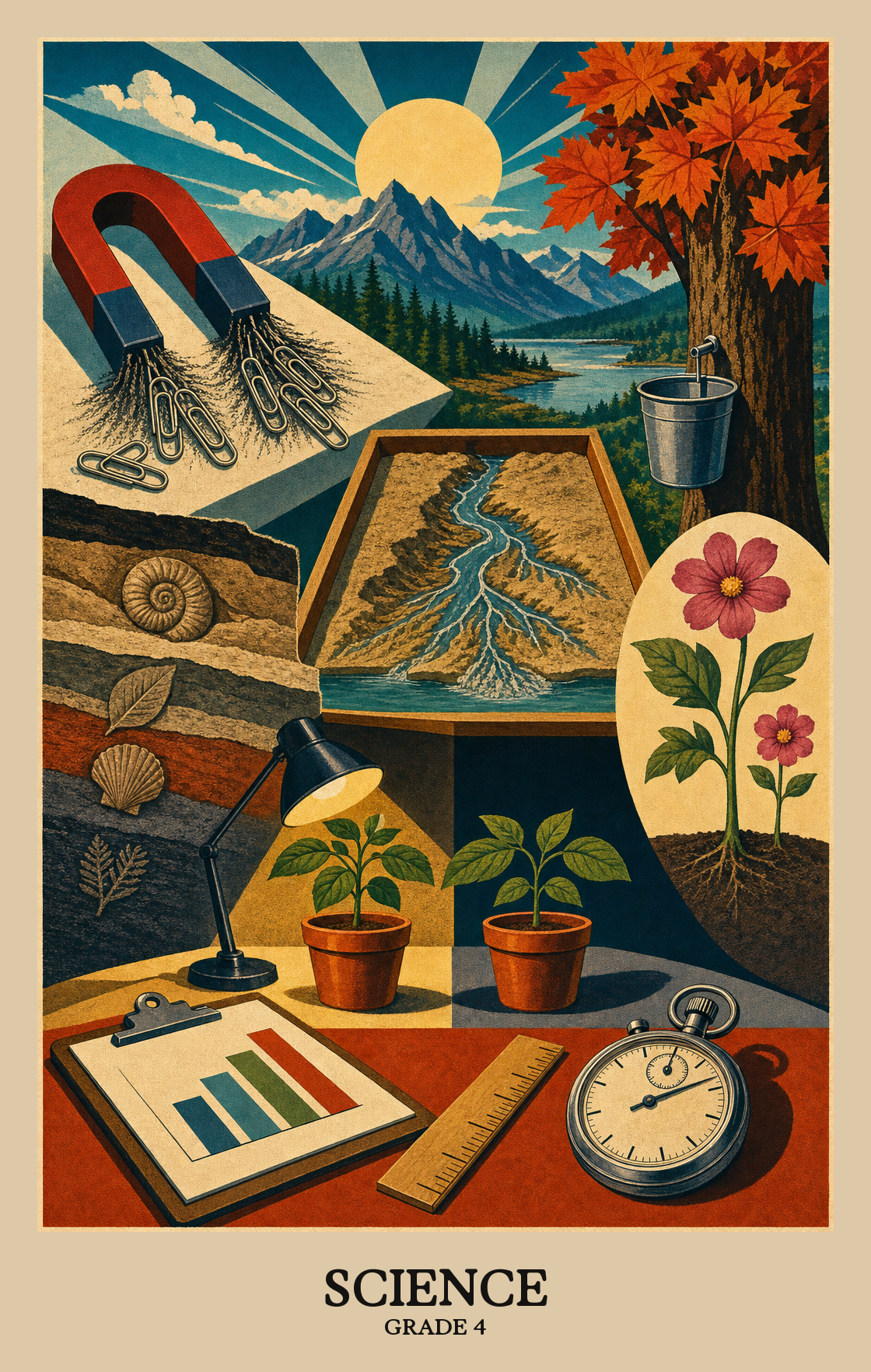
This is the year science shifts from watching the world to testing how it works. Students ask questions and run fair experiments about magnets, water shaping the land, and traits that pass from parent to plant or animal. They read rock layers like a storybook and study how communities, including Minnesota tribes, use natural resources. By spring, students can plan a simple test, collect data, and use it to back up an answer.
Students start the year practicing how to ask sharp questions about what they see and how to spot what is actually being tested. They learn to plan a fair test where one thing changes at a time.
Students explore how magnets and electricity can push or pull objects without touching them. They use what they learn to sketch a simple invention that solves a small problem using a magnet.
Students look at how water moves around the planet and how wind, ice, and rain slowly wear land down. They read maps and graphs to compare how much fresh water and salt water Earth actually has.
Students use rock layers and fossils as clues to figure out how a place changed long ago. They also compare ways people can protect homes and roads from floods, earthquakes, and other natural events.
Students read about where energy and fuels come from and how using them affects the land, air, and water. They learn how Minnesota American Indian Tribes and other communities make decisions about caring for natural resources.
Students notice how plants and animals pass traits to their young and why no two siblings look exactly alike. They also gather evidence that the environment, like sunlight or food, can shape how a living thing grows.
Students practice turning curiosity into a clear question or problem worth investigating. This is how science starts before any experiment begins.
Students ask questions about what they notice, what their experiments show, and what they read. The questions can challenge a classmate's idea or dig into a result that doesn't quite make sense.
Students ask questions about why a magnet can push or pull another object without touching it, and how electric charges can do the same. The goal is to figure out what causes those invisible forces to work.
Students learn to ask focused questions about a real problem before trying to solve it. Those questions help them figure out what the solution must do and what limits it has to work within.
Students think of a real problem that magnets could help solve, such as keeping a cabinet door closed or sorting metal objects, then describe what a good solution would need to do.
| Standard | Definition | Code |
|---|---|---|
| Asking questions and defining problems | Students practice turning curiosity into a clear question or problem worth investigating. This is how science starts before any experiment begins. | 4P.1.1 |
| Students will be able to ask questions about aspects of the phenomena they… | Students ask questions about what they notice, what their experiments show, and what they read. The questions can challenge a classmate's idea or dig into a result that doesn't quite make sense. | 4P.1.1.1 |
| Ask questions to determine cause and effect relationships of electric and… | Students ask questions about why a magnet can push or pull another object without touching it, and how electric charges can do the same. The goal is to figure out what causes those invisible forces to work. | 4P.1.1.1.1 |
| Students will be able to ask questions about a problem to be solved so they can… | Students learn to ask focused questions about a real problem before trying to solve it. Those questions help them figure out what the solution must do and what limits it has to work within. | 44P.1.1.2 |
| Define a simple design problem that can be solved by applying scientific ideas… | Students think of a real problem that magnets could help solve, such as keeping a cabinet door closed or sorting metal objects, then describe what a good solution would need to do. | 4P.1.1.2.1 |
Students learn to ask clear questions about the natural world and identify what makes a problem worth investigating. This is the starting point for all scientific thinking in fourth grade science.
Students look at something in nature, a cloud pattern, a melting ice cube, or a diagram they built, and write questions about what they notice. They also question what classmates say and what they read in science books.
Students ask questions about how water travels through nature, such as where rain goes after it falls or how rivers form, then sort each question by type, like whether it can be answered by an experiment or by observation.
Students plan and carry out simple science investigations, deciding what to test, what to measure, and how to record what they find.
Students design and run their own science tests, then collect and organize data to back up what they think is happening. This standard is about asking a question, figuring out how to test it, and using real results as evidence.
Students observe rocks, soil, or land features up close to gather evidence of how water, wind, ice, or plant roots slowly break things down or wear them away.
Students design and run controlled tests on a model to figure out what stops soil or land from washing away. They change one thing at a time, look for weak spots, and use what they learn to make the model work better.
Students use numbers and simple calculations to describe patterns in Earth data, like temperature changes across seasons or the depth of a rock layer.
Students use numbers, measurements, and simple step-by-step rules to describe how the natural world works, then check whether those numbers match what they actually see outside.
Students read charts and maps showing where Earth's water is stored, then use those visuals to explain why most of the planet's water is salty and only a small fraction is fresh.
Students build or draw models of Earth systems, like weather patterns or landforms, to show how the parts work together and explain what they observe.
Students build diagrams or drawings to show how something in nature works, then update those models as they learn more and use them to explain their thinking to others.
Students draw or diagram how Earth's land, living things, water, and air connect to each other, using what they've observed or measured. A diagram might show how rain soaks into soil, feeds plants, and evaporates back into clouds.
Students look at patterns in weather data to explain why conditions change and suggest ways communities can prepare for severe weather.
Students use real evidence from experiments or research to explain why something in nature happens. They also look at other people's explanations and point out what those explanations might be missing or getting wrong.
Rock layers act like pages in Earth's history book. Students study fossils and rock patterns to explain how a landscape changed over millions of years.
Students apply what they know about science to design a solution to a real problem, then check whether it meets the rules and limits set for that problem.
Students look at real problems like flooding or erosion, then come up with more than one solution and compare which works best. The goal is to reduce the harm these natural events cause to people.
Students read and compare science texts, diagrams, or charts to gather information about Earth and space topics. They pick out the key ideas and explain what they found in their own words.
Students read science books, articles, and data to answer questions about Earth and space, then judge whether claims hold up and share what they found. The focus is on gathering real evidence and explaining it clearly.
Students read articles or watch videos to learn where energy sources like coal, oil, and solar power come from. They describe how using those resources affects the land, water, and air around us.
Students research how different cultures, including Minnesota's American Indian tribes, explain natural events and solve real-world problems. They compare those methods and share what they find.
Students research how different communities, including Minnesota American Indian tribes, decide how to use natural resources like water, soil, and forests. They compare ideas from multiple sources to understand how evidence and science shape those choices.
| Standard | Definition | Code |
|---|---|---|
| Asking questions and defining problems | Students learn to ask clear questions about the natural world and identify what makes a problem worth investigating. This is the starting point for all scientific thinking in fourth grade science. | 4E.1.1 |
| Students will be able to ask questions about aspects of the phenomena they… | Students look at something in nature, a cloud pattern, a melting ice cube, or a diagram they built, and write questions about what they notice. They also question what classmates say and what they read in science books. | 4E.1.1.1 |
| Ask questions about how water moves through the Earth system and identify the… | Students ask questions about how water travels through nature, such as where rain goes after it falls or how rivers form, then sort each question by type, like whether it can be answered by an experiment or by observation. | 4E.1.1.1.2 |
| Planning and carrying out investigations | Students plan and carry out simple science investigations, deciding what to test, what to measure, and how to record what they find. | E.1.2 |
| Students will be able to design and conduct investigations in the classroom… | Students design and run their own science tests, then collect and organize data to back up what they think is happening. This standard is about asking a question, figuring out how to test it, and using real results as evidence. | 4E.1.2.1 |
| Make observations and measurements to provide evidence of the effects of… | Students observe rocks, soil, or land features up close to gather evidence of how water, wind, ice, or plant roots slowly break things down or wear them away. | 4E.1.2.1.1 |
| Plan and carry out fair tests in which variables are controlled and failure… | Students design and run controlled tests on a model to figure out what stops soil or land from washing away. They change one thing at a time, look for weak spots, and use what they learn to make the model work better. | 4E.1.2.1.2 |
| Using mathematics and computational thinking | Students use numbers and simple calculations to describe patterns in Earth data, like temperature changes across seasons or the depth of a rock layer. | 4E.2.2 |
| Students will be able to use mathematics to represent physical variables and… | Students use numbers, measurements, and simple step-by-step rules to describe how the natural world works, then check whether those numbers match what they actually see outside. | 4E.2.2.1 |
| Interpret charts, maps and/or graphs of the amounts of salt water and fresh… | Students read charts and maps showing where Earth's water is stored, then use those visuals to explain why most of the planet's water is salty and only a small fraction is fresh. | 4E.2.2.1.1 |
| Developing and using models | Students build or draw models of Earth systems, like weather patterns or landforms, to show how the parts work together and explain what they observe. | 4E.3.1 |
| Students will be able to develop, revise | Students build diagrams or drawings to show how something in nature works, then update those models as they learn more and use them to explain their thinking to others. | 4E.3.1.1 |
| Develop a model based in part on student observations or data to describe ways… | Students draw or diagram how Earth's land, living things, water, and air connect to each other, using what they've observed or measured. A diagram might show how rain soaks into soil, feeds plants, and evaporates back into clouds. | 4E.3.1.1.1 |
| Constructing explanations and designing solutions | Students look at patterns in weather data to explain why conditions change and suggest ways communities can prepare for severe weather. | 4E.3.2 |
| Students will be able to apply scientific principles and empirical evidence | Students use real evidence from experiments or research to explain why something in nature happens. They also look at other people's explanations and point out what those explanations might be missing or getting wrong. | 4E.3.2.1 |
| Identify evidence from patterns in rock formations and fossils in rock layers… | Rock layers act like pages in Earth's history book. Students study fossils and rock patterns to explain how a landscape changed over millions of years. | 4E.3.2.1.1 |
| Students will be able to use their understanding of scientific principles and… | Students apply what they know about science to design a solution to a real problem, then check whether it meets the rules and limits set for that problem. | 4E.3.2.2 |
| Generate and compare multiple solutions to reduce the impacts of natural Earth… | Students look at real problems like flooding or erosion, then come up with more than one solution and compare which works best. The goal is to reduce the harm these natural events cause to people. | 4E.3.2.2.1 |
| Obtaining, evaluating and communicating information | Students read and compare science texts, diagrams, or charts to gather information about Earth and space topics. They pick out the key ideas and explain what they found in their own words. | 4E.4.2 |
| Students will be able to read and interpret multiple sources to obtain… | Students read science books, articles, and data to answer questions about Earth and space, then judge whether claims hold up and share what they found. The focus is on gathering real evidence and explaining it clearly. | 4E.4.2.1 |
| Read and comprehend grade appropriate complex texts and/or other reliable media… | Students read articles or watch videos to learn where energy sources like coal, oil, and solar power come from. They describe how using those resources affects the land, water, and air around us. | 4E.4.2.1.1 |
| Students will be able to gather information about and communicate the methods… | Students research how different cultures, including Minnesota's American Indian tribes, explain natural events and solve real-world problems. They compare those methods and share what they find. | 4E.4.2.2 |
| Obtain and combine multiple sources of information about ways individual… | Students research how different communities, including Minnesota American Indian tribes, decide how to use natural resources like water, soil, and forests. They compare ideas from multiple sources to understand how evidence and science shape those choices. | 4E.4.2.2.1 |
Students look at evidence from observations or experiments and defend a scientific claim. They explain why their evidence supports their conclusion and consider other possible explanations.
Students back up their science explanations with evidence, then defend or revise those explanations when new evidence shows up. They also look at other students' arguments and push back when the reasoning doesn't hold up.
Students back up a claim about why the same plant or animal can look or behave differently depending on where it grows up. They use examples from nature to show that surroundings shape traits, not just genes.
Students read and compare information from books, diagrams, and other sources to answer science questions, then share what they found in writing or discussion.
Students read articles, diagrams, and other sources to learn about living things, then judge whether the information holds up and share what they found using writing, drawings, or discussion.
Plants and animals inherit traits from their parents, but no two offspring look exactly alike. Students research that idea using books, videos, and other sources, then explain why dogs in the same litter or seeds from the same plant still turn out different.
| Standard | Definition | Code |
|---|---|---|
| Engaging in argument from evidence | Students look at evidence from observations or experiments and defend a scientific claim. They explain why their evidence supports their conclusion and consider other possible explanations. | 4L.4.1 |
| Students will be able to engage in argument from evidence for the explanations… | Students back up their science explanations with evidence, then defend or revise those explanations when new evidence shows up. They also look at other students' arguments and push back when the reasoning doesn't hold up. | 4L.4.1.1 |
| Construct or support an argument that traits can be influenced by different… | Students back up a claim about why the same plant or animal can look or behave differently depending on where it grows up. They use examples from nature to show that surroundings shape traits, not just genes. | 4L.4.1.1.1 |
| Obtaining, evaluating and communicating information | Students read and compare information from books, diagrams, and other sources to answer science questions, then share what they found in writing or discussion. | 4L.4.2 |
| Students will be able to read and interpret multiple sources to obtain… | Students read articles, diagrams, and other sources to learn about living things, then judge whether the information holds up and share what they found using writing, drawings, or discussion. | 4L.4.2.1 |
| Obtain information from various media sources to determine that plants and… | Plants and animals inherit traits from their parents, but no two offspring look exactly alike. Students research that idea using books, videos, and other sources, then explain why dogs in the same litter or seeds from the same plant still turn out different. | 4L.4.2.1.2 |
Alternate standards-based assessment for eligible students with the most significant cognitive disabilities, administered in the same subjects and grades as the MCA program.
Federally administered sample-based assessment in reading, mathematics, science, writing, and other subjects. NAEP results inform state-by-state comparisons rather than individual student or school accountability.
Students explore four big areas: magnets and electricity, water and erosion on Earth, rocks and fossils, and how living things inherit traits. The year leans on hands-on investigations where students ask questions, test ideas, and explain what they find with evidence.
Go outside and notice things together. Watch how rain moves dirt in the yard, play with magnets on the fridge, or look at rocks on a walk. Asking students what they think is happening and why builds the same thinking they use in class.
Less than you might expect. Most of the work is about explaining how something happens and backing it up with evidence. Knowing a few key ideas, like fresh water being rare or traits coming from parents, matters more than long vocabulary lists.
A common path is to start with magnets and electric forces, move into Earth processes like erosion and rock layers, then tie in water distribution and natural resources, and finish with traits and inheritance. Earth topics take the most time because they include fieldwork and design challenges.
Controlling variables in a fair test and using evidence to support a claim. Students often jump to conclusions or change two things at once. Building a simple sentence frame for claims and evidence, then using it all year, makes a real difference.
Students design small solutions to real problems, like slowing erosion on a hillside or using magnets to solve a simple task. They build something, test it, and improve it. The point is the thinking process, not a polished final product.
Students learn how different communities, including Minnesota Tribes, use evidence and long-standing knowledge to make decisions about land, water, and other resources. It gives students more than one lens for thinking about how people study and care for the natural world.
By spring, students should be able to ask a testable question, run a fair test, and explain results using evidence from what they saw or measured. They should also be able to read a short science article or chart and pull out the main idea.
Try one small experiment at the kitchen table, like which materials a magnet pulls or how fast ice melts in different spots. Ten minutes of doing usually beats an hour of reading about it, and it shows that science is mostly about noticing and wondering.