Maps, places, and Minnesota
Students start the year exploring Minnesota through maps and regions. They use map tools to answer questions about where people live, what the land is like, and how cities and rural areas connect.
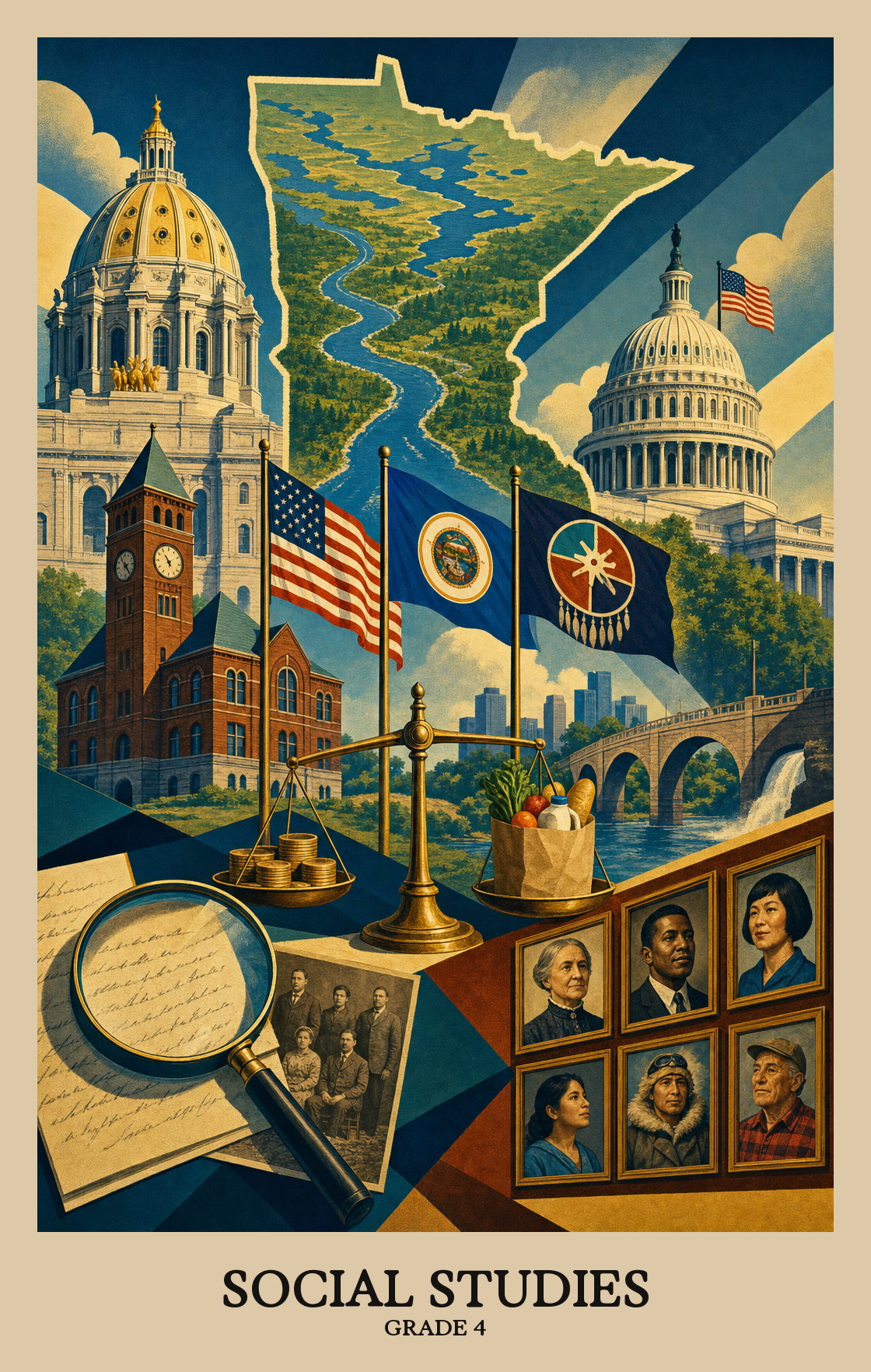
This is the year social studies zooms in on Minnesota and how it works. Students look at how local, state, and federal governments make decisions, and they study Tribal Nations as their own sovereign governments. They read maps, weigh trade-offs in everyday spending choices, and ask whose stories get told about the past. By spring, students can use a primary source like a letter or photograph to back up an argument about Minnesota history.
Students start the year exploring Minnesota through maps and regions. They use map tools to answer questions about where people live, what the land is like, and how cities and rural areas connect.
Students learn that Tribal Nations are sovereign governments with their own leaders and laws. They also hear stories from many groups who have lived in Minnesota, including ones often left out of older textbooks.
Students look at how city, state, and federal governments make rules and solve problems. They practice the habits of a good citizen, like asking questions, weighing sides, and speaking up about issues that affect their community.
Students learn that people, businesses, and governments cannot have everything, so they make trade-offs. They look at how prices, jobs, and rewards shape the choices families and communities make every day.
Students dig into letters, photos, and other records from the past. They notice whose voices are missing, ask what the source was really for, and build short arguments using evidence from more than one place.
Students explore how race, religion, gender, and where someone lives shape how people are treated. They connect past injustices to issues today and think about what fairness could look like in their own community.
Students practice the thinking and talking skills that help people take part in a democracy. That means reading about real issues, forming opinions, and explaining their reasoning to others.
Students learn what values like fairness, liberty, and majority rule actually mean in practice, then look at real moments when those values have pulled against each other in American history.
Students learn how the rules and laws that govern their city, state, and country get made, and who has the power to change them. They also look at how Tribal Nations govern themselves.
Students look at how rules and laws get made, and who helps shape them. They also explore how ordinary people and community groups push for change when something in their neighborhood or country needs fixing.
Students learn that Tribal Nations are self-governing and have a distinct legal relationship with the U.S. government. They look at how that relationship works and what it means for how tribes make their own laws and decisions.
| Standard | Definition | Code |
|---|---|---|
| Civic Skills: Apply civic reasoning and demonstrate civic skills for the… | Students practice the thinking and talking skills that help people take part in a democracy. That means reading about real issues, forming opinions, and explaining their reasoning to others. | 4.1.1.1 |
| Democratic Values and Principles: Explain democratic values and principles that… | Students learn what values like fairness, liberty, and majority rule actually mean in practice, then look at real moments when those values have pulled against each other in American history. | 4.1.2.1 |
| Governmental Institutions and Political Processes: Explain and evaluate… | Students learn how the rules and laws that govern their city, state, and country get made, and who has the power to change them. They also look at how Tribal Nations govern themselves. | 4.1.4.1 |
| Public Policy: Analyze how public policy is shaped by governmental and… | Students look at how rules and laws get made, and who helps shape them. They also explore how ordinary people and community groups push for change when something in their neighborhood or country needs fixing. | 4.1.5.1 |
| Tribal Nations: Evaluate the unique political status, trust relationships and… | Students learn that Tribal Nations are self-governing and have a distinct legal relationship with the U.S. government. They look at how that relationship works and what it means for how tribes make their own laws and decisions. | 4.1.6.1 |
Students pick an economic question, such as why prices rise or what happens when a store closes, then use data and basic economic reasoning to argue for a solution. They also think through how that solution would affect different groups of people.
Scarcity means there is never enough of everything people want, so someone has to choose what to spend, buy, or build. Students look at how those choices leave some people with more and others with less.
Students learn why people, businesses, and governments make economic choices, and what happens because of those choices. They look at how rewards and costs push decision-makers in different directions, and who benefits or loses out as a result.
Students learn why the economy sometimes booms and sometimes slows down, and how government decisions like changing taxes or spending money affect everyday life for families and communities.
| Standard | Definition | Code |
|---|---|---|
| Economic Inquiry: Use economic models and reasoning and data analysis to… | Students pick an economic question, such as why prices rise or what happens when a store closes, then use data and basic economic reasoning to argue for a solution. They also think through how that solution would affect different groups of people. | 4.2.7.1 |
| Fundamental Economic Concepts: Analyze how scarcity and artificial shortages… | Scarcity means there is never enough of everything people want, so someone has to choose what to spend, buy, or build. Students look at how those choices leave some people with more and others with less. | 4.2.8.1 |
| Microeconomics: Explain and evaluate how resources are used and how goods and… | Students learn why people, businesses, and governments make economic choices, and what happens because of those choices. They look at how rewards and costs push decision-makers in different directions, and who benefits or loses out as a result. | 4.2.10.1 |
| Macroeconomics: Measure and evaluate the well-being of nations and… | Students learn why the economy sometimes booms and sometimes slows down, and how government decisions like changing taxes or spending money affect everyday life for families and communities. | 4.2.11.1 |
Students use maps, aerial photos, and digital tools like Google Earth to answer questions about places. They figure out where things are, why they're located there, and how location affects daily life.
Students use maps, globes, and digital mapping tools to answer real questions about places. They figure out why things are located where they are and how location affects people's lives.
Students explain how governments, laws, or powerful groups shape what a place looks and feels like. Think of why a town has certain buildings, borders, or rules.
Students describe a place or region and explain who holds power there (a government, a group, or a rule) and how that power shapes what the place looks like or how people live in it.
Students look at how people and the environment affect each other, including how burning fuel and cutting forests change the climate over time.
Students explore how the same neighborhood, landmark, or landscape can feel completely different depending on who grew up there and what their family's history is with that place.
| Standard | Definition | Code |
|---|---|---|
| Geospatial Skills and Inquiry | Students use maps, aerial photos, and digital tools like Google Earth to answer questions about places. They figure out where things are, why they're located there, and how location affects daily life. | 4.3.13.1 |
| Geospatial Skills and Inquiry | Students use maps, globes, and digital mapping tools to answer real questions about places. They figure out why things are located where they are and how location affects people's lives. | 4.3.13.2 |
| Places and Regions: Describe places and regions, explaining how they are… | Students explain how governments, laws, or powerful groups shape what a place looks and feels like. Think of why a town has certain buildings, borders, or rules. | 4.3.14.1 |
| Places and Regions: Describe places and regions, explaining how they are… | Students describe a place or region and explain who holds power there (a government, a group, or a rule) and how that power shapes what the place looks like or how people live in it. | 4.3.14.2 |
| Human-Environment Interaction: Evaluate the relationship between humans and… | Students look at how people and the environment affect each other, including how burning fuel and cutting forests change the climate over time. | 4.3.16.1 |
| Culture: Investigate how sense of place is impacted by different cultural… | Students explore how the same neighborhood, landmark, or landscape can feel completely different depending on who grew up there and what their family's history is with that place. | 4.3.17.1 |
Students learn to ask questions about why things happened in history and whose stories got told. They practice looking for voices and events that history books sometimes leave out.
Students look at photos, letters, and written accounts from the past to figure out who wrote them, why, and who might be missing from the story.
Students pull facts from several sources about the same historical event, then use those facts to build a written argument or story that explains what happened and why.
| Standard | Definition | Code |
|---|---|---|
| Context, Change, and Continuity: Ask historical questions about context… | Students learn to ask questions about why things happened in history and whose stories got told. They practice looking for voices and events that history books sometimes leave out. | 4.4.18.1 |
| Historical Sources and Evidence: Investigate a variety of historical sources… | Students look at photos, letters, and written accounts from the past to figure out who wrote them, why, and who might be missing from the story. | 4.4.20.1 |
| Causation and Argumentation: Integrate evidence from multiple… | Students pull facts from several sources about the same historical event, then use those facts to build a written argument or story that explains what happened and why. | 4.4.21.1 |
Students look at how the words people use and who holds power shape labels like race, religion, and gender. Then they connect those ideas to their own identity and to groups in Minnesota whose histories have often been left out of the story.
Students look at how the words people use and the power some groups hold can shape how others are seen or labeled. They then connect that to their own identity and the communities of Minnesota whose histories have often been left out of the main story.
Students look at history through the eyes of ethnic and Indigenous communities to understand how past injustices still shape life today, then consider what lessons from that history might help fix those problems.
Students look at history through the eyes of ethnic and Indigenous communities to understand how past injustices still shape life today. They study what happened, why it persisted, and what people have done to push back.
| Standard | Definition | Code |
|---|---|---|
| Identity: Analyze the ways power and language construct the social identities… | Students look at how the words people use and who holds power shape labels like race, religion, and gender. Then they connect those ideas to their own identity and to groups in Minnesota whose histories have often been left out of the story. | 4.5.23.1 |
| Identity: Analyze the ways power and language construct the social identities… | Students look at how the words people use and the power some groups hold can shape how others are seen or labeled. They then connect that to their own identity and the communities of Minnesota whose histories have often been left out of the main story. | 4.5.23.2 |
| Ways of Knowing and Methodologies: Use ethnic and Indigenous studies methods… | Students look at history through the eyes of ethnic and Indigenous communities to understand how past injustices still shape life today, then consider what lessons from that history might help fix those problems. | 4.5.25.1 |
| Ways of Knowing and Methodologies: Use ethnic and Indigenous studies methods… | Students look at history through the eyes of ethnic and Indigenous communities to understand how past injustices still shape life today. They study what happened, why it persisted, and what people have done to push back. | 4.5.25.2 |
Federally administered sample-based assessment in reading, mathematics, science, writing, and other subjects. NAEP results inform state-by-state comparisons rather than individual student or school accountability.
Students study how government works at the city, state, and national level, including Tribal Nations. They also learn how maps, money, history, and culture shape Minnesota and the people who live here.
Talk about real decisions in everyday life. Why did a store raise the price of eggs? Why does the city plow some streets first? Walk through a map before a road trip. These short conversations build the same thinking students use in class.
Students should be able to explain that Tribal Nations are sovereign governments with their own leaders and laws, not just cultural groups. They should know a few specific Nations in Minnesota and how those governments work with the state and federal government.
A common move is to start with civics in the fall while class routines and rules are fresh, then shift to economics in the winter using scarcity and choice as the anchor. Geography and history can run alongside both, tied to Minnesota places and people.
Tribal sovereignty, the difference between local and state government, and opportunity cost tend to need a second pass. Students often confuse Tribal Nations with cultural heritage, and they need repeated practice naming what was given up when a choice was made.
Pick one local story and follow it for a week. A city council vote, a new park, a road project, a news piece about a Minnesota Tribal Nation. Real, close-to-home stories tend to stick where textbook summaries do not.
Students should be able to look at a photo, letter, or map and ask who made it, when, and why. The goal is not deep analysis. It is the habit of checking the source and noticing whose story is missing.
Students can explain how a law or rule gets made, use a map to answer a real question, and describe a problem in their community along with one way people are trying to solve it. They can also point to more than one perspective on a historical event.
Students should be comfortable reading a short article or primary source and saying what it is about and who wrote it. They should be able to name branches of government, locate Minnesota and its neighbors on a map, and explain a basic trade-off in plain language.