Counting and sorting to start
Students count objects out loud, match each one to a number, and learn that the last number tells how many. They sort buttons, blocks, and toys by color, shape, and size.
This is the year numbers become real. Students learn that counting means one number for one object, and the last number tells how many. By spring, they can count a pile of up to 31 objects, add and subtract small amounts within 5, and sort shapes like circles, squares, and cubes. They also spot patterns and compare which group has more.
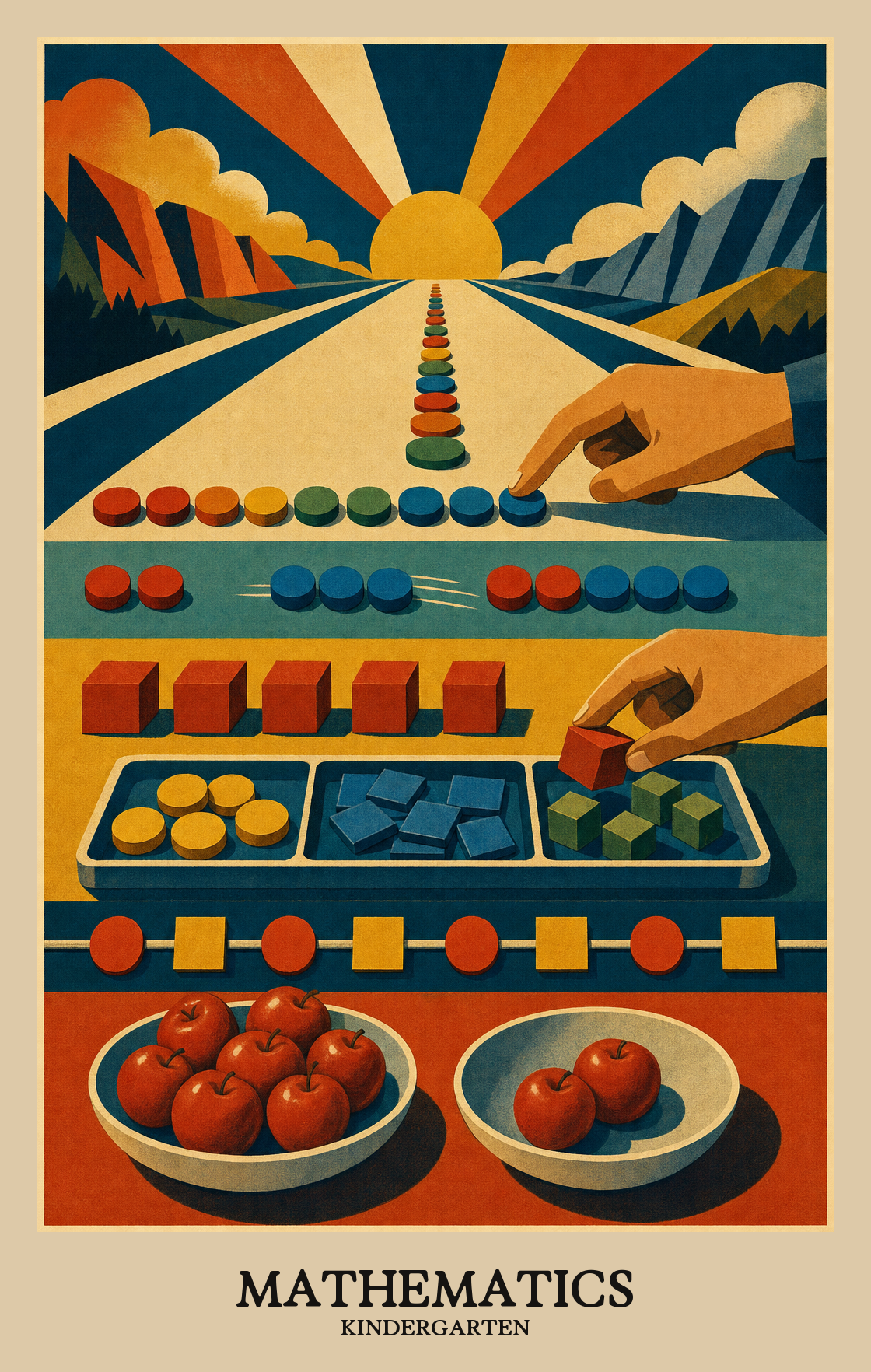
Students count objects out loud, match each one to a number, and learn that the last number tells how many. They sort buttons, blocks, and toys by color, shape, and size.
Students read and write numbers up to 10 and figure out which group has more or fewer. They start breaking small numbers apart, like seeing that 7 is 5 and 2 together.
Students act out simple story problems with fingers, drawings, and counters. By the end of this stretch, they can add and subtract within 5 without stopping to count.
Students name circles, squares, triangles, cubes, and cones, and describe where things sit using words like above, below, and next to. They compare which object is longer, heavier, or holds more.
Students count collections up to 31 by making groups of ten, and count backward from 20. They spot and extend patterns in shapes, sounds, and numbers, including counting by tens to 100.
Students collect simple information from the classroom, like favorite snacks or weather each day, and show it with tally marks, drawings, or stacks of cubes. They talk about what the picture tells them.
Students look at a group of objects, pictures, or numbers and describe what they notice, like which color appears most or which pile is bigger.
Students sort objects or draw pictures to show what they counted, then explain what they noticed. This is an early form of making a chart or graph.
| Standard | Definition | Code |
|---|---|---|
| Notice and describe patterns in data-rich situations. (MP1, MP7) # ☼ ✜ | Students look at a group of objects, pictures, or numbers and describe what they notice, like which color appears most or which pile is bigger. | 0.1.1.1 |
| Organize objects, draw pictures | Students sort objects or draw pictures to show what they counted, then explain what they noticed. This is an early form of making a chart or graph. | 0.1.1.2 |
Students pick two objects and compare them by one feature, like length or weight, then say which has more, less, or the same amount and explain why.
Students pick up everyday objects and talk about what they notice: how long something is, how heavy it feels, or how much space it takes up.
Students sort everyday objects into groups by how they look or feel. They might group blocks by shape, crayons by color, or buttons by size.
Students sort and compare shapes like squares, triangles, cubes, and spheres by describing what they notice: how many sides, whether edges are straight or curved, flat or solid.
Students put simple shapes together to make new ones, and break them apart again. They can name a triangle or rectangle whether it is big, small, tilted, or upright.
Students name everyday objects by their shape and describe where things are using words like above, below, beside, and next to.
| Standard | Definition | Code |
|---|---|---|
| Compare objects with a measurable attribute in common, to see which object has… | Students pick two objects and compare them by one feature, like length or weight, then say which has more, less, or the same amount and explain why. | 0.2.3.1 |
| Describe several measurable attributes of objects such as length and weight… | Students pick up everyday objects and talk about what they notice: how long something is, how heavy it feels, or how much space it takes up. | 0.2.3.2 |
| Sort objects using characteristics such as shape, size, color and thickness… | Students sort everyday objects into groups by how they look or feel. They might group blocks by shape, crayons by color, or buttons by size. | 0.2.4.1 |
| Identify and compare two- and threedimensional shapes such as squares… | Students sort and compare shapes like squares, triangles, cubes, and spheres by describing what they notice: how many sides, whether edges are straight or curved, flat or solid. | 0.2.4.2 |
| Compose, decompose and name simple shapes | Students put simple shapes together to make new ones, and break them apart again. They can name a triangle or rectangle whether it is big, small, tilted, or upright. | 0.2.4.3 |
| Describe objects in the environment using names of shapes. Describe the… | Students name everyday objects by their shape and describe where things are using words like above, below, beside, and next to. | 0.2.4.4 |
Students count a group of objects by touching each one and saying one number as they go. The last number they say tells how many are in the group, and numbers like "first," "second," and "third" tell where something falls in a line.
Counting a big pile of things is easier when students sort them into groups of ten first. Students practice this with tools like ten-frames or cups, counting collections up to 31.
Students read, write, and compare whole numbers up to 31, using drawings, objects, or spoken words to show how many. They also learn that numbers like 13 or 17 are just a group of ten plus a few extras.
Counting forward to 31 and backward from 20. Students practice both directions, with or without objects to touch and count.
Students practice counting forward and backward by deciding which number comes just before or just after a number someone names.
Students solve simple adding and subtracting story problems, like "3 apples plus 2 more" or "5 birds minus 1," using small objects, drawings, or numbers to show their thinking. All totals stay within 10.
Breaking a number like 7 into two groups, such as 3 and 4 or 5 and 2. Students show each split with a drawing or a simple equation, and find more than one way to break the same number apart.
Adding and subtracting with numbers up to 5 becomes quick and confident work. Students solve these small problems without counting on fingers or pausing to figure out the answer.
Students compare two groups of objects to figure out which has more, which has fewer, or whether they match. They use counting or lining objects up side by side to check.
The equal sign means both sides have the same amount. Students learn that "=" is not just a signal to write an answer but a way to show two amounts balance each other.
Students spot what comes next in a pattern, then build or continue one of their own. The pattern might repeat, grow, or shrink, using shapes, colors, sizes, or numbers.
Students find the pattern in counting by 10s: 0, 10, 20, 30, all the way to 100. They practice saying those numbers in order until the sequence feels predictable.
| Standard | Definition | Code |
|---|---|---|
| Recognize that a number can be used to represent how many objects are in a set… | Students count a group of objects by touching each one and saying one number as they go. The last number they say tells how many are in the group, and numbers like "first," "second," and "third" tell where something falls in a line. | 0.3.5.1 |
| Count collections of objects up to 31 by grouping in 10s using ten-frames… | Counting a big pile of things is easier when students sort them into groups of ten first. Students practice this with tools like ten-frames or cups, counting collections up to 31. | 0.3.5.2 |
| Read, write, compare, order | Students read, write, and compare whole numbers up to 31, using drawings, objects, or spoken words to show how many. They also learn that numbers like 13 or 17 are just a group of ten plus a few extras. | 0.3.5.3 |
| Count forward, with and without objects, to at least 31. Count backward from… | Counting forward to 31 and backward from 20. Students practice both directions, with or without objects to touch and count. | 0.3.5.4 |
| Find a number that is 1 more or 1 less than a given number. (MP7, MP8) | Students practice counting forward and backward by deciding which number comes just before or just after a number someone names. | 0.3.5.5 |
| Solve and represent a variety of addition and subtraction contextual situation… | Students solve simple adding and subtracting story problems, like "3 apples plus 2 more" or "5 birds minus 1," using small objects, drawings, or numbers to show their thinking. All totals stay within 10. | 0.3.5.6 |
| Compose and decompose numbers less than or equal to 10 into pairs in more than… | Breaking a number like 7 into two groups, such as 3 and 4 or 5 and 2. Students show each split with a drawing or a simple equation, and find more than one way to break the same number apart. | 0.3.5.7 |
| Fluently add and subtract within 5 | Adding and subtracting with numbers up to 5 becomes quick and confident work. Students solve these small problems without counting on fingers or pausing to figure out the answer. | 0.3.5.8 |
| Identify whether the number of objects in one group is greater than, less than… | Students compare two groups of objects to figure out which has more, which has fewer, or whether they match. They use counting or lining objects up side by side to check. | 0.3.6.1 |
| Recognize that the equal sign | The equal sign means both sides have the same amount. Students learn that "=" is not just a signal to write an answer but a way to show two amounts balance each other. | 0.3.6.2 |
| Recognize, create, complete | Students spot what comes next in a pattern, then build or continue one of their own. The pattern might repeat, grow, or shrink, using shapes, colors, sizes, or numbers. | 0.3.7.1 |
| Recognize patterns in counting | Students find the pattern in counting by 10s: 0, 10, 20, 30, all the way to 100. They practice saying those numbers in order until the sequence feels predictable. | 0.3.7.2 |
Standards-based mathematics assessment for grades 3 through 8 and grade 11, aligned to Minnesota Academic Standards.
Alternate standards-based assessment for eligible students with the most significant cognitive disabilities, administered in the same subjects and grades as the MCA program.
Students learn to count, read, and write numbers up to at least 31, and count up to 100 by tens. They sort and compare objects, name shapes, and start adding and subtracting small numbers using fingers, blocks, or drawings.
Count real things together. Stairs going up, grapes on a plate, cars in the driveway. Touch each object as you say the number so one object goes with one number. Stop sometimes and ask what number comes next, or what is one more.
Students should count to at least 31, write those numbers, and tell which group has more or less. They should also know that 14 is a ten and four ones, even if they say it in their own words.
Use snacks, coins, or toys. Put out five crackers, eat two, and ask how many are left. Keep the numbers under ten. Students should be quick and confident with adding and subtracting within five by the end of the year.
Start with counting to 10 with one-to-one matching, then push to 20, then 31. Bring in ten-frames once students count past 10 so they see numbers like 14 as a ten and four ones. Save skip counting by tens to 100 for later in the year.
One-to-one counting past 15, writing teen numbers without reversing them, and understanding that the equal sign means both sides match. Build in short, frequent practice on these instead of one long unit.
Sorting and shape work runs alongside number work, not as a separate block. Pull a shape sort or pattern task into morning meeting or stations. Students should name flat and solid shapes and describe where objects sit using words like above, below, and beside.
Students count to 31, count to 100 by tens, and find one more or one less. They add and subtract within five without counting every time, break numbers up to 10 into pairs, and compare two groups to say which has more.