Asking questions about motion
Students start the year as careful observers. They watch how things roll, slide, and stop, then ask questions they can actually test by pushing, pulling, or changing the setup.
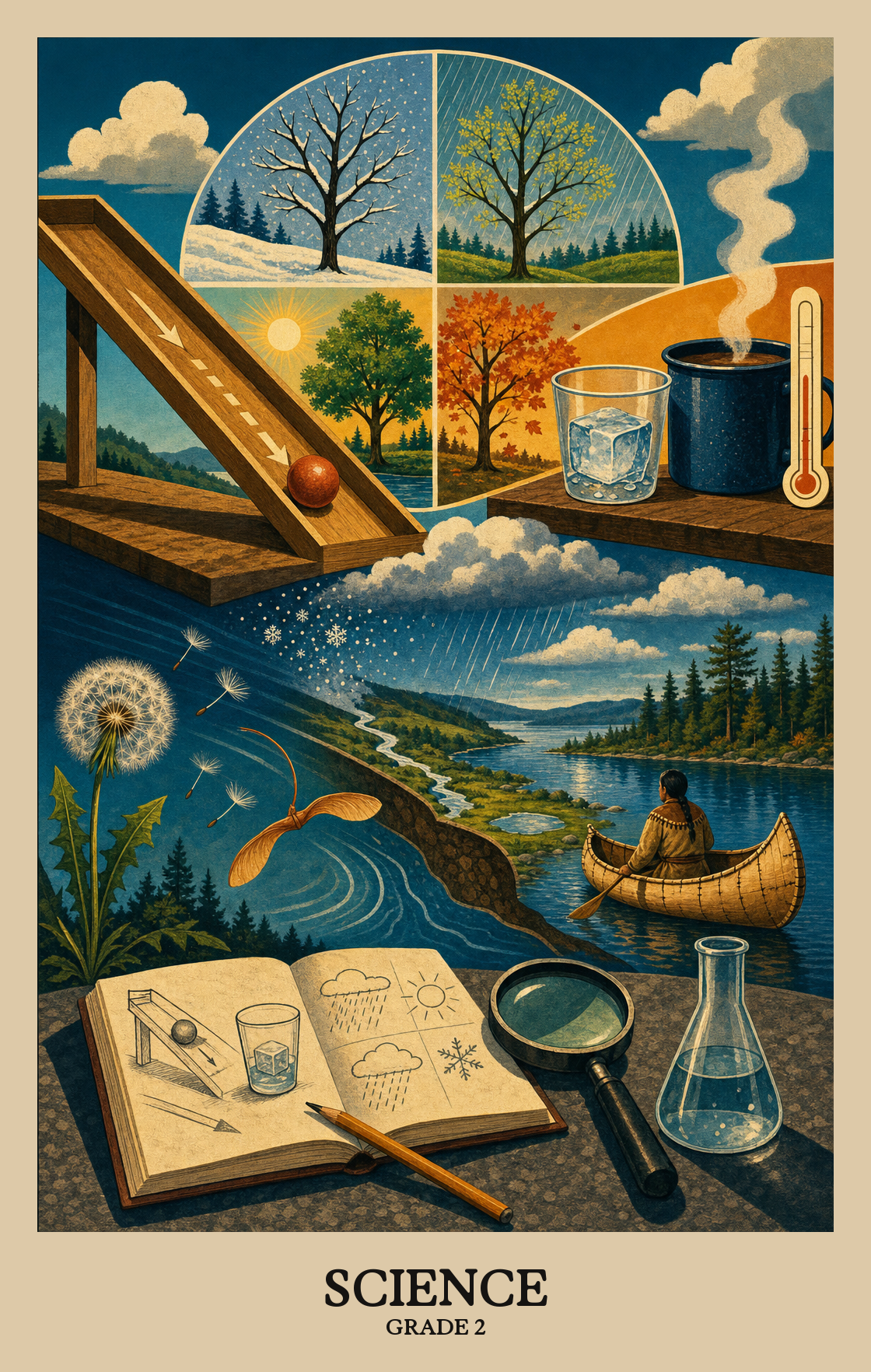
This is the year science becomes hands-on investigation. Students ask questions about how things move, test what happens when materials heat up or cool down, and track weather across the seasons. They look at where water shows up on Earth, study how plants spread their seeds, and learn how Minnesota American Indian Tribes choose the right material for a job. By spring, students can run a simple experiment, record what they see, and explain their thinking with the evidence they collected.
Students start the year as careful observers. They watch how things roll, slide, and stop, then ask questions they can actually test by pushing, pulling, or changing the setup.
Students test what happens when materials get warmer or colder. They notice which changes can be undone, like melting an ice cube, and which cannot, like baking bread.
Students look at why certain materials get used for certain jobs. They learn how Minnesota American Indian Tribes and other cultures choose materials that fit the work, from clothing to shelter to tools.
Students chart what weather to expect across the seasons and find where water shows up around the world. They also compare designs meant to protect homes from storms, wind, and flooding.
Students close the year studying living things. They build a device that spreads seeds the way nature does and use evidence to explain why some animals thrive in a habitat while others struggle.
Students ask questions about physical science topics and figure out what problem needs solving before starting an investigation.
Students ask questions about things they notice, experiments they run, and ideas they read about. Wondering "why does that happen?" or "what if we tried this?" is where science starts.
Students watch something move, then come up with a question about it that a simple test or experiment could answer. Think: "Why does the ball roll faster on the smooth floor than the carpet?"
Students plan a simple test, gather what they need, and record what happens. The focus is on asking a question first, then finding out the answer by trying something real.
Students plan a simple test to answer a question they have about something they noticed, then gather and record results that back up what they think is happening.
Students plan a simple test to see what happens when they heat or cool everyday materials like water, butter, or clay. They watch and describe how the material looks, feels, or changes shape as the temperature goes up or down.
Students use counting, measuring, and simple math to describe what they observe in science. They might measure how far an object moves or count how many times something happens.
Second graders use numbers and simple patterns to describe what they observe, like measuring how far a ball rolls or comparing weights. They also follow step-by-step rules to figure out how things in nature or everyday objects work.
Students look at how pushes and pulls affect a moving object, then predict what will happen next based on the numbers they observe. A balanced push keeps an object still; an unbalanced one gets it moving or changes its direction.
Students build or draw simple models to show how something works, like a diagram of water moving through a pipe or a sketch of how a ball rolls down a ramp.
Students build simple drawings or diagrams to show how something works, then update those drawings as they learn more and use them to explain their thinking to classmates.
Students draw or build a model showing what happens when something heats up or cools down. Some changes, like ice melting, can be undone. Others, like a cooked egg, cannot.
Students read and compare information from books, diagrams, and other sources to answer a science question, then share what they found in their own words or drawings.
Students learn how different communities, including Minnesota American Indian tribes, explain natural events and solve everyday problems. They gather those ideas and share what they find.
Students learn how different cultures, including Minnesota Native communities, choose materials based on their natural properties. For example, selecting bark, stone, or fiber for a specific tool or shelter based on what that material can do.
| Standard | Definition | Code |
|---|---|---|
| Asking questions and defining problems | Students ask questions about physical science topics and figure out what problem needs solving before starting an investigation. | 2P.1.1 |
| Students will be able to ask questions about aspects of the phenomena they… | Students ask questions about things they notice, experiments they run, and ideas they read about. Wondering "why does that happen?" or "what if we tried this?" is where science starts. | 2P.1.1.1 |
| Ask questions about an object's motion based on observation that can be… | Students watch something move, then come up with a question about it that a simple test or experiment could answer. Think: "Why does the ball roll faster on the smooth floor than the carpet?" | 2P.1.1.1.1 |
| Planning and carrying out investigations | Students plan a simple test, gather what they need, and record what happens. The focus is on asking a question first, then finding out the answer by trying something real. | 2P.1.2 |
| Students will be able to design and conduct investigations in the classroom… | Students plan a simple test to answer a question they have about something they noticed, then gather and record results that back up what they think is happening. | 2P.1.2.1 |
| Plan and conduct an investigation to describe how heating and cooling affects… | Students plan a simple test to see what happens when they heat or cool everyday materials like water, butter, or clay. They watch and describe how the material looks, feels, or changes shape as the temperature goes up or down. | 2P.1.2.1.1 |
| Using mathematics and computational thinking | Students use counting, measuring, and simple math to describe what they observe in science. They might measure how far an object moves or count how many times something happens. | 2P.2.2 |
| Students will be able to use mathematics to represent physical variables and… | Second graders use numbers and simple patterns to describe what they observe, like measuring how far a ball rolls or comparing weights. They also follow step-by-step rules to figure out how things in nature or everyday objects work. | 2P.2.2.1 |
| Identify and predict quantitative patterns of the effects of balanced and… | Students look at how pushes and pulls affect a moving object, then predict what will happen next based on the numbers they observe. A balanced push keeps an object still; an unbalanced one gets it moving or changes its direction. | 2P.2.2.1.1 |
| Developing and using models | Students build or draw simple models to show how something works, like a diagram of water moving through a pipe or a sketch of how a ball rolls down a ramp. | 2P.3.1 |
| Students will be able to develop, revise | Students build simple drawings or diagrams to show how something works, then update those drawings as they learn more and use them to explain their thinking to classmates. | 2P.3.1.1 |
| Develop a simple diagram or physical model to illustrate how some changes… | Students draw or build a model showing what happens when something heats up or cools down. Some changes, like ice melting, can be undone. Others, like a cooked egg, cannot. | 2P.3.1.1.1 |
| Obtaining, evaluating and communicating information | Students read and compare information from books, diagrams, and other sources to answer a science question, then share what they found in their own words or drawings. | 2P.4.2 |
| Students will be able to gather information about and communicate the methods… | Students learn how different communities, including Minnesota American Indian tribes, explain natural events and solve everyday problems. They gather those ideas and share what they find. | 2P.4.2.2 |
| Obtain information and communicate how Minnesota American Indian Tribes and… | Students learn how different cultures, including Minnesota Native communities, choose materials based on their natural properties. For example, selecting bark, stone, or fiber for a specific tool or shelter based on what that material can do. | 2P.4.2.2.1 |
Students look at weather data collected over time and find patterns, like which months tend to be rainy or warm. They use what they see in the data to explain what the weather is usually like in their area.
Students look at their weather records, plant measurements, or other science notes and spot patterns. They figure out what those patterns mean and whether one thing might be causing another to change.
Students collect weather information for each season and use charts or drawings to show what the weather is usually like. They compare seasons to explain why spring feels different from winter.
Students test objects built to protect against storms or floods, then compare which ones held up and which ones didn't. The goal is to see the tradeoffs, not just pick a winner.
Students read or listen to sources about Earth and space, then share what they learned in words or pictures. The focus is on finding reliable information and explaining it clearly to others.
Reading books, charts, and other sources, students gather facts about Earth science topics, decide which information is trustworthy, and share what they learned through writing, drawing, or talking.
Students look at books, maps, or other sources to find out where water exists on Earth, such as oceans, rivers, lakes, and underground. They collect that information and explain what they learned.
Students research what the weather is usually like in different parts of the world, using books, websites, and other sources. They use what they find to describe how climates differ from one region to another.
| Standard | Definition | Code |
|---|---|---|
| Analyzing and interpreting data | Students look at weather data collected over time and find patterns, like which months tend to be rainy or warm. They use what they see in the data to explain what the weather is usually like in their area. | 2E.2.1 |
| Students will be able to represent observations and data in order to recognize… | Students look at their weather records, plant measurements, or other science notes and spot patterns. They figure out what those patterns mean and whether one thing might be causing another to change. | 2E.2.1.1 |
| Represent data to describe typical weather conditions expected during a… | Students collect weather information for each season and use charts or drawings to show what the weather is usually like. They compare seasons to explain why spring feels different from winter. | 2E.2.1.1.1 |
| Analyze data from tests of objects designed to reduce the impacts of… | Students test objects built to protect against storms or floods, then compare which ones held up and which ones didn't. The goal is to see the tradeoffs, not just pick a winner. | 2E.2.1.1.2 |
| Obtaining, evaluating and communicating information | Students read or listen to sources about Earth and space, then share what they learned in words or pictures. The focus is on finding reliable information and explaining it clearly to others. | 2E.4.2 |
| Students will be able to read and interpret multiple sources to obtain… | Reading books, charts, and other sources, students gather facts about Earth science topics, decide which information is trustworthy, and share what they learned through writing, drawing, or talking. | 2E.4.2.1 |
| Obtain and use information from multiple sources to identify where water is… | Students look at books, maps, or other sources to find out where water exists on Earth, such as oceans, rivers, lakes, and underground. They collect that information and explain what they learned. | 2E.4.2.1.1 |
| Obtain and use information from multiple sources, including electronic sources… | Students research what the weather is usually like in different parts of the world, using books, websites, and other sources. They use what they find to describe how climates differ from one region to another. | 2E.4.2.1.2 |
Students look at a problem in nature and explain what they think is happening, then come up with a simple solution to fix it. They back up their ideas with what they have observed or learned.
Students sketch or build a solution to a simple science problem, then check whether it meets the rules they were given, like staying under a size limit or using only certain materials.
Students design and build something that works the way a plant or animal does to scatter seeds. They study how nature moves seeds (by wind, water, or fur) and use that idea to create their own device.
Students look at two different explanations about living things and decide which one has better evidence to back it up.
Students look at evidence, build an explanation, and defend it when someone disagrees. If new evidence shows they were wrong, they update their thinking.
Students look at a specific habitat and use evidence to argue why some animals and plants thrive there, others barely get by, and others could not live there at all.
| Standard | Definition | Code |
|---|---|---|
| Constructing explanations and designing solutions | Students look at a problem in nature and explain what they think is happening, then come up with a simple solution to fix it. They back up their ideas with what they have observed or learned. | 2L.3.2 |
| Students will be able to use their understanding of scientific principles and… | Students sketch or build a solution to a simple science problem, then check whether it meets the rules they were given, like staying under a size limit or using only certain materials. | 2L.3.2.2 |
| Engineer a device that mimics the structures and functions of plants or animals… | Students design and build something that works the way a plant or animal does to scatter seeds. They study how nature moves seeds (by wind, water, or fur) and use that idea to create their own device. | 2L.3.2.2.1 |
| Engaging in argument from evidence | Students look at two different explanations about living things and decide which one has better evidence to back it up. | 2L.4.1 |
| Students will be able to engage in argument from evidence for the explanations… | Students look at evidence, build an explanation, and defend it when someone disagrees. If new evidence shows they were wrong, they update their thinking. | 2L.4.1.1 |
| Construct an argument with evidence that evaluates how in a particular habitat… | Students look at a specific habitat and use evidence to argue why some animals and plants thrive there, others barely get by, and others could not live there at all. | 2L.4.1.1.1 |
Alternate standards-based assessment for eligible students with the most significant cognitive disabilities, administered in the same subjects and grades as the MCA program.
Students study how things move, how heating and cooling change materials, weather and water on Earth, and how plants and animals survive in different habitats. They also start designing simple solutions, like a device that helps a seed travel.
Talk about the weather each morning and keep a simple chart for a week. Melt an ice cube and refreeze it, then toast bread and try to un-toast it. Ask what changed back and what did not. Five minutes of noticing counts.
Students should ask a question about something they noticed, plan a small test, and share what they found with a drawing or chart. They should also explain why some changes from heat or cold can be undone and some cannot.
A common path is matter and motion in the fall, weather and water through winter, and habitats and seed dispersal in spring. Weave the science practices, like asking questions and building models, into every unit instead of teaching them on their own.
Two ideas stick the hardest: which changes from heating or cooling can be reversed, and the difference between balanced and unbalanced forces. Plan extra hands-on rounds with ice, clay, butter, and ramps, and ask students to predict before they test.
Drawings are models, and models are a real part of science at this age. A labeled picture of how a maple seed spins to the ground, or how ice melts into water, shows thinking. Ask what each label means and what the arrows show.
Short, repeatable, and tied to one question. Students plan with a sentence frame, collect data in a simple table or tally, and share findings in pairs before the group. Keep materials familiar, such as ice, fabric, ramps, rain gauges, and seeds.
Students learn how Tribes and communities choose materials based on properties such as warmth, strength, or flexibility, like birch bark for containers or wool for cold weather. Use sources from Tribal Nations themselves when possible, and connect the choices to the science of materials.
Look for a child who notices patterns in weather, motion, or living things and can describe them in a sentence or sketch. They should be able to plan a simple test, record what happens, and use that evidence when they explain their thinking.