Who we are together
Students start the year by looking at the groups they belong to, from family to classroom to neighborhood. They notice how people are alike and different, and why every person's story matters.
This is the year students start to see how communities work and how their own choices fit in. Students learn how leaders are chosen, how rules get made, and why people sometimes disagree about what is fair. They look at maps, study how people use the land, and hear stories from many different groups who have lived in Minnesota. By spring, students can name a right they have, point out a place on a map, and explain a choice a community made and why.
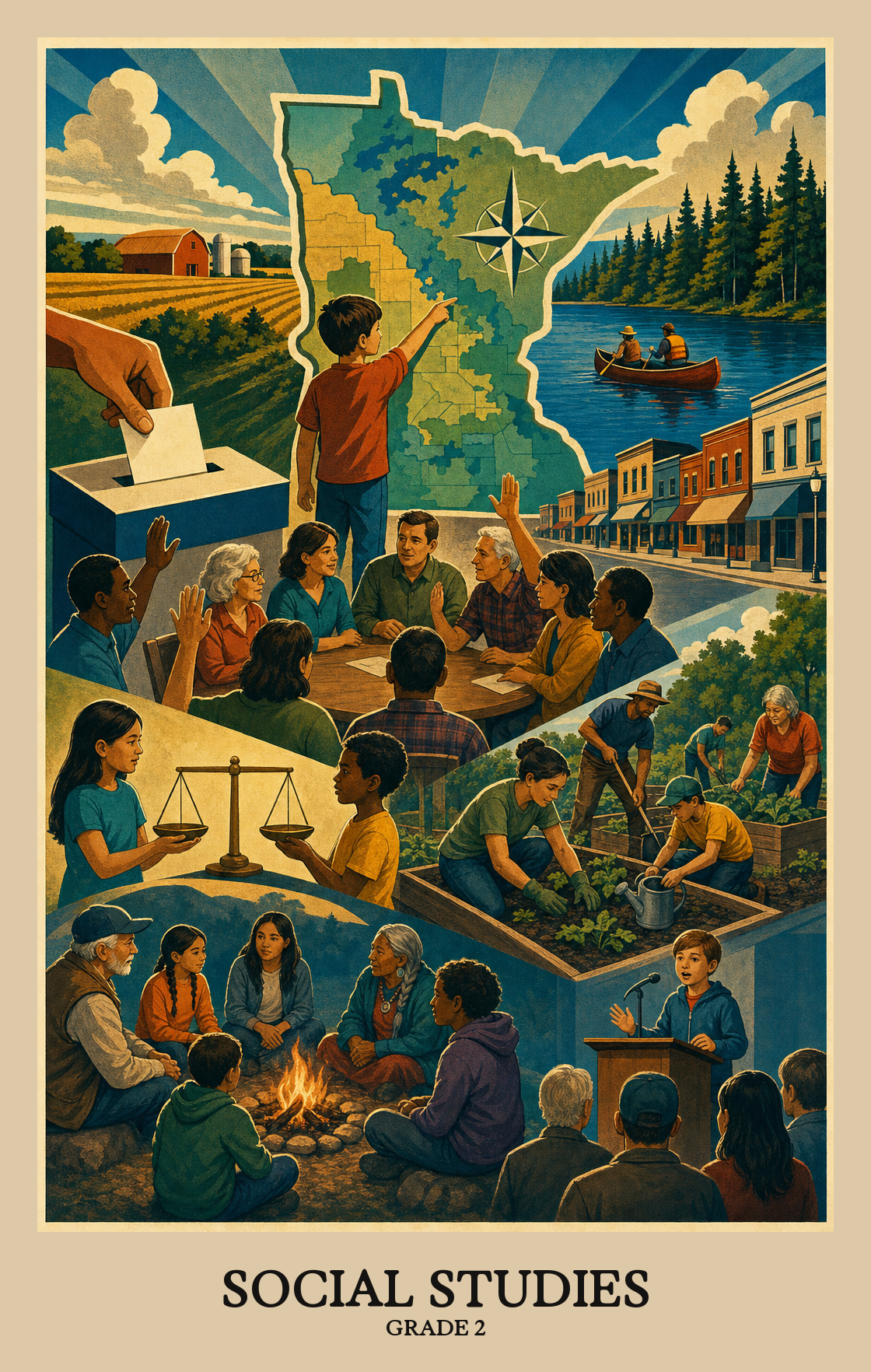
Students start the year by looking at the groups they belong to, from family to classroom to neighborhood. They notice how people are alike and different, and why every person's story matters.
Students look at the rules that hold a classroom and a community together. They talk about what is fair, what people owe each other, and how kids can speak up when something feels wrong.
Students use simple maps to find their school, their state, and the rivers and lakes around them. They notice how weather and land shape the way people live and work in Minnesota.
Students learn that Tribal Nations are their own governments with long histories in this land. They hear stories from many groups who have lived in Minnesota and notice voices that often get left out.
Students explore why people cannot have everything they want and how families and communities decide what to buy, save, or share. They start setting small goals with money of their own.
Students look at real people and groups who worked for fairness, in Minnesota and beyond. They use pictures, letters, and other clues from the past to ask questions and build a short argument of their own.
Students practice the habits of good citizenship: listening to different views, thinking through a problem, and making a decision about what's fair or right. These skills help students take part in their school and community now and for the rest of their lives.
Students learn what values like fairness, equality, and voting rights mean in everyday life. They also look at times when the rules that govern our country can pull in different directions, and how people work through those disagreements.
Students learn what rights and responsibilities mean in a democracy. They explain what people are allowed to do, what duties they owe others, and how following rules helps a community work fairly.
Rules and laws come from different levels of government: a town council, a state legislature, and Congress all make different rules. Students learn how each level works and why those rules exist.
Students learn that Tribal Nations are their own self-governing nations with a special legal relationship to the U.S. government. That relationship comes with specific rights, responsibilities, and structures that are different from those of U.S. states.
| Standard | Definition | Code |
|---|---|---|
| Civic Skills: Apply civic reasoning and demonstrate civic skills for the… | Students practice the habits of good citizenship: listening to different views, thinking through a problem, and making a decision about what's fair or right. These skills help students take part in their school and community now and for the rest of their lives. | 2.1.1.1 |
| Democratic Values and Principles: Explain democratic values and principles that… | Students learn what values like fairness, equality, and voting rights mean in everyday life. They also look at times when the rules that govern our country can pull in different directions, and how people work through those disagreements. | 2.1.2.1 |
| Rights and Responsibilities | Students learn what rights and responsibilities mean in a democracy. They explain what people are allowed to do, what duties they owe others, and how following rules helps a community work fairly. | 2.1.3.1 |
| Governmental Institutions and Political Processes: Explain and evaluate… | Rules and laws come from different levels of government: a town council, a state legislature, and Congress all make different rules. Students learn how each level works and why those rules exist. | 2.1.4.1 |
| Tribal Nations: Evaluate the unique political status, trust relationships and… | Students learn that Tribal Nations are their own self-governing nations with a special legal relationship to the U.S. government. That relationship comes with specific rights, responsibilities, and structures that are different from those of U.S. states. | 2.1.6.1 |
Students look at a real economic question (like why something costs more or who gets left out when prices rise), use simple data to build an argument, and then think through how their proposed fix might help or hurt different groups of people.
Scarcity means there isn't enough of something for everyone who wants it. Students learn why people, businesses, and governments have to make choices about what to spend money or time on, and what they give up when they choose.
Students practice setting money goals and making a simple plan to reach them, thinking about what makes saving easier or harder for different families.
| Standard | Definition | Code |
|---|---|---|
| Economic Inquiry: Use economic models and reasoning and data analysis to… | Students look at a real economic question (like why something costs more or who gets left out when prices rise), use simple data to build an argument, and then think through how their proposed fix might help or hurt different groups of people. | 2.2.7.1 |
| Fundamental Economic Concepts: Analyze how scarcity and artificial shortages… | Scarcity means there isn't enough of something for everyone who wants it. Students learn why people, businesses, and governments have to make choices about what to spend money or time on, and what they give up when they choose. | 2.2.8.1 |
| Personal Finance: Apply economic concepts and models to develop individual… | Students practice setting money goals and making a simple plan to reach them, thinking about what makes saving easier or harder for different families. | 2.2.9.1 |
Students use maps, globes, and simple digital tools to answer questions about places, like why a town sits near a river or how far one city is from another.
Students describe a place or region and explain who makes the rules there, such as a mayor, a governor, or a national government, and how those rules shape what the place looks like and how people live.
Students look at how people change the land, water, and air around them, and how the environment shapes how people live. They start to examine what happens when the climate shifts over time.
| Standard | Definition | Code |
|---|---|---|
| Geospatial Skills and Inquiry | Students use maps, globes, and simple digital tools to answer questions about places, like why a town sits near a river or how far one city is from another. | 2.3.13.1 |
| Places and Regions: Describe places and regions, explaining how they are… | Students describe a place or region and explain who makes the rules there, such as a mayor, a governor, or a national government, and how those rules shape what the place looks like and how people live. | 2.3.14.1 |
| Human-Environment Interaction: Evaluate the relationship between humans and… | Students look at how people change the land, water, and air around them, and how the environment shapes how people live. They start to examine what happens when the climate shifts over time. | 2.3.16.1 |
Students learn to ask questions about why things changed over time and whose stories get told about the past. They practice looking at history from more than one point of view.
Reading history means understanding that two people can see the same event differently. Students learn to spot whose perspective a source comes from and why that person's background shapes what they noticed or left out.
Students look at old photos, letters, and written accounts to figure out who made them, why, and whose story might be missing. They practice reading history like a detective, not just a bystander.
Students pull facts from more than one source about a historical event and use those facts to build a clear argument or story about what happened and why.
| Standard | Definition | Code |
|---|---|---|
| Context, Change, and Continuity: Ask historical questions about context… | Students learn to ask questions about why things changed over time and whose stories get told about the past. They practice looking at history from more than one point of view. | 2.4.18.1 |
| Historical Perspectives | Reading history means understanding that two people can see the same event differently. Students learn to spot whose perspective a source comes from and why that person's background shapes what they noticed or left out. | 2.4.19.1 |
| Historical Sources and Evidence: Investigate a variety of historical sources… | Students look at old photos, letters, and written accounts to figure out who made them, why, and whose story might be missing. They practice reading history like a detective, not just a bystander. | 2.4.20.1 |
| Causation and Argumentation: Integrate evidence from multiple… | Students pull facts from more than one source about a historical event and use those facts to build a clear argument or story about what happened and why. | 2.4.21.1 |
Students look at how the words people use and who holds power can shape how groups are seen and labeled. They connect those ideas to their own identity and to communities in Minnesota whose stories have often been left out of history.
Students look at how the words people use and the power some groups hold can shape how others see themselves and their communities. They connect those ideas to their own identity and to groups in Minnesota whose stories have often been left out.
Students learn how people and communities have stood up against unfair treatment to win rights and dignity. They look at what worked and why, then practice working together to make things fairer for others.
Students look at history through the eyes of different communities, including Indigenous peoples, to understand why unfair systems exist today and what past lessons might help fix them.
| Standard | Definition | Code |
|---|---|---|
| Identity: Analyze the ways power and language construct the social identities… | Students look at how the words people use and who holds power can shape how groups are seen and labeled. They connect those ideas to their own identity and to communities in Minnesota whose stories have often been left out of history. | 2.5.23.1 |
| Identity: Analyze the ways power and language construct the social identities… | Students look at how the words people use and the power some groups hold can shape how others see themselves and their communities. They connect those ideas to their own identity and to groups in Minnesota whose stories have often been left out. | 2.5.23.2 |
| Resistance: Describe how individuals and communities have fought for freedom… | Students learn how people and communities have stood up against unfair treatment to win rights and dignity. They look at what worked and why, then practice working together to make things fairer for others. | 2.5.24.1 |
| Ways of Knowing and Methodologies: Use ethnic and Indigenous studies methods… | Students look at history through the eyes of different communities, including Indigenous peoples, to understand why unfair systems exist today and what past lessons might help fix them. | 2.5.25.1 |
Federally administered sample-based assessment in reading, mathematics, science, writing, and other subjects. NAEP results inform state-by-state comparisons rather than individual student or school accountability.
Students learn how communities work. They look at how rules are made, how people make choices about money and resources, how maps describe places, and how stories from the past shape life today. They also learn about Minnesota's Tribal Nations and the many groups who live in the state.
Talk about real decisions as they happen. Point out a stop sign and ask who decides where it goes. Compare prices at the store and talk about choices when money is tight. Share family stories about where relatives came from and why.
Students should know that Tribal Nations are their own governments, not just groups of people. They should be able to name that Minnesota is home to Dakota and Ojibwe nations and that these nations have their own leaders, laws, and land.
Most teachers anchor each quarter to one strand: government and rules, then economics and choices, then geography and maps, then history and identity. Weave Tribal Nations and ethnic studies into every unit instead of saving them for one week.
At this age it means fairness in real situations. Students learn that everyone in a classroom or community has rights, like being heard and being safe, and responsibilities, like following agreed rules and speaking up when something is unfair.
Point of view is the hardest one. Students often assume one story is the whole story. Plan to revisit it across units by pairing two sources about the same event and asking who is telling it and who is missing.
They look at photos, objects, maps, and short stories and ask simple questions: Who made this? When? Who is in it and who is not? Picture books, family photos, and old menus all count as sources at home.
By spring, students should be able to read a simple map, explain why a rule exists, describe a choice someone made when resources were limited, and tell a short story about the past using more than one source.
Answer honestly in plain words. It is fine to say that some groups were treated unfairly and that people worked hard to change that. Then ask what feels fair to them and listen. These conversations matter more than having every fact right.