Cells and living things
Students start the year looking at the smallest parts of living things. They build models to show that every plant and animal is made of cells, and they study how the parts of a single cell keep it alive.
This is the year science zooms in on life itself. Students study how cells work together to build a living body, how food and energy move through plants and animals, and why offspring look like their parents but not exactly. They also look at how living things share an ecosystem and how species change over long stretches of time. By spring, students can use a model or a set of data to explain something living, like why a population grows, shrinks, or changes.
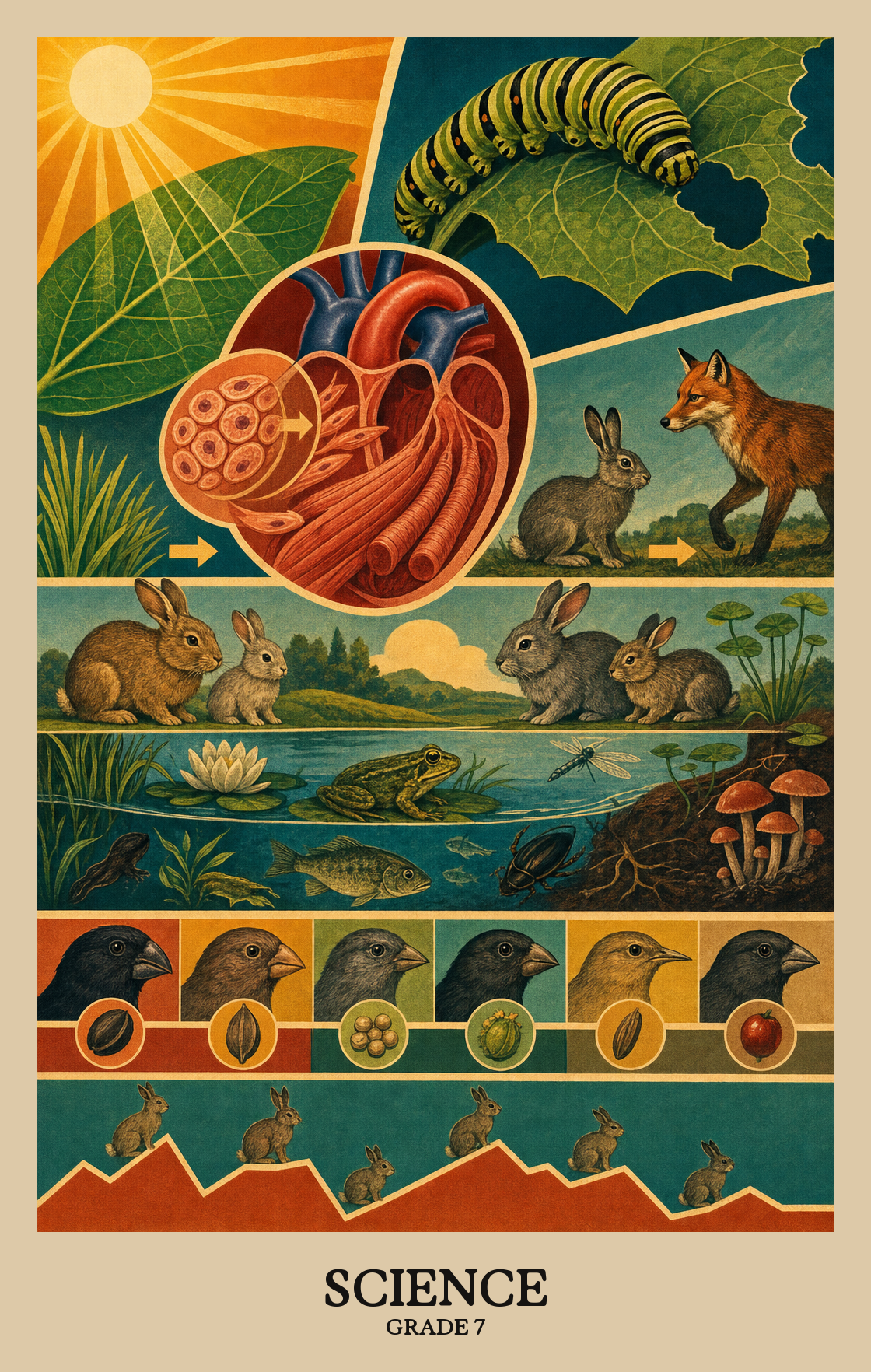
Students start the year looking at the smallest parts of living things. They build models to show that every plant and animal is made of cells, and they study how the parts of a single cell keep it alive.
Students zoom out from one cell to the whole body. They explain how groups of cells form tissues and organs that work as a team, and how food gets broken down to fuel growth and movement.
Students look at why family members share some traits but not others. They compare how plants and animals reproduce, and they show why some offspring are copies of one parent while others are a mix of two.
Students study how living things depend on each other and on water, sunlight, and soil. They track how energy moves through a food web and argue what happens to a population when its habitat changes.
Students learn how Minnesota American Indian Tribes and communities have long observed and cared for local plants, animals, and waters. They gather sources and share what this knowledge reveals about patterns in nature.
Students close the year by looking at how life on Earth has changed over millions of years. They compare fossils to living animals, study early stages of growth across species, and explain how helpful traits become more common in a group.
Students practice asking testable questions and narrowing down a problem clearly enough that it can actually be investigated. Good science starts here, before any experiment begins.
Students ask questions about what they observe, what experiments suggest, and what they read. The questions drive the investigation forward rather than just checking whether an answer is right.
Students ask questions about how cells in the body send signals to each other, like how a muscle cell knows to contract or how an immune cell knows to respond.
Students design and run experiments to answer science questions, then record what happened and explain what the results mean.
Students design their own experiments to test a question, then collect and organize data to back up their conclusions. This standard covers the full cycle: forming an idea, running the investigation, and using real results as evidence.
Students run a hands-on investigation to gather proof that every living thing is built from cells. Some organisms are just one cell; others are made of millions working together.
Students build and use models (drawings, diagrams, or physical replicas) to explain how living things are structured and how their parts work together.
Students sketch or build a model of a science idea, then update it as they learn more. The model helps them ask questions, make predictions, and explain what they think is happening.
Students draw or label a model of a cell and explain what the whole cell does and how each part helps it do that job.
Students draw or build a model showing how food molecules break apart and recombine inside the body to release energy or build new tissue.
Students build explanations for how living things grow and function, then design solutions to problems using what they know about cells, tissues, and organs.
Students use real evidence from experiments or research to explain why something happens in the natural world. They also look at other explanations and find gaps or flaws in the reasoning.
Students explain, using evidence, why organisms grow differently based on their genes and their surroundings. A plant starved of sunlight and a plant with a genetic advantage won't grow the same way, and students use real examples to show why.
Students explain, using evidence, how plants use sunlight and carbon dioxide to make food. This connects to how energy and matter move through living things.
Students look at data or observations and build a case for why one explanation makes more sense than another. They learn to back up a scientific claim with actual evidence, not just a guess.
Students build an explanation, defend it with evidence, and revise it if new evidence changes the picture. They also evaluate other students' scientific arguments and push back when the reasoning doesn't hold up.
Students look at real evidence (like diagrams or data) to argue whether a claim about body systems holds up. The focus is on how organs, tissues, and cells work together as one connected system.
Students look at real evidence, like how a flower attracts pollinators or how a bird performs a mating call, and then argue whether that behavior or structure actually helps an animal or plant reproduce successfully.
| Standard | Definition | Code |
|---|---|---|
| Asking questions and defining problems | Students practice asking testable questions and narrowing down a problem clearly enough that it can actually be investigated. Good science starts here, before any experiment begins. | 7LM.1.1 |
| Students will be able to ask questions about aspects of the phenomena they… | Students ask questions about what they observe, what experiments suggest, and what they read. The questions drive the investigation forward rather than just checking whether an answer is right. | 7LM.1.1.1 |
| Ask questions about the processes and outcomes of various methods of… | Students ask questions about how cells in the body send signals to each other, like how a muscle cell knows to contract or how an immune cell knows to respond. | 7LM.1.1.1.1 |
| Planning and carrying out investigations | Students design and run experiments to answer science questions, then record what happened and explain what the results mean. | 7LM.1.2 |
| Students will be able to design and conduct investigations in the classroom… | Students design their own experiments to test a question, then collect and organize data to back up their conclusions. This standard covers the full cycle: forming an idea, running the investigation, and using real results as evidence. | 7LM.1.2.1 |
| Conduct an investigation to provide evidence that living things are made of… | Students run a hands-on investigation to gather proof that every living thing is built from cells. Some organisms are just one cell; others are made of millions working together. | 7LM.1.2.1.1 |
| Developing and using models | Students build and use models (drawings, diagrams, or physical replicas) to explain how living things are structured and how their parts work together. | 7LM.3.1 |
| Students will be able to develop, revise | Students sketch or build a model of a science idea, then update it as they learn more. The model helps them ask questions, make predictions, and explain what they think is happening. | 7LM.3.1.1 |
| Develop and use a model to describe the function of a cell as a whole and… | Students draw or label a model of a cell and explain what the whole cell does and how each part helps it do that job. | 7LM.3.1.1.1 |
| Develop and use a model to describe how food is rearranged through chemical… | Students draw or build a model showing how food molecules break apart and recombine inside the body to release energy or build new tissue. | 7L.3.1.1.2 |
| Constructing explanations and designing solutions | Students build explanations for how living things grow and function, then design solutions to problems using what they know about cells, tissues, and organs. | 7LM.3.2 |
| Students will be able to apply scientific principles and empirical evidence | Students use real evidence from experiments or research to explain why something happens in the natural world. They also look at other explanations and find gaps or flaws in the reasoning. | 7LM.3.2.1 |
| Construct an explanation based on evidence for how environmental and genetic… | Students explain, using evidence, why organisms grow differently based on their genes and their surroundings. A plant starved of sunlight and a plant with a genetic advantage won't grow the same way, and students use real examples to show why. | 7LM.3.2.1.1 |
| Construct an explanation based on evidence for the role of photosynthesis in… | Students explain, using evidence, how plants use sunlight and carbon dioxide to make food. This connects to how energy and matter move through living things. | 7LM.3.2.1.2 |
| Engaging in argument from evidence | Students look at data or observations and build a case for why one explanation makes more sense than another. They learn to back up a scientific claim with actual evidence, not just a guess. | 7LM.4.1 |
| Students will be able to engage in argument from evidence for the explanations… | Students build an explanation, defend it with evidence, and revise it if new evidence changes the picture. They also evaluate other students' scientific arguments and push back when the reasoning doesn't hold up. | 7LM.4.1.1 |
| Support or refute an explanation by arguing from evidence for how the body is a… | Students look at real evidence (like diagrams or data) to argue whether a claim about body systems holds up. The focus is on how organs, tissues, and cells work together as one connected system. | 7LM.4.1.1.1 |
| Support or refute an explanation by arguing from evidence and scientific… | Students look at real evidence, like how a flower attracts pollinators or how a bird performs a mating call, and then argue whether that behavior or structure actually helps an animal or plant reproduce successfully. | 7LM.4.1.1.2 |
Students ask questions about why living things look or behave differently from their parents, then narrow those questions into problems they can actually investigate.
Students practice asking questions about what they observe in science class, whether it's a lab result, a classmate's idea, or something they read. Good questions are the starting point for figuring out how traits get passed from parents to offspring.
Students watch a demonstration or model and ask questions about what causes a trait to change, such as why a plant grows differently after its genetic instructions are altered.
Students build or draw models to show how traits pass from parents to offspring, explaining patterns like why siblings can look similar but not identical.
Building and refining models, like diagrams or drawings, helps students show what they understand about heredity and test predictions about how traits pass from parents to offspring.
Students draw or build a model showing why organisms that reproduce with one parent pass on exact copies of their genes, while organisms that reproduce with two parents mix genes and create offspring that look slightly different from either parent.
| Standard | Definition | Code |
|---|---|---|
| Asking questions and defining problems | Students ask questions about why living things look or behave differently from their parents, then narrow those questions into problems they can actually investigate. | 7LH.1.1 |
| Students will be able to ask questions about aspects of the phenomena they… | Students practice asking questions about what they observe in science class, whether it's a lab result, a classmate's idea, or something they read. Good questions are the starting point for figuring out how traits get passed from parents to offspring. | 7LH.1.1.1 |
| Ask questions that arise from careful observations of phenomena or models to… | Students watch a demonstration or model and ask questions about what causes a trait to change, such as why a plant grows differently after its genetic instructions are altered. | 7LH.1.1.1.2 |
| Developing and using models | Students build or draw models to show how traits pass from parents to offspring, explaining patterns like why siblings can look similar but not identical. | 7LH.3.1 |
| Students will be able to develop, revise | Building and refining models, like diagrams or drawings, helps students show what they understand about heredity and test predictions about how traits pass from parents to offspring. | 7LH.3.1.1 |
| Develop and use a model to describe why asexual reproduction results in… | Students draw or build a model showing why organisms that reproduce with one parent pass on exact copies of their genes, while organisms that reproduce with two parents mix genes and create offspring that look slightly different from either parent. | 7LH.3.1.1.4 |
Students look at real data about ecosystems and draw conclusions from it. They practice reading graphs, charts, and tables to figure out how living things interact and how energy moves through a food web.
Students look at data they've collected from an ecosystem and search for patterns, like whether temperature affects how many organisms survive. They figure out what those patterns mean and whether one factor might be influencing another.
When food, water, or space runs short, populations shrink or shift. Students read charts and data to explain how resource availability drives those changes across an ecosystem.
Students build and use models (like diagrams or food webs) to show how energy and matter move through an ecosystem and how organisms depend on one another.
Students build diagrams or other visual models to show how a scientific system works, then update those models as their thinking changes. The goal is to use the model to explain ideas and back up predictions.
Students draw or diagram how energy moves through a food web and how matter like water and nutrients cycles through living things and the surrounding environment.
Students examine data about ecosystems and make a case for their conclusions. They support each claim with specific evidence and explain why that evidence points where they say it does.
Students look at real data and competing ideas, then make a case for which solution or design holds up best. The argument has to be grounded in evidence, not just opinion.
Students gather real data about an ecosystem, then build a case explaining how a change, like a drought or a new predator, causes animal or plant populations to rise or fall.
Students compare different real-world plans meant to protect wildlife or keep an ecosystem healthy, then decide which plan the evidence best supports.
Students read scientific sources about ecosystems and pull out the key ideas, then explain what they found in their own words, using data or details from the text to back up their points.
Students research how different cultures, including Minnesota American Indian tribes, explain natural events and solve environmental problems. They compare those methods to scientific approaches and share what they find.
Students research how Minnesota American Indian tribes and other cultures use traditional knowledge to predict and explain how plants, animals, and other living things interact across different ecosystems. They pull from multiple sources and share what they find.
| Standard | Definition | Code |
|---|---|---|
| Analyzing and interpreting data | Students look at real data about ecosystems and draw conclusions from it. They practice reading graphs, charts, and tables to figure out how living things interact and how energy moves through a food web. | 7LE.2.1 |
| Students will be able to represent observations and data in order to recognize… | Students look at data they've collected from an ecosystem and search for patterns, like whether temperature affects how many organisms survive. They figure out what those patterns mean and whether one factor might be influencing another. | 7LE.2.1.1 |
| Analyze and interpret data to provide evidence for the effects of resource… | When food, water, or space runs short, populations shrink or shift. Students read charts and data to explain how resource availability drives those changes across an ecosystem. | 7LE.2.1.1.1 |
| Developing and using models | Students build and use models (like diagrams or food webs) to show how energy and matter move through an ecosystem and how organisms depend on one another. | 7LE.3.1 |
| Students will be able to develop, revise | Students build diagrams or other visual models to show how a scientific system works, then update those models as their thinking changes. The goal is to use the model to explain ideas and back up predictions. | 7LE.3.1.1 |
| Develop and use a model to describe the cycling of matter and flow of energy… | Students draw or diagram how energy moves through a food web and how matter like water and nutrients cycles through living things and the surrounding environment. | 7LE.3.1.1.3 |
| Engaging in argument from evidence | Students examine data about ecosystems and make a case for their conclusions. They support each claim with specific evidence and explain why that evidence points where they say it does. | 7LE.4.1 |
| Students will be able to argue from evidence to justify the best solution to a… | Students look at real data and competing ideas, then make a case for which solution or design holds up best. The argument has to be grounded in evidence, not just opinion. | 7LE.4.1.2 |
| Construct an argument supported by empirical evidence that changes in physical… | Students gather real data about an ecosystem, then build a case explaining how a change, like a drought or a new predator, causes animal or plant populations to rise or fall. | 7LE.4.1.2.1 |
| Evaluate competing design solutions for maintaining biodiversity or ecosystem… | Students compare different real-world plans meant to protect wildlife or keep an ecosystem healthy, then decide which plan the evidence best supports. | 7LE.4.1.2.2 |
| Obtaining, evaluating and communicating information | Students read scientific sources about ecosystems and pull out the key ideas, then explain what they found in their own words, using data or details from the text to back up their points. | 7LE.4.2 |
| Students will be able to gather information about and communicate the methods… | Students research how different cultures, including Minnesota American Indian tribes, explain natural events and solve environmental problems. They compare those methods to scientific approaches and share what they find. | 7LE.4.2.2 |
| Gather multiple sources of information and communicate how Minnesota American… | Students research how Minnesota American Indian tribes and other cultures use traditional knowledge to predict and explain how plants, animals, and other living things interact across different ecosystems. They pull from multiple sources and share what they find. | 7LE.4.2.2.1 |
Students look at fossil records, body structures, and DNA comparisons to find patterns that show how species have changed over time and how different organisms are related to one another.
Students look at data from living things and spot patterns, such as which traits appear together or how a feature changes across species. Then they explain what those patterns might mean.
Fossils tell a story of life on Earth over millions of years. Students read that record to spot patterns: which creatures existed when, which died out, and how living things changed over time.
Students look at drawings of animal embryos at different stages of development and compare how similar they look across species. Those early similarities reveal relationships between animals that you'd never guess just by looking at the adults.
Students use numbers, graphs, or data tables to spot patterns in how traits are inherited or how species change over time.
Students use math to describe how living things change over generations, things like population size, survival rates, or inherited traits. They build simple rules or steps (algorithms) to model patterns they see in nature.
Students follow a step-by-step process to show how natural selection can make a trait more or less common in a population over time. They use that logic to explain why, say, a color or body feature spreads or fades across generations.
Students look at fossil records and living species to explain how life has changed over time, then propose solutions to real biological problems using what evolution reveals about how organisms adapt and survive.
Students pick a real-world science phenomenon and explain what's causing it, using evidence from experiments or research. They also check their own explanations (and other people's) for gaps or weak reasoning.
Students look at body structures shared across living and extinct organisms, then use those similarities and differences to explain how the organisms may be related over time.
Some individuals in a population have genetic traits that make them better suited to their environment. Students use evidence to explain how those traits help certain individuals survive and reproduce more often.
| Standard | Definition | Code |
|---|---|---|
| Analyzing and interpreting data | Students look at fossil records, body structures, and DNA comparisons to find patterns that show how species have changed over time and how different organisms are related to one another. | 7LB.2.1 |
| Students will be able to represent observations and data in order to recognize… | Students look at data from living things and spot patterns, such as which traits appear together or how a feature changes across species. Then they explain what those patterns might mean. | 7LB.2.1.1 |
| Analyze and interpret data for patterns in the fossil record that document the… | Fossils tell a story of life on Earth over millions of years. Students read that record to spot patterns: which creatures existed when, which died out, and how living things changed over time. | 7LB.2.1.1.2 |
| Analyze visual data to compare patterns of similarities in the embryological… | Students look at drawings of animal embryos at different stages of development and compare how similar they look across species. Those early similarities reveal relationships between animals that you'd never guess just by looking at the adults. | 7L.2.1.1.3 |
| Using mathematics and computational thinking | Students use numbers, graphs, or data tables to spot patterns in how traits are inherited or how species change over time. | 7LB.2.2 |
| Students will be able to use mathematics to represent physical variables and… | Students use math to describe how living things change over generations, things like population size, survival rates, or inherited traits. They build simple rules or steps (algorithms) to model patterns they see in nature. | 7LB.2.2.1 |
| Use an algorithm to explain how natural selection may lead to increases and… | Students follow a step-by-step process to show how natural selection can make a trait more or less common in a population over time. They use that logic to explain why, say, a color or body feature spreads or fades across generations. | 7LB.2.2.1.1 |
| Constructing explanations and designing solutions | Students look at fossil records and living species to explain how life has changed over time, then propose solutions to real biological problems using what evolution reveals about how organisms adapt and survive. | 7LB.3.2 |
| Students will be able to apply scientific principles and empirical evidence | Students pick a real-world science phenomenon and explain what's causing it, using evidence from experiments or research. They also check their own explanations (and other people's) for gaps or weak reasoning. | 7LB.3.2.1 |
| Apply scientific ideas to construct an explanation for the anatomical… | Students look at body structures shared across living and extinct organisms, then use those similarities and differences to explain how the organisms may be related over time. | 7LB.3.2.1.3 |
| Construct an explanation based on evidence that describes how genetic… | Some individuals in a population have genetic traits that make them better suited to their environment. Students use evidence to explain how those traits help certain individuals survive and reproduce more often. | 7LB.3.2.1.4 |
Alternate standards-based assessment for eligible students with the most significant cognitive disabilities, administered in the same subjects and grades as the MCA program.
Students study living things from the cell up to the ecosystem. They learn how cells work, how traits pass from parents to offspring, how energy and matter move through food webs, and how species change over long stretches of time.
Talk through what students are noticing in the world. Ask why a houseplant leans toward the window, what a squirrel is doing in the yard, or how a sibling ended up with the same eye color as a grandparent. Curiosity at home reinforces the habits of asking questions and looking for evidence.
Students should be able to build a simple model, run a basic investigation, and back up a claim with evidence. They should also be comfortable explaining how cells, bodies, and ecosystems are connected.
Naming parts is a small piece of it. Most of the year is spent explaining how things work and why, using evidence from labs, readings, and models. If students can explain what a cell part does, that matters more than naming it.
A common path is cells first, then heredity, then ecosystems, then evolution. Each unit builds on the last, so genetics makes more sense after cells, and evolution makes more sense after genetics and ecosystems.
Photosynthesis and cellular respiration trip up most students, especially the idea that plants build matter from air and water. The difference between sexual and asexual reproduction and how natural selection actually works also need repeated practice with concrete examples.
Hands-on investigation should be a regular part of the week, not a special event. Plan for short labs tied to the current unit, plus a few longer investigations where students design part of the procedure and analyze their own data.
Students gather information on how Minnesota Tribes and communities understand and care for local ecosystems, such as wild rice waters, forests, and prairies. Plan to use primary sources from Tribal Nations rather than secondhand summaries, and connect the knowledge to the ecology students are already studying.
Use the family itself as the example. Sketch a quick family tree and talk about which traits show up across generations. Short videos on dominant and recessive traits can help, but a ten minute conversation at the kitchen table often does more.
A ready student can explain how a plant makes its own food, describe how traits pass from parents to offspring, and give an example of how a change in an environment affects the animals living there. Ask these as dinner questions and listen for reasoning, not just vocabulary.