Atoms and the periodic table
Students start the year with the building blocks of matter. They learn what atoms are made of, how elements are organized on the periodic table, and how scientists tell elements, compounds, and mixtures apart.
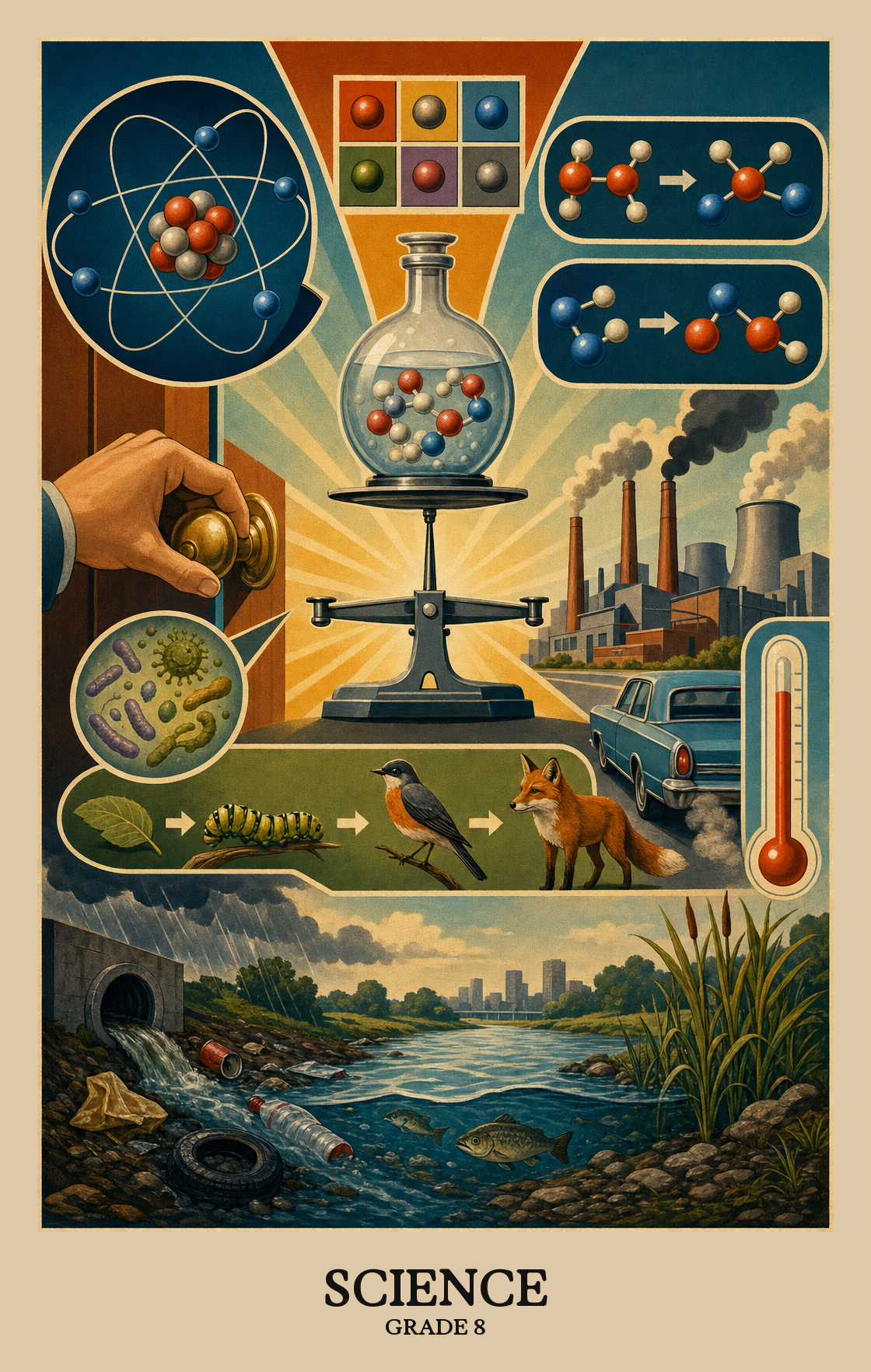
This is the year science zooms in to the atom and out to the planet at the same time. Students learn what everything is made of, from protons and electrons to elements on the periodic table, and how atoms rearrange in chemical reactions without any matter disappearing. They also study how living things share energy in food webs, how germs spread, and how human choices affect water and the climate. By spring, they can explain why burning fuel or mixing chemicals changes matter but never destroys it.
Students start the year with the building blocks of matter. They learn what atoms are made of, how elements are organized on the periodic table, and how scientists tell elements, compounds, and mixtures apart.
Students look at what happens when matter changes. They sort physical changes like melting or cutting from chemical reactions that produce a new substance, and they see why the amount of matter stays the same before and after.
Students compare viruses, bacteria, fungi, and parasites and learn how each one spreads and gets treated. They also work out the difference between an epidemic and a pandemic using real outbreak data.
Students study how living things depend on food, water, shelter, and space. They trace energy from plants through animals and decomposers, and notice how water and carbon move through a food web.
Students read Earth's past by looking at rock layers and fossils. They figure out which layers are older, use index fossils to date events, and explain what faults and rock formations reveal about the planet over time.
Students close the year on people and the planet. They test what makes water safe to drink, compare renewable and nonrenewable energy sources, and weigh how human activity connects to rising global temperatures.
Students study how physical and chemical properties of matter change when substances interact, and whether those changes happen in sealed containers or open environments.
Students sort substances into three groups: pure elements (one kind of atom), compounds (atoms bonded into a fixed recipe), and mixtures (ingredients that stay separate). The sorting depends on how the atoms inside are arranged.
Students draw or label a model of an atom showing where protons, neutrons, and electrons sit, what charge each carries, and how their sizes compare.
Students read patterns in the Periodic Table to explain why elements are arranged the way they are, connecting each element's physical traits and chemical behavior to its position on the table.
Students sort changes in matter into two groups: physical changes like cutting or melting, and chemical changes like rust forming or gas bubbling up. They explain what evidence tells them which type of change happened.
Students draw or use diagrams to show that atoms just swap partners during a chemical reaction. Nothing is created or destroyed, so the number of each type of atom on both sides of the equation stays the same.
| Standard | Definition | Code |
|---|---|---|
| Understand the properties of matter and changes that occur when matter… | Students study how physical and chemical properties of matter change when substances interact, and whether those changes happen in sealed containers or open environments. | PS.8.1 |
| Construct an explanation to classify matter as elements, compounds | Students sort substances into three groups: pure elements (one kind of atom), compounds (atoms bonded into a fixed recipe), and mixtures (ingredients that stay separate). The sorting depends on how the atoms inside are arranged. | PS.8.1.1 |
| Use models to illustrate the structure of atoms in terms of the… | Students draw or label a model of an atom showing where protons, neutrons, and electrons sit, what charge each carries, and how their sizes compare. | PS.8.1.2 |
| Analyze and interpret data to explain how the physical properties of elements… | Students read patterns in the Periodic Table to explain why elements are arranged the way they are, connecting each element's physical traits and chemical behavior to its position on the table. | PS.8.1.3 |
| Construct an explanation to classify changes in matter as physical changes | Students sort changes in matter into two groups: physical changes like cutting or melting, and chemical changes like rust forming or gas bubbling up. They explain what evidence tells them which type of change happened. | PS.8.1.4 |
| Use models to illustrate how atoms are rearranged during a chemical reaction so… | Students draw or use diagrams to show that atoms just swap partners during a chemical reaction. Nothing is created or destroyed, so the number of each type of atom on both sides of the equation stays the same. | PS.8.1.5 |
Students learn what makes certain bacteria, viruses, and other pathogens dangerous and how they cause illness in living things.
Students compare viruses, bacteria, fungi, and parasites: what makes each one spread, how doctors treat infections caused by each, and how people can prevent getting sick in the first place.
Students learn the difference between an outbreak that spreads through one community and one that spreads across countries. They look at real data to understand how a disease travels, how it gets treated, and how it gets stopped.
| Standard | Definition | Code |
|---|---|---|
| Understand the hazards caused by agents of diseases that affect… | Students learn what makes certain bacteria, viruses, and other pathogens dangerous and how they cause illness in living things. | LS.8.1 |
| Construct an explanation to compare the basic characteristics of… | Students compare viruses, bacteria, fungi, and parasites: what makes each one spread, how doctors treat infections caused by each, and how people can prevent getting sick in the first place. | LS.8.1.1 |
| Analyze and interpret data to explain the difference between epidemic… | Students learn the difference between an outbreak that spreads through one community and one that spreads across countries. They look at real data to understand how a disease travels, how it gets treated, and how it gets stopped. | LS.8.1.2 |
Living things respond to both the other organisms around them and to non-living conditions like temperature, water, and sunlight. Students learn how those relationships shape where organisms live and whether they survive.
Students run experiments to see how changes in living things (like predators or prey) and non-living conditions (like water or shelter) cause animal and plant populations to grow, shrink, or shift.
Students map out how living things feed on, compete with, or depend on each other in an ecosystem. They explain what happens when those relationships go well or badly, covering predators and prey, parasites, and partnerships where both sides benefit.
Food does two jobs for every living thing: it supplies energy to move and grow, and it supplies raw materials to build and repair the body. Students explain how this works for animals and plants alike.
Food webs show how energy passes from plants to animals to decomposers. Students use diagrams to trace how water and carbon cycle through those same living things, connecting energy flow and matter in one system.
| Standard | Definition | Code |
|---|---|---|
| Understand how organisms interact with and respond to the biotic and abiotic… | Living things respond to both the other organisms around them and to non-living conditions like temperature, water, and sunlight. Students learn how those relationships shape where organisms live and whether they survive. | LS.8.2 |
| Carry out investigations to explain how changing biotic and abiotic… | Students run experiments to see how changes in living things (like predators or prey) and non-living conditions (like water or shelter) cause animal and plant populations to grow, shrink, or shift. | LS.8.2.1 |
| Construct an explanation to summarize the relationships among… | Students map out how living things feed on, compete with, or depend on each other in an ecosystem. They explain what happens when those relationships go well or badly, covering predators and prey, parasites, and partnerships where both sides benefit. | LS.8.2.2 |
| Construct an explanation to summarize how food provides the energy and the… | Food does two jobs for every living thing: it supplies energy to move and grow, and it supplies raw materials to build and repair the body. Students explain how this works for animals and plants alike. | LS.8.2.3 |
| Use models to explain how the flow of energy within food webs is interconnected… | Food webs show how energy passes from plants to animals to decomposers. Students use diagrams to trace how water and carbon cycle through those same living things, connecting energy flow and matter in one system. | LS.8.2.4 |
Students study how living things have changed over generation after generation, using fossils, DNA comparisons, and other evidence to explain why those changes happened.
| Standard | Definition | Code |
|---|---|---|
| Understand the evolution of organisms over time based on evidence and processes | Students study how living things have changed over generation after generation, using fossils, DNA comparisons, and other evidence to explain why those changes happened. | LS.8.3 |
Fossils and rock layers tell the story of how Earth and its living things have changed over billions of years. Students read that evidence to understand what life looked like long ago and how land itself has shifted over time.
Students use the position of rock layers and specific fossils found inside them to figure out which rocks are older and which are younger, without needing an exact date.
Fossils, rock layers, and fault lines are clues about Earth's past. Students use that physical evidence to build and defend an explanation of how Earth and its living things have changed over time.
| Standard | Definition | Code |
|---|---|---|
| Understand the history of Earth and its life forms based on evidence of change… | Fossils and rock layers tell the story of how Earth and its living things have changed over billions of years. Students read that evidence to understand what life looked like long ago and how land itself has shifted over time. | ESS.8.1 |
| Analyze and interpret data to conclude the relative age of Earth and relative… | Students use the position of rock layers and specific fossils found inside them to figure out which rocks are older and which are younger, without needing an exact date. | ESS.8.2.1 |
| Engage in argument from evidence to explain the use of fossils, composition of… | Fossils, rock layers, and fault lines are clues about Earth's past. Students use that physical evidence to build and defend an explanation of how Earth and its living things have changed over time. | ESS.8.2.2 |
Students learn how water moves through Earth's systems, from freshwater rivers and lakes to the brackish zones where rivers meet the sea, to the open ocean. Each system works differently and shapes the life and land around it.
| Standard | Definition | Code |
|---|---|---|
| Understand the hydrosphere including freshwater, estuarine, ocean systems | Students learn how water moves through Earth's systems, from freshwater rivers and lakes to the brackish zones where rivers meet the sea, to the open ocean. Each system works differently and shapes the life and land around it. | ESS.8.2 |
Students study how humans change water systems (through dams, pollution, and land use) and how those changes come back to affect the water people drink, flood patterns, and coastal safety.
Students examine real water-quality data and build an argument for why clean water depends on ongoing monitoring, treatment standards, and responsible stewardship of local water sources.
Students look at real water-quality readings, like temperature, pH, and cloudiness, to judge whether a water source in North Carolina is safe to drink or use. They learn which conditions signal a healthy supply and which signal a problem.
Getting energy, whether from coal, wind, solar, or other sources, always has trade-offs. Students study how each method affects land, water, air, and living things.
Students sort energy sources into two groups: ones that naturally replenish, like sunlight and wind, and ones that run out, like coal and oil. They explain what makes each source fall into one category or the other.
Students pick a side on a real debate, like coal mining or wind farms, and back their position with evidence. They practice explaining how getting and moving energy affects the land, water, and air.
Students look at temperature records and industrial data to explain why average global temperatures have risen since the mid-1800s, connecting human activities like burning fossil fuels to measurable changes in Earth's climate.
Students compare how long different energy sources last and what happens to the environment when we keep using them. They look at why saving energy and using it wisely matters for the future.
| Standard | Definition | Code |
|---|---|---|
| Understand the reciprocal relationship between the hydrosphere and humans | Students study how humans change water systems (through dams, pollution, and land use) and how those changes come back to affect the water people drink, flood patterns, and coastal safety. | ESS.8.3 |
| Engage in argument from evidence to explain that the good health of humans and… | Students examine real water-quality data and build an argument for why clean water depends on ongoing monitoring, treatment standards, and responsible stewardship of local water sources. | ESS.8.3.2 |
| Analyze and interpret data to predict the safety and potability of… | Students look at real water-quality readings, like temperature, pH, and cloudiness, to judge whether a water source in North Carolina is safe to drink or use. They learn which conditions signal a healthy supply and which signal a problem. | ESS.8.3.1 |
| Understand the environmental implications associated with the various methods… | Getting energy, whether from coal, wind, solar, or other sources, always has trade-offs. Students study how each method affects land, water, air, and living things. | ESS.8.4 |
| Construct an explanation to classify the primary sources of energy as either… | Students sort energy sources into two groups: ones that naturally replenish, like sunlight and wind, and ones that run out, like coal and oil. They explain what makes each source fall into one category or the other. | ESS.8.4.1 |
| Engage in argument from evidence to explain the environmental consequences of… | Students pick a side on a real debate, like coal mining or wind farms, and back their position with evidence. They practice explaining how getting and moving energy affects the land, water, and air. | ESS.8.4.2 |
| Analyze and interpret data to illustrate the relationship between… | Students look at temperature records and industrial data to explain why average global temperatures have risen since the mid-1800s, connecting human activities like burning fossil fuels to measurable changes in Earth's climate. | ESS.8.4.3 |
| Obtain, evaluate, and communicate information to compare the long… | Students compare how long different energy sources last and what happens to the environment when we keep using them. They look at why saving energy and using it wisely matters for the future. | ESS.8.4.4 |
End-of-grade science assessment in grades 5 and 8, aligned to North Carolina science standards.
Alternate assessment for eligible students with significant cognitive disabilities, covering state-tested grades and subjects.
Federally administered sample-based assessment in reading, mathematics, science, writing, and other subjects. NAEP results inform state-by-state comparisons rather than individual student or school accountability.
Students study four big areas: atoms and chemical reactions, how diseases spread, how living things share energy in ecosystems, and how humans affect water and energy resources. They also look at fossils and rock layers to figure out the age of the Earth.
Talk about everyday science: why ice melts, why a cut apple turns brown, where tap water comes from, or why a power bill went up. Ask students to explain what they learned that week in their own words. Five minutes of curiosity at dinner goes a long way.
No. Students should understand how the table is organized and what protons, neutrons, and electrons do inside an atom. Memorizing every element is not the goal. Reading the table and predicting how an element behaves is.
Atomic structure and balancing chemical equations usually need a second pass. Energy flow through food webs is another common sticking point, especially the link between matter cycling and energy transfer. Build in review time after each.
Most teachers start with matter and atoms because chemistry vocabulary supports later units on water quality and energy resources. Ecosystems and disease fit well in the middle, with fossils and Earth history later in the year once students are comfortable using evidence to build arguments.
Students can explain a chemical reaction using a balanced equation, trace energy and matter through a food web, and use data to argue whether a water sample is safe to drink. They can also use rock layers and fossils to put events in order.
When students make a claim, ask two questions: What is the evidence? How do you know? This is the same thinking the class uses for water quality, fossils, and energy sources. It builds the habit of backing up ideas with facts.
They should be comfortable reading a data table or graph, writing a short evidence-based explanation, and using models to show what is happening at a small scale, like atoms in a reaction. Lab safety and careful measurement also matter.