Skip to content

What does a student learn in ?

This is the year students zoom in on North Carolina and trace how the state's story fits inside the country's story. Students look at who built the state, who was left out, and how reforms changed daily life over time. They weigh founding ideals against real laws and decisions, and study how geography, money, and migration shaped communities. By spring, students can explain a specific moment in North Carolina history and connect it to a bigger national change.

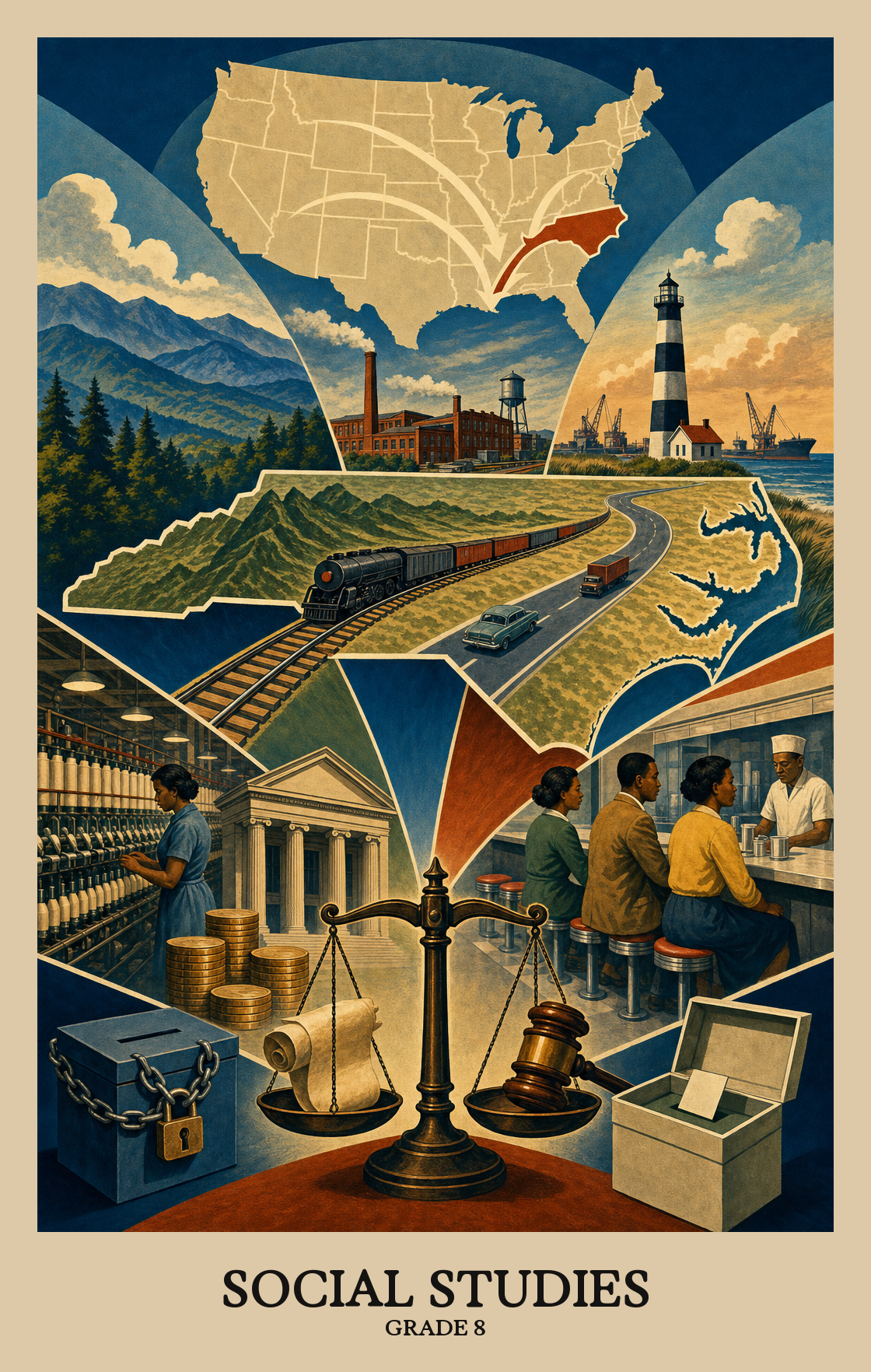
Illustration of what students learn in Grade 8 Social Studies
  • North Carolina history
  • Founding ideals
  • Civil rights reforms
  • Economic change
  • Migration and geography
  • Slavery and segregation
Source: North Carolina NC Standard Course of Study
Year at a glance
How the year usually goes. Every school and district set their own curriculum, so treat this as a guide, not official pacing.
  1. 1

    Land, people, and early settlement

    Students start with the map. They look at how rivers, mountains, and the coast shaped where people lived in North Carolina and how early groups, including Native nations and newcomers, built communities side by side.

  2. 2

    Founding ideals and government

    Students read the big ideas behind the country's founding documents and ask what they actually promised. They compare how state and local governments live up to those ideals or fall short.

  3. 3

    Slavery, conflict, and resistance

    Students study how slavery, the Civil War, and laws that pushed people down shaped the state and the country. They also learn how the people affected pushed back and built lives, families, and movements.

  4. 4

    Growth, migration, and the economy

    Students follow how farms, factories, and new industries changed who had work and who had to move. They look at the role of women, Black communities, and Native groups in building the state's economy.

  5. 5

    Reform movements and civil rights

    Students examine how people organized to end segregation, win the vote, and push for fair treatment. They weigh which reforms changed daily life and which left work unfinished.

  6. 6

    North Carolina today

    Students connect the year's history to the state they live in now. They look at recent change, ongoing debates, and how personal choices and public policy still shape communities.

Mastery Learning Standards
The required skills a student should display by the end of Grade 8.
Behavioral Sciences
  • Analyze the impact of group behavior on the development of North Carolina and…

    8.B.1

    Groups shape history. Students examine how the actions of communities, movements, and organizations pushed North Carolina and the country to change over time.

  • Determine how the relationship between different regional, social, ethnic

    8.B.1.1

    Groups of people from different regions, races, and backgrounds have shaped North Carolina and the country over time. Students examine how those relationships, whether cooperative or tense, pushed history forward.

  • Explain how cultural values, practices and the interactions of various…

    8.B.1.2

    Cultural groups shape how a society grows over time. Students explain how the beliefs, traditions, and daily practices of Native American, religious, and racial communities have shaped the laws, customs, and character of North Carolina and the country.

Civics & Government
  • Understand how democratic principles have influenced the government structure…

    8.C&G.1

    Students trace how ideas like majority rule, individual rights, and limited government shaped the laws and branches of government in North Carolina and across the country.

  • Summarize the democratic ideals outlined in the founding documents of the state…

    8.C&G.1.1

    Founding documents like the Constitution and the Declaration of Independence spell out core democratic ideas: limited government, individual rights, and the consent of the governed. Students read those documents and explain what those ideals mean in plain terms.

  • Compare how decisions of state and local government conform and conflict with…

    8.C&G.1.2

    State and local governments don't always match the ideals written into the national founding documents. Students compare specific state and local decisions to democratic principles like majority rule and individual rights, identifying where those decisions line up and where they fall short.

  • Critique the policies, laws

    8.C&G.1.3

    Students look at real laws and government structures, then explain whether they live up to American democratic ideals or fall short of them.

  • Compare different perspectives on the role of state, national

    8.C&G.1.4

    Students read arguments from different sides about what state, federal, and tribal governments should each handle, then explain where those views agree and where they split.

  • Compare different perspectives on the role of state, national

    8.C&G.1.5

    Students read arguments from different sides about what state, federal, and tribal governments should each handle. They practice explaining why people disagree, not just what the disagreement is.

  • Evaluate the effectiveness of societal reforms

    8.C&G.2

    Students look at a real reform, like a civil rights law or a labor regulation, and decide whether it actually changed conditions for the people it was meant to help.

  • Summarize the strategies and societal reforms used to address discrimination…

    8.C&G.2.1

    Students study the real methods people used to fight discrimination, from court cases and protests to new laws, and examine whether those efforts actually changed things in North Carolina and across the country.

  • Assess the effectiveness of reforms in terms of the impact on individuals…

    8.C&G.2.2

    Students look at a real reform, such as a labor law or civil rights policy, and judge whether it actually changed people's lives, shifted government rules, or reshaped the institutions meant to carry it out.

Economics
  • Understand the economic development of North Carolina and the nation

    8.E.1

    Students trace how North Carolina and the broader U.S. economy grew and changed over time, from farming and early industry to modern trade and business.

  • Explain how economic growth and decline have positively and negatively impacted…

    8.E.1.1

    When the economy grows, jobs appear and businesses expand. When it shrinks, people lose work and communities struggle. Students trace how those boom-and-bust cycles have shaped real lives and towns in North Carolina and across the country.

  • Explain how economic growth and decline have positively and negatively impacted…

    8.E.1.2

    When the economy grows or shrinks, real people feel it. Students explain how those shifts have helped or hurt workers, families, businesses, and communities in North Carolina and across the country.

  • Distinguish the role women, indigenous groups

    8.E.1.3

    Students examine how women, Native Americans, and racial minorities shaped North Carolina's economy, including whether those groups had fair access to jobs, pay, and opportunities to move up.

  • Exemplify ways personal financial decision making influences the economy

    8.E.1.4

    Personal choices about spending, saving, and borrowing add up. When students learn how those choices shape demand, debt, and local businesses, they see how household decisions ripple through the broader economy.

Geography
  • Understand geographic factors that influence the development of North Carolina…

    8.G.1

    Geographic features like mountains, rivers, and coastlines shaped where towns grew, how people traded, and which industries took hold in North Carolina and across the country.

  • Summarize the human and physical characteristics of North Carolina and the…

    8.G.1.1

    Students identify what makes North Carolina and the U.S. distinct, covering physical features like rivers and mountains alongside human factors like cities, industries, and population patterns.

  • Explain how location, resources

    8.G.1.2

    Students look at why cities, farms, and industries grew where they did in North Carolina and across the country. Location, natural resources, and the way people settled the land all shaped those decisions.

  • Explain how location and human geography have presented opportunities and…

    8.G.1.3

    Rivers, mountains, and roads shape where people settle and how goods travel. Students explain how North Carolina's physical features and human-built systems have opened up or blocked the movement of people, products, and ideas across the state and country.

  • Explain the reasons for and effects of forced and voluntary migration on…

    8.G.1.4

    Forced migration means people were pushed out of their homes against their will. Voluntary migration means people chose to move. Students explain why both kinds of movement happened and how they changed the lives of different groups across North Carolina and the country.

  • Explain how geographic expansion has impacted the development of North Carolina…

    8.G.1.5

    Students trace how the U.S. grew westward and how that expansion shaped North Carolina's economy, population, and borders over time.

History
  • Understand the role of conflict and cooperation in the development of North…

    8.H.1

    Conflict and cooperation both shaped American history. Students study how wars, treaties, debates, and alliances pushed North Carolina and the country to change over time.

  • Explain the causes and effects of conflict in North Carolina and the nation

    8.H.1.1

    Students trace why a conflict started and what changed because of it, from local disputes in North Carolina to wars and political crises that reshaped the country.

  • Summarize how debate, negotiation, compromise

    8.H.1.2

    Debate, negotiation, and compromise have shaped American and North Carolina history. Students study specific moments when leaders argued, bargained, or worked together to resolve conflict and move the country forward.

  • Explain how slavery, segregation, voter suppression, reconcentration

    8.H.1.3

    Students learn how laws and policies, from slavery to segregation to voter suppression, were deliberately used to control and exploit specific groups of people in North Carolina and across the country.

  • Explain how recovery, resistance

    8.H.1.4

    Students examine how people pushed back against unfair treatment over time, and how that resistance changed laws, communities, and the course of American history.

  • Understand how innovation and change have impacted the development of North…

    8.H.2

    Students trace how new inventions, industries, and ideas changed the way people lived in North Carolina and across the country over time.

  • Explain the influences of individuals and groups during times of innovation and…

    8.H.2.2

    People and organizations shape how things change. Students examine who pushed for new ideas or reforms in North Carolina and the country, and explain how those individuals and groups made a difference.

  • Explain how the experiences and achievements of women, minorities, indigenous

    8.H.2.3

    Students study how women, minority groups, and indigenous peoples shaped North Carolina and the country through their work, resistance, and ideas across different periods in history.

Assessments
The state tests students at this grade and subject take.
National Monitoring

NAEP (National Assessment of Educational Progress)

Federally administered sample-based assessment in reading, mathematics, science, writing, and other subjects. NAEP results inform state-by-state comparisons rather than individual student or school accountability.

When given:
biennial in winter
Frequency:
every two years
Official source
Common Questions
  • What does eighth grade social studies actually cover this year?

    Students study the history of their state and the country, with a strong focus on how different groups have shaped both. They look at conflict and cooperation, government, geography, the economy, and the ways people have pushed for fairer treatment over time.

  • How can I help at home if my child finds history boring?

    Connect it to people and places. Visit a local historical marker, watch a short documentary together, or ask a grandparent what life was like when they were younger. Ten minutes of real conversation about the past does more than rereading a textbook.

  • How should I sequence the year across so many topics?

    Most teachers anchor the year in chronological history and weave geography, economics, civics, and behavioral sciences into each era. Picking four or five big eras and threading the same questions through each one keeps the year coherent without rushing.

  • What does my child need to be able to do by the end of the year?

    Students should be able to explain why an event happened, who was affected, and what changed afterward. They should also be able to back up an opinion about a law, reform, or historical decision with specific evidence from what they read.

  • Which skills usually need the most reteaching?

    Sourcing and corroboration are the stubborn ones. Students often accept a single document as the full story. Building in regular practice comparing two accounts of the same event pays off across every unit.

  • How do I talk about hard topics like slavery and segregation at home?

    Be honest and steady. Students at this age can handle the truth and want adults to take it seriously. Ask what they learned in class, listen to their reactions, and answer questions plainly without rushing to wrap things up.

  • How do I know my child is ready for high school social studies?

    Watch for three habits: reading a primary source and pulling out the main idea, writing a paragraph that uses evidence, and forming an opinion about a historical question. If those feel solid by spring, students are in good shape.

  • How much of the year should focus on North Carolina versus the nation?

    A rough two-thirds national, one-third state split works well, but the state pieces land best when taught inside national events. Reconstruction, industrial growth, and civil rights all have strong local stories students can investigate.

  • What kinds of writing should students be doing in this class?

    Short evidence-based responses are the workhorse. A few longer pieces across the year, like a document-based essay or a position paper on a reform, give students room to build an argument with sources.