Counting and naming numbers
Students learn to count out loud, point to objects one at a time, and write numbers from 0 to 20. By the end of this stretch, they can tell a parent how many crackers are on the plate without recounting.
This is the year numbers start to mean something. Students learn to count to 100, write numbers up to 20, and match a number to a real group of objects. They start adding and taking away small amounts with their fingers, blocks, or drawings. By spring, students can count out 15 crackers, tell which pile has more, and name shapes like a triangle or a cube.
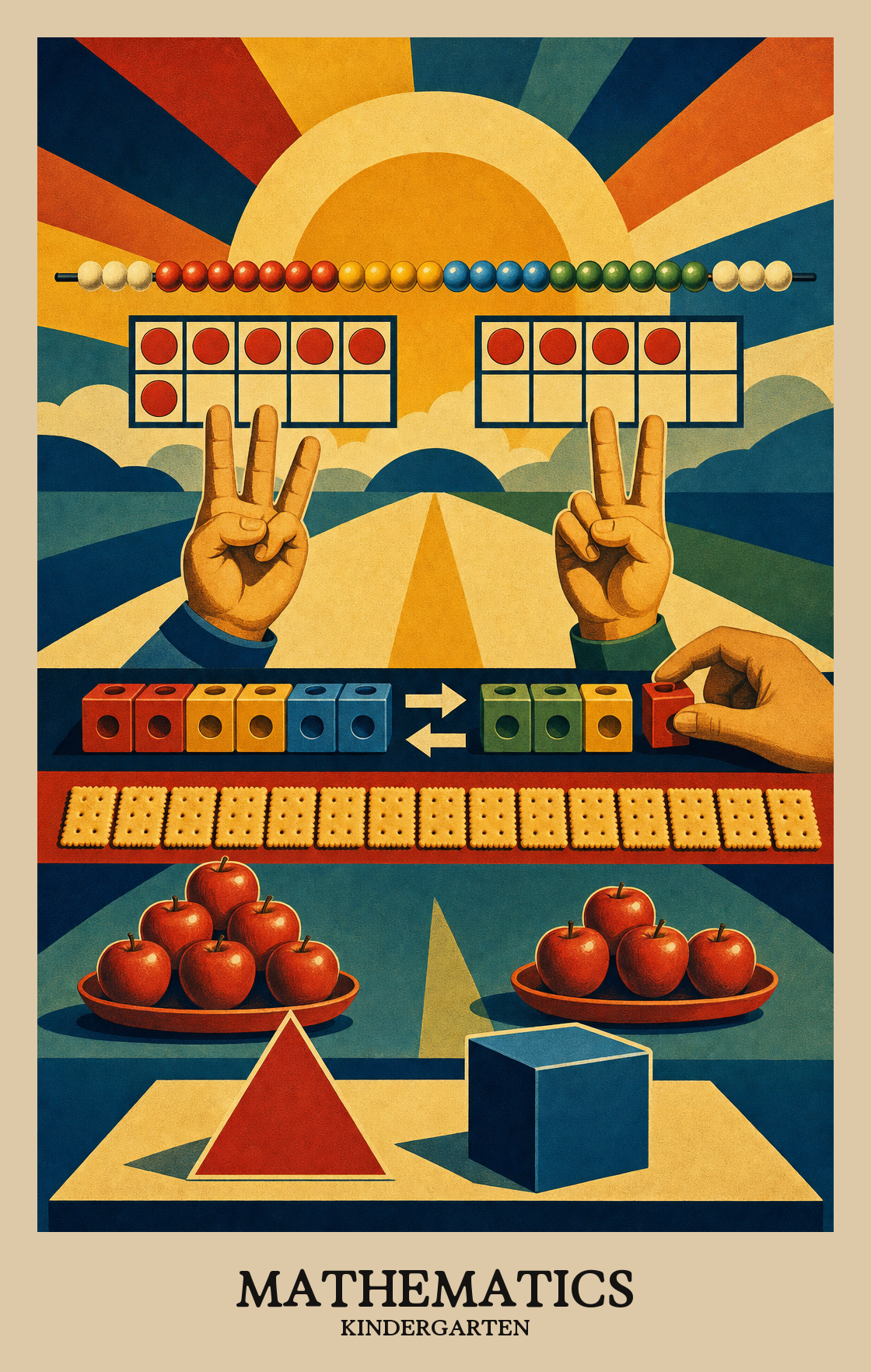
Students learn to count out loud, point to objects one at a time, and write numbers from 0 to 20. By the end of this stretch, they can tell a parent how many crackers are on the plate without recounting.
Students figure out which pile has more, which has less, and when two groups are equal. They match objects up and count carefully to back up their answer.
Students use fingers, drawings, and small objects to put groups together and take some away. They start to recognize small amounts at a glance and get quick with sums and differences up to 5.
Students see that numbers like 13 or 17 are really a group of ten plus a few extra. They build these numbers with blocks or drawings so the teens stop feeling like a jumble.
Students compare which object is longer, heavier, or taller, and sort buttons, blocks, or crayons into groups by color or size. Then they count each group and say which has the most.
Students name circles, squares, triangles, rectangles, and hexagons, and spot cubes, cones, cylinders, and spheres in everyday objects. They build new shapes by putting smaller ones together.
Counting out loud to 100, one number at a time, and then by tens: 10, 20, 30, all the way to 100. Students learn the names of numbers and the pattern they follow.
Starting from any number, students count forward without going back to 1 first. For example, starting from 7, they say 7, 8, 9, 10 instead of starting over from the beginning.
Students write the numbers 0 through 20 and use them to show how many objects are in a group. Writing a 0 means there is nothing there to count.
Counting a group of objects means pointing to each one and saying one number as you go. The last number said tells how many there are total, and students learn to spot groups up to five at a glance without counting at all.
Counting a group of objects to say how many are there, and figuring out what number comes next when one more is added. Students practice with up to 20 objects in a row, a circle, or a scattered pile.
Two groups of objects sit side by side, and students decide which has more, which has fewer, or whether both have the same amount. They figure it out by lining up the objects to match them or by counting each group.
Students look at two written numbers (both 10 or under) and decide which one is greater, which is smaller, or whether they are equal. No counting objects, just the numerals themselves.
| Standard | Definition | Code |
|---|---|---|
| Know number names and recognize patterns in the counting sequence… | Counting out loud to 100, one number at a time, and then by tens: 10, 20, 30, all the way to 100. Students learn the names of numbers and the pattern they follow. | NC.K.CC.1 |
| Count forward beginning from a given number within the known sequence, instead… | Starting from any number, students count forward without going back to 1 first. For example, starting from 7, they say 7, 8, 9, 10 instead of starting over from the beginning. | NC.K.CC.2 |
| Write numbers from 0 to 20 | Students write the numbers 0 through 20 and use them to show how many objects are in a group. Writing a 0 means there is nothing there to count. | NC.K.CC.3 |
| Understand the relationship between numbers and quantities.<ul><li>When… | Counting a group of objects means pointing to each one and saying one number as you go. The last number said tells how many there are total, and students learn to spot groups up to five at a glance without counting at all. | NC.K.CC.4 |
| Count to answer "How many?" in the following situations:<ul><li>Given a number… | Counting a group of objects to say how many are there, and figuring out what number comes next when one more is added. Students practice with up to 20 objects in a row, a circle, or a scattered pile. | NC.K.CC.5 |
| Identify whether the number of objects, within 10, in one group is greater… | Two groups of objects sit side by side, and students decide which has more, which has fewer, or whether both have the same amount. They figure it out by lining up the objects to match them or by counting each group. | NC.K.CC.6 |
| Compare two numbers, within 10, presented as written numerals | Students look at two written numbers (both 10 or under) and decide which one is greater, which is smaller, or whether they are equal. No counting objects, just the numerals themselves. | NC.K.CC.7 |
Students show what adding and subtracting means using whatever helps them think: fingers, drawings, small objects, or acting it out. They connect those different ways to show they understand what joining and separating numbers actually does.
Students listen to simple add-and-remove story problems and figure out the answer using objects or drawings. All numbers stay at 10 or below.
Breaking a number into two smaller pieces shows how numbers are built. Students split numbers up to 10 in different ways, like seeing that 7 can be 3 and 4, or 5 and 2, and draw or write each split.
Starting with any number up to 10, students find what to add to reach exactly 10. They might use blocks, fingers, or a drawing to figure it out, then write or sketch the answer.
Students look at small groups of objects and instantly see how many there are without counting one by one. They also put two groups together and recognize the total, as long as the combined amount is 5 or less.
Students add and subtract numbers up to 5 quickly and accurately, without counting on their fingers. Think of it as knowing that 3 plus 2 equals 5 the same way they know their own name.
| Standard | Definition | Code |
|---|---|---|
| Represent addition and subtraction, within 10:<ul><li>Use a variety of… | Students show what adding and subtracting means using whatever helps them think: fingers, drawings, small objects, or acting it out. They connect those different ways to show they understand what joining and separating numbers actually does. | NC.K.OA.1 |
| Solve addition and subtraction word problems, within 10, using objects or… | Students listen to simple add-and-remove story problems and figure out the answer using objects or drawings. All numbers stay at 10 or below. | NC.K.OA.2 |
| Decompose numbers less than or equal to 10 into pairs in more than one way… | Breaking a number into two smaller pieces shows how numbers are built. Students split numbers up to 10 in different ways, like seeing that 7 can be 3 and 4, or 5 and 2, and draw or write each split. | NC.K.OA.3 |
| For any number from 0 to 10, find the number that makes 10 when added to the… | Starting with any number up to 10, students find what to add to reach exactly 10. They might use blocks, fingers, or a drawing to figure it out, then write or sketch the answer. | NC.K.OA.4 |
| Recognize and combine groups with totals up to 5 | Students look at small groups of objects and instantly see how many there are without counting one by one. They also put two groups together and recognize the total, as long as the combined amount is 5 or less. | NC.K.OA.6 |
| Demonstrate fluency with addition and subtraction within 5 | Students add and subtract numbers up to 5 quickly and accurately, without counting on their fingers. Think of it as knowing that 3 plus 2 equals 5 the same way they know their own name. | NC.K.OA.5 |
Students take numbers like 13 or 17 and break them into a group of ten and a few leftovers. They show this with blocks, drawings, or simple math expressions.
| Standard | Definition | Code |
|---|---|---|
| Compose and decompose numbers from 11 to 19 into ten ones and some further ones… | Students take numbers like 13 or 17 and break them into a group of ten and a few leftovers. They show this with blocks, drawings, or simple math expressions. | NC.K.NBT.1 |
Students look at one object and describe more than one thing they can measure about it, like how tall a cup is and how heavy it feels.
Students pick two objects and compare them directly, such as holding two pencils side by side to see which is longer. They then put the difference into words.
Students sort everyday objects into groups (by color, shape, or size), count how many are in each group, and figure out which group has the most or least.
| Standard | Definition | Code |
|---|---|---|
| Describe measurable attributes of objects | Students look at one object and describe more than one thing they can measure about it, like how tall a cup is and how heavy it feels. | NC.K.MD.1 |
| Directly compare two objects with a measurable attribute in common, to see… | Students pick two objects and compare them directly, such as holding two pencils side by side to see which is longer. They then put the difference into words. | NC.K.MD.2 |
| Classify objects into given categories | Students sort everyday objects into groups (by color, shape, or size), count how many are in each group, and figure out which group has the most or least. | NC.K.MD.3 |
Students look around the room and name what they see: circles, squares, triangles. They also describe where things are, above, below, beside, or behind something else.
Students learn to recognize and name shapes like squares, circles, triangles, and cubes no matter how big they are or which way they're turned.
Students sort everyday shapes into two groups: flat (like a square or circle drawn on paper) and solid (like a can or a block you can pick up).
Students look at flat and solid shapes, like circles, cubes, and cones, and describe what makes them alike or different. They use their own words to talk about things like the number of sides, corners, or how a shape feels when you hold it.
Students draw and build everyday shapes like triangles, squares, and circles, then move into 3D objects like cubes and cones. The focus is on making shapes with their hands, not just recognizing them on a page.
Students put simple shapes together to build a bigger one, like fitting two triangles side by side to make a square. The focus is on how smaller pieces combine to form a new shape.
| Standard | Definition | Code |
|---|---|---|
| Describe objects in the environment using names of shapes | Students look around the room and name what they see: circles, squares, triangles. They also describe where things are, above, below, beside, or behind something else. | NC.K.G.1 |
| Correctly name squares, circles, triangles, rectangles, hexagons, cubes, cones… | Students learn to recognize and name shapes like squares, circles, triangles, and cubes no matter how big they are or which way they're turned. | NC.K.G.2 |
| Identify squares, circles, triangles, rectangles, hexagons, cubes, cones… | Students sort everyday shapes into two groups: flat (like a square or circle drawn on paper) and solid (like a can or a block you can pick up). | NC.K.G.3 |
| Analyze and compare two- and three-dimensional shapes, in different sizes and… | Students look at flat and solid shapes, like circles, cubes, and cones, and describe what makes them alike or different. They use their own words to talk about things like the number of sides, corners, or how a shape feels when you hold it. | NC.K.G.4 |
| Model shapes in the world by:<ul><li>Building and drawing triangles… | Students draw and build everyday shapes like triangles, squares, and circles, then move into 3D objects like cubes and cones. The focus is on making shapes with their hands, not just recognizing them on a page. | NC.K.G.5 |
| Compose larger shapes from simple shapes | Students put simple shapes together to build a bigger one, like fitting two triangles side by side to make a square. The focus is on how smaller pieces combine to form a new shape. | NC.K.G.6 |
End-of-grade mathematics assessment for grades 3 through 8, aligned to the North Carolina Standard Course of Study.
Alternate assessment for eligible students with significant cognitive disabilities, covering state-tested grades and subjects.
Students should count to 100, write numbers 0 to 20, and add and subtract within 5 quickly. They should also sort objects, name common shapes like circles and cubes, and break numbers up to 10 into smaller pairs.
Count real things together. Steps on the stairs, grapes on a plate, cars in the parking lot. Ask how many before counting, then count to check. Once that feels easy, start counting from a number other than 1, like starting at 7 and going up.
Making 10 means knowing the pairs that add to ten, like 6 and 4 or 7 and 3. These pairs make first grade addition much easier. Practice with fingers, coins, or small toys: show 6 and ask how many more to reach 10.
Yes, and it points to the next thing to practice. Saying the number words is one skill. Touching each object once while saying one number is another. Slow the count down, move each object as it is named, and the last number said is the total.
Build the verbal count first, then one-to-one correspondence with small groups, then cardinality (the last number names the total). Subitizing small sets up to 5 can run alongside. Counts to 100 and counting on from any number tend to come together later in the year.
One-to-one correspondence past 10, writing numbers without reversals (especially 6, 7, and 9), and decomposing teen numbers as ten and some more. Build in short daily practice rather than long sessions, and use objects before moving to written numerals.
Watch for fluent addition and subtraction within 5, accurate counting and comparing of groups up to 20, and the ability to see a teen number as ten ones plus some extra. Naming shapes and breaking 10 into pairs in more than one way are also strong signals.
Only the small ones. Students should know sums and differences within 5 without stopping to count, like 2 plus 3 or 4 minus 1. Larger facts can still be solved with fingers or drawings. Speed comes later; accuracy and understanding come first.
Go on a shape hunt. Find circles on clocks and plates, rectangles on doors and books, triangles on roofs and slices of pizza. For solid shapes, point out cans (cylinders), balls (spheres), and ice cream cones. Ask what is the same and what is different.