Our classroom community
Students start the year learning why classrooms have rules and what happens when people follow them or don't. They practice taking turns, listening, and working together to make the room run smoothly.
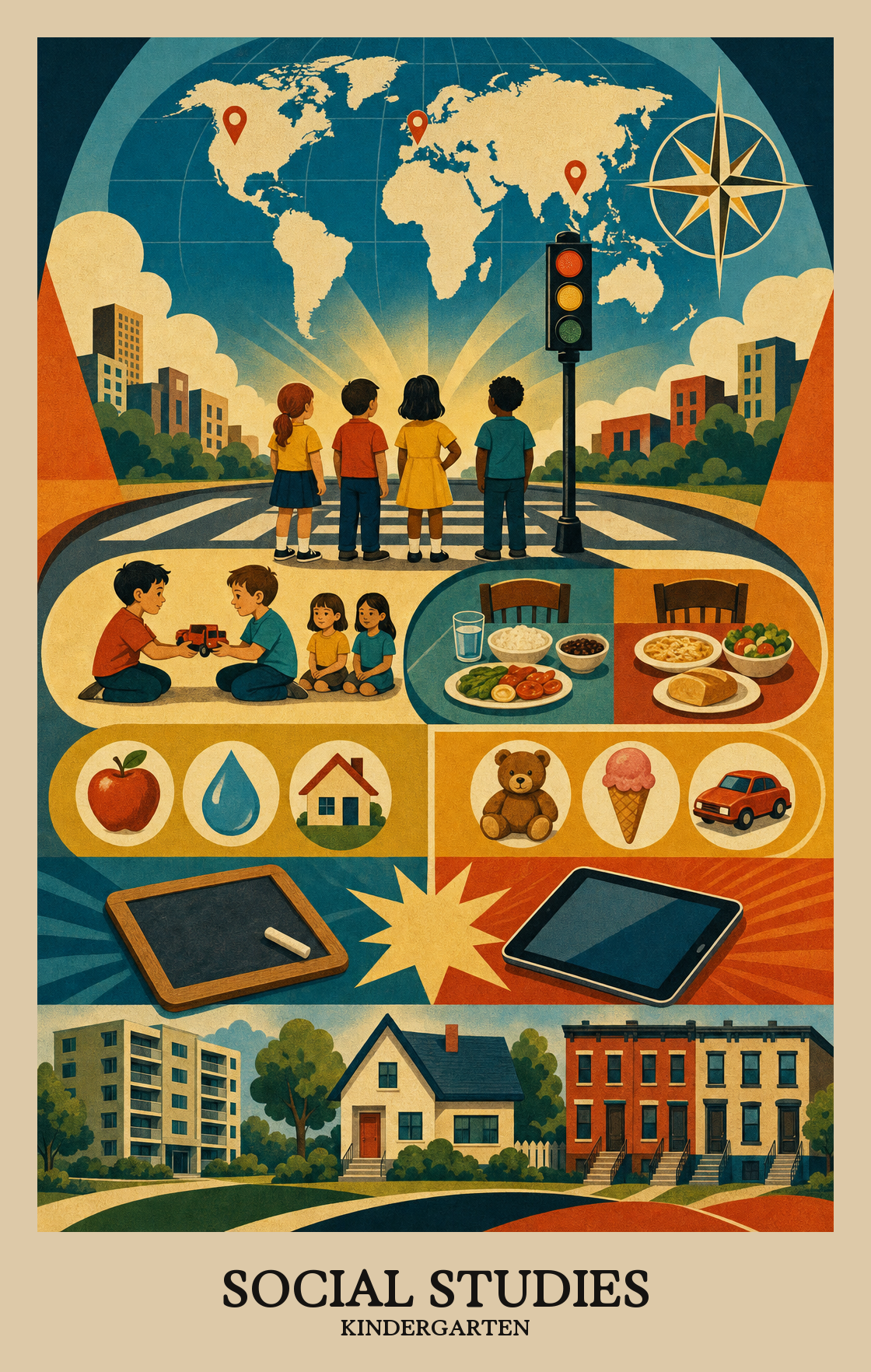
This is the year students start to see the world beyond their own home. Students learn that classrooms and communities run on rules, and that people in other places live, eat, and celebrate in their own ways. They tell needs apart from wants, find places on a map, and notice how life today is different from life long ago. By spring, students can point out a rule that keeps the classroom fair and name one way another family lives differently from their own.
Students start the year learning why classrooms have rules and what happens when people follow them or don't. They practice taking turns, listening, and working together to make the room run smoothly.
Students sort the things people need to live from the things they simply want. They also start noticing the difference between everyday items, like food or shoes, and the help that people give, like a haircut or a bus ride.
Students use maps, globes, and pictures to find places in the classroom, the neighborhood, and other parts of the world. They learn position words like above, below, near, and far to describe where things are.
Students look at how people around the world use natural resources like water, trees, and soil. They also talk about why families sometimes move when the weather, land, or surroundings change.
Students explore everyday traditions in their own community and compare them to how families live in other parts of the world. They hear stories about kindness, patience, and respect, and what those traits look like in real life.
Students wrap up the year by looking at how people and places change over time. They compare homes, schools, and daily life in the past to life today, and talk about events that shaped the world they know.
Students look at how different families and communities celebrate, eat, dress, and mark special occasions. They start to see that people share some customs and differ in others.
Cultural practices are the everyday things families and communities do together, like sharing meals, celebrating holidays, or telling stories. Students learn to spot those traditions in their own neighborhood and in places far away.
Students look at how people in their own neighborhood and in other parts of the world celebrate, eat, dress, and mark special occasions, then notice what is the same and what is different.
Stories about kindness, persistence, and treating others well show students how people help their neighborhoods and communities. Students practice putting those ideas into their own words.
| Standard | Definition | Code |
|---|---|---|
| Understand cultural practices in local communities and around the world | Students look at how different families and communities celebrate, eat, dress, and mark special occasions. They start to see that people share some customs and differ in others. | K.B.1 |
| Identify cultural practices in local communities and around the world | Cultural practices are the everyday things families and communities do together, like sharing meals, celebrating holidays, or telling stories. Students learn to spot those traditions in their own neighborhood and in places far away. | K.B.1.1 |
| Compare cultural practices of people in local communities and around the world | Students look at how people in their own neighborhood and in other parts of the world celebrate, eat, dress, and mark special occasions, then notice what is the same and what is different. | K.B.1.2 |
| Summarize stories that illustrate how positive character traits such as… | Stories about kindness, persistence, and treating others well show students how people help their neighborhoods and communities. Students practice putting those ideas into their own words. | K.B.1.3 |
Rules are made by groups of people working together, not handed down from nowhere. Students learn why communities agree on rules and what happens when everyone follows them.
Rules tell people what to do and keep everyone safe. Students learn why classrooms, schools, and neighborhoods have rules and what happens when people follow them.
Students practice following rules at school and in their neighborhood, like taking turns, walking in the halls, and listening when others speak.
Students learn what happens when classroom or school rules are followed and what happens when they aren't. They connect rules to real outcomes, like keeping a game fair or staying safe on the playground.
Students learn and follow a step-by-step process for working with others to make their classroom or neighborhood better, like agreeing on a rule or solving a shared problem.
| Standard | Definition | Code |
|---|---|---|
| Understand that people work together to create and follow rules | Rules are made by groups of people working together, not handed down from nowhere. Students learn why communities agree on rules and what happens when everyone follows them. | K.C&G.1 |
| Explain why people follow rules in the classroom, school | Rules tell people what to do and keep everyone safe. Students learn why classrooms, schools, and neighborhoods have rules and what happens when people follow them. | K.C&G.1.1 |
| Exemplify ways people follow rules in the classroom, school | Students practice following rules at school and in their neighborhood, like taking turns, walking in the halls, and listening when others speak. | K.C&G.1.2 |
| Identify the consequences of following or not following rules in the classroom… | Students learn what happens when classroom or school rules are followed and what happens when they aren't. They connect rules to real outcomes, like keeping a game fair or staying safe on the playground. | K.C&G.1.3 |
| Use a procedure for how people can effectively work together to improve… | Students learn and follow a step-by-step process for working with others to make their classroom or neighborhood better, like agreeing on a rule or solving a shared problem. | K.C&G.1.4 |
Students learn what it means to want something versus need something, and why people trade, work, or save to get what they have.
Needs are things people must have to survive, like food and shelter. Wants are things people would like but can live without. Students learn to sort everyday items into one group or the other.
Goods are things you can hold, like food or a toy. Services are things people do for you, like a haircut or a doctor visit. Students learn to tell the difference between the two.
| Standard | Definition | Code |
|---|---|---|
| Analyze basic economic concepts | Students learn what it means to want something versus need something, and why people trade, work, or save to get what they have. | K.E.1 |
| Differentiate between needs and wants | Needs are things people must have to survive, like food and shelter. Wants are things people would like but can live without. Students learn to sort everyday items into one group or the other. | K.E.1.1 |
| Differentiate between goods and services | Goods are things you can hold, like food or a toy. Services are things people do for you, like a haircut or a doctor visit. Students learn to tell the difference between the two. | K.E.1.2 |
Students learn words like "near," "far," "left," and "right" to describe where things are. They practice using simple maps and pictures to show what their neighborhood or classroom looks like.
Students use maps and globes to find places, from their own classroom to countries on the other side of the world.
Students look at maps and globes to find and name physical features like mountains, rivers, and oceans. They learn to read simple geographic tools to describe what the land looks like.
Students use words like near, far, left, right, above, and below to describe where things are, from their own classroom to places around the world.
Students learn how people change the land around them and how weather and nature shape how people live.
People use land, water, and trees to meet everyday needs like growing food, building homes, and staying warm. Students learn how communities around the world depend on what nature provides.
Students explain why people move to new places because of weather, water, land, or other natural features. A place that gets too cold, too dry, or floods regularly can push families to find somewhere better suited to their needs.
| Standard | Definition | Code |
|---|---|---|
| Apply simple geographic representations, tools, and terms to… | Students learn words like "near," "far," "left," and "right" to describe where things are. They practice using simple maps and pictures to show what their neighborhood or classroom looks like. | K.G.1 |
| Use maps, globes, and/or digital representations to locate places in the… | Students use maps and globes to find places, from their own classroom to countries on the other side of the world. | K.G.1.1 |
| Identify physical features of places using maps, globes, and/or digital… | Students look at maps and globes to find and name physical features like mountains, rivers, and oceans. They learn to read simple geographic tools to describe what the land looks like. | K.G.1.2 |
| Identify locations in the classroom, community | Students use words like near, far, left, right, above, and below to describe where things are, from their own classroom to places around the world. | K.G.1.3 |
| Understand interactions between humans and the environment | Students learn how people change the land around them and how weather and nature shape how people live. | K.G.2 |
| Explain ways people around the world use natural resources | People use land, water, and trees to meet everyday needs like growing food, building homes, and staying warm. Students learn how communities around the world depend on what nature provides. | K.G.2.1 |
| Explain how the environment influences people to move from place to place | Students explain why people move to new places because of weather, water, land, or other natural features. A place that gets too cold, too dry, or floods regularly can push families to find somewhere better suited to their needs. | K.G.2.2 |
Students look at how things were different in the past and how they have changed. They might compare old cars, clothes, or family photos to what they see today.
People look different, learn new things, and take on new responsibilities as they grow. Students find examples of how a person changes from baby to child to adult.
Students look at simple events from the past, like the founding of a town or the start of a holiday, and explain how those events changed everyday life. History is a chain of events, each one affecting what comes next.
Students look at how daily life has changed over time, comparing old photographs, stories, and objects to what home and community life looks like now.
| Standard | Definition | Code |
|---|---|---|
| Understand change over time | Students look at how things were different in the past and how they have changed. They might compare old cars, clothes, or family photos to what they see today. | K.H.1 |
| Exemplify ways in which people change over time | People look different, learn new things, and take on new responsibilities as they grow. Students find examples of how a person changes from baby to child to adult. | K.H.1.1 |
| Explain how various events have shaped history | Students look at simple events from the past, like the founding of a town or the start of a holiday, and explain how those events changed everyday life. History is a chain of events, each one affecting what comes next. | K.H.1.2 |
| Compare life in the past to life today within the home, community | Students look at how daily life has changed over time, comparing old photographs, stories, and objects to what home and community life looks like now. | K.H.1.3 |
Federally administered sample-based assessment in reading, mathematics, science, writing, and other subjects. NAEP results inform state-by-state comparisons rather than individual student or school accountability.
Students learn about rules, families, jobs, maps, and how life has changed over time. Most lessons start with what students already know, like their classroom or neighborhood, and then stretch out to the wider world. A lot of the learning happens through stories, pictures, and class discussions.
Talk about the rules at home and why they exist. Point out workers in the community, like the mail carrier or grocery clerk, and explain what they do. Look at a map together when going somewhere new, even a simple drawing of the route to school.
Students learn that needs are things people must have to live, like food, water, and a place to sleep. Wants are things people would like but can live without, like toys or candy. Sorting items from a store flyer into two piles at home is a quick way to practice.
Start with the classroom and the school before moving to the neighborhood, then the country and the world. Use positional words like above, below, next to, and between every day so the vocabulary becomes routine. A globe and a flat map side by side helps students see they show the same places.
Read aloud stories where a character shows kindness, keeps trying after a setback, or treats someone fairly. After the story, ask what the character did and how it helped others. Picture books work better than long discussions at this age.
Students should be able to name a few ways families around the world celebrate, eat, dress, or play, and notice what feels the same and what feels different from their own life. The goal is curiosity and respect, not memorizing facts about specific countries.
History at this age is about change over time in things students can see, like how a baby grows into a kid, or how toys, clothes, and homes looked long ago compared to now. Old family photos and short stories from grandparents make the idea concrete.
By spring, students should follow classroom rules and explain why rules matter, sort needs from wants, use a simple map to find a place, and tell one way life today is different from long ago. Comfort with discussion and listening to classmates matters as much as the content.