Matter all around us
Students look closely at solids, liquids, and gases. They figure out that air is real stuff that takes up space, and they watch what happens to things like ice and water when they heat up or cool down.
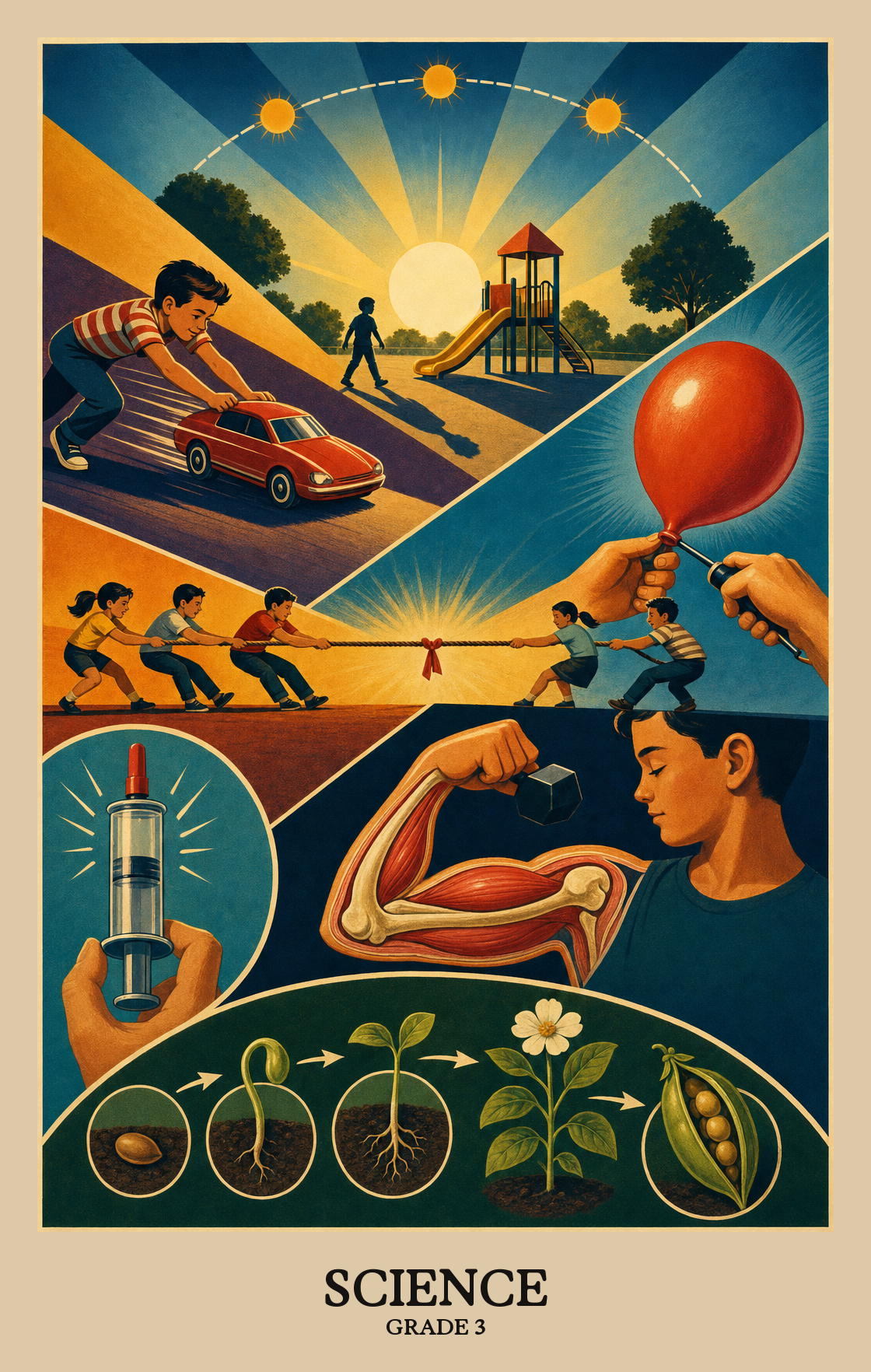
This is the year science gets hands-on, with students testing ideas instead of just naming parts. Students push and pull objects to see how forces change speed, and they figure out that even air takes up space. They learn how skin, bones, and muscles keep the body working, and how plants grow from seed to seed. By spring, students can explain why a shadow moves across the playground during the day.
Students look closely at solids, liquids, and gases. They figure out that air is real stuff that takes up space, and they watch what happens to things like ice and water when they heat up or cool down.
Students experiment with how forces make things start, stop, or change direction. They compare which objects move faster over the same distance and notice how gravity pulls everything back toward the ground.
Students rub their hands together and feel friction make heat. They test how warmth moves from a hot object to a cooler one, by touching and from a short distance away.
Students learn how bones and muscles work together to move the body and how skin keeps it safe. They also study the parts of a plant, what each part does, and how a seed grows into a new plant.
Students test what plants need to survive, like water, light, and good soil. They look at different kinds of soil and notice why some are better for growing than others.
Students place Earth in the solar system with the sun, planets, and moons. They track shadows during the day, watch star patterns across the sky, and use models to compare oceans, rivers, mountains, and valleys.
Students observe what happens to materials like ice, clay, or paper when they're cut, heated, or mixed. The focus is on what changed and what stayed the same.
Students gather simple evidence, like a balloon that expands or a plastic bag that puffs up, to argue that air is a real substance with mass that takes up space even though they can't see it.
Students sort everyday materials like rocks, water, and air into groups based on what those materials look, feel, or do. They run simple tests and use the results to explain why each material counts as a solid, liquid, or gas.
When matter heats up or cools down, its properties can change. Students look at what happened before and after, then use that evidence to explain why the change occurred.
| Standard | Definition | Code |
|---|---|---|
| Understand the structure and properties of matter before and after they undergo… | Students observe what happens to materials like ice, clay, or paper when they're cut, heated, or mixed. The focus is on what changed and what stayed the same. | PS.3.1 |
| Engage in argument from evidence to infer that air is a substance… | Students gather simple evidence, like a balloon that expands or a plastic bag that puffs up, to argue that air is a real substance with mass that takes up space even though they can't see it. | PS.3.1.1 |
| Carry out investigations to classify solids, liquids | Students sort everyday materials like rocks, water, and air into groups based on what those materials look, feel, or do. They run simple tests and use the results to explain why each material counts as a solid, liquid, or gas. | PS.3.1.2 |
| Engage in argument from evidence to explain observable changes to… | When matter heats up or cools down, its properties can change. Students look at what happened before and after, then use that evidence to explain why the change occurred. | PS.3.1.3 |
Students learn what makes things move, speed up, slow down, or change direction. They also explore how pushes, pulls, and other forces affect the way objects move.
Students push, pull, or drop objects and watch how the force changes where they go or how fast they move. The goal is to connect what they did to what changed.
Students time two moving objects over the same distance and decide which one is faster. Speed is compared by how long each object takes to finish the trip, not by guessing.
Students use drawings or physical models to show why objects fall down instead of up. Gravity is the force pulling everything toward Earth, whether the object is a ball in the air or a rock on the ground.
| Standard | Definition | Code |
|---|---|---|
| Understand motion and factors that affect motion | Students learn what makes things move, speed up, slow down, or change direction. They also explore how pushes, pulls, and other forces affect the way objects move. | PS.3.2 |
| Carry out investigations to infer changes in speed or direction resulting… | Students push, pull, or drop objects and watch how the force changes where they go or how fast they move. The goal is to connect what they did to what changed. | PS.3.2.1 |
| Carry out investigations to compare the relative speeds | Students time two moving objects over the same distance and decide which one is faster. Speed is compared by how long each object takes to finish the trip, not by guessing. | PS.3.2.2 |
| Use models to explain the effect of Earth's gravity on the motion of any object… | Students use drawings or physical models to show why objects fall down instead of up. Gravity is the force pulling everything toward Earth, whether the object is a ball in the air or a rock on the ground. | PS.3.2.3 |
Energy moves between objects when they interact. Students learn how a moving ball can push another ball, how heat travels from a warm hand to a cold surface, and how light can warm an object it hits.
Rubbing two objects together creates heat. Students ask questions about why that happens and test examples like rubbing their hands together or dragging an eraser across paper.
Students investigate how heat moves from a warmer object to a cooler one, either by touching (like a warm hand on a cold cup) or across a gap (like sunlight warming your skin).
| Standard | Definition | Code |
|---|---|---|
| Understand how energy can be transferred from one object to another | Energy moves between objects when they interact. Students learn how a moving ball can push another ball, how heat travels from a warm hand to a cold surface, and how light can warm an object it hits. | PS.3.3 |
| Ask questions to explain how heat is created by friction | Rubbing two objects together creates heat. Students ask questions about why that happens and test examples like rubbing their hands together or dragging an eraser across paper. | PS.3.3.1 |
| Carry out investigations to explain how energy can be transferred from a warmer… | Students investigate how heat moves from a warmer object to a cooler one, either by touching (like a warm hand on a cold cup) or across a gap (like sunlight warming your skin). | PS.3.3.2 |
The skin, bones, and muscles work together to protect the body, hold it upright, and keep it moving. Students learn what each system does and why the body needs all of them.
Students use models of bones and muscles to figure out what each part does, like how bones hold the body upright and muscles move it.
Skin does more than cover the body. Students learn why skin acts as a barrier that keeps out germs, holds in moisture, and helps the body stay healthy.
Plants have roots, stems, and leaves that each do a specific job. Students learn how those parts help a plant get water, stay upright, and make food from sunlight.
Plants have roots, stems, leaves, and flowers, and each part does a specific job to keep the plant alive. Students investigate what those parts do and why plants matter to other living things.
Students use drawings or models to show how a seed grows into a plant, flowers, makes new seeds, and starts the cycle over again.
| Standard | Definition | Code |
|---|---|---|
| Understand human body systems and how they are essential for life: protection… | The skin, bones, and muscles work together to protect the body, hold it upright, and keep it moving. Students learn what each system does and why the body needs all of them. | LS.3.1 |
| Use models to infer the functions of the skeletal and muscular systems | Students use models of bones and muscles to figure out what each part does, like how bones hold the body upright and muscles move it. | LS.3.1.1 |
| Obtain, evaluate, and communicate scientific information to explain why skin is… | Skin does more than cover the body. Students learn why skin acts as a barrier that keeps out germs, holds in moisture, and helps the body stay healthy. | LS.3.1.2 |
| Understand how plant structures aid in survival | Plants have roots, stems, and leaves that each do a specific job. Students learn how those parts help a plant get water, stay upright, and make food from sunlight. | LS.3.2 |
| Carry out investigations to explain the structures and functions of plants… | Plants have roots, stems, leaves, and flowers, and each part does a specific job to keep the plant alive. Students investigate what those parts do and why plants matter to other living things. | LS.3.2.1 |
| Use models to exemplify the distinct stages of the life cycle of seed plants | Students use drawings or models to show how a seed grows into a plant, flowers, makes new seeds, and starts the cycle over again. | LS.3.2.2 |
Plants need the right conditions to survive. Students learn how sunlight, water, soil, and temperature affect whether a plant grows or dies.
Students test how sunlight, water, and soil affect whether plants grow well or die. They run simple experiments and use what they observe to explain why plants thrive in some places and struggle in others.
Students look at soil samples and explain how differences in texture, color, and what's mixed in (sand, clay, bits of organic matter) affect whether plants can take root and grow there.
| Standard | Definition | Code |
|---|---|---|
| Understand how environmental factors aid in the survival of plants | Plants need the right conditions to survive. Students learn how sunlight, water, soil, and temperature affect whether a plant grows or dies. | LS.3.3 |
| Carry out investigations to explain how environmental conditions determine how… | Students test how sunlight, water, and soil affect whether plants grow well or die. They run simple experiments and use what they observe to explain why plants thrive in some places and struggle in others. | LS.3.3.1 |
| Construct an explanation to infer how the basic properties and components of… | Students look at soil samples and explain how differences in texture, color, and what's mixed in (sand, clay, bits of organic matter) affect whether plants can take root and grow there. | LS.3.3.2 |
Students learn what the Sun, Moon, and Earth are made of and how they move together. They study patterns like why the Moon seems to change shape each night and why the Sun rises and sets each day.
Students use diagrams or models to see where Earth fits in the solar system. Earth is the third planet from the sun, which is actually a star, and it travels around the sun along with other planets and their moons.
Shadows change length and direction as the sun moves across the sky. Students measure or observe a shadow at different times of day to see how the sun's position shifts from morning to afternoon.
Stars follow the same path across the sky every day. Students learn to spot those repeating patterns and explain why the sun, like other stars, rises and sets in a predictable arc.
| Standard | Definition | Code |
|---|---|---|
| Remember the major components and patterns observed in the earth/moon/sun… | Students learn what the Sun, Moon, and Earth are made of and how they move together. They study patterns like why the Moon seems to change shape each night and why the Sun rises and sets each day. | ESS.3.1 |
| Use models to recognize that the Earth is part of a system called the… | Students use diagrams or models to see where Earth fits in the solar system. Earth is the third planet from the sun, which is actually a star, and it travels around the sun along with other planets and their moons. | ESS.3.1.1 |
| Carry out investigations to recognize that changes in the length and direction… | Shadows change length and direction as the sun moves across the sky. Students measure or observe a shadow at different times of day to see how the sun's position shifts from morning to afternoon. | ESS.3.1.2 |
| Obtain, evaluate and communicate information to recognize the patterns of the… | Stars follow the same path across the sky every day. Students learn to spot those repeating patterns and explain why the sun, like other stars, rises and sets in a predictable arc. | ESS.3.1.3 |
Students use models like diagrams and globes to learn the shapes and layers that make up Earth's surface, from mountains and valleys to the ground beneath their feet.
Students sort Earth's water into two groups: saltwater bodies like oceans and seas, and freshwater bodies like rivers, lakes, and glaciers. They use maps or models to compare where each type is found.
Students use models like diagrams or clay sculptures to compare land features found on Earth. They look at how a volcano, mountain, valley, canyon, cavern, and island each have a different shape and form.
| Standard | Definition | Code |
|---|---|---|
| Understand the structures of the Earth’s surface using models | Students use models like diagrams and globes to learn the shapes and layers that make up Earth's surface, from mountains and valleys to the ground beneath their feet. | ESS.3.2 |
| Use models to compare Earth's saltwater and freshwater features | Students sort Earth's water into two groups: saltwater bodies like oceans and seas, and freshwater bodies like rivers, lakes, and glaciers. They use maps or models to compare where each type is found. | ESS.3.2.1 |
| Use models to compare Earth's land features | Students use models like diagrams or clay sculptures to compare land features found on Earth. They look at how a volcano, mountain, valley, canyon, cavern, and island each have a different shape and form. | ESS.3.2.2 |
Alternate assessment for eligible students with significant cognitive disabilities, covering state-tested grades and subjects.
Students study matter (solids, liquids, gases, and air), motion and forces, heat and energy, the human body, plants and soil, and the Earth, sun, and moon. A lot of it is hands-on investigation, not just reading about science.
Talk about what students notice. Watch ice melt in a glass, push a toy car down a ramp at different angles, or look at shadows in the yard at breakfast and again at dinner. Ask what changed and why. Five minutes of curiosity goes a long way.
Students make a claim, like air takes up space, and back it up with what they saw in an investigation. At home, ask students to explain how they know something is true, not just what they think.
Matter and motion pair well in the fall because both rely on simple investigations with everyday objects. Save the solar system and Earth features for later, once students are comfortable using models to explain ideas they cannot directly touch.
Gravity gets confused with weight or magnetism. Friction and heat transfer also trip students up. Plan extra investigations where students feel the friction of rubbing hands together or compare how fast a warm spoon cools in air versus water.
No. Ice cubes, balloons, rubber bands, toy cars, soil from outside, a flashlight, and a few seeds cover most of the year. Students learn more from a simple investigation they run themselves than from a polished demonstration.
Plant a few bean seeds in cups with different soil or different amounts of light. Check them every few days and talk about what looks healthy. Even one windowsill experiment helps students see how roots, stems, and leaves do their jobs.
Students can plan a simple investigation, record what they see, and explain a result using evidence. They can name the planets in order from the sun, describe how shadows change during the day, and explain how bones, muscles, and skin work together.
Students track how a shadow's length and direction change from morning to afternoon. At home, mark a shadow on the sidewalk with chalk in the morning and check it again at lunch and dinner. The pattern is the lesson.