Skip to content

What does a student learn in ?

This is the year social studies zooms in on the local community and the state. Students look at how different groups, leaders, and natural resources shaped the towns and regions around them. They start using maps, old photos, and short readings to compare how people lived then and now. By spring, students can explain why their community grew where it did and name a few groups whose work and traditions still show up today.

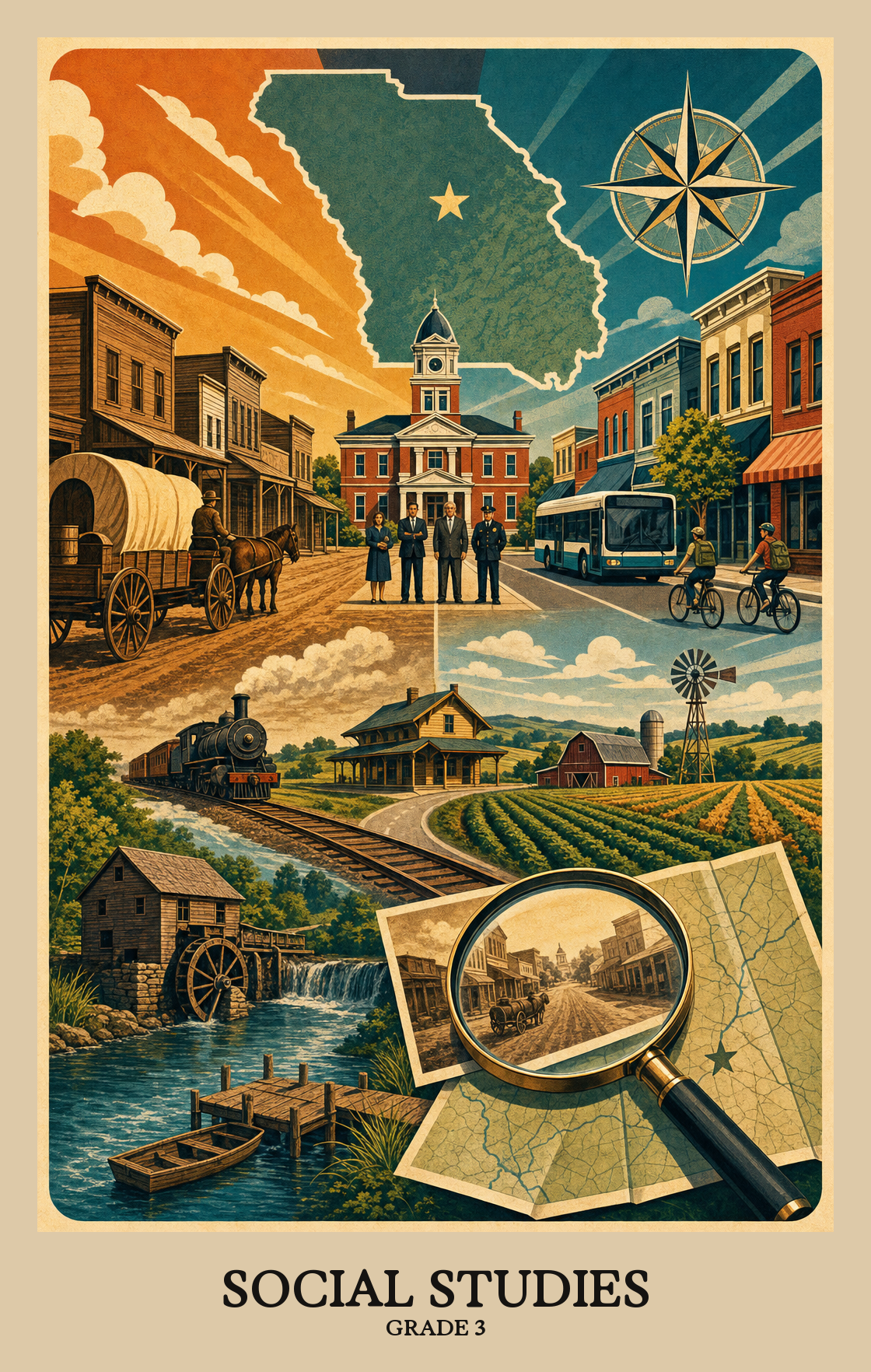
Illustration of what students learn in Grade 3 Social Studies
  • Local community
  • State and local government
  • Maps and geography
  • Natural resources
  • Cultures and traditions
  • Primary sources
Source: North Carolina NC Standard Course of Study
Year at a glance
How the year usually goes. Every school and district set their own curriculum, so treat this as a guide, not official pacing.
  1. 1

    People who built our community

    Students start the year looking at the groups who shaped their town and state. They learn how families from different backgrounds, traditions, and faiths brought ideas and customs that still show up in local life today.

  2. 2

    Maps, land, and weather

    Students study where their community sits and how the land and climate around it shape daily life. They look at how rivers, mountains, and roads decide what gets grown, built, and traded nearby.

  3. 3

    How local economies work

    Students learn where the things they use come from and why prices go up or down. They look at local business owners and how natural resources like farmland or timber turn into goods people buy.

  4. 4

    State and local government

    Students learn the difference between the people who run their town, their county, and the state. They look at what mayors, governors, and tribal leaders actually do and how those leaders solve everyday problems.

  5. 5

    History that shaped our town

    Students close the year by studying real events and people from their community's past. They read old photos, letters, and articles to see how the same event can be told in more than one way.

Mastery Learning Standards
The required skills a student should display by the end of Grade 3.
Behavioral Sciences
  • Understand how values and beliefs of individuals and groups influence…

    3.B.1

    Values are the ideas people care most about, like fairness or family. Students explore how those beliefs shape the rules, traditions, and choices that make each community look and act the way it does.

  • Explain how the values, beliefs

    3.B.1.1

    Different families and groups bring their own traditions, beliefs, and ways of life into a community. Students explain how those differences have shaped the neighborhoods, towns, and state where they live.

  • Compare values, beliefs, cultural practices and traditions of various groups…

    3.B.1.2

    Students look at two or more groups in their community and compare what those groups value, believe, and celebrate. The goal is to see how different backgrounds shape the same neighborhood.

Civics and Government
  • Understand the structure and function of state and local government

    3.C&G.1

    Students learn how state and local governments are organized and what they actually do, like passing laws, running schools, and keeping communities safe.

  • Compare the structure and function of both state and local government

    3.C&G.1.1

    State government runs the whole state; local government runs your town or city. Students compare how each is set up and what decisions each one makes.

  • Classify the roles and responsibilities of leaders in state and local…

    3.C&G.1.2

    Students sort out who does what in their city, county, and state. They learn which leaders make laws, which ones carry out rules, and what sets each job apart.

  • Compare how state, local

    3.C&G.1.3

    State, local, and tribal governments each solve community problems in different ways. Students compare those approaches to see how government decisions affect the people nearby.

Economics
  • Explain how entrepreneurship develops local communities

    3.E.1.1

    Entrepreneurs start businesses that create jobs and bring new goods or services to a neighborhood. Students learn how those choices shape the local economy over time.

  • Explain how the natural resources of a region impact the production and…

    3.E.1.2

    Natural resources shape what a local area makes and buys. Students explain how things like forests, rivers, or farmland lead to certain jobs, products, and businesses in a community.

  • Summarize the role supply and demand plays in local economies

    3.E.1.3

    Supply and demand explain why prices rise when a product is hard to find and drop when there is plenty of it. Students learn how those shifts shape what local businesses charge and what people in the community can afford to buy.

Geography
  • Understand how geography impacts the development of regions and communities

    3.G.1

    Geography shapes where people build towns, what jobs they do, and how communities grow. Students explore how features like rivers, mountains, and climate influence the way a place develops over time.

  • Explain how the absolute and relative location of places impacts the…

    3.G.1.1

    A place's exact address on a map and its distance from nearby cities, roads, or water shapes how a community grows. Students explain why towns form where they do and how location affects daily life.

  • Explain how climate and physical characteristics affect the ways in which…

    3.G.1.2

    Climate and landforms shape how people dress, build homes, and grow food. Students explain why people in a desert live differently than people near a mountain or ocean.

  • Explain how movement of goods, people

    3.G.1.3

    Geography shapes how people travel, trade, and share ideas. Students learn how mountains, rivers, and coastlines change the routes people use to move goods from place to place.

History
  • Understand how various people and historical events have shaped…

    3.H.1

    Local history isn't just dates. Students learn how the people and events of the past shaped the neighborhood, town, or city they live in today.

  • Explain how the experiences and achievements of women, indigenous, religious

    3.H.1.1

    Students look at real people from different backgrounds in their community's past and explain what those people built, started, or changed. The goal is to see how a wide range of voices shaped the town or neighborhood students live in today.

  • Explain the lasting impact historical events have had on local communities

    3.H.1.2

    Historical events leave marks on communities that last for generations. Students look at how a past event, like a war, a flood, or a founding, changed the way a local community looks, works, or celebrates today.

  • Use primary and secondary sources to compare multiple interpretations of…

    3.H.1.3

    Students look at photos, maps, old documents, and written accounts to figure out how different people remember or explain the same local event or symbol. The same history can mean different things to different people.

No state assessments at this grade
Students take their next one in Grade 4.
National Monitoring

NAEP (National Assessment of Educational Progress)

Federally administered sample-based assessment in reading, mathematics, science, writing, and other subjects. NAEP results inform state-by-state comparisons rather than individual student or school accountability.

When given:
biennial in winter
Frequency:
every two years
Official source
Common Questions
  • What does third grade social studies focus on this year?

    Students study their local community and state. They look at how geography, history, government, money, and the people who live in a place all shape what that community is like today.

  • How can families help at home?

    Talk about the town and state on car rides and at dinner. Point out the mayor on the news, notice where food at the store comes from, and share family stories about where relatives have lived. Ten minutes of real conversation does a lot.

  • What does my child need to know about government?

    Students should be able to name some jobs in state and local government, like mayor, governor, and council member, and explain what those leaders do. A quick way to practice is watching a short local news clip together and asking who is in charge of fixing the problem.

  • Why is there so much focus on different groups of people?

    Students learn that a community is built by many groups over time, including Native nations, immigrants, and people of different religions and backgrounds. The goal is for students to see how each group has shaped where they live, not just read a list of names.

  • How should the year be sequenced?

    A common arc starts with geography and location, moves into the people and history of the community, then builds into government and economics once students have context. Saving supply, demand, and entrepreneurship for later in the year gives students the background they need to make sense of it.

  • Which standards usually need the most reteaching?

    Supply and demand and the difference between state and local government tend to be the stickiest. Short, concrete examples help more than definitions, like a lemonade stand running out of cups or a pothole that the city fixes instead of the governor.

  • How are primary and secondary sources used at this grade?

    Students compare two tellings of the same local event or symbol, such as a old photo next to a textbook paragraph. The point is to notice that sources can disagree and to ask why, not to write a formal analysis.

  • How do I know my child is ready for fourth grade?

    By spring, students should be able to describe their community and state, name a few important people and events from local history, explain what leaders do, and give an example of how geography shapes daily life. If they can talk about those things at dinner, they are in good shape.

  • What is a good end-of-year bar for mastery?

    Students can explain how location, resources, people, and leaders all work together to shape a community, and can back up claims with a specific example from the state or town. Look for students reaching for evidence on their own, not waiting to be prompted.