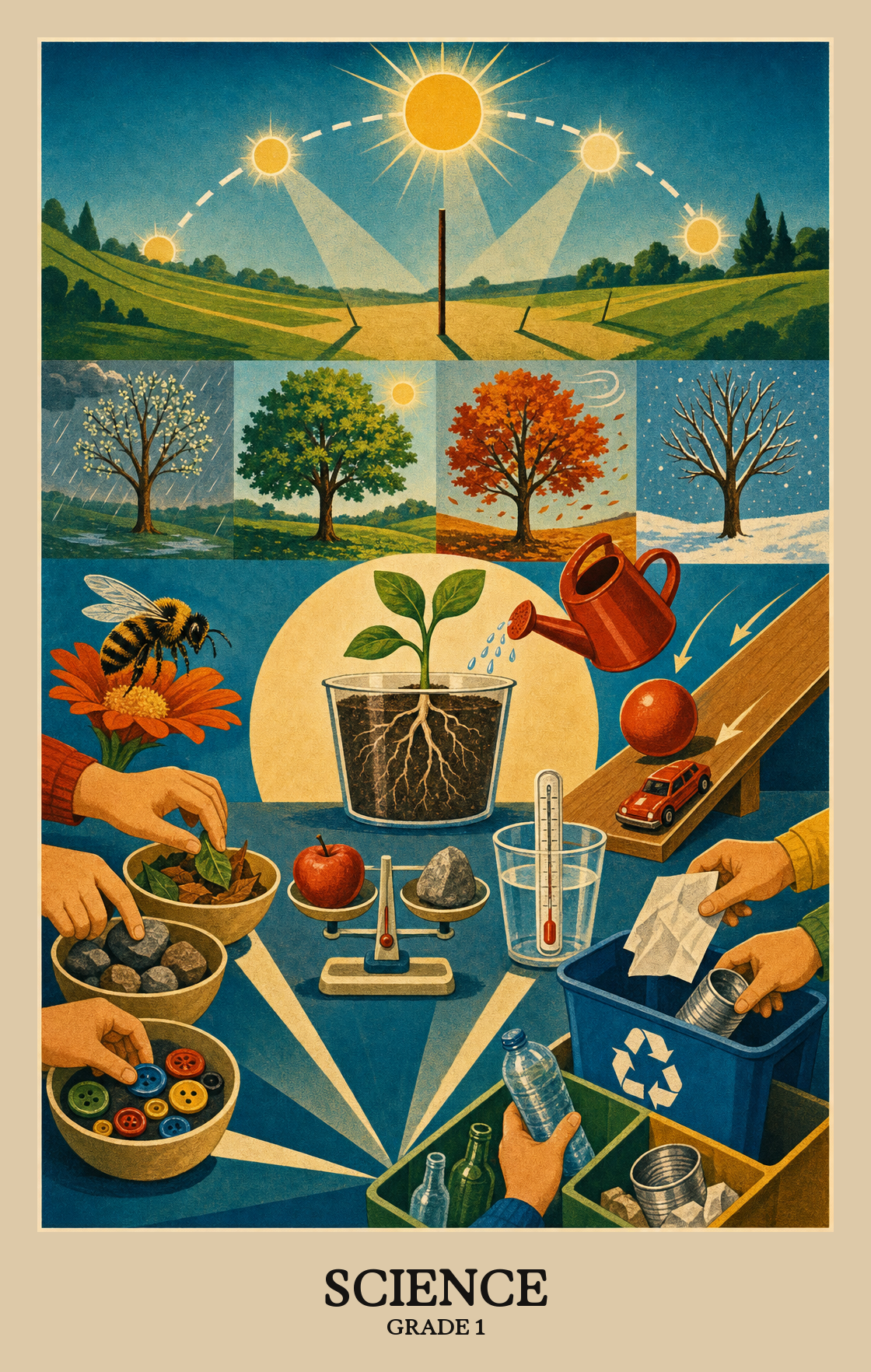
The student will demonstrate an understanding of scientific and engineering… | Students ask questions, make predictions, and test ideas the way scientists do. These practices run through every science topic they study in first grade. | 1.1 |
asking questions and defining problems | Students ask questions about things they notice and describe a problem clearly enough that someone else could understand it. | 1.1.a |
ask questions and make predictions based on observations | Students look at something closely, then ask questions about what they notice and guess what might happen next. | 1.1.a.i |
identify a simple problem that can be solved through the development of a new… | Students look at something that doesn't work well and name what the problem is. That first step, spotting the problem, is what engineers do before they build or improve a tool. | 1.1.a.ii |
planning and carrying out investigations | Students plan a simple test, gather what they need, and record what happens. This is how scientists check whether their ideas hold up. | 1.1.b |
with guidance, conduct investigations to produce data | Students practice running simple experiments with a teacher's help, collecting information along the way to answer a science question. | 1.1.b.i |
identify characteristics and properties of objects by observations | Students look closely at objects and describe what they notice: color, shape, size, texture, or whether something is heavy or light. This is how scientists start figuring out how things work. | 1.1.b.ii |
use tools to measure relative length, weight, volume | Students use rulers, scales, measuring cups, and thermometers to compare how long, heavy, full, or warm everyday objects are. | 1.1.b.iii |
| | Students look at results from an experiment or observation and decide what the data shows. They ask whether the numbers or patterns make sense and what conclusion they support. | 1.1.c |
use and share pictures, drawings, and/or writings of observations | Students record what they notice during science activities by drawing pictures or writing notes, then share their observations with the class. | 1.1.c.i |
describe patterns and relationships | Students look at data or observations they have collected and explain what they notice repeating or changing. They practice putting those patterns into words a classmate could understand. | 1.1.c.ii |
classify and arrange objects based on a single physical characteristic or… | Students sort objects into groups by picking one feature to focus on, such as color, size, shape, or texture. Everything in the group shares that one trait. | 1.1.c.iii |
organize and represent various forms of data using tables, picture graphs | Students sort information from a science activity into a simple table or picture graph so patterns are easier to see. | 1.1.c.iv |
read and interpret data displayed in tables, picture graphs | Students read simple charts and picture graphs, then describe what the data shows using words like "more," "less," and "equal to." | 1.1.c.v |
constructing and critiquing conclusions and explanations | Students look at what they observed and decide what it means, then explain why they think so. They also listen to a classmate's explanation and say whether the evidence supports it. | 1.1.d |
make simple conclusions based on data or observations | Students look at what they found out from an experiment or observation and say what it means. For example, if a plant grew taller near the window, they explain why that might be. | 1.1.d.i |
recognize unusual or unexpected results | When an experiment turns out differently than expected, students notice the surprise and treat it as worth investigating, not ignoring. | 1.1.d.ii |
developing and using models | Students draw pictures, build simple objects, or act out ideas to show how something works. A model helps students explain their thinking before they can fully put it into words. | 1.1.e |
use physical models to demonstrate simple phenomena and natural processes | Students build or use a hands-on model, like a paper mountain or a bowl of water, to show how something in nature works. | 1.1.e.i |
| | Students read simple books, charts, or pictures to find information about a science topic, then share what they learned by drawing, talking, or writing about it. | 1.1.f |
communicate observations and data using simple graphs, pictures, drawings… | Students record what they notice by drawing pictures, making simple graphs, and writing or talking about what they found. | 1.1.f.i |