Being a good classmate
Students start the year learning how a classroom works together. They practice honesty, kindness, following rules, taking turns, and voting on small classroom choices.
This is the year social studies stretches beyond the classroom to the wider community and to Virginia itself. Students learn how citizens treat each other, why rules matter, and how voting works in a classroom and a state. They meet people from Virginia's past, from Pocahontas and George Washington to Maggie L. Walker and Arthur Ashe, and they start reading simple maps with a key and compass rose. By spring, students can name Virginia symbols, point to Virginia on a map, and explain the difference between a need and a want.
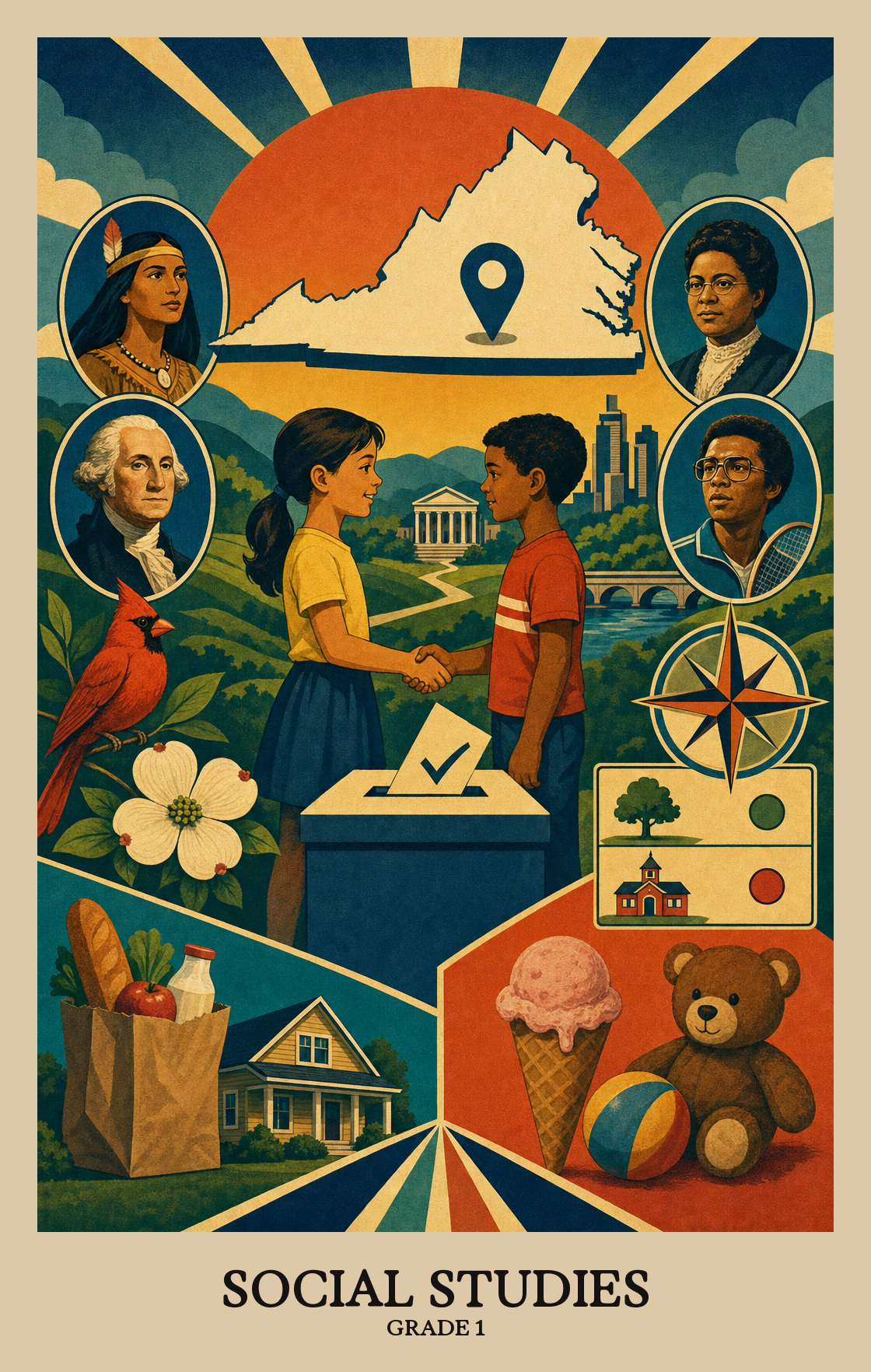
Students start the year learning how a classroom works together. They practice honesty, kindness, following rules, taking turns, and voting on small classroom choices.
Students learn the Pledge of Allegiance and the National Anthem, and find out what the stars, stripes, and colors of the flag stand for. They also talk about holidays like Veterans Day, Thanksgiving, and Martin Luther King, Jr. Day.
Students use simple maps to find land, water, cities, and roads. They practice north, south, east, and west, and locate Virginia, the United States, and the oceans on a map or globe.
Students hear stories about the people who built and changed Virginia, from Chief Powhatan and Pocahontas to George Washington, Maggie L. Walker, and Arthur Ashe. They also learn about Jamestown and how life in Virginia has changed.
Students learn the difference between goods and services and see how people can be both shoppers and workers. They talk about earning, saving, and choosing needs before wants.
Reading maps, timelines, and pictures, students learn to ask questions, find information, and explain what they discovered about people, places, and events.
Students look at real objects, photos, maps, and charts to find information. They practice using different kinds of sources, not just textbooks, to answer questions about the world around them.
Students use maps and simple pictures of places to find and describe geographic features like hills, rivers, and oceans.
Students ask questions about what they see, read, or hear to figure out why things happen or how the world works.
Students put events or facts in order, from first to last, and sort related ideas into groups. This is how they make sense of what they read, see, and discuss in social studies.
Students look at two things side by side and explain what makes them alike and what makes them different. This helps them understand the people, places, and events they are learning about.
Cause and effect means one thing makes another thing happen. Students look at events or situations and figure out why something happened and what it led to.
Students practice deciding how to spend or save a limited amount of money by weighing what they want against what things cost. They learn that choosing one thing often means giving up another.
Students practice being a good classmate and community member: listening to others, doing their best work, and taking responsibility for their actions.
Students practice using the right words when talking or writing about history, maps, and community. Knowing the vocabulary helps them explain what they learned in their own sentences.
| Standard | Definition | Code |
|---|---|---|
| The student will apply history and social science skills to the content by | Reading maps, timelines, and pictures, students learn to ask questions, find information, and explain what they discovered about people, places, and events. | S.1 |
| viewing and exploring information sources, including | Students look at real objects, photos, maps, and charts to find information. They practice using different kinds of sources, not just textbooks, to answer questions about the world around them. | S.1.a |
| applying geographic skills to identify and understand geographic features | Students use maps and simple pictures of places to find and describe geographic features like hills, rivers, and oceans. | S.1.b |
| demonstrating curiosity and critical thinking through questioning | Students ask questions about what they see, read, or hear to figure out why things happen or how the world works. | S.1.c |
| sequencing and organizing information | Students put events or facts in order, from first to last, and sort related ideas into groups. This is how they make sense of what they read, see, and discuss in social studies. | S.1.d |
| identifying similarities and differences to clarify and explain content | Students look at two things side by side and explain what makes them alike and what makes them different. This helps them understand the people, places, and events they are learning about. | S.1.e |
| recognizing cause-and-effect relationships | Cause and effect means one thing makes another thing happen. Students look at events or situations and figure out why something happened and what it led to. | S.1.f |
| using economic decision-making models to make informed economic decisions | Students practice deciding how to spend or save a limited amount of money by weighing what they want against what things cost. They learn that choosing one thing often means giving up another. | S.1.g |
| practicing civility, respect, hard work | Students practice being a good classmate and community member: listening to others, doing their best work, and taking responsibility for their actions. | S.1.h |
| using content vocabulary to demonstrate comprehension | Students practice using the right words when talking or writing about history, maps, and community. Knowing the vocabulary helps them explain what they learned in their own sentences. | S.1.i |
Citizenship in the classroom means following rules, taking turns, and treating classmates with respect. Students practice the habits of a good community member every day at school.
Students practice being honest and kind, including toward themselves. These habits are the foundation of how a classroom community works together.
Students learn why classrooms have rules and practice stopping to think before they act.
Students learn to treat classmates with respect and recognize that different families celebrate different holidays, eat different foods, and follow different customs. Those differences are worth noticing and appreciating.
Students practice working as a group to get something done, like finishing a class project, by listening to others and taking turns sharing ideas.
Students practice being a community member by taking on classroom jobs and helping at home or school. Small tasks like passing out supplies or tidying up show how each person's effort helps the group.
Students vote on classroom decisions, like choosing a game or a class activity. Voting is how a group makes fair choices when people disagree.
Local leaders like mayors and state lawmakers get their jobs through elections. Students learn that citizens choose their representatives by voting.
Students learn why communities celebrate shared holidays and local traditions. They practice recognizing specific Virginia and national observances and explaining what those days mean.
Labor Day is a national holiday in September that honors working people. Students learn why communities set aside this day to recognize the jobs adults do to keep neighborhoods, towns, and the country running.
Students learn why Columbus Day, also called Yorktown Victory Day in Virginia, is set aside as a holiday and what it marks in the state's history.
Election Day is the day communities vote to choose their leaders. Students learn why voting matters and how people in Virginia and across the country take part in picking who makes decisions for them.
Students learn why Veterans Day exists and what it honors. The holiday recognizes the men and women who have served in the United States military.
Thanksgiving Day is a national holiday in November when Americans pause to reflect on what they are grateful for. Students learn why communities celebrate it and how it connects to Virginia's history and traditions.
Students learn that Christmas Day on December 25 is one of Virginia's official holidays, when many families and communities pause work and school to celebrate traditions together.
Students learn that New Year's Day on January 1 marks the start of a new calendar year. It is one of Virginia's official holidays, a day communities and families recognize together.
Students learn why the country honors Martin Luther King, Jr. each January. The holiday marks his work to make sure all people were treated fairly, no matter their race.
Students learn why Virginia sets aside a day to honor George Washington, the first U.S. president, and what his leadership meant for the country.
Memorial Day is a national holiday in late May when communities pause to honor military members who died in service. Students learn why this day is set aside and how people mark it with ceremonies and remembrance.
Students learn what Juneteenth marks: the day in 1865 when enslaved people in Texas heard they were free, months after the Emancipation Proclamation. It is now a national holiday honoring the end of slavery in the United States.
Independence Day is the Fourth of July holiday when Americans celebrate the country's birthday. Students learn why communities mark this day each year and what it means for the United States.
Symbols like the American flag and phrases like the Pledge of Allegiance are part of how the country honors its history. Students learn what those symbols mean and why Americans use them.
Students learn the words to the Pledge of Allegiance and the National Anthem, and practice the respectful gestures Americans use when honoring the flag.
Students learn what the colors, stars, and stripes on the American flag stand for and why each part was chosen.
Students learn Virginia's official symbols: the state flag, the capitol building in Richmond, the cardinal, and the dogwood flower.
Symbols like the flag and songs like the national anthem remind people of shared values and history. Students explain why communities use these symbols and keep up traditions to show pride in their country.
| Standard | Definition | Code |
|---|---|---|
| The student will apply history and social science skills to practice… | Citizenship in the classroom means following rules, taking turns, and treating classmates with respect. Students practice the habits of a good community member every day at school. | 1.1 |
| practicing honesty and showing kindness to oneself and others | Students practice being honest and kind, including toward themselves. These habits are the foundation of how a classroom community works together. | 1.1.a |
| recognizing the purpose of rules and practicing self-control | Students learn why classrooms have rules and practice stopping to think before they act. | 1.1.b |
| being respectful of others and celebrating differences in ethnic origins… | Students learn to treat classmates with respect and recognize that different families celebrate different holidays, eat different foods, and follow different customs. Those differences are worth noticing and appreciating. | 1.1.c |
| working respectfully with one another to achieve a goal | Students practice working as a group to get something done, like finishing a class project, by listening to others and taking turns sharing ideas. | 1.1.d |
| contributing one’s time and talents to help others in their homes, schools | Students practice being a community member by taking on classroom jobs and helping at home or school. Small tasks like passing out supplies or tidying up show how each person's effort helps the group. | 1.1.e |
| participating in classroom decision-making by voting | Students vote on classroom decisions, like choosing a game or a class activity. Voting is how a group makes fair choices when people disagree. | 1.1.f |
| understanding that local and state government representatives are elected by… | Local leaders like mayors and state lawmakers get their jobs through elections. Students learn that citizens choose their representatives by voting. | 1.1.g |
| The student will apply history and social science skills to explain how… | Students learn why communities celebrate shared holidays and local traditions. They practice recognizing specific Virginia and national observances and explaining what those days mean. | 1.2 |
| Labor Day | Labor Day is a national holiday in September that honors working people. Students learn why communities set aside this day to recognize the jobs adults do to keep neighborhoods, towns, and the country running. | 1.2.a |
| Columbus Day (Yorktown Victory Day) | Students learn why Columbus Day, also called Yorktown Victory Day in Virginia, is set aside as a holiday and what it marks in the state's history. | 1.2.b |
| Election Day | Election Day is the day communities vote to choose their leaders. Students learn why voting matters and how people in Virginia and across the country take part in picking who makes decisions for them. | 1.2.c |
| Veterans Day | Students learn why Veterans Day exists and what it honors. The holiday recognizes the men and women who have served in the United States military. | 1.2.d |
| Thanksgiving Day | Thanksgiving Day is a national holiday in November when Americans pause to reflect on what they are grateful for. Students learn why communities celebrate it and how it connects to Virginia's history and traditions. | 1.2.e |
| Christmas Day | Students learn that Christmas Day on December 25 is one of Virginia's official holidays, when many families and communities pause work and school to celebrate traditions together. | 1.2.f |
| New Year’s Day | Students learn that New Year's Day on January 1 marks the start of a new calendar year. It is one of Virginia's official holidays, a day communities and families recognize together. | 1.2.g |
| Martin Luther King, Jr | Students learn why the country honors Martin Luther King, Jr. each January. The holiday marks his work to make sure all people were treated fairly, no matter their race. | 1.2.h |
| George Washington Day | Students learn why Virginia sets aside a day to honor George Washington, the first U.S. president, and what his leadership meant for the country. | 1.2.i |
| Memorial Day | Memorial Day is a national holiday in late May when communities pause to honor military members who died in service. Students learn why this day is set aside and how people mark it with ceremonies and remembrance. | 1.2.j |
| Juneteenth | Students learn what Juneteenth marks: the day in 1865 when enslaved people in Texas heard they were free, months after the Emancipation Proclamation. It is now a national holiday honoring the end of slavery in the United States. | 1.2.k |
| Independence Day | Independence Day is the Fourth of July holiday when Americans celebrate the country's birthday. Students learn why communities mark this day each year and what it means for the United States. | 1.2.l |
| The student will apply history and social science skills to describe the… | Symbols like the American flag and phrases like the Pledge of Allegiance are part of how the country honors its history. Students learn what those symbols mean and why Americans use them. | 1.3 |
| learning the Pledge of Allegiance and the National Anthem and the ways people… | Students learn the words to the Pledge of Allegiance and the National Anthem, and practice the respectful gestures Americans use when honoring the flag. | 1.3.a |
| explaining the symbolism of the colors, stars | Students learn what the colors, stars, and stripes on the American flag stand for and why each part was chosen. | 1.3.b |
| identifying the Virginia flag, state capitol building, the cardinal as the… | Students learn Virginia's official symbols: the state flag, the capitol building in Richmond, the cardinal, and the dogwood flower. | 1.3.c |
| explaining why people use symbols and have traditions | Symbols like the flag and songs like the national anthem remind people of shared values and history. Students explain why communities use these symbols and keep up traditions to show pride in their country. | 1.3.d |
Students learn about Virginia's past by reading simple sources, asking questions about what happened, and explaining what they find using maps, timelines, or pictures.
Students learn about the earliest settlements in Virginia, including a Powhatan village called Werowocomoco and the first English colony at Jamestown. They describe what those places were and why they mattered.
Students look at how a town or neighborhood in Virginia used to look and work, then describe what changed over the years. They might compare old photos, tools, or daily routines to what people use and do today.
Students find their own city or county on a map of Virginia and point to where it sits in relation to other places in the state.
Students learn about real people who changed life in Virginia, from explorers and founders to activists and leaders. They look at what those people did and why it still matters to Virginians today.
Students learn who Chief Powhatan and Pocahontas were, why they mattered to the people already living in Virginia long before European settlers arrived, and how their stories connect to the history of the land we now call Virginia.
Students learn who John Smith and Christopher Newport were and why they matter to Virginia's story. These two explorers arrived in the early 1600s and helped establish Jamestown, one of the first permanent English settlements in America.
Students learn who George Washington, Thomas Jefferson, James Madison, and James Monroe were, and why each one mattered to Virginia and to the country they helped build.
Students learn about Virginians who broke through unfair barriers to achieve something no one who looked like them had done before, and how their actions changed life in Virginia for the better.
| Standard | Definition | Code |
|---|---|---|
| The student will apply history and social science skills to understand… | Students learn about Virginia's past by reading simple sources, asking questions about what happened, and explaining what they find using maps, timelines, or pictures. | 1.4 |
| identifying and describing important events and locations throughout the early… | Students learn about the earliest settlements in Virginia, including a Powhatan village called Werowocomoco and the first English colony at Jamestown. They describe what those places were and why they mattered. | 1.4.a |
| describing how life in various Virginia communities has changed over time | Students look at how a town or neighborhood in Virginia used to look and work, then describe what changed over the years. They might compare old photos, tools, or daily routines to what people use and do today. | 1.4.b |
| identifying local cities or counties on a map of Virginia | Students find their own city or county on a map of Virginia and point to where it sits in relation to other places in the state. | 1.4.c |
| The student will apply history and social science skills to describe… | Students learn about real people who changed life in Virginia, from explorers and founders to activists and leaders. They look at what those people did and why it still matters to Virginians today. | 1.5 |
| Indigenous peoples: Chief Powhatan and Pocahontas | Students learn who Chief Powhatan and Pocahontas were, why they mattered to the people already living in Virginia long before European settlers arrived, and how their stories connect to the history of the land we now call Virginia. | 1.5.a |
| Explorers: John Smith and Christopher Newport | Students learn who John Smith and Christopher Newport were and why they matter to Virginia's story. These two explorers arrived in the early 1600s and helped establish Jamestown, one of the first permanent English settlements in America. | 1.5.b |
| Presidents: George Washington, Thomas Jefferson, James Madison | Students learn who George Washington, Thomas Jefferson, James Madison, and James Monroe were, and why each one mattered to Virginia and to the country they helped build. | 1.5.c |
| Barrier Breakers: John Mercer Langston, Booker T | Students learn about Virginians who broke through unfair barriers to achieve something no one who looked like them had done before, and how their actions changed life in Virginia for the better. | 1.5.d |
Students learn to read simple maps and globes, identify basic landforms like mountains and rivers, and connect places to everyday life. Geography at this level builds the habit of asking "where is this, and why does it matter?"
Reading a simple map, students identify what symbols stand for: which shapes mark land or water, where cities appear, and how roads connect them.
Reading a map, students use North, South, East, and West to describe where places are and how to get from one place to another.
Students find Virginia, the United States, the continents, and the oceans on a map or globe. They practice pointing to where things are in the world, from their home state all the way out to the largest landmasses and bodies of water.
Students draw a basic map of a place, then add a title, a key that explains the symbols, and a compass rose showing which direction is north.
Students learn how place and location shaped important events in Virginia and U.S. history. They practice connecting where something happened to why it happened the way it did.
Students learn to name Virginia's mountains, rivers, and coastline, then explain how those features shape where people build homes, grow food, or travel.
Virginia sits far enough north that temperatures shift with the seasons. Students learn why the state gets cold winters, warm summers, and two seasons in between, all because of where Virginia sits on the map.
Students find Jamestown on a map and learn why early English settlers chose that spot in Virginia. This is one of the first places Europeans built a lasting settlement in America.
Students find Richmond and Washington, D.C., on a map of Virginia and a map of the United States, learning where the state capital and the nation's capital sit in relation to each other.
| Standard | Definition | Code |
|---|---|---|
| The student will apply history and social science skills to develop geographic… | Students learn to read simple maps and globes, identify basic landforms like mountains and rivers, and connect places to everyday life. Geography at this level builds the habit of asking "where is this, and why does it matter?" | 1.6 |
| using basic map symbols, including references to land, water, cities | Reading a simple map, students identify what symbols stand for: which shapes mark land or water, where cities appear, and how roads connect them. | 1.6.a |
| using cardinal directions on maps | Reading a map, students use North, South, East, and West to describe where places are and how to get from one place to another. | 1.6.b |
| locating Virginia, the United States, continents | Students find Virginia, the United States, the continents, and the oceans on a map or globe. They practice pointing to where things are in the world, from their home state all the way out to the largest landmasses and bodies of water. | 1.6.c |
| constructing simple maps and including a title, map legend or key | Students draw a basic map of a place, then add a title, a key that explains the symbols, and a compass rose showing which direction is north. | 1.6.d |
| The student will apply history and social science skills to connect geography… | Students learn how place and location shaped important events in Virginia and U.S. history. They practice connecting where something happened to why it happened the way it did. | 1.7 |
| identifying landforms and bodies of water of Virginia and describing how they… | Students learn to name Virginia's mountains, rivers, and coastline, then explain how those features shape where people build homes, grow food, or travel. | 1.7.a |
| understanding that the location of Virginia determines its climate and results… | Virginia sits far enough north that temperatures shift with the seasons. Students learn why the state gets cold winters, warm summers, and two seasons in between, all because of where Virginia sits on the map. | 1.7.b |
| locating the site of the Jamestown colony | Students find Jamestown on a map and learn why early English settlers chose that spot in Virginia. This is one of the first places Europeans built a lasting settlement in America. | 1.7.c |
| locating Richmond and Washington, D.C., on Virginia and United States maps | Students find Richmond and Washington, D.C., on a map of Virginia and a map of the United States, learning where the state capital and the nation's capital sit in relation to each other. | 1.7.d |
Students learn that people choose how to spend money or time based on what they need most. They practice explaining why buying food comes before buying a toy, and what gets given up when a choice is made.
Goods are things you can hold, like food or clothing. Services are things people do for you, like a haircut or a doctor visit. Students learn to tell the difference between the two.
People who buy goods or services are consumers. People who make or provide them are producers. Students learn that the same person can be both, like a baker who sells bread but also buys flour.
Students learn why people work for money and how saving up lets them buy things they need or want, like food, clothing, or a toy.
Students name things made or grown in Virginia (like apples or furniture) and services people provide there (like teaching or fixing cars). This shows how Virginia workers meet the needs of people in their community.
Needs are things people must have, like food and shelter. Wants are things people would like but can live without. Students learn why having limited money means choosing needs first.
| Standard | Definition | Code |
|---|---|---|
| The student will apply history and social science skills to explain how… | Students learn that people choose how to spend money or time based on what they need most. They practice explaining why buying food comes before buying a toy, and what gets given up when a choice is made. | 1.8 |
| identifying the difference between goods and services | Goods are things you can hold, like food or clothing. Services are things people do for you, like a haircut or a doctor visit. Students learn to tell the difference between the two. | 1.8.a |
| describing how people can be both consumers and producers | People who buy goods or services are consumers. People who make or provide them are producers. Students learn that the same person can be both, like a baker who sells bread but also buys flour. | 1.8.b |
| describing ways people work to earn and save money to purchase goods and… | Students learn why people work for money and how saving up lets them buy things they need or want, like food, clothing, or a toy. | 1.8.c |
| describing goods and services produced in Virginia | Students name things made or grown in Virginia (like apples or furniture) and services people provide there (like teaching or fixing cars). This shows how Virginia workers meet the needs of people in their community. | 1.8.d |
| describing why people must make choices, prioritizing needs over wants | Needs are things people must have, like food and shelter. Wants are things people would like but can live without. Students learn why having limited money means choosing needs first. | 1.8.e |
Alternate assessment program for eligible students with significant cognitive disabilities, covering state-tested grades and subjects.
Students learn how to be a good classmate, how maps work, who some important people from Virginia history were, and how money and jobs fit together. They also learn the Pledge of Allegiance, the meaning of the flag, and which holidays the country celebrates and why.
Talk about why rules exist at home, point out the flag when out and about, and read picture books about presidents or Pocahontas. When buying groceries, mention the choice between what is needed and what is wanted. Small conversations add up.
Students should recognize the holidays and know roughly why each one matters, not recite dates. For the people, they should know a name, what the person did, and why it still matters. Stories stick better than lists.
Students should find Virginia, the United States, the oceans, and the continents on a map or globe. They should use north, south, east, and west, read a simple map key, and draw a basic map with a title, key, and compass rose.
A common path is to start with classroom citizenship and rules, move into symbols and holidays as they come up on the calendar, then build Virginia history and geography in the winter, and finish with economics in the spring. Anchor each unit in a few names, places, and vocabulary words.
Cardinal directions and map keys take repeated practice, and students often mix up goods and services. Plan short weekly map warm-ups and sort real items into goods and services so the vocabulary sticks.
Pick picture books about George Washington, Pocahontas, Booker T. Washington, Maggie Walker, or Arthur Ashe. After reading, ask what the person did and why people still talk about them today. One question is enough.
By the end of the year, students should explain why rules matter, name a few Virginia changemakers and what they did, locate Virginia and Jamestown on a map, and tell the difference between a need and a want. Comfort with these basics matters more than perfect recall.