Thinking and working like a scientist
Students learn to ask questions they can actually test, plan a fair experiment, and measure with rulers, scales, and timers. They practice turning numbers into bar graphs and line graphs they can explain.
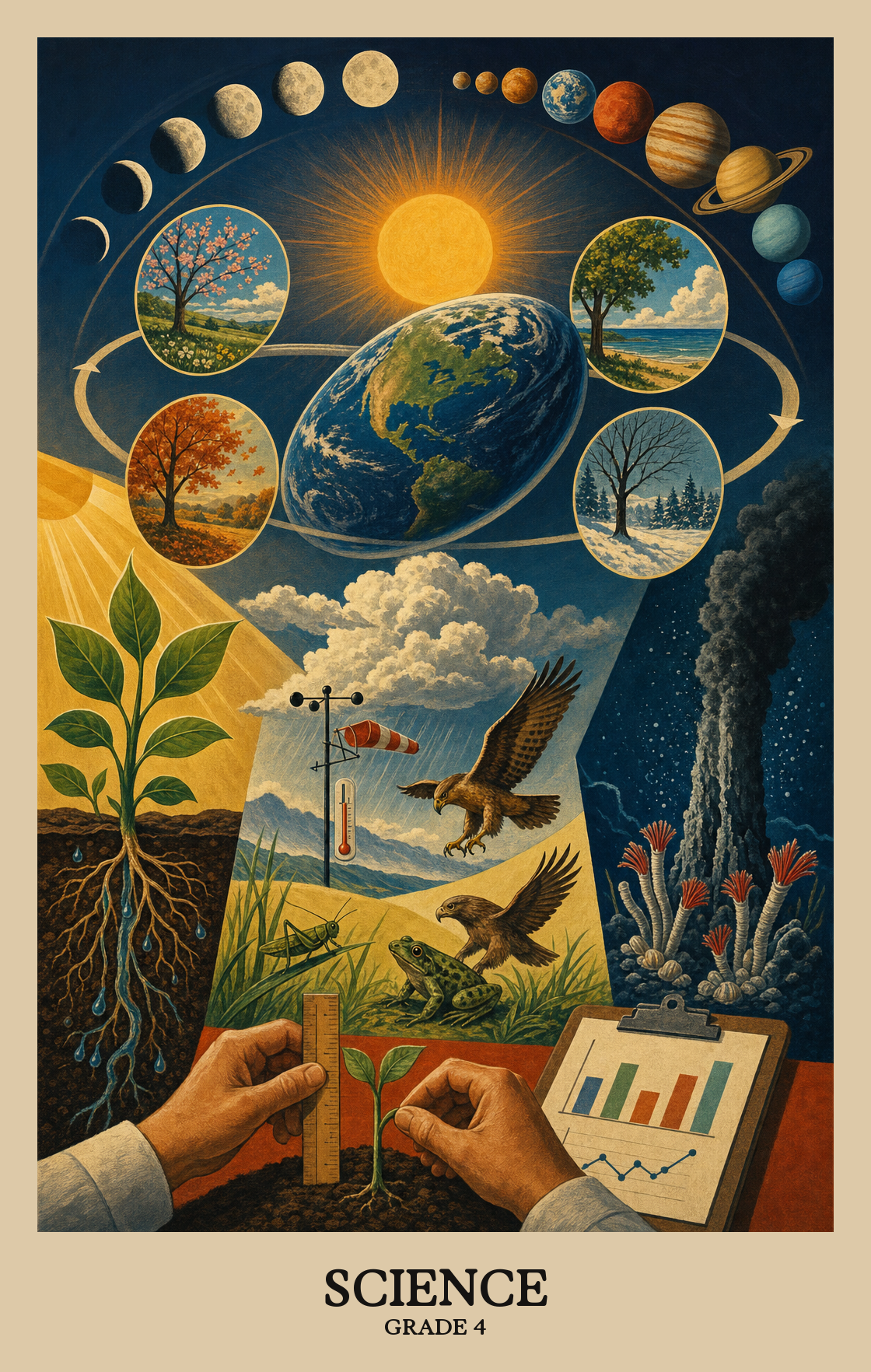
This is the year science zooms out from the backyard to the whole solar system and the ocean floor. Students learn how plants make their own food, how animals fit into food webs, and how weather, seasons, and moon phases connect. They also start working like scientists, planning small experiments and turning their measurements into bar graphs and line graphs. By spring, students can explain why Earth has seasons and name the planets in order from the sun.
Students learn to ask questions they can actually test, plan a fair experiment, and measure with rulers, scales, and timers. They practice turning numbers into bar graphs and line graphs they can explain.
Students study how plants make their own food from sunlight and how animals get energy by eating other living things. They map who eats whom in a food web and sort living things into groups.
Students track temperature, wind, and rain to make short weather forecasts. They look at how storms shape the land and animals around them, and why one place has different seasons than another.
Students figure out why day turns to night, why the moon looks different each week, and why summer feels different from winter. They compare the planets by size and order out from the sun.
Students explore what the ocean floor looks like and how waves and tides move water around. They finish the year looking at Virginia's rivers, forests, soil, and rocks, and why people work to protect them.
Scientific and engineering practices are the habits scientists and engineers actually use: asking questions, testing ideas, collecting data, and explaining what the results mean.
Students learn to ask a focused question about something they observe, or describe a problem clearly enough that it can be tested or solved.
Students sort questions into two groups: ones science can test by observing or measuring, and ones it can't. A question like "How fast does ice melt?" is testable; "What flavor is best?" is not.
Students write a prediction that names a cause and its expected effect, such as "if I add more salt to water, it will take longer to freeze." The hypothesis must connect a specific change to a specific result.
Students spot a real problem (something that leaks, breaks, or doesn't work) and put it into words clearly enough that someone else could try to solve it.
Students design a simple test or experiment, decide what to observe and measure, then carry it out to collect real data. The question drives the plan.
Students pick out what they plan to change and what they plan to measure before an experiment begins. That choice keeps the test fair and the results trustworthy.
Students work with a partner or small group to design a simple test, then carry it out together to answer a science question.
Students pick materials and put together a simple device meant to solve a real problem. The focus is on making something that works, not just planning it on paper.
Students measure length, mass, and liquid volume using metric units, choosing the right tool for the job, like a ruler for centimeters or a scale for grams.
Students practice reading a clock or stopwatch to find how much time passed between a start and an end point, then record that measurement in seconds, minutes, or hours.
Students look at data from an experiment, spot patterns, and decide what the results mean. They judge whether the data actually supports their conclusion.
Students record measurements or counts in bar graphs and line graphs so patterns in the data are easier to spot.
Reading a bar graph or line graph, students pull out patterns and explain what the numbers actually show.
Reading the same data shown two different ways, like a chart and a graph, and explaining what's the same or different between them.
Students look at test results to decide whether an object or tool did what it was supposed to do. If the results show a problem, students use that information to explain what went wrong.
Students write a conclusion that explains what their experiment showed, then review conclusions from classmates to find gaps or questions the data doesn't answer.
Students look at measurements and patterns they collected to explain why something happened or to make a reasonable guess about what they didn't directly observe.
Students build or draw models to show how something works or why something happens. A model might be a diagram, a physical object, or a sketch that stands in for a real process they can't observe directly.
Students build or use diagrams, drawings, or physical models to show how something in nature works, then explain what the model reveals.
Models (like a drawing of the solar system or a plastic globe) leave things out or get the scale wrong. Students learn to spot what a model cannot show and explain why the real thing is more complex.
Students read science texts, diagrams, and other sources to find useful information, then decide what's reliable and share what they learned with others.
Students read science articles, videos, or other reliable sources written at their grade level, then use what they learned to support their science work.
Students share what they found or built by writing, drawing, or talking it through with classmates or adults. The goal is to explain results or design ideas clearly enough that someone else can understand them.
| Standard | Definition | Code |
|---|---|---|
| The student will demonstrate an understanding of scientific and engineering… | Scientific and engineering practices are the habits scientists and engineers actually use: asking questions, testing ideas, collecting data, and explaining what the results mean. | 4.1 |
| asking questions and defining problems | Students learn to ask a focused question about something they observe, or describe a problem clearly enough that it can be tested or solved. | 4.1.a |
| identify scientific and non-scientific questions | Students sort questions into two groups: ones science can test by observing or measuring, and ones it can't. A question like "How fast does ice melt?" is testable; "What flavor is best?" is not. | 4.1.a.i |
| develop hypotheses as cause-and-effect relations | Students write a prediction that names a cause and its expected effect, such as "if I add more salt to water, it will take longer to freeze." The hypothesis must connect a specific change to a specific result. | 4.1.a.ii |
| define a simple design problem that can be solved through the development of an… | Students spot a real problem (something that leaks, breaks, or doesn't work) and put it into words clearly enough that someone else could try to solve it. | 4.1.a.iii |
| planning and carrying out investigations | Students design a simple test or experiment, decide what to observe and measure, then carry it out to collect real data. The question drives the plan. | 4.1.b |
| identify variables when planning an investigation | Students pick out what they plan to change and what they plan to measure before an experiment begins. That choice keeps the test fair and the results trustworthy. | 4.1.b.i |
| collaboratively plan and conduct investigations | Students work with a partner or small group to design a simple test, then carry it out together to answer a science question. | 4.1.b.ii |
| use tools and/or materials to design and/or build a device that solves a… | Students pick materials and put together a simple device meant to solve a real problem. The focus is on making something that works, not just planning it on paper. | 4.1.b.iii |
| take metric measurements using appropriate tools | Students measure length, mass, and liquid volume using metric units, choosing the right tool for the job, like a ruler for centimeters or a scale for grams. | 4.1.b.iv |
| measure elapsed time | Students practice reading a clock or stopwatch to find how much time passed between a start and an end point, then record that measurement in seconds, minutes, or hours. | 4.1.b.v |
| interpreting, analyzing | Students look at data from an experiment, spot patterns, and decide what the results mean. They judge whether the data actually supports their conclusion. | 4.1.c |
| organize and represent data in bar graphs and line graphs | Students record measurements or counts in bar graphs and line graphs so patterns in the data are easier to spot. | 4.1.c.i |
| interpret and analyze data represented in bar graphs and line graphs | Reading a bar graph or line graph, students pull out patterns and explain what the numbers actually show. | 4.1.c.ii |
| compare two different representations of the same data | Reading the same data shown two different ways, like a chart and a graph, and explaining what's the same or different between them. | 4.1.c.iii |
| analyze data from tests of an object or tool to determine whether it works as… | Students look at test results to decide whether an object or tool did what it was supposed to do. If the results show a problem, students use that information to explain what went wrong. | 4.1.c.iv |
| constructing and critiquing conclusions and explanations | Students write a conclusion that explains what their experiment showed, then review conclusions from classmates to find gaps or questions the data doesn't answer. | 4.1.d |
| use evidence (i.e., measurements, observations, patterns) to construct or… | Students look at measurements and patterns they collected to explain why something happened or to make a reasonable guess about what they didn't directly observe. | 4.1.d.i |
| developing and using models | Students build or draw models to show how something works or why something happens. A model might be a diagram, a physical object, or a sketch that stands in for a real process they can't observe directly. | 4.1.e |
| develop and/or use models to explain natural phenomena | Students build or use diagrams, drawings, or physical models to show how something in nature works, then explain what the model reveals. | 4.1.e.i |
| identify limitations of models | Models (like a drawing of the solar system or a plastic globe) leave things out or get the scale wrong. Students learn to spot what a model cannot show and explain why the real thing is more complex. | 4.1.e.ii |
| obtaining, evaluating | Students read science texts, diagrams, and other sources to find useful information, then decide what's reliable and share what they learned with others. | 4.1.f |
| read and comprehend reading-level-appropriate texts and/or other reliable media | Students read science articles, videos, or other reliable sources written at their grade level, then use what they learned to support their science work. | 4.1.f.i |
| communicate scientific information, design ideas, and/or solutions with others | Students share what they found or built by writing, drawing, or talking it through with classmates or adults. The goal is to explain results or design ideas clearly enough that someone else can understand them. | 4.1.f.ii |
Plants and animals have body parts built for survival. Students study how those structures, like roots, leaves, wings, or shells, set each living thing apart and help it find food, stay safe, and grow.
Plants make their own food using sunlight, water, and air through a process called photosynthesis. Animals depend on that food too, so if plants can't photosynthesize, the whole food chain breaks down.
Plants get energy from sunlight through their leaves. Animals get energy by eating plants or other animals. Students learn how those two different approaches shape the body parts each living thing has.
Plants and animals each have their own way of making offspring. Students learn how flowers and seeds work for plants, and how animal reproduction differs from that process.
Living things depend on other living things and on nonliving parts of their environment, like water, soil, and sunlight. Students investigate how those connections work and what happens when one part of the system changes.
Plants, animals, and other living things in an area depend on each other to survive. A change to one species, like a predator disappearing or a plant dying off, ripples through everything else sharing that space.
A food web is a map of what eats what in a habitat. Students learn how energy moves from plants to plant-eaters to predators, and what happens to the whole web when one creature disappears.
As animals and plants grow, their habitat and role in the ecosystem can shift. A tadpole lives in water and eats algae; the frog it becomes hunts insects on land.
Classification sorts living things into groups based on shared traits, like body covering or number of legs. Students use those groupings to figure out what an unknown organism is.
| Standard | Definition | Code |
|---|---|---|
| The student will investigate and understand that plants and animals have… | Plants and animals have body parts built for survival. Students study how those structures, like roots, leaves, wings, or shells, set each living thing apart and help it find food, stay safe, and grow. | 4.2 |
| the survival of plants and animals depends on photosynthesis | Plants make their own food using sunlight, water, and air through a process called photosynthesis. Animals depend on that food too, so if plants can't photosynthesize, the whole food chain breaks down. | 4.2.a |
| plants and animals have different structures and processes for obtaining energy | Plants get energy from sunlight through their leaves. Animals get energy by eating plants or other animals. Students learn how those two different approaches shape the body parts each living thing has. | 4.2.b |
| plants and animals have different structures and processes for creating… | Plants and animals each have their own way of making offspring. Students learn how flowers and seeds work for plants, and how animal reproduction differs from that process. | 4.2.c |
| The student will investigate and understand that organisms, including humans… | Living things depend on other living things and on nonliving parts of their environment, like water, soil, and sunlight. Students investigate how those connections work and what happens when one part of the system changes. | 4.3 |
| interrelationships exist in populations, communities | Plants, animals, and other living things in an area depend on each other to survive. A change to one species, like a predator disappearing or a plant dying off, ripples through everything else sharing that space. | 4.3.a |
| food webs show the flow of energy within an ecosystem | A food web is a map of what eats what in a habitat. Students learn how energy moves from plants to plant-eaters to predators, and what happens to the whole web when one creature disappears. | 4.3.b |
| changes in an organism's niche and habitat may occur at various stages in its… | As animals and plants grow, their habitat and role in the ecosystem can shift. A tadpole lives in water and eats algae; the frog it becomes hunts insects on land. | 4.3.c |
| classification can be used to identify organisms | Classification sorts living things into groups based on shared traits, like body covering or number of legs. Students use those groupings to figure out what an unknown organism is. | 4.3.d |
Weather shapes what plants and animals can survive in a given place. Students study how storms, temperature changes, and seasonal patterns affect living things, and how scientists use data to forecast what's coming.
Weather records built from temperature, rainfall, and wind readings let forecasters spot patterns and predict what conditions are likely next. Students learn how tracking past weather helps make sense of future storms, heat waves, or dry spells.
Weather shapes what lives where. Students explore how events like droughts, floods, and storms change ecosystems, shifting which plants and animals can survive in a given place.
Seasons repeat the same patterns of heat, rain, and cold year after year. Those long-term patterns, not just last week's weather, define what the climate of a place is really like.
Planets differ in size, appearance, and distance from the Sun. Students learn where each planet sits in the solar system and what makes it distinct from the others.
Planets spin slowly on an invisible center line, like a top, while also traveling a long oval path around the sun. Students learn the difference between a planet's daily spin and its yearly trip around the sun.
Planets differ in size, color, and composition, and each one sits in a fixed position from the Sun. Students learn the order of the eight planets and what makes each one distinct.
Students compare the sizes of the sun and planets, learning that the sun dwarfs every planet and that planets range widely in size from each other.
Earth, the moon, and the sun move in predictable patterns that explain what students can see in the sky. Students learn why the moon appears to change shape each night and why Earth has seasons, day and night, and tides.
Students learn how Earth spins daily to create day and night, orbits the sun each year to create seasons, and how the moon circles Earth to create its changing phases.
Students learn why summer and winter happen. As Earth orbits the sun, its tilt points different parts of the planet toward or away from the sun, changing the temperature and day length each season.
Students learn why the moon looks different each week and how those same changes in the moon's position pull on Earth's oceans to make tides rise and fall.
Students compare Earth, the moon, and the sun by size, distance, age, and what they're made of. The sun dwarfs both Earth and the moon, and each formed at different times from different materials.
Oceans cover most of Earth's surface and have their own conditions, including saltwater, varying depths, currents, and living things found nowhere else on land. Students study what makes the ocean a distinct environment.
Students learn what the bottom of the ocean looks like, including mountains, trenches, and flat plains that most people never see. It looks nothing like a flat sandy surface.
Students learn what ocean water is made of and why it moves. They explore how salt content, temperature, and waves or currents shape the way water behaves across the ocean.
Students study how ocean creatures depend on and affect each other, such as how a fish feeds on smaller organisms that rely on sunlight and nutrients from the water.
| Standard | Definition | Code |
|---|---|---|
| The student will investigate and understand that weather conditions and… | Weather shapes what plants and animals can survive in a given place. Students study how storms, temperature changes, and seasonal patterns affect living things, and how scientists use data to forecast what's coming. | 4.4 |
| weather measurements create a record that can be used to make weather… | Weather records built from temperature, rainfall, and wind readings let forecasters spot patterns and predict what conditions are likely next. Students learn how tracking past weather helps make sense of future storms, heat waves, or dry spells. | 4.4.a |
| common and extreme weather events affect ecosystems | Weather shapes what lives where. Students explore how events like droughts, floods, and storms change ecosystems, shifting which plants and animals can survive in a given place. | 4.4.b |
| long term seasonal weather trends determine the climate of a region | Seasons repeat the same patterns of heat, rain, and cold year after year. Those long-term patterns, not just last week's weather, define what the climate of a place is really like. | 4.4.c |
| The student will investigate and understand that the planets have… | Planets differ in size, appearance, and distance from the Sun. Students learn where each planet sits in the solar system and what makes it distinct from the others. | 4.5 |
| planets rotate on their axes and revolve around the sun | Planets spin slowly on an invisible center line, like a top, while also traveling a long oval path around the sun. Students learn the difference between a planet's daily spin and its yearly trip around the sun. | 4.5.a |
| planets have characteristics and a specific order in the solar system | Planets differ in size, color, and composition, and each one sits in a fixed position from the Sun. Students learn the order of the eight planets and what makes each one distinct. | 4.5.b |
| the sizes of the sun and planets can be compared to one another | Students compare the sizes of the sun and planets, learning that the sun dwarfs every planet and that planets range widely in size from each other. | 4.5.c |
| The student will investigate and understand that there are relationships among… | Earth, the moon, and the sun move in predictable patterns that explain what students can see in the sky. Students learn why the moon appears to change shape each night and why Earth has seasons, day and night, and tides. | 4.6 |
| the motions of Earth, the moon | Students learn how Earth spins daily to create day and night, orbits the sun each year to create seasons, and how the moon circles Earth to create its changing phases. | 4.6.a |
| the causes for Earth's seasons | Students learn why summer and winter happen. As Earth orbits the sun, its tilt points different parts of the planet toward or away from the sun, changing the temperature and day length each season. | 4.6.b |
| the causes for the four major phases of the moon and the relationship to the… | Students learn why the moon looks different each week and how those same changes in the moon's position pull on Earth's oceans to make tides rise and fall. | 4.6.c |
| the relative size, position, age and makeup of Earth, the moon | Students compare Earth, the moon, and the sun by size, distance, age, and what they're made of. The sun dwarfs both Earth and the moon, and each formed at different times from different materials. | 4.6.d |
| The student will investigate and understand that the ocean environment has… | Oceans cover most of Earth's surface and have their own conditions, including saltwater, varying depths, currents, and living things found nowhere else on land. Students study what makes the ocean a distinct environment. | 4.7 |
| geology of the ocean floor | Students learn what the bottom of the ocean looks like, including mountains, trenches, and flat plains that most people never see. It looks nothing like a flat sandy surface. | 4.7.a |
| physical properties and movement of ocean water | Students learn what ocean water is made of and why it moves. They explore how salt content, temperature, and waves or currents shape the way water behaves across the ocean. | 4.7.b |
| interaction of organisms in the ocean | Students study how ocean creatures depend on and affect each other, such as how a fish feeds on smaller organisms that rely on sunlight and nutrients from the water. | 4.7.c |
Natural resources are materials found in nature that people use. Students explore what Virginia offers, from forests and farmland to coal, water, and wildlife, and learn why protecting those resources matters.
Students learn what a watershed is: the land area that funnels rain and snowmelt into a single river, lake, or stream. They explore how that water moves through the land and why keeping it clean matters.
Plants and animals are natural resources. Students learn how people use them for food, clothing, shelter, and other everyday needs.
Minerals and rocks are natural materials pulled from the ground. Ores are rocks that contain useful metals like iron or copper. Students learn how people identify and use these materials in everyday life.
Forests, soil, and farmland are natural resources people use every day. Students learn what makes these resources valuable and why replacing or restoring them takes much longer than using them up.
| Standard | Definition | Code |
|---|---|---|
| The student will investigate and understand that Virginia has important natural… | Natural resources are materials found in nature that people use. Students explore what Virginia offers, from forests and farmland to coal, water, and wildlife, and learn why protecting those resources matters. | 4.8 |
| watersheds and water | Students learn what a watershed is: the land area that funnels rain and snowmelt into a single river, lake, or stream. They explore how that water moves through the land and why keeping it clean matters. | 4.8.a |
| plants and animals | Plants and animals are natural resources. Students learn how people use them for food, clothing, shelter, and other everyday needs. | 4.8.b |
| minerals, rocks, and ores | Minerals and rocks are natural materials pulled from the ground. Ores are rocks that contain useful metals like iron or copper. Students learn how people identify and use these materials in everyday life. | 4.8.c |
| forests, soil, and land | Forests, soil, and farmland are natural resources people use every day. Students learn what makes these resources valuable and why replacing or restoring them takes much longer than using them up. | 4.8.d |
Alternate assessment program for eligible students with significant cognitive disabilities, covering state-tested grades and subjects.
Federally administered sample-based assessment in reading, mathematics, science, writing, and other subjects. NAEP results inform state-by-state comparisons rather than individual student or school accountability.
Students study living things and ecosystems, weather and the solar system, the ocean, and Virginia's natural resources. They also build science habits like asking questions, running fair tests, measuring with rulers and thermometers, and reading bar graphs and line graphs.
Talk about what students see outside. Watch the moon change shape over a month, check the weather each morning, or sort leaves by shape. Ask what they noticed and what they think caused it. Five minutes of real observation beats a worksheet.
Students should explain how plants make their own food, trace energy through a food web, name the planets in order, and explain why we have seasons and moon phases. They should also plan a simple fair test and graph the results.
Many teachers start with science practices and living systems in the fall while gardens and local habitats are still active. Weather and space fit well in winter when students can track daily conditions. Save oceans and Virginia resources for spring, when field trips and outdoor work are easier.
Moon phases and seasons trip students up because both involve motion they cannot see. Photosynthesis is also tricky since students want to say plants eat soil. Plan extra time with models, a lamp and a ball, and let students act out the motions.
Students should know the planets in order from the sun and the four main moon phases by name. Memorizing helps, but understanding matters more. Ask them to draw the moon each night for a month and talk about what changes.
Quite a bit. Students measure in centimeters, grams, and degrees, time events with a stopwatch, and read short articles about animals, weather, and rocks. Strong reading and measurement skills make the science work much smoother.
Students should name one thing they change, one thing they measure, and what they keep the same. A test of which soil grows beans best is a good example. Ask them to predict first, then compare the prediction to what actually happened.
Students should be able to plan a simple investigation, record data in a table, and turn it into a bar or line graph. They should also use evidence to explain what they found, instead of just saying what they think is true.