Skip to content

What does a student learn in ?

This is the year Virginia's own story comes into focus. Students walk through their state from the first peoples and Jamestown to the Revolution, the Civil War, segregation, and the civil rights leaders who pushed back. They learn to read maps, weigh primary sources, and trace cause and effect across centuries. By spring, students can name Virginia's regions, explain why the colony grew, and tell who fought for change during Jim Crow and beyond.

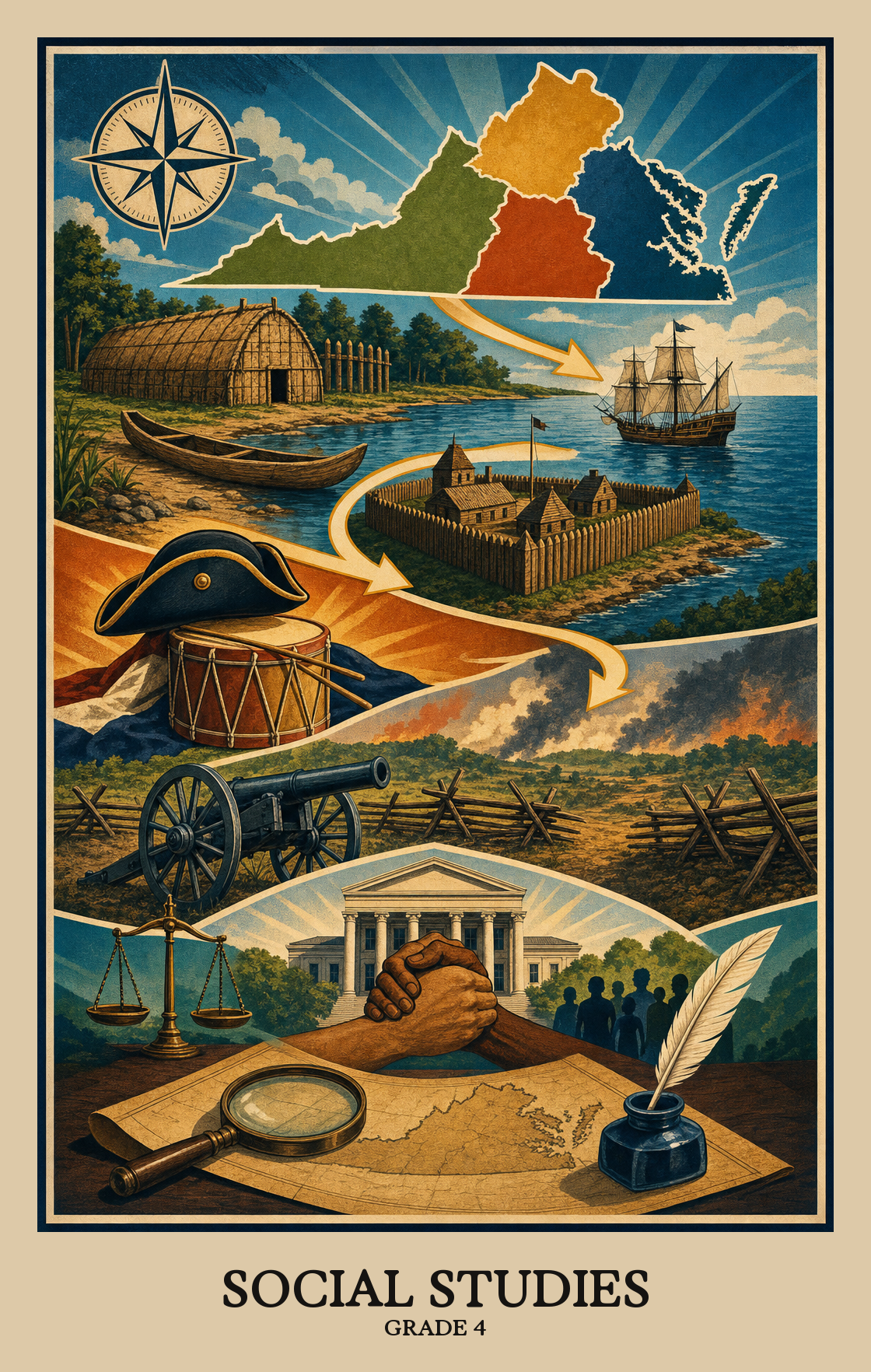
Illustration of what students learn in Grade 4 Social Studies
  • Virginia regions
  • Jamestown colony
  • American Revolution
  • Civil War
  • Reconstruction
  • Civil rights leaders
  • Maps and sources
Source: Virginia Virginia Standards of Learning
Year at a glance
How the year usually goes. Every school and district set their own curriculum, so treat this as a guide, not official pacing.
  1. 1

    Virginia's land and first peoples

    Students start with the map. They find Virginia, its neighboring states, its rivers and mountains, and the five regions that shape life there. They also learn about the Indigenous nations who lived on this land long before any settlers arrived.

  2. 2

    Jamestown and colonial life

    Students follow the English settlers who landed at Jamestown in 1607. They study why people came, how the colony survived through trade with the Powhatan and tobacco farming, and how the arrival of Africans and the start of race-based slavery shaped colonial Virginia.

  3. 3

    Revolution and a new nation

    Students meet Virginians like George Washington, Thomas Jefferson, and James Madison and learn why the colonies broke from Britain. They read about the ideas behind the Declaration of Independence and the Bill of Rights, and how the war ended with victory at Yorktown.

  4. 4

    Civil War and Reconstruction

    Students learn that slavery caused the Civil War and that many of its battles were fought on Virginia soil. They study people who resisted slavery, leaders on both sides, and the long struggle after the war through Reconstruction, Jim Crow laws, and segregation.

  5. 5

    Civil Rights and modern Virginia

    Students follow Virginia into the 1900s and today. They look at the World Wars, the fight to end segregated schools after Brown v. Board of Education, and the Virginians who led that work. They finish by looking at the jobs, products, and ideas that connect Virginia to the world now.

Mastery Learning Standards
The required skills a student should display by the end of Grade 4.
Skills
  • The student will apply history and social science skills to the content by

    S.VS

    Students use reading, writing, and research skills to explore history and social studies topics, pulling evidence from maps, charts, and other sources to ask questions and support their thinking.

  • analyzing and interpreting information sources, including but not limited to…

    S.VS.a

    Students practice reading maps, charts, photos, and written records to figure out what happened and why. They learn to tell the difference between a firsthand account and a summary written later.

  • applying geographic skills to identify and understand geographic features and…

    S.VS.b

    Students use maps, globes, and other geographic tools to find physical features like mountains and rivers and explain how those features connect to the way people live.

  • developing questions, enhancing curiosity

    S.VS.c

    Students form their own questions about history and society, then dig into sources to figure out what happened and why.

  • using evidence to construct timelines, classify events

    S.VS.d

    Students build timelines from real sources, sort historical events into categories, and decide whether a statement is a provable fact or someone's opinion.

  • comparing and contrasting people, places

    S.VS.e

    Students look at two people, places, or events side by side and explain what makes them alike and what sets them apart.

  • identifying cause-and-effect relationships to clarify and explain content

    S.VS.f

    Students read about a historical event or topic and explain what caused it to happen and what happened as a result.

  • using economic decision-making models to make informed economic decisions and…

    S.VS.g

    Students practice making money decisions by weighing tradeoffs, like whether to spend or save, and explaining why the choice they made was worth it.

  • practicing civility, respect, hard work, honesty, trustworthiness

    S.VS.h

    Students practice the habits that make classrooms and communities work: listening respectfully, following through on commitments, and being honest even when it's inconvenient.

  • developing products that reflect an understanding of content

    S.VS.i

    Students turn what they've learned into something real: a map, a poster, a short report, or another finished piece that shows they actually understood the topic.

Physical Geography
  • The student will apply history and social science skills to explain the…

    VS.1

    Reading maps and landforms helps explain why Virginians settled where they did, how the land shaped their work and daily life, and why those patterns still matter today.

  • locating Virginia and its bordering states on maps of the United States and…

    VS.1.a

    Students find Virginia on a map and name the states that share its borders.

  • locating and describing the relative location and physical characteristics of…

    VS.1.b

    Students identify Virginia's five geographic regions on a map and describe where each one sits relative to the others, including its terrain, waterways, and landforms.

  • locating, identifying

    VS.1.c

    Students find Virginia's rivers, bays, and coastline on a map and explain how those waterways shaped where people settled, how goods moved, and what communities grew up around them.

Virginia’s Indigenous Peoples
  • The student will apply history and social science skills to describe the…

    VS.2

    Students learn about Virginia's Native peoples, including who they were, where they lived, and how their communities have changed over time. This standard covers both their history and the nations that still exist in Virginia today.

  • describing how archaeologists have recovered artifacts from important places in…

    VS.2.a

    Archaeologists dig up objects left behind by Virginia's Indigenous peoples to learn how they lived. Werowocomoco, a major village site, is one place where those discoveries have shaped what we know about early Virginia history.

  • describing Virginia’s three most prominent Indigenous language groups

    VS.2.b

    Students learn about the three main Native American language groups that lived in Virginia before European arrival: the Algonquian, the Siouan, and the Iroquoian. Each group had its own language, territory, and way of life.

  • describing the diversity among the Indigenous nations

    VS.2.c

    Students learn that Virginia's Indigenous peoples were not one group with one culture. Different nations across the region spoke different languages, built different homes, and organized their communities in different ways.

  • describing the relationships and interactions of Virginia’s Indigenous Peoples…

    VS.2.d

    Students study how Virginia's Indigenous peoples in the 1600s used the land, water, and forests around them for food, shelter, and trade. The geography shaped where they lived and how they survived.

  • describing the lives and cultures of Virginia’s Indigenous Peoples leading to…

    VS.2.e

    Students trace how Virginia's Indigenous peoples, including the Powhatan, have lived, traded, and governed themselves from early history through today.

1607 through the American Revolution
  • The student will apply history and social science skills to explain the causes…

    VS.3

    Students trace what led settlers to found Jamestown in 1607 and what happened after: who survived, who didn't, and how that colony shaped early American life.

  • explaining the reasons for English colonization

    VS.3.a

    Students learn why England sent settlers to Virginia in the 1600s, focusing on the search for wealth, new trade routes, and land. The goal was profit and power, not just adventure.

  • describing the economic and geographic influences on the decision to settle at…

    VS.3.b

    Students explain why English settlers picked the Jamestown site, looking at what the land and water offered and what the Virginia Company hoped to gain.

  • describing the importance of the Virginia Company of London Charter

    VS.3.c

    The Virginia Company of London was a group of English investors who got a charter (an official permission document) from the king to start a settlement in America. That charter made Jamestown possible in 1607.

  • describing the interactions between the English colonists and the Indigenous…

    VS.3.d

    Early English colonists at Jamestown depended on the Powhatan people to survive. Students learn how the two groups traded, communicated, and sometimes clashed during the early years of the Virginia colony.

  • describing the hardships faced by settlers at Jamestown and the changes that…

    VS.3.e

    Students learn what nearly doomed the Jamestown settlement and what saved it. They look at starvation, disease, and conflict, then study how trade with the Powhatan, John Smith's leadership, and tobacco farming turned the colony around.

  • analyzing the impact of the arrival of Africans and women to the Jamestown…

    VS.3.f

    Students examine how enslaved Africans and women shaped daily life and survival at Jamestown, and why their presence changed what the settlement could do and become.

  • identifying the significance of establishing the General Assembly

    VS.3.g

    Students learn why the General Assembly, created in Virginia in 1619, mattered. It was the first time colonists in English America chose their own representatives to make laws, setting a pattern that shaped how Americans would govern themselves.

  • The student will apply history and social science skills to understand life in…

    VS.4

    Colonial Virginia comes to life through daily routines, laws, farming, and relationships between settlers and Native peoples. Students study how ordinary people lived, worked, and governed themselves in early Virginia.

  • explaining the importance and influence of agriculture

    VS.4.a

    Farming shaped daily life in colonial Virginia. Students learn how tobacco, wheat, and other crops drove the economy, determined who held power, and pulled enslaved Africans into the colony by force.

  • examining how colonial Virginia reflected the culture of Indigenous Peoples…

    VS.4.b

    Colonial Virginia was shaped by Native American, English, Scots-Irish, German, and African people. Students study how each group's language, customs, and daily life left a mark on the colony.

  • distinguishing between indentured servants and enslaved people, including how…

    VS.4.c

    Students learn the difference between indentured servants, who worked to pay off a debt and could eventually go free, and enslaved Africans, who were captured, sold, and forced into lifelong bondage with no path to freedom.

  • describing the laws that established race-based enslavement

    VS.4.d

    Students learn how colonial Virginia passed laws that made slavery permanent and inherited, tying a person's enslaved status to their race for the first time.

  • explaining the reasons for the relocation of Virginia’s capital from Jamestown…

    VS.4.e

    Students learn why Virginia moved its capital from Jamestown to Williamsburg in the early 1700s, including problems like fire, disease, and the push for a more central location.

  • describing ways people exchanged goods and services in Colonial Virginia

    VS.4.f

    Students learn how colonists traded with neighbors and merchants, paying with coins, credit, or goods instead of cash. It covers the basic buying and selling that kept colonial farms, shops, and ports running.

  • The student will apply history and social science skills to explain Virginia…

    VS.5

    Virginia had its own story inside the American Revolution. Students learn what Virginians did to push for independence, who led that effort, and how the fighting played out in their home colony.

  • explaining the principles and events that convinced the colonists to declare…

    VS.5.a

    Students learn why colonists broke from Britain, covering the taxes, laws, and conflicts that pushed them toward revolution. They study how those grievances shaped the ideas written into the Declaration of Independence.

  • examining the important contributions, leadership

    VS.5.b

    Students look at the roles Virginians played in the American Revolution, from generals and lawmakers to enslaved people, Indigenous Peoples, and women who shaped the outcome in ways history books often overlooked.

  • identifying the reasons for the relocation of Virginia’s capital from…

    VS.5.c

    Students learn why Virginia moved its capital from Williamsburg to Richmond during the Revolutionary War period, including the need to protect the government from British attack by moving it farther inland.

  • identifying the importance of the American victory at Yorktown

    VS.5.d

    Students learn why the 1781 battle at Yorktown ended the Revolutionary War, and why that American and French victory over British forces matters as a turning point in the country's fight for independence.

Political Growth and Western Expansion: 1775 to the Mid-1800s
  • The student will apply history and social science skills to explain the…

    VS.6

    Students learn how Virginia and key Virginians helped shape the early United States, from the country's founding through the 1800s, covering new laws, westward growth, and the people who pushed the nation forward.

  • explaining the roles of George Washington

    VS.6.a

    Students learn why three Virginians shaped the early United States. Washington led the country as its first president, Madison helped write the Constitution, and Henry argued passionately for American independence.

  • explaining the development of founding Virginia documents, including the…

    VS.6.b

    Two Virginia documents shaped the country's founding ideas. Students learn what George Mason wrote about basic rights and what Thomas Jefferson argued about religious freedom, and why both documents mattered beyond Virginia.

  • describing how principles of these founding Virginia documents inspired the…

    VS.6.c

    Students trace how early Virginia documents, like the Virginia Declaration of Rights, shaped the Declaration of Independence and the U.S. Constitution. The ideas Virginians wrote down first showed up later in the nation's most important laws.

  • explaining how geographical features and technological advances impacted the…

    VS.6.d

    Mountains, rivers, and open plains shaped where settlers could travel. New tools like steamboats and better roads made the long journey west possible for more families.

  • explaining the causes and events of Nat Turner’s Rebellion and how it impacted…

    VS.6.e

    Students learn why Nat Turner led an armed uprising in Virginia in 1831 and what happened after. The rebellion frightened slaveholders and led to harsher laws that made the lives of enslaved people even more restricted.

Civil War and Postwar Eras
  • The students will apply history and social science skills to understand the key…

    VS.7

    Students learn what pushed Virginia and the nation into the Civil War, who the key figures were, and what the fighting and its aftermath meant for real people living through it.

  • explaining the role of John Brown and the impact of the raid at Harper’s Ferry

    VS.7.a

    Students learn why John Brown raided a federal weapons depot in 1859 and how that event deepened the divide between North and South over slavery in the years before the Civil War.

  • describing how the institution of slavery was the cause of the Civil War

    VS.7.b

    Students learn that slavery was the main reason the Civil War started, and study the other political tensions that pushed southern states to leave the Union.

  • explaining the significance of the Underground Railroad and the contributions…

    VS.7.c

    The Underground Railroad was a secret network of people who helped enslaved Americans escape to freedom. Students learn what it was, why it mattered, and how Harriet Tubman risked her life to guide others along it.

  • explaining major events and issues that divided Virginians and led to…

    VS.7.d

    Students learn why Virginians disagreed so deeply over slavery and states' rights that the state split in two, with the western counties breaking away to form West Virginia during the Civil War.

  • identifying major battles that took place in Virginia

    VS.7.e

    Students learn which major Civil War battles were fought on Virginia soil and why those locations mattered to both sides.

  • identifying and explaining the leadership roles of Virginians, including

    VS.7.f

    Students learn about specific Virginians who led troops or made pivotal decisions during the Civil War, including Confederate generals, a Union general, and two Black soldiers recognized for bravery under fire.

  • evaluating the experiences and contributions of Indigenous Peoples and enslaved…

    VS.7.g

    Students examine what Black Americans and Indigenous Peoples actually lived through during the Civil War, including the roles of spies and allies like Elizabeth Van Lew and Mary Bowser who worked against the Confederacy.

  • The student will apply history and social science skills to explain the…

    VS.8

    After the Civil War, Virginia had to rebuild its government, economy, and communities. Students learn what changed for formerly enslaved people, how Virginia rejoined the United States, and why those years still shape the state today.

  • describing what the Thirteenth, Fourteenth

    VS.8.a

    After the Civil War, Congress added three amendments to the Constitution to end slavery, grant citizenship to formerly enslaved people, and give Black men the right to vote.

  • examining the effects of Reconstruction on life in Virginia

    VS.8.b

    After the Civil War, Virginia faced major changes to its laws, government, and daily life. Students study what those changes meant for formerly enslaved people, white Southerners, and the state as a whole.

  • describing the role that the “Freedmen’s Schools” played in the lives of…

    VS.8.c

    After the Civil War, formerly enslaved people in Virginia were legally banned from learning to read. Freedmen's Schools gave African Americans their first real access to education, teaching adults and children to read and write.

  • discussing the election of African American leader John Mercer to Congress in…

    VS.8.d

    Students learn about John Mercer Langston, who won election to Congress in 1890 and became one of the first African Americans to represent Virginia in the federal government.

  • describing the effect of the Supreme Court’s decision in Plessy v

    VS.8.e

    The Supreme Court ruled in 1896 that Black and white Americans could be kept separate in public places. That decision made segregation legal across the South for the next 60 years.

  • analyzing the effects of segregation and “Jim Crow” laws on life in Virginia

    VS.8.f

    After the Civil War, Virginia passed laws that kept Black and white Virginians apart in schools, restaurants, and public places. Students examine how those laws shaped everyday life and limited opportunities for Black Virginians.

  • The student will apply history and social science skills to understand the ways…

    VS.9

    Virginia changed dramatically after the Civil War. Students examine how new roads, railroads, and industries connected communities across the state, and how waves of new residents made Virginia more varied in where people came from and how they lived.

  • explaining the importance of railroads, waterways, new industries

    VS.9.a

    After the Civil War, Virginia rebuilt its economy by expanding railroads and waterways, starting new industries, and growing its cities. Students learn how each of those changes helped Virginia earn and trade more than it had before the war.

  • explaining the economic and social transition from a rural society to a more…

    VS.9.b

    Students learn how life in Virginia shifted after the Civil War, as more people moved from farms to cities to find work and how that change reshaped daily life, jobs, and communities.

Virginia: 1900 to Present
  • The student will apply history and social science skills to understand the role…

    VS.10

    Students learn how Virginians contributed to both World War I and World War II, from soldiers who fought overseas to workers and communities at home who supported the war effort.

  • examining how key leaders and citizens prepared for wartime

    VS.10.a

    Students learn how Virginia's governors, military leaders, and everyday citizens got the state ready for World War I and World War II. That includes raising troops, managing resources at home, and supporting the war effort from the factory floor to the front lines.

  • describing the contributions made by military veterans and Medal of Honor…

    VS.10.b

    Students learn about Virginians who served in the military and received the Medal of Honor, the nation's highest award for battlefield bravery. They study what those veterans did and why their actions still matter today.

  • The student will apply history and social science skills to understand the…

    VS.11

    Students examine how Virginians fought for equal rights during the Civil Rights Movement, from segregated schools and lunch counters to the laws that changed them. They look at key people, events, and turning points that shaped Virginia's path toward equality.

  • explaining the social and political events connected to disenfranchisement of…

    VS.11.a

    Students learn how Virginia tried to keep Black citizens from voting and from attending integrated schools in the 1900s. They study the court cases, including Brown v. Board of Education, that challenged those laws, and the Virginians who fought to change them.

  • investigating the political, social

    VS.11.b

    Students study how Virginians like Barbara Johns and Oliver Hill pushed for equal rights in the mid-1900s, and what changed politically and economically because of their actions.

  • The student will use history and social science skills to recognize why…

    VS.12

    Students learn why Virginia has produced more U.S. presidents than any other state, tracing the birthplaces and legacies of presidents like Washington, Jefferson, and Madison.

  • The student will apply history and social science skills to explain Virginia’s…

    VS.13

    Students learn how Virginia fits into today's world economy. They look at what the state buys and sells with other countries, which industries bring in jobs, and how decisions made far away can affect people working right here in Virginia.

  • examining major products and industries important to Virginia

    VS.13.a

    Students learn which crops, factories, and businesses drive Virginia's economy today, tracing how the state's key industries have shifted since 1900.

  • examining the impact of the ideas, innovations

    VS.13.b

    Students study how inventions, businesses, and ideas from Virginia shaped industries and trade around the world during the 1900s and beyond.

Assessments
The state tests students at this grade and subject take.
State Summative

SOL History and Social Science

Standards of Learning history and social science assessments, including Virginia Studies and Civics and Economics.

When given:
spring
Frequency:
annual
Official source
Alternate assessment

Virginia Alternate Assessment Program

Alternate assessment program for eligible students with significant cognitive disabilities, covering state-tested grades and subjects.

When given:
state testing window
Frequency:
annual
Official source
National Monitoring

NAEP (National Assessment of Educational Progress)

Federally administered sample-based assessment in reading, mathematics, science, writing, and other subjects. NAEP results inform state-by-state comparisons rather than individual student or school accountability.

When given:
biennial in winter
Frequency:
every two years
Official source
Common Questions
  • What does social studies look like this year?

    Students study Virginia from its first peoples through today. They learn about the land and rivers, the Jamestown settlement, slavery, the Revolution, the Civil War, and the Civil Rights Movement. The year ends with how Virginia fits into the world now.

  • How can families help with social studies at home?

    Talk about places students have been in Virginia and look them up on a map. Visit a local historic site, museum, or marker when there is time. Even a ten-minute conversation about a person or event from class helps the names and dates stick.

  • My child gets overwhelmed by all the names and dates. What helps?

    Pick one person or event each week and ask students to tell the story in their own words. A simple timeline taped to the fridge, with three or four events at a time, beats trying to memorize a long list. Connections matter more than dates.

  • What does mastery look like by the end of the year?

    Students can place big events in Virginia history in order and explain causes and effects in plain language. They can read a map of the state's regions, use a primary source to answer a question, and discuss hard topics like slavery and segregation with care.

  • How should the year be sequenced?

    Most teachers start with geography and the five regions, then move chronologically from Indigenous nations through Jamestown, the Revolution, the Civil War, Reconstruction, and into the 20th and 21st centuries. Building a class timeline as the year goes helps students see how each unit connects to the next.

  • Which topics usually need the most reteaching?

    The five geographic regions, the difference between indentured servants and enslaved people, and the causes of the Civil War tend to need a second pass. Reconstruction, Jim Crow, and Massive Resistance also need careful time so students understand how laws and court cases shaped daily life.

  • How are hard topics like slavery and segregation handled?

    These topics are taught directly and honestly, with age-appropriate language and real stories of people who resisted, like Harriet Tubman, Barbara Johns, and Oliver Hill. Families can support this by answering questions calmly and letting students know it is okay to feel upset about what they learn.

  • What primary sources should students be working with?

    Plan to use maps, photographs, artifacts from places like Werowocomoco and Jamestown, and short excerpts from the Virginia Declaration of Rights and the Declaration of Independence. Pair each source with one focused question so students practice pulling evidence rather than just reading around it.

  • How do I know my child is ready for fifth grade social studies?

    By spring, students should be able to read a basic map, put major Virginia events in order, and explain why something happened, not just what happened. If students can retell a story from history and point to a cause, they are in good shape.