Thinking and working like a scientist
Students start the year learning how to ask a question they can actually test. They make predictions, measure things with rulers and thermometers, and sort what counts as evidence from what is just a guess.
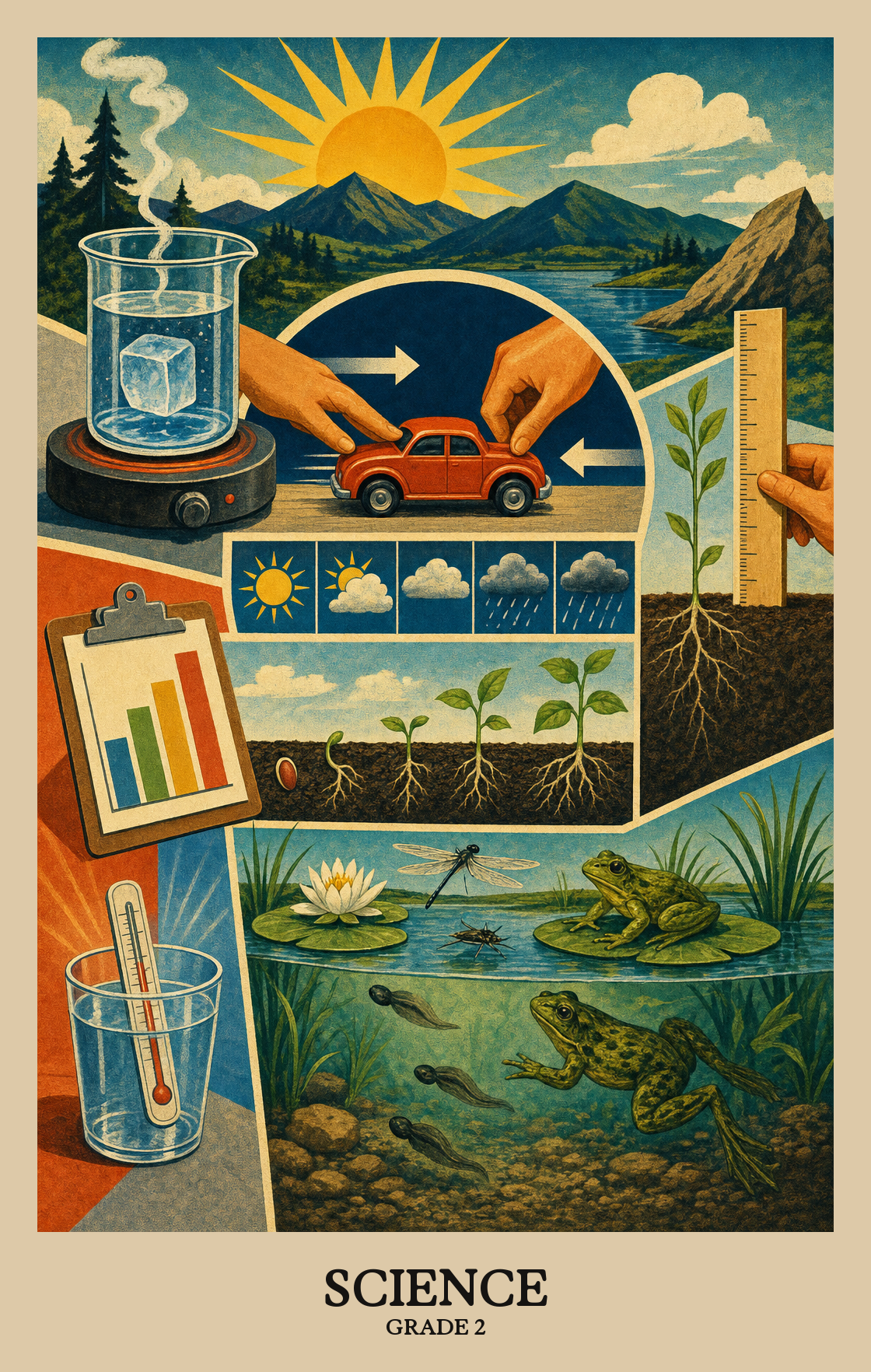
This is the year science moves from noticing the world to testing it. Students push and pull objects to see how forces change motion, and they watch how heating and cooling turn solids into liquids or gases. They track weather day by day and follow how plants and animals grow and depend on their habitats. By spring, students can measure something with a ruler or thermometer, record what they find on a simple bar graph, and explain what the data shows.
Students start the year learning how to ask a question they can actually test. They make predictions, measure things with rulers and thermometers, and sort what counts as evidence from what is just a guess.
Students explore what makes objects move. They try out pushes and pulls, watch how gravity drops things down, and play with magnets that pull on metal from across a table.
Students learn that everything around them takes up space and has weight. They compare how a rock, a glass of water, and the air in a balloon behave, and watch ice melt or water boil to see matter change.
Students follow how plants and animals grow up, from seed to flower and from egg to adult. They look at how animals get food, water, and shelter from the place they live, and what happens when that place changes.
Students track the weather day by day and look for patterns across the seasons. They notice how rain, wind, and cold change what plants and animals do, and how big storms can reshape the land.
Students wrap up the year by looking at why plants matter to people and animals. They see how plants give us food, wood, and oxygen, and how roots and trees hold soil in place during wind and rain.
Reading a thermometer, measuring with a ruler, and recording what they observe are the everyday habits this standard covers. Students learn to ask questions, collect data, and explain what the evidence shows.
Students practice asking questions about things they notice and naming problems they want to solve. This is how science and engineering work begins.
Students practice turning their curiosity into testable questions, the kind that can be answered by observing, measuring, or running a simple experiment.
Students look at what they already know and what they observe, then guess what might happen next. This is how scientists think before they test an idea.
Students spot a real, small problem (like a bag that won't stay closed) and explain how a new or better tool could fix it.
Students plan a question they want to test, then run a simple experiment to find the answer. They decide what to try, what to watch for, and what to record.
Students plan and run simple experiments with a teacher's help, then record what they find. The focus is on gathering real data, not just guessing at answers.
Students pick the right tool for the job: a ruler for length, a scale for weight, a thermometer for temperature. They read the measurement in inches, pounds, or degrees Fahrenheit.
Students practice reading clocks and stopwatches to measure how long something takes. They learn which tool fits the job, whether they need a clock on the wall or a stopwatch in hand.
Students look at the data they collected and figure out what it means. They decide if the results make sense and whether the evidence supports their idea.
Reading a pictograph or bar graph, and making one from scratch. Students collect information, then sort it into rows or columns so patterns are easy to spot.
Reading a bar graph or pictograph, students figure out what the data shows and answer questions about it, like which group had more or which result happened most often.
Students look at data they collected and decide what it means. Then they check whether their explanation actually matches what they observed.
Students look at what they noticed or measured and decide what it means. For example, if a plant grew taller each week, they state that the plant grew over time.
Students sort statements into two piles: what someone thinks and what was actually observed or measured. They explain why a hunch or feeling does not count as proof.
When an experiment doesn't turn out the way they expected, students notice that something surprising happened and treat it as worth paying attention to, not a mistake to ignore.
Students draw pictures, diagrams, or build simple objects to represent something real, like how clouds form or how a bridge holds weight. The model helps them test an idea before trying it out.
Students build or draw a simple model, like a diagram of the water cycle or a paper bridge, to show how something in nature works.
Students find facts from books, videos, or other sources, decide if the information makes sense, and share what they learned with others.
Students record what they noticed during an experiment by drawing pictures, writing words, or filling in a simple bar graph. The goal is to share findings clearly so others can understand what happened.
| Standard | Definition | Code |
|---|---|---|
| The student will demonstrate an understanding of scientific and engineering… | Reading a thermometer, measuring with a ruler, and recording what they observe are the everyday habits this standard covers. Students learn to ask questions, collect data, and explain what the evidence shows. | 2.1 |
| asking questions and defining problems | Students practice asking questions about things they notice and naming problems they want to solve. This is how science and engineering work begins. | 2.1.a |
| ask questions that can be investigated | Students practice turning their curiosity into testable questions, the kind that can be answered by observing, measuring, or running a simple experiment. | 2.1.a.i |
| make predictions based on observations and prior experiences | Students look at what they already know and what they observe, then guess what might happen next. This is how scientists think before they test an idea. | 2.1.a.ii |
| identify a simple problem that can be solved through the development of a new… | Students spot a real, small problem (like a bag that won't stay closed) and explain how a new or better tool could fix it. | 2.1.a.iii |
| planning and carrying out investigations | Students plan a question they want to test, then run a simple experiment to find the answer. They decide what to try, what to watch for, and what to record. | 2.1.b |
| with guidance, plan and conduct simple investigations to produce data | Students plan and run simple experiments with a teacher's help, then record what they find. The focus is on gathering real data, not just guessing at answers. | 2.1.b.i |
| use appropriate tools to measure length, weight | Students pick the right tool for the job: a ruler for length, a scale for weight, a thermometer for temperature. They read the measurement in inches, pounds, or degrees Fahrenheit. | 2.1.b.ii |
| measure time intervals using proper tools | Students practice reading clocks and stopwatches to measure how long something takes. They learn which tool fits the job, whether they need a clock on the wall or a stopwatch in hand. | 2.1.b.iii |
| interpreting, analyzing | Students look at the data they collected and figure out what it means. They decide if the results make sense and whether the evidence supports their idea. | 2.1.c |
| organize and represent data in pictographs and bar graphs | Reading a pictograph or bar graph, and making one from scratch. Students collect information, then sort it into rows or columns so patterns are easy to spot. | 2.1.c.i |
| read and interpret data represented in pictographs and bar graphs | Reading a bar graph or pictograph, students figure out what the data shows and answer questions about it, like which group had more or which result happened most often. | 2.1.c.ii |
| constructing and critiquing conclusions and explanations | Students look at data they collected and decide what it means. Then they check whether their explanation actually matches what they observed. | 2.1.d |
| make simple conclusions based on data or observations | Students look at what they noticed or measured and decide what it means. For example, if a plant grew taller each week, they state that the plant grew over time. | 2.1.d.i |
| distinguish between opinion and evidence | Students sort statements into two piles: what someone thinks and what was actually observed or measured. They explain why a hunch or feeling does not count as proof. | 2.1.d.ii |
| recognize unusual or unexpected results | When an experiment doesn't turn out the way they expected, students notice that something surprising happened and treat it as worth paying attention to, not a mistake to ignore. | 2.1.d.iii |
| developing and using models | Students draw pictures, diagrams, or build simple objects to represent something real, like how clouds form or how a bridge holds weight. The model helps them test an idea before trying it out. | 2.1.e |
| use models to demonstrate simple phenomena and natural processes | Students build or draw a simple model, like a diagram of the water cycle or a paper bridge, to show how something in nature works. | 2.1.e.i |
| obtaining, evaluating | Students find facts from books, videos, or other sources, decide if the information makes sense, and share what they learned with others. | 2.1.f |
| communicate observations and data using simple graphs, drawings, numbers… | Students record what they noticed during an experiment by drawing pictures, writing words, or filling in a simple bar graph. The goal is to share findings clearly so others can understand what happened. | 2.1.f.i |
Pushing or pulling an object can change how fast it moves or which direction it goes. Students explore how different forces, like gravity or a hand pushing a toy car, can speed things up, slow them down, or change their path.
Pushing or pulling an object directly, like kicking a ball or opening a door, makes that object move. Students learn that this kind of contact force is what gets things going.
Gravity and magnetism can push or pull objects without touching them. Students learn why a magnet attracts a paper clip across a table and why a ball falls to the ground even when no hand is holding it.
Pushes and pulls are forces, and students learn how they show up in everyday life: opening a door, riding a bike, or tossing a ball.
| Standard | Definition | Code |
|---|---|---|
| The student will investigate and understand that different types of forces may… | Pushing or pulling an object can change how fast it moves or which direction it goes. Students explore how different forces, like gravity or a hand pushing a toy car, can speed things up, slow them down, or change their path. | 2.2 |
| forces from direct contact can cause an object to move | Pushing or pulling an object directly, like kicking a ball or opening a door, makes that object move. Students learn that this kind of contact force is what gets things going. | 2.2.a |
| some forces, including gravity and magnetism, can cause objects to move from a… | Gravity and magnetism can push or pull objects without touching them. Students learn why a magnet attracts a paper clip across a table and why a ball falls to the ground even when no hand is holding it. | 2.2.b |
| forces have applications in our lives | Pushes and pulls are forces, and students learn how they show up in everyday life: opening a door, riding a bike, or tossing a ball. | 2.2.c |
Matter comes in three forms: solid, liquid, and gas. Students learn to tell them apart and understand how the same material, like water, can shift from one form to another.
Matter is any physical stuff in the world, from air to rocks to water. Students learn that everything made of matter has mass (how heavy it feels) and takes up space.
Solids hold their shape, liquids flow and take the shape of their container, and gases spread out to fill whatever space they're in. Students sort everyday materials by figuring out which type of matter they are.
Heating something up or cooling it down can change what form it takes. Ice melts into water when it warms, and water freezes back into ice when it cools.
| Standard | Definition | Code |
|---|---|---|
| The student will investigate and understand that matter can exist in different… | Matter comes in three forms: solid, liquid, and gas. Students learn to tell them apart and understand how the same material, like water, can shift from one form to another. | 2.3 |
| matter has mass and takes up space | Matter is any physical stuff in the world, from air to rocks to water. Students learn that everything made of matter has mass (how heavy it feels) and takes up space. | 2.3.a |
| solids, liquids, and gases have different characteristics | Solids hold their shape, liquids flow and take the shape of their container, and gases spread out to fill whatever space they're in. Students sort everyday materials by figuring out which type of matter they are. | 2.3.b |
| heating and cooling can change the phases of matter | Heating something up or cooling it down can change what form it takes. Ice melts into water when it warms, and water freezes back into ice when it cools. | 2.3.c |
Plants and animals grow through a predictable set of changes, not randomly. Students observe how a seed becomes a plant, or how a young animal changes as it matures.
Animals are born, grow into adults, reproduce, and eventually die. That pattern is called a life cycle, and it repeats across generations.
Plants grow through a life cycle: seed, seedling, adult plant, and back to seed again. Students learn to put those stages in order and explain what the plant needs to complete each one.
Living things depend on each other and on their surroundings to survive. Students explore how plants, animals, and their environment work together as a connected system.
Plants and animals depend on each other and on things like water, soil, and sunlight to survive. A bee needs a flower; the flower needs the bee.
Animals live in a habitat that gives them everything they need to survive: food, water, shelter, and space. Students learn why an animal that loses its habitat struggles to meet those basic needs.
Habitats change because of weather, other animals, and human activity. Students learn to recognize what can alter a habitat over time and what that means for the plants and animals living there.
| Standard | Definition | Code |
|---|---|---|
| The student will investigate and understand that plants and animals undergo a… | Plants and animals grow through a predictable set of changes, not randomly. Students observe how a seed becomes a plant, or how a young animal changes as it matures. | 2.4 |
| animals have life cycles | Animals are born, grow into adults, reproduce, and eventually die. That pattern is called a life cycle, and it repeats across generations. | 2.4.a |
| plants have life cycles | Plants grow through a life cycle: seed, seedling, adult plant, and back to seed again. Students learn to put those stages in order and explain what the plant needs to complete each one. | 2.4.b |
| The student will investigate and understand that living things are part of a… | Living things depend on each other and on their surroundings to survive. Students explore how plants, animals, and their environment work together as a connected system. | 2.5 |
| plants and animals are interdependent with their living and nonliving… | Plants and animals depend on each other and on things like water, soil, and sunlight to survive. A bee needs a flower; the flower needs the bee. | 2.5.a |
| an animal's habitat provides all of its basic needs | Animals live in a habitat that gives them everything they need to survive: food, water, shelter, and space. Students learn why an animal that loses its habitat struggles to meet those basic needs. | 2.5.b |
| habitats change over time due to many influences | Habitats change because of weather, other animals, and human activity. Students learn to recognize what can alter a habitat over time and what that means for the plants and animals living there. | 2.5.c |
Students learn about different kinds of weather, like rain, snow, wind, and sunshine. They observe how weather changes from day to day and how it varies across seasons and places on Earth.
Weather comes in different types, and each one has its own features. Students learn to tell apart sunny, cloudy, rainy, windy, and snowy days by what they see and feel outside.
Students collect daily weather data, like temperature and rainfall, and look for patterns over time. Noticing that some days are usually warmer or wetter helps students make sense of how weather changes across weeks and seasons.
Students record daily weather, such as temperature and rain, to spot patterns. Noticing those patterns helps people get ready before a storm arrives.
Seasons shift and so does the world around them. Students learn how weather patterns and changing seasons affect how plants grow, how animals behave, and what the surrounding environment looks like throughout the year.
Weather and seasonal changes shape how plants and animals live. Students learn why bears hibernate in winter, why plants lose leaves in fall, and how a rainy season can speed up or slow down growth.
Wind and rain wear down hills, move soil, and reshape shorelines over time. Students learn how weather slowly changes the surface of the Earth.
Changes to Earth's surface happen at very different speeds. A volcano can reshape a hillside in hours, while a river carves a canyon over millions of years.
| Standard | Definition | Code |
|---|---|---|
| The student will investigate and understand that there are different types of… | Students learn about different kinds of weather, like rain, snow, wind, and sunshine. They observe how weather changes from day to day and how it varies across seasons and places on Earth. | 2.6 |
| different types of weather have specific characteristics | Weather comes in different types, and each one has its own features. Students learn to tell apart sunny, cloudy, rainy, windy, and snowy days by what they see and feel outside. | 2.6.a |
| measuring, recording | Students collect daily weather data, like temperature and rainfall, and look for patterns over time. Noticing that some days are usually warmer or wetter helps students make sense of how weather changes across weeks and seasons. | 2.6.b |
| tracking weather allows us to prepare for the weather and storms | Students record daily weather, such as temperature and rain, to spot patterns. Noticing those patterns helps people get ready before a storm arrives. | 2.6.c |
| The student will investigate and understand that weather patterns and seasonal… | Seasons shift and so does the world around them. Students learn how weather patterns and changing seasons affect how plants grow, how animals behave, and what the surrounding environment looks like throughout the year. | 2.7 |
| weather and seasonal changes affect the growth and behavior of living things | Weather and seasonal changes shape how plants and animals live. Students learn why bears hibernate in winter, why plants lose leaves in fall, and how a rainy season can speed up or slow down growth. | 2.7.a |
| wind and weather can change the land | Wind and rain wear down hills, move soil, and reshape shorelines over time. Students learn how weather slowly changes the surface of the Earth. | 2.7.b |
| changes can happen quickly or slowly over time | Changes to Earth's surface happen at very different speeds. A volcano can reshape a hillside in hours, while a river carves a canyon over millions of years. | 2.7.c |
Plants give us food, wood, medicine, and clean air. Students learn why plants are considered natural resources and how people depend on them in everyday life.
Plant products like wood, cotton, and food crops shape where communities grow and how they develop. Students learn why some areas become farms, factories, or trading centers based on what plants are available nearby.
Plants give off oxygen that animals breathe, grow into trees and bushes animals nest in, and produce seeds, fruits, and leaves animals eat.
Plants act as natural barriers that slow down wind and water, protecting the soil underneath. Students learn how trees, grass, and other plants help keep the ground from washing or blowing away.
| Standard | Definition | Code |
|---|---|---|
| The student will investigate and understand that plants are important natural… | Plants give us food, wood, medicine, and clean air. Students learn why plants are considered natural resources and how people depend on them in everyday life. | 2.8 |
| the availability of plant products affects the development of a geographic area | Plant products like wood, cotton, and food crops shape where communities grow and how they develop. Students learn why some areas become farms, factories, or trading centers based on what plants are available nearby. | 2.8.a |
| plants provide oxygen, homes | Plants give off oxygen that animals breathe, grow into trees and bushes animals nest in, and produce seeds, fruits, and leaves animals eat. | 2.8.b |
| plants can help reduce the impact of wind and water | Plants act as natural barriers that slow down wind and water, protecting the soil underneath. Students learn how trees, grass, and other plants help keep the ground from washing or blowing away. | 2.8.c |
Alternate assessment program for eligible students with significant cognitive disabilities, covering state-tested grades and subjects.
Students explore pushes and pulls, magnets, and gravity. They study solids, liquids, and gases, and watch what heating and cooling do to each. They also learn about life cycles, habitats, weather patterns, and why plants matter as a natural resource.
Talk about what you both notice outside. Watch clouds before a storm, check the thermometer together, or sort laundry into solids and liquids. When a child asks why something happened, ask what they think first, then test it if you can.
Students learn to ask questions that can actually be tested with something on hand, like a magnet, a ruler, or a cup of water. They also learn to guess what will happen before they try, then check if the guess matched what they saw.
Most teachers start with practices and tools so students can measure and graph from day one. Force and matter pair well in the fall because they share hands-on routines. Life cycles fit spring, with weather and plants woven across the year so students can track real changes outside.
Telling opinion apart from evidence is hard at seven. So is reading a bar graph instead of just making one. Plan extra practice with sentence stems like "I think" versus "I saw," and revisit graph reading every few weeks with new class data.
Less than you might expect. Students should use words like solid, liquid, gas, habitat, and life cycle in conversation, but the goal is using them correctly, not spelling them on a test. Talking about what these words mean at home is more useful than flashcards.
A good investigation has a question students can actually answer, a simple plan, and a way to record what happened. Tools should be basic rulers, scales, thermometers, and timers in U.S. Customary units. Keep the variables few so students can see what changed.
Students should be able to ask a testable question, measure with a ruler or thermometer, and put results into a simple chart or bar graph. They should also explain a life cycle, name the three phases of matter, and describe how weather changes from season to season.